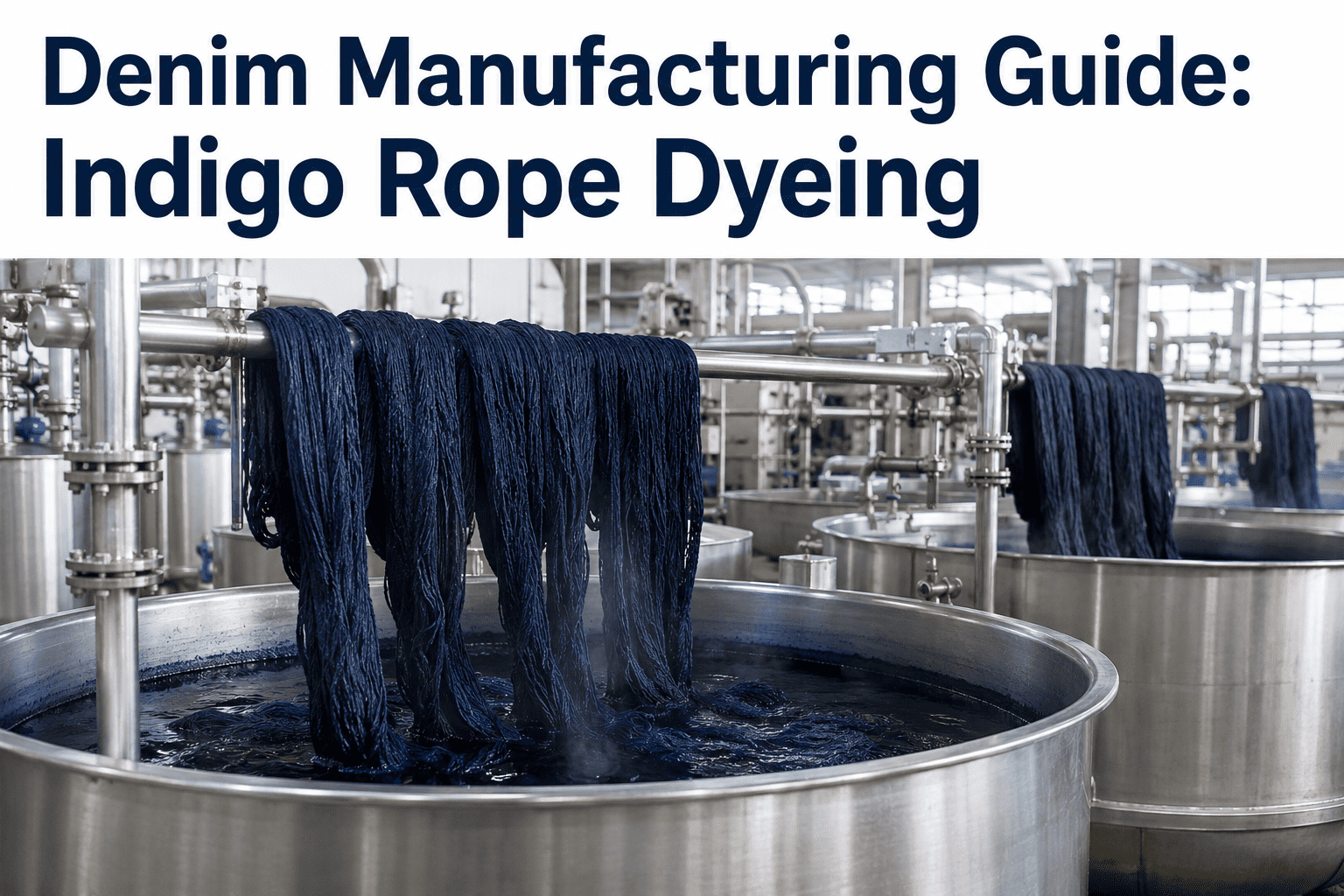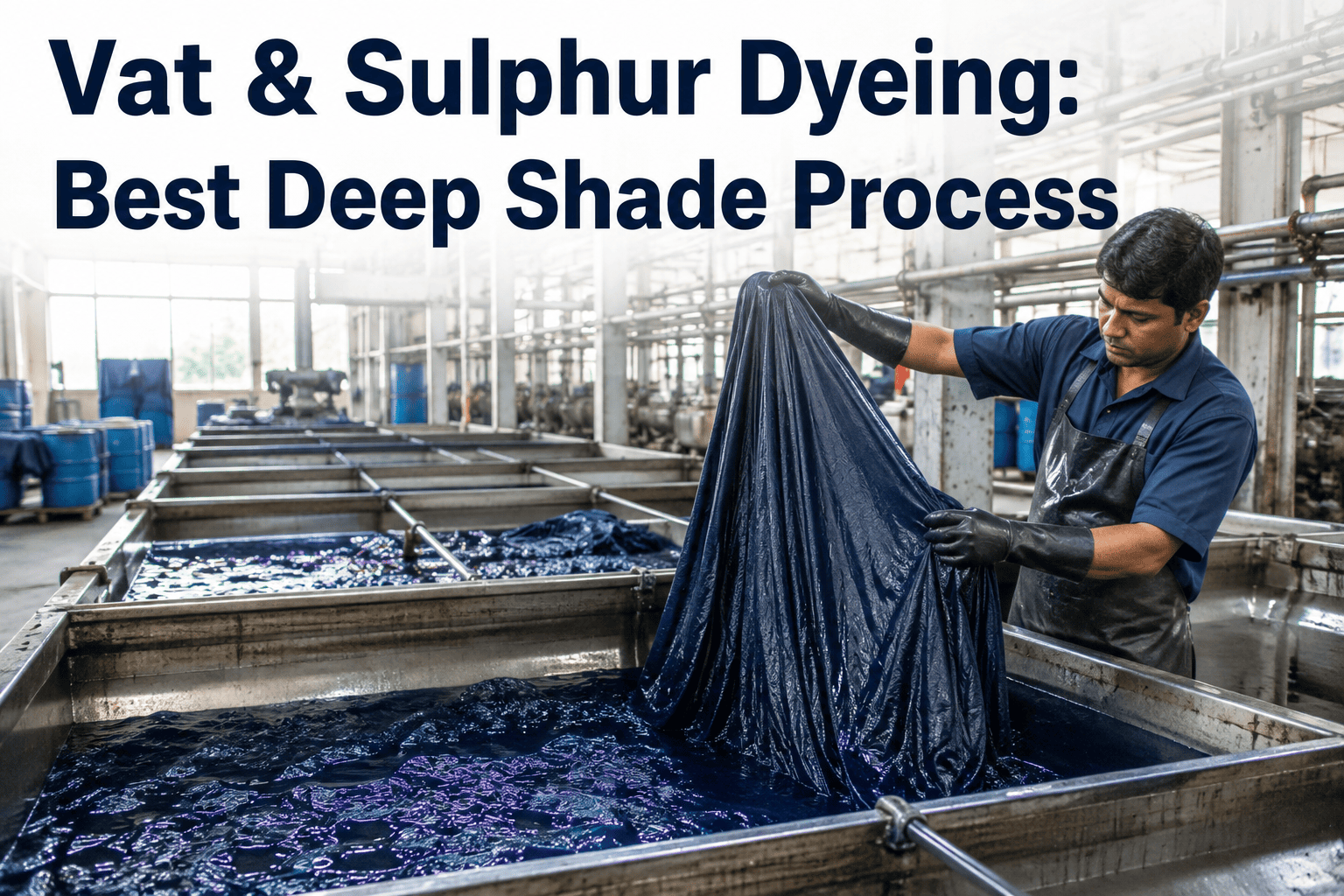
Denim looks green the moment it leaves an indigo dye box, and that colour shift is not a defect, it is the entire chemistry of vat dyeing playing out in real time. Reduction potential, bath temperature, and air exposure all have to line up within a narrow window or the fabric comes out streaked, tender, or inconsistent shade to shade. See how iFactory tracks redox potential, dwell time, and oxidation consistency across every dye box in real time with a Book a Demo.
Deep Shades Depend On A Redox Window Most Mills Never Actually Measure
Vat and sulphur dyeing both run on the same underlying chemistry: a water-insoluble pigment has to be chemically reduced into a soluble leuco form, driven into the fibre, then oxidised back into its permanent, wash-fast state. Get any one of those three stages wrong and the mill pays for it in reprocessing, not in the lab.
Vat Dyes And Sulphur Dyes Share A Method, Not A Chemistry
Both dye classes are applied in a reduced, water-soluble leuco form and only become permanent once oxidised back to their insoluble pigment structure inside the fibre. Where they differ is the reducing agent, the redox potential required, and how forgiving each is of process drift, which is exactly why treating them with identical parameters is one of the most common causes of shade rejection on mixed dye floors.
| Parameter | Vat Dyes (Indigo) | Sulphur Dyes |
|---|---|---|
| Primary Reducing Agent | Sodium dithionite (hydrosulfite) | Sodium dithionite with glucose, or sulphides |
| Required Redox Potential | Approximately −600 mV | Lower potential, wider tolerance band |
| Bath Temperature | Cold to room temperature preferred | Hot dyeing common with sugar-based reducers |
| Oxidation Method | Air oxidation between dye boxes | Air oxidation, chemical oxidant for light shades |
| Typical Application | Denim warp yarn, deep blues | Blacks, tops, deep shade bottoms |
Shade Variation Is Rarely A Recipe Problem. It's A Process Drift Problem.
iFactory logs redox potential, bath temperature, and air passage timing against every batch so the cause of a shade reject is visible before the roll leaves the dye range.
Four Stages, And Each One Can Quietly Ruin The Batch
Continuous indigo and sulphur dyeing runs as a repeated cycle of impregnation, reduction, oxidation, and washing, often through multiple dye boxes to build up depth of shade. A drift at any single stage compounds across every subsequent pass, which is why deep shades are disproportionately harder to hold consistent than light ones.
Yarn Preparation
Yarn must be clean of paraffin, waxes, and sizing residue before impregnation, since uneven hydrophilicity is one of the earliest and hardest-to-trace causes of streaky dyeing.
Reduction
The dye is converted to its soluble leuco form in an alkaline bath. Heating the bath accelerates decomposition of the reducing agent, which is why indigo baths are typically held cold rather than hot.
Impregnation And Passage
Yarn passes through two to four dip boxes for medium to dark shades, with each pass building depth incrementally rather than in a single saturation step.
Oxidation And Wash-Off
Air exposure between boxes converts the soluble leuco dye back to its insoluble, wash-fast pigment form, which is also why freshly dyed indigo yarn looks green before it finishes oxidising to blue.
Six Defects That Trace Back To Redox Or Oxidation Drift
Most rejected denim and sulphur-dyed rolls fail for reasons that trace back to one of a small number of root causes, and the defect name on the inspection sheet is usually just the visible symptom of an upstream process variable that went unmeasured.
Oxidation Marks
Localised stains that appear specifically on vat-dyed fabric where air exposure between dye boxes was uneven across the width of the yarn sheet.
Shade Streaking
Uneven dye absorption caused by high-twist yarn variation or inconsistent bath agitation, most visible on tightly twisted warp yarns.
Side-To-Side Variation
Temperature differences across the width of the dye range, or chemical addition concentrated on one side of the bath, produce a visible tone gradient across the roll.
Sulphur Tendering
Sulphur converts to sulphuric acid on the fibre after oxidation if wash-off is incomplete, weakening cellulosic fibres in a defect that often only shows up after garment wash.
Tailing Effect
Long batch loading times combined with high dye substantivity mean the leading and trailing ends of a batch pick up different amounts of dye.
Poor Wash Fastness
Incomplete oxidation leaves dye in its soluble leuco form, which washes out easily and is one of the most common causes of crocking and bleeding complaints.
Why Reducing Agent Choice Is Becoming A Compliance Question, Not Just A Cost One
Sodium dithionite remains the dominant reducing agent for both dye classes because of how fast it reduces the dye at temperature, but its breakdown byproducts add heavily to chemical oxygen demand and sulphate load in effluent. Mills increasingly evaluate glucose-based reduction, biodegradable reducing agents, and electrochemical reduction methods specifically because they reduce the effluent treatment burden downstream, not because the dyeing result changes. This is one of the clearer cases where a process decision made at the dye range has a direct, measurable effect on effluent treatment plant loading several stages later in the mill.
One Redox Sensor Won't Fix Shade Variance. Connected Data Across Every Box Will.
iFactory ties dye box redox readings, bath temperature, and oxidation timing to batch outcomes so root cause is identified in hours, not after the next rejected roll.
What Mills Typically See After Adding Redox And Oxidation Monitoring
Mills that add continuous redox potential and oxidation timing data to their existing dye range controls tend to see improvement across the same handful of metrics, regardless of whether the primary product is denim warp or sulphur black tops.
The Five Variables That Actually Predict A Good Batch
Most dye range operators already watch temperature and dye concentration closely, since those are the easiest parameters to read off a panel gauge. The variables that most reliably predict whether a batch will pass shade inspection are less visible and require dedicated instrumentation rather than a glance at the control panel, which is exactly why they tend to be the ones left unmonitored until a rejection forces the question.
Frequently Asked Questions
Q: Why does freshly dyed indigo denim look green instead of blue?
Indigo is applied to the yarn in its reduced, water-soluble leuco form, which has a distinctly different colour than the finished pigment. The blue colour only develops once the leuco dye is exposed to air and oxidises back into insoluble indigo, which is why yarn coming out of the final dye box still needs a proper air passage before it reaches its true final shade. Mills that rush yarn through insufficient air exposure often see the green tint persist into finished fabric, which reads as an incomplete or inconsistent shade downstream. Reach out through Support Contact if oxidation timing is a recurring issue on your range.
Q: Why is the indigo dye bath usually kept cold instead of heated?
Heating the reduction bath accelerates decomposition of sodium dithionite, the reducing agent responsible for keeping indigo in its soluble leuco form. Once the reducing agent breaks down faster than it can be replenished, the bath loses reduction potential and dye begins reverting to its insoluble form while still in the tank, producing inconsistent uptake on the yarn. This is why most continuous indigo ranges hold the reduction bath at or near room temperature even though sulphur dyeing with sugar-based reducers can tolerate, and sometimes benefits from, higher bath temperatures.
Q: What causes sulphur black shades to look dull or flat instead of deep?
Uneven dispersion of the sulphur top dye during application is one of the most common causes, since the dye settles unevenly in the bath if agitation is inconsistent, producing a shade that reads as dull and flat rather than a clean deep black. Without proper chemical oxidation of the medium to light shade layers underneath, air oxidation alone can proceed inconsistently and add further shade variation on top of the dispersion issue. A Book a Demo session can walk through how batch-level oxidation and dispersion data help isolate which of the two is driving a specific shade complaint.
Q: How does incomplete sulphur wash-off lead to fabric tendering after garment wash?
Sulphur remaining on the fibre after dyeing converts to sulphuric acid during subsequent oxidation and wear cycles, and this acid formation weakens cellulosic fibres over time even though the fabric may pass initial quality inspection. Because the tendering effect develops gradually rather than appearing immediately, it is one of the more difficult sulphur dyeing defects to catch before the garment reaches a customer, which makes final wash-off temperature and duration control disproportionately important compared to how much attention it typically receives on the floor.
Q: Is it possible to reduce the environmental load of vat and sulphur dyeing without changing the recipe?
Yes, in most cases the shade result depends on reduction potential being reached and maintained rather than on which specific reducing agent produced it, which is why glucose-based and other biodegradable reducing agents are increasingly substituted for sodium dithionite on mills focused on reducing chemical oxygen demand at the effluent plant. The transition typically requires retuning bath temperature and dwell time rather than the dye recipe itself, since alternative reducing agents often behave differently at a given temperature than dithionite does.