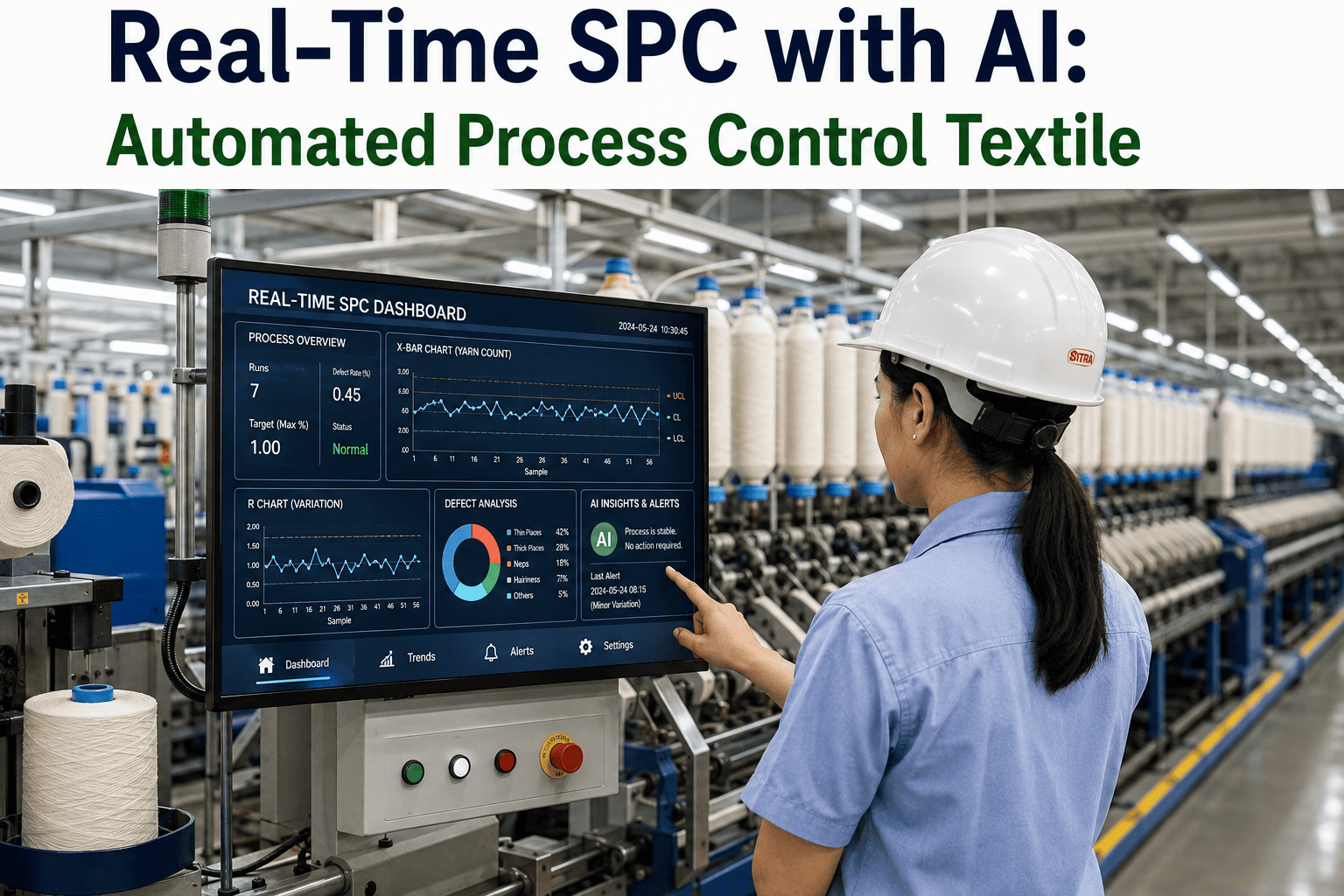
A control chart doesn't need a point outside the limits to tell you something is wrong. Eight consecutive points on the same side of the centerline, or a run of six steadily climbing — both are statistically unlikely enough to signal a real process shift, and both typically happen well before a single reading ever crosses a hard control limit. Most textile plants only look for the second kind of violation, the obvious one, because catching the subtler pattern requires watching every point against multiple rule sets continuously, which is exactly the kind of task human operators reviewing charts once a shift will always miss some of. iFactory's real-time SPC engine evaluates every reading against the full Western Electric and Nelson rule sets as it happens, flagging the pattern-based violations most manual chart reviews never catch.This distinction — between catching an outlier and catching a trend — is where most textile quality control programs quietly leave value on the table. A plant can have a technically compliant SPC program, with charts posted and reviewed on schedule, and still miss the majority of genuinely useful signals simply because a human reviewing a chart periodically is structurally unable to apply eight statistical rules to every single point in real time. The rules aren't the limiting factor; the review cadence is.
Most Process Drift Doesn't Trip an Alarm. It Trips a Pattern — And Patterns Need a Computer Watching.
A single out-of-limits reading is easy to catch. A slow eight-point drift toward the upper control limit is not — not for a technician glancing at a chart between other tasks. AI-driven SPC watches every rule, on every reading, continuously.
Why a Point Inside the Limits Can Still Be a Violation
The most basic form of SPC monitoring looks for one thing: has a reading crossed the upper or lower control limit. That's a real signal, but it's the least subtle one — by the time a single point breaches a 3-sigma limit, the process has already produced an out-of-spec unit. The more valuable signals are the ones that appear while every individual reading is still technically within limits, because those are the patterns that give a plant time to intervene before a defect actually occurs.
Think of it as the difference between a smoke alarm and a thermostat trend. The smoke alarm — the equivalent of Rule 1 — only fires once there's already smoke, which is useful but late. A thermostat tracking a room's temperature climbing steadily over an hour, well before it reaches an alarming level, gives far more lead time to act. Pattern-based SPC rules are the thermostat; limit-crossing detection alone is the smoke alarm.
This is the core idea behind the Western Electric and Nelson rule sets, developed decades ago specifically to formalize pattern detection beyond the simple limit check. Western Electric's four original rules established the basic zone-based tests — a point beyond 3 sigma, two of three points beyond 2 sigma, four of five beyond 1 sigma, and eight points running on one side of the centerline. Nelson's later eight-rule extension added detection for trends, oscillation, and reduced variation — patterns a human reviewing a chart once per shift will reliably miss, because they only become visible when you're tracking every point against every rule, continuously, not sampling the chart periodically.
It's worth understanding why these particular thresholds were chosen rather than treating them as arbitrary. Each rule is calibrated so that, under a genuinely stable, in-control process, the probability of triggering purely by chance is small — roughly comparable across the different rules, even though the patterns they detect look very different from each other. That calibration is what makes the combined rule set trustworthy rather than superstitious: a Rule 2 violation firing on your process carries roughly the same statistical weight as a Rule 5 violation firing, even though one looks for a sustained run and the other looks for a cluster near the outer zone.
| Rule | Pattern Detected | What It Typically Signals |
|---|---|---|
| Rule 1 | One point beyond 3σ from centerline | A sudden, significant process shift or equipment fault |
| Rule 2 | 8 consecutive points on the same side of centerline | A sustained shift in the process mean |
| Rule 5 | 2 of 3 consecutive points beyond 2σ, same side | An early-stage shift, often before Rule 1 triggers |
| Rule 6 | 4 of 5 consecutive points beyond 1σ, same side | A moderate but consistent drift developing |
| Rule 7 | 15 consecutive points within 1σ of centerline | Reduced variation — often a measurement or calibration issue |
Watching Every Reading Against Eight Rules Simultaneously Isn't a Human-Scale Task
iFactory evaluates each new reading against the full rule set the instant it's captured — surfacing the violation type and the affected parameter, not just a chart that someone has to interpret later.
From Detection to Correction — What "Automated" Actually Means Here
Detecting a rule violation is the first half of the value; the second half is what happens immediately after. A textile SPC system that flags a violation and stops there still depends on a technician noticing the alert, diagnosing the cause, and manually adjusting the process — which reintroduces the same human-speed bottleneck the automated detection was originally meant to solve. The more mature implementations close that loop: a detected Rule 2 violation on dye bath temperature doesn't just generate an alert, it maps to a specific, pre-validated corrective action — reduce heating rate by a defined increment, hold at current temperature for an extra interval, or flag the batch for manual review if the deviation exceeds a threshold the model isn't confident correcting on its own.
This distinction matters because "AI-powered SPC" gets used loosely to describe systems that range from slightly smarter alerting to genuinely closed-loop correction. A useful way to evaluate any vendor's claim is to ask specifically what happens in the sixty seconds after a violation fires — if the honest answer is "an email gets sent," the system is doing detection, not control. Automated process control implies the system can act on what it detects, within limits the process engineering team has explicitly approved in advance.
There's also a middle ground worth naming explicitly, because it's where most textile plants realistically start: recommendation without automatic execution. The system detects the violation, diagnoses the likely cause, and proposes a specific correction — but a technician still confirms the action before it's applied. This preserves human oversight during the trust-building phase of a rollout while still dramatically cutting the time between detection and decision, since the technician is reviewing a fully-formed recommendation rather than starting a diagnosis from scratch.
Continuous Rule Evaluation
Every new reading — temperature, tension, pH, speed — gets checked against the full active rule set the moment it's captured, not batched for periodic review. This is the layer that catches the eight-point run a shift-based manual check would miss entirely.
Root Parameter Attribution
A violation on a downstream quality metric often traces back to an upstream parameter drift — the system correlates the flagged pattern against related process variables to point at the likely cause, not just the symptom.
Bounded Automated Adjustment
For violations that map to a pre-approved corrective action within engineering-defined limits, the system applies the correction directly — a small heating rate reduction, a tension recalibration — without waiting on a human decision.
Human Review for Ambiguous Cases
Anything outside the pre-approved correction envelope — a Rule 1 violation, a novel pattern, or a deviation exceeding the automated adjustment threshold — routes to a technician with full context already attached, rather than a raw alert requiring the technician to reconstruct what happened from scratch.
What "Zero-Defect" Actually Means in Practice
Zero-defect manufacturing is more accurately described as a direction than a literal destination — no real production system eliminates every possible failure mode permanently, and vendors implying otherwise are overselling. What real-time AI-driven SPC and vision inspection genuinely deliver is a substantial reduction in the defects that reach a customer or get discovered only at final inspection, by catching the process drift and the visible defect earlier in the sequence, closer to the moment they start rather than after they've already propagated through an entire batch or roll.
It's worth being precise about this because the phrase "zero-defect" tends to set an expectation that's easy to disappoint if it's taken literally. The more honest framing is that the defect rate compresses toward a much smaller residual — the failure modes that remain are usually the genuinely novel ones, conditions the historical data hasn't seen before, or physical events like a raw material batch with an undocumented quality issue that no process parameter monitoring could have anticipated. That residual doesn't disappear, but it shrinks to a fraction of what an unmonitored or periodically-reviewed process would produce.
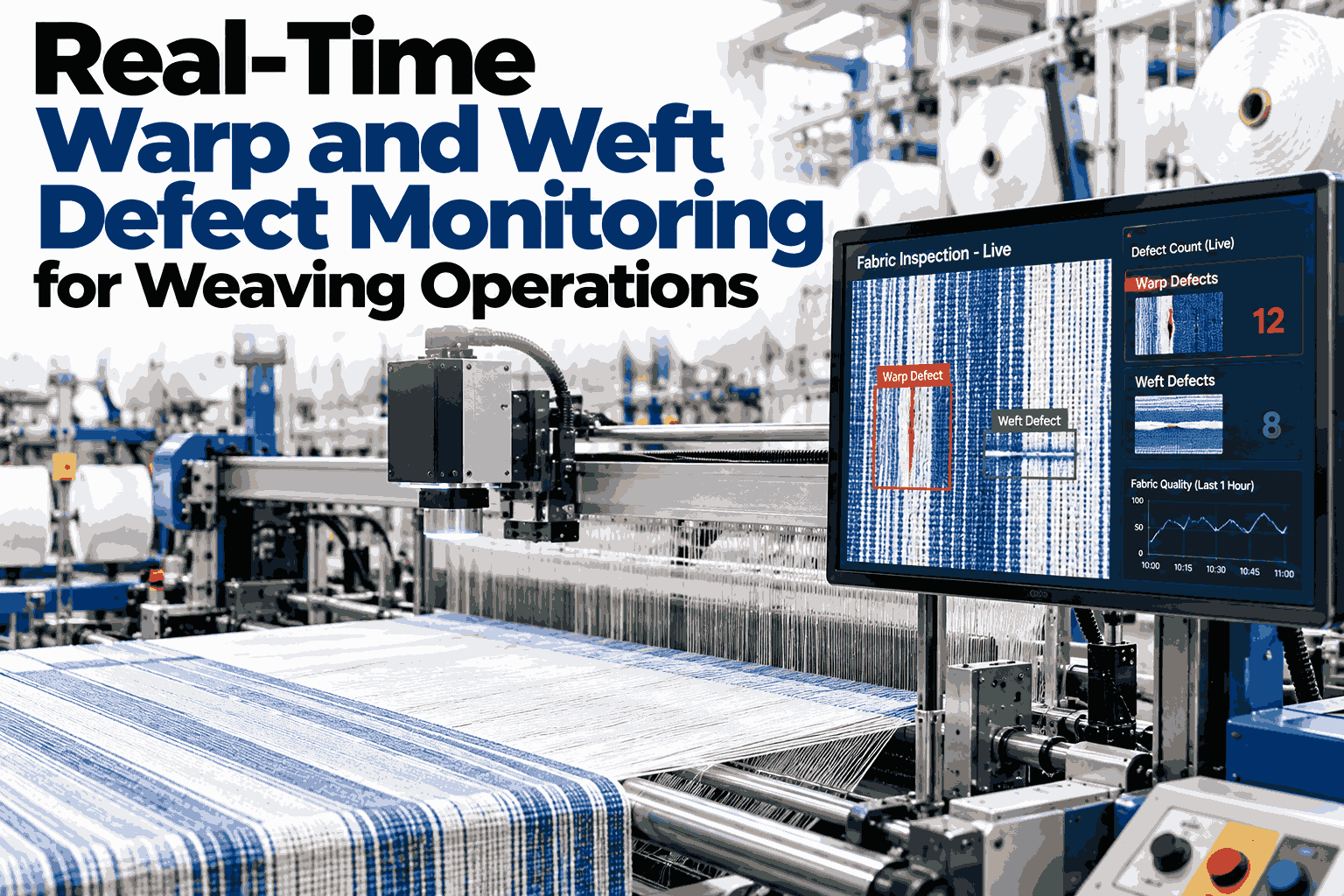
Manual visual inspection, even performed carefully, misses a meaningful share of fabric defects — human attention naturally degrades over a shift, and subtle color or structural variations are genuinely difficult to catch consistently at production speed. AI-based vision inspection systems trained on a specific fabric's normal appearance can flag anomalies with substantially higher and more consistent accuracy than manual review, and critically, they don't fatigue over an eight-hour shift the way a human inspector does. Pairing that vision-based defect detection with SPC-driven process monitoring closes the loop from both directions — catching parameter drift before a defect forms, and catching the defect itself if it does form, faster than a person would.
Rolling Out Real-Time SPC Without Triggering Alert Fatigue
The best way to sabotage an SPC automation rollout is to enable all eight Nelson rules on every monitored parameter on day one. The result is a flood of alerts, many of them true statistical violations but not all of them operationally meaningful, and operators learn within a week to tune the noise out — at which point even the genuinely important alerts stop getting the attention they deserve. A more durable rollout sequence starts narrow and expands only as trust in the system's signal quality builds over time.
This is a change management problem disguised as a technical one, and treating it that way changes the rollout plan. The technical capability to enable all eight rules simultaneously exists from day one — the constraint isn't the software, it's the operators' capacity to absorb and act on a sudden increase in alert volume without becoming desensitized to it. A rollout paced to match that human capacity, rather than the system's technical capability, is consistently what separates SPC automation projects that stick from the ones quietly abandoned within a year.
Start with Rule 1 on your one or two most critical parameters
The simplest, most unambiguous rule — a point beyond 3 sigma — builds trust in the system before layering in the more subtle pattern-detection rules that require more operator context to interpret correctly.
Add pattern rules gradually over several weeks
Introduce Rules 2 and 5 next, since they're the most likely to catch a real developing shift, before adding the more sensitive rules like Rule 7, which can trigger on measurement noise as easily as a real process issue.
Validate every automated correction in shadow mode first
Let the system recommend corrections without applying them automatically, and compare its recommendations against what an experienced technician would have done, before switching any correction to fully automatic.
Define the automated correction envelope explicitly
Process engineering should set the exact boundaries within which the system is allowed to self-correct — outside those boundaries, every violation escalates to a person, no exceptions.
Review false-positive rate monthly and retune thresholds
A rule that fires too often on your specific process and equipment combination will get ignored regardless of its statistical validity — tuning sensitivity to your actual variation is an ongoing discipline, not a one-time setup step.
Common Mistakes That Undermine Real-Time SPC Programs
The plants that succeed with real-time SPC aren't the ones with the most sophisticated rule sets running on day one — they're the ones that treat rule rollout like any other change management process. Start with the rule that's easiest to trust, prove it catches real issues without drowning operators in noise, and only then add the next layer. I've seen more SPC automation projects fail from alert fatigue than from the technology falling short.
Frequently Asked Questions
What's the difference between Western Electric Rules and Nelson Rules?
Western Electric Rules are the original four pattern-detection tests, developed for telephone manufacturing and published in 1956 — they cover the basic zone-based checks: one point beyond 3 sigma, two of three beyond 2 sigma, four of five beyond 1 sigma, and eight consecutive points on one side of the centerline. Nelson Rules, developed later, kept those same four tests and added four more covering trends, alternating patterns, and reduced variation, for eight rules total.
In practice, if you enable all eight Nelson rules, you've already enabled the four Western Electric rules, since Nelson's set is a superset rather than a competing standard. Book a demo to see how iFactory lets you enable rules individually rather than all at once.
How many false alarms should we expect from a real-time SPC system?
Every SPC rule carries a known, small probability of firing on pure random variation even when the process is genuinely in control — that's a mathematical property of the statistics, not a system flaw. Rule 1, the simplest test, has the lowest false-alarm rate of any rule in the set, which is exactly why it's the recommended starting point for a new rollout.
More sensitive rules like Rule 7 trade a higher false-alarm tendency for earlier detection of subtle drift, so the right balance depends on how costly a missed detection is on that specific parameter versus how disruptive a false alarm is to your operators. Book a demo to review realistic false-alarm expectations for your specific process and rule configuration.
Can real-time SPC actually adjust the process automatically, or does it just alert someone?
Both are possible, and which one you get depends heavily on implementation maturity and how the vendor defines "automated." At minimum, real-time SPC detects rule violations continuously and alerts the right person immediately — a meaningful improvement over periodic manual chart review. At a more mature stage, the system maps specific violation types to pre-approved corrective actions and applies them directly within boundaries process engineering has explicitly defined in advance.
The transition from alert-only to bounded automated correction should happen gradually, validated in shadow mode before any correction goes live. Book a demo to see how iFactory structures that transition on your specific processes.
Does AI-based defect detection replace the need for SPC on process parameters?
No — they address different points in the process and work best together rather than as substitutes. AI vision inspection detects a defect once it's already visible on the fabric, which is valuable but inherently reactive to that point in the sequence. SPC on process parameters like temperature, tension, and pH catches the drift that's likely to produce a defect before the defect actually forms, which is earlier and generally cheaper to correct.
A mature quality system uses both: SPC to catch and correct process drift proactively, and vision inspection as a final safety net for anything that slips through. iFactory's support team can walk through how the two systems complement each other on a typical dyeing or finishing line.
How long does it take to see results after deploying real-time SPC?
The detection benefit is close to immediate — once a parameter is instrumented and Rule 1 is active, out-of-limit readings get flagged the moment they occur rather than at the next scheduled chart review. The more subtle pattern-detection rules take longer to demonstrate clear value, since they need enough historical data running through the system to confirm the thresholds are correctly tuned to your specific process variation rather than generating noise.
Most plants see measurable improvement in time-to-detection within the first few weeks, with the fuller benefit of tuned, multi-rule monitoring and any automated correction capability developing over a few months as trust in the system builds. Book a demo to discuss a realistic rollout timeline for your production environment.
Stop Reviewing Control Charts. Start Having Them Reviewed Continuously.
iFactory evaluates every reading against the full Western Electric and Nelson rule sets in real time, attributes violations to their likely root parameter, and applies bounded corrections within limits your engineering team defines — so drift gets caught while it's still just a statistical pattern, not yet a visible defect on the roll.