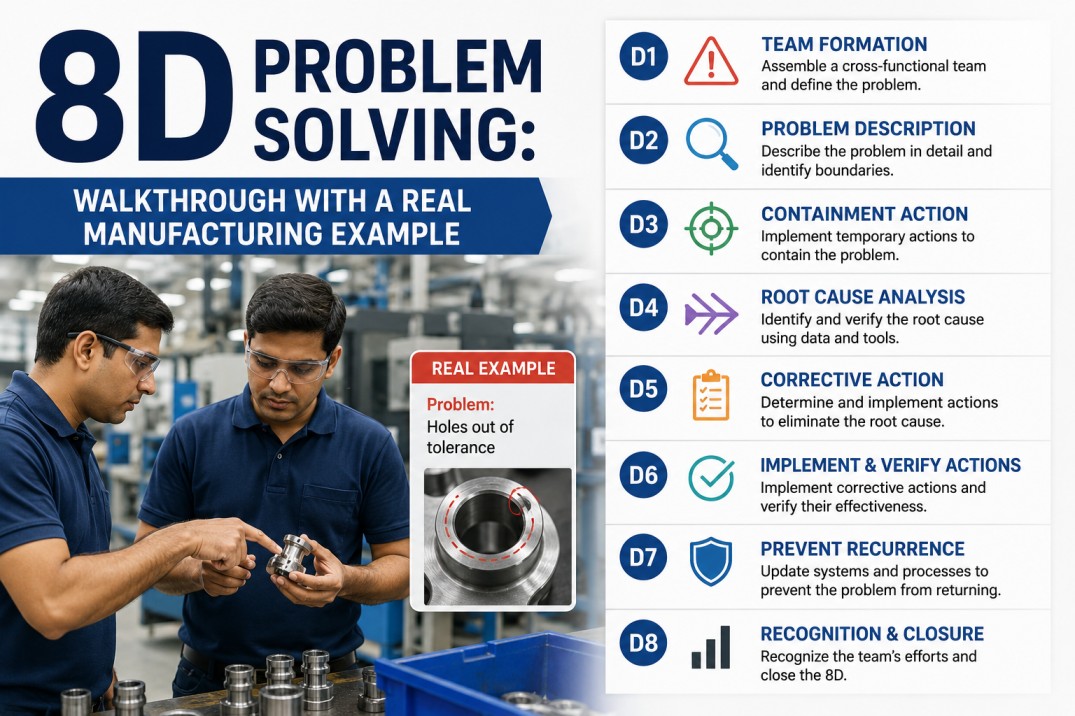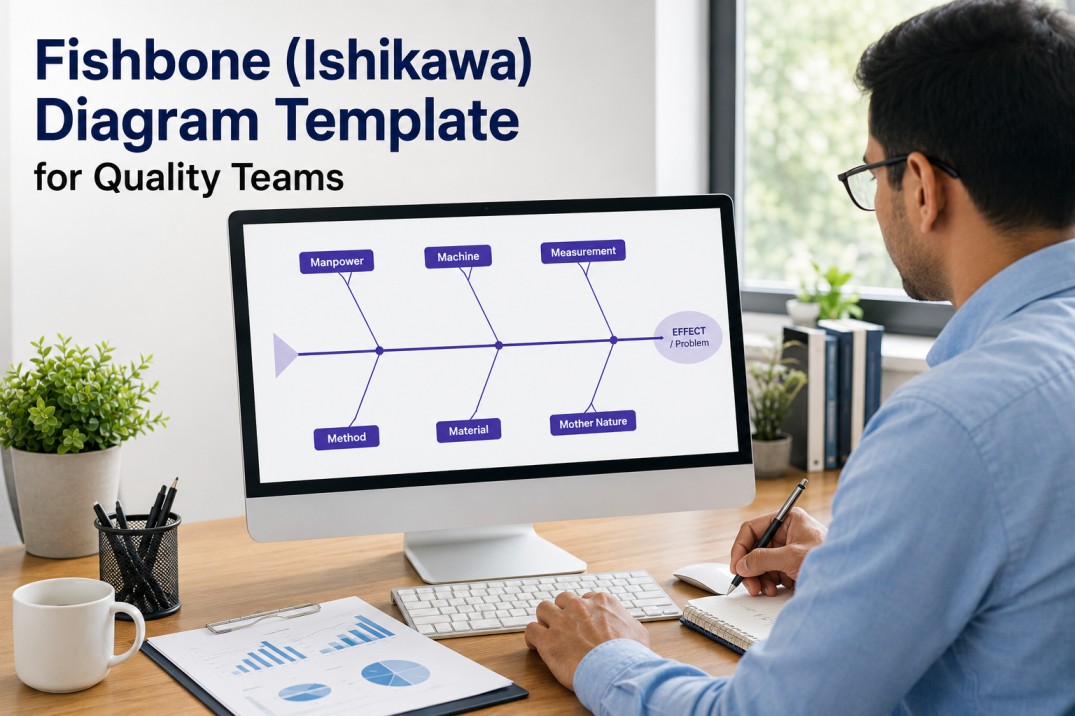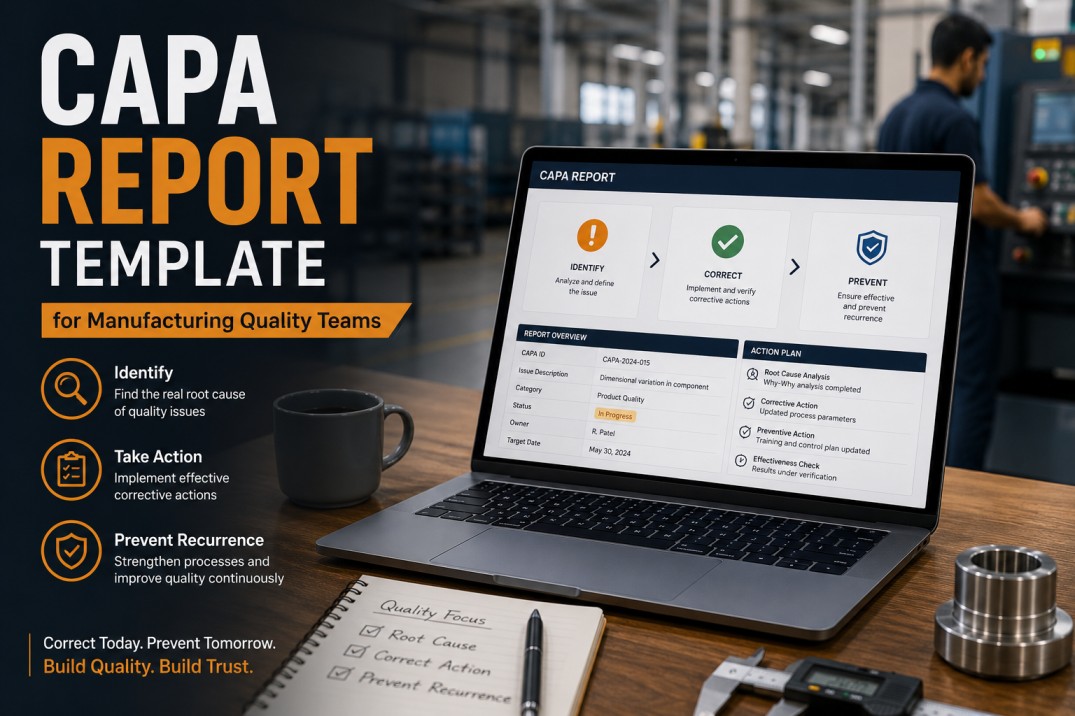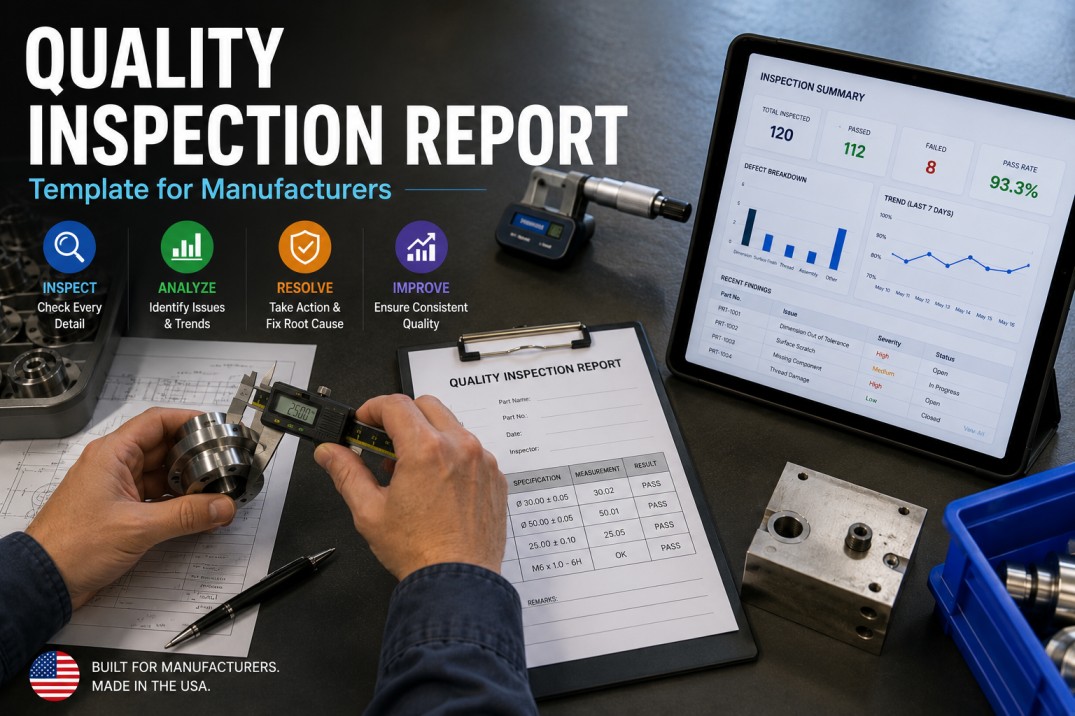
An 8D report template structures quality problem solving across eight disciplines — from emergency containment through permanent corrective action, preventive action, and team recognition. The 8D format is the required corrective action submission format for Ford, GM, Stellantis, BMW, and many other automotive OEMs, and it is increasingly adopted in aerospace, electronics, and industrial manufacturing as the standard for structured problem resolution. This page walks through every discipline of the 8D report format, explains what auditors look for in each section, and shows how iFactory turns 8D submissions into trackable, auditable quality records.
Run 8D Reports in iFactory — From D0 to D8, Trackable and Auditable
iFactory's 8D module walks your team through each discipline with built-in 5-Why and Ishikawa tools, team assignment, evidence upload, and automatic deadline tracking. Every 8D becomes a searchable, auditable quality record — not a PDF that gets emailed and lost.
Emergency Response — Before D1 Begins
D0 is the immediate response action taken before the formal 8D team is assembled. Its purpose is to protect the customer from any additional non-conforming product while the investigation is in progress. D0 actions are temporary — they do not address root cause. Common D0 actions include sorting in-process inventory, placing a shipment hold, notifying the customer, and initiating a field retrieval if product has already been delivered.
Customer Notification
Notify the customer immediately upon confirmation of the non-conformance. Document the notification method, date, time, and customer contact. Failure to notify promptly is a contractual violation with most OEM customers.
Shipment Hold
Place an immediate hold on all suspect finished goods inventory. Update ERP status. Notify the shipping department. If product has already shipped, initiate a field containment.
Suspect Inventory Sort
100% sort of all suspect WIP and finished goods. Document the quantity inspected, quantity accepted, and quantity rejected. Accepted parts re-tagged and re-released.
Team Formation — The Right People for the Problem
D1 documents the cross-functional team responsible for solving the problem. Team members must have the authority to implement changes — not just observe. A team of process engineers and quality engineers without a manufacturing or operations representative cannot implement process changes. The D1 section must list each team member's name, role, department, and phone or email for the customer contact.
Problem Description — Is, Is Not Analysis
D2 defines the problem with enough precision that anyone reading the 8D report can understand exactly what failed, where, when, how many, and under what conditions. The most effective tool for D2 is the Is/Is Not matrix — defining what the defect is and explicitly what it is not. This scoping discipline prevents the investigation from chasing symptoms that are not part of the actual failure mode.
| Dimension | IS (What the problem is) | IS NOT (What it is not) |
|---|---|---|
| What | Hole diameter undersized by 0.08mm on Part #A4421-Rev D | Not a surface finish issue; not a thread defect |
| Where | Operations 30 (drilling) — Spindle 2 only | Not Spindle 1, 3, or 4; not any other operation |
| When | First observed in Lot 2025-0418; confirmed in 3 subsequent lots | Not observed in lots prior to 2025-0418 |
| How Many | 22 of 200 parts inspected (11%) in 4 affected lots | Not 100% of parts; not consistent within a single lot |
| How Much | Diameter 0.05–0.12mm below minimum tolerance | Not above nominal; not at lower tolerance limit |
Interim Containment Action
D3 formalizes the containment actions first taken at D0. The D3 section must describe the containment method, the scope of suspect product covered, the quantity inspected, and the results. Containment at D3 must be verified — not just described. The verification evidence (sort records, inspection results, photos) must be attached to the 8D report. D3 actions remain in force until D5 permanent corrective actions are verified effective.
Root Cause Analysis — The Discipline That Determines Everything
D4 is where most 8D reports fail. The most common D4 failures are: identifying a proximate cause instead of a root cause, stopping the 5-Why at the process level instead of the system level, and not separately investigating the escape cause. Every D4 must produce two root causes: the reason the defect was produced, and the reason it was not detected before reaching the customer. Both require separate D5 corrective actions.
Production Root Cause — 5-Why
- Why 1: Hole diameter undersized (the defect)
- Why 2: Drill insert worn beyond replacement interval
- Why 3: Insert replacement frequency not in control plan
- Why 4: Control plan not updated after tool change in 2024
- Root Cause: Change control process does not require control plan review on tool changes
Escape Root Cause — Why Not Detected
- Why 1: Defective parts shipped to customer
- Why 2: In-process inspection did not sample Spindle 2
- Why 3: IPQC plan samples one spindle per run — does not rotate
- Why 4: IPQC plan written before Spindle 2 was added to the cell
- Root Cause: IPQC plan not updated when machine configuration changed
Permanent Corrective Action & Implementation
D5 defines the permanent corrective actions that address both root causes identified in D4. D6 documents implementation — with evidence that each action was actually completed, not just planned. For each action, the 8D must specify what was changed, who changed it, when it was changed, and what evidence confirms the change.
Add drill insert replacement frequency to control plan for Op 30, Spindle 2. Include tool wear measurement at defined interval. Obtain customer-required approval if control plan is customer-submitted document.
Revise IPQC sampling plan to rotate through all active spindles. No spindle to go unsampled for more than two consecutive production runs. Verify new plan covers current machine configuration.
Revise change control SOP to require control plan and IPQC plan review on any tooling or equipment change. Obtain management approval and issue new SOP revision.
Re-train operators and quality technicians on updated control plan and IPQC plan. Document training completion with signatures and dates.
Preventive Action — Apply the Learning Broadly
D7 extends the D5 corrective actions to similar processes, products, or operations where the same root cause could exist but has not yet produced a defect. A D7 that says "not applicable" is almost always wrong — there is almost always a similar process or product that should be audited for the same gap. Customers reviewing 8D reports specifically look for evidence that the organization has extended its learning beyond the immediate failure.
Team Recognition & Closure
D8 formally closes the 8D with team recognition, a summary of all actions and their verified effectiveness, and the official closure signature from the Quality Manager or authorized representative. The 8D cannot be closed until D6 implementation is complete and D7 preventive actions are documented. Effectiveness verification evidence must be attached — typically production data from the first three to five lots after D6 implementation showing no recurrence.
Turn 8D Submissions into Trackable, Auditable Quality Records
iFactory's 8D module guides your team through D0–D8 with structured forms, 5-Why and Ishikawa tools, team assignment, deadline tracking, and evidence attachment. Every 8D is a searchable record — never lost in an email thread.
8D Report Checklist — 25 Items
Use this checklist to verify that every discipline of the 8D report meets customer submission standards — from D0 emergency response through D8 closure. Covers common rejection reasons for each discipline.
| # | Checklist Item | Type | Priority | Photo | Required | Critical |
|---|---|---|---|---|---|---|
| 1 | D0: Customer notified within required timeframe — communication date and contact documented | Pass/Fail | High | — | ✓ | ✓ |
| 2 | D0: Shipment hold placed — ERP updated, shipping department notified | Pass/Fail | High | — | ✓ | ✓ |
| 3 | D0: Suspect inventory sorted — quantity accepted and rejected documented | Pass/Fail | High | ✓ | ✓ | ✓ |
| 4 | D1: Cross-functional team listed with name, role, and contact — includes authority to implement changes | Pass/Fail | High | — | ✓ | ✓ |
| 5 | D2: Problem description answers what, where, when, how many, and how much | Text | High | — | ✓ | ✓ |
| 6 | D2: Is/Is Not analysis completed — explicitly scopes what the problem is not | Pass/Fail | High | — | ✓ | ✓ |
| 7 | D2: Specific part number, lot, and quantity of non-conforming units stated | Pass/Fail | High | — | ✓ | ✓ |
| 8 | D2: Problem statement does not pre-assume root cause | Pass/Fail | Med | — | ✓ | — |
| # | Checklist Item | Type | Priority | Photo | Required | Critical |
|---|---|---|---|---|---|---|
| 9 | Containment method described — scope, quantity inspected, and results documented | Pass/Fail | High | ✓ | ✓ | ✓ |
| 10 | Containment effectiveness verified with evidence — not just declared | Pass/Fail | High | — | ✓ | ✓ |
| 11 | D3 actions confirmed in force until D5 permanent corrective actions are verified | Pass/Fail | High | — | ✓ | ✓ |
| 12 | Sort records, inspection results, or photos attached as D3 evidence | Pass/Fail | High | ✓ | ✓ | ✓ |
| # | Checklist Item | Type | Priority | Photo | Required | Critical |
|---|---|---|---|---|---|---|
| 13 | Production root cause identified using 5-Why — Why chain reaches system level | Pass/Fail | High | — | ✓ | ✓ |
| 14 | Escape root cause separately identified — why defect was not detected | Pass/Fail | High | — | ✓ | ✓ |
| 15 | Root cause verified with data — not assumed without evidence | Pass/Fail | High | — | ✓ | ✓ |
| 16 | Both root causes directly connected to D5 corrective actions | Pass/Fail | High | — | ✓ | ✓ |
| 17 | "Operator error" or "machine failure" not accepted without system-level analysis | Pass/Fail | High | — | ✓ | ✓ |
| # | Checklist Item | Type | Priority | Photo | Required | Critical |
|---|---|---|---|---|---|---|
| 18 | D5: Permanent corrective actions address both production and escape root causes | Pass/Fail | High | — | ✓ | ✓ |
| 19 | D5: Each action has specific description, owner name, and due date | Pass/Fail | High | — | ✓ | ✓ |
| 20 | D6: Evidence of implementation attached — updated docs, photos, training records | Pass/Fail | High | ✓ | ✓ | ✓ |
| 21 | D6: Control plan and IPQC plan updated to reflect permanent corrective actions | Pass/Fail | High | — | ✓ | ✓ |
| 22 | D7: Preventive actions applied to similar products, processes, or operations | Pass/Fail | Med | — | ✓ | — |
| 23 | D7: Not marked "N/A" without documented justification | Pass/Fail | Med | — | ✓ | — |
| 24 | D8: Effectiveness verified — production data from 3+ runs shows no recurrence | Pass/Fail | High | — | ✓ | ✓ |
| 25 | D8: Closure signed by Quality Manager with date — all disciplines complete | Signature | High | — | ✓ | ✓ |
Frequently Asked Questions
What is an 8D report and when is it required?
An 8D report is a structured corrective action document that addresses a quality problem through eight disciplines: emergency response, team formation, problem description, interim containment, root cause analysis, permanent corrective action, preventive action, and team recognition. It is specifically required by Ford (Global 8D), General Motors, Stellantis, BMW, and many other automotive OEMs as the mandatory format for supplier corrective action responses. It is also widely adopted in aerospace, electronics, and industrial manufacturing for structured problem resolution.
What is the difference between an 8D report and a CAPA?
An 8D report and a CAPA (Corrective and Preventive Action) address the same objective — permanent elimination of a quality problem — but with different structure. The 8D format is more prescriptive about team formation (D1), problem description using Is/Is Not analysis (D2), and interim containment (D3) as discrete documented steps. CAPA is a broader term that can use various root cause tools. Most automotive OEMs require the specific 8D format for supplier submissions; ISO 9001 and AS9100 accept CAPA in any documented format. iFactory supports both formats from the same platform. Book a Demo
How long does an 8D report take to complete?
D0 through D3 must typically be completed within 24 to 72 hours of the initial customer notification — this is a hard deadline for most automotive OEM customers. D4 through D6 are typically due within 30 days. D7 and D8 — preventive actions and verified closure — are typically due within 60 to 90 days. Customer-specific requirements define the exact deadlines and any extension approval process. iFactory tracks all deadlines automatically and escalates overdue disciplines to the assigned team lead.
What makes a D4 root cause analysis acceptable to automotive customers?
An acceptable D4 root cause analysis must: use a documented methodology (5-Why is minimum, Ishikawa or fault tree preferred for complex failures), identify both the production root cause and the escape root cause, show the complete Why chain without skipping steps, provide evidence that the identified root cause was verified — not assumed, and demonstrate that the D5 corrective actions are directly connected to the identified root causes. Root cause analyses that stop at 'operator error' or 'machine wear' without investigating why those conditions existed are routinely rejected.
Can iFactory generate an 8D report PDF for customer submission?
Yes. iFactory generates a formatted 8D report PDF directly from the data entered in the 8D workflow — all eight disciplines, team member list, root cause documentation, action items with completion dates, and effectiveness verification evidence. The PDF is formatted to meet standard automotive 8D format requirements. Book a Demo to see the 8D module and report output. Book a Demo
Replace Your 8D Report Excel Sheet with a Digital Problem-Solving Platform
iFactory gives automotive and manufacturing quality teams a complete digital 8D workflow — from D0 emergency response through D8 verified closure — with 5-Why, Ishikawa, team assignment, and auto-generated PDF output for customer submission.