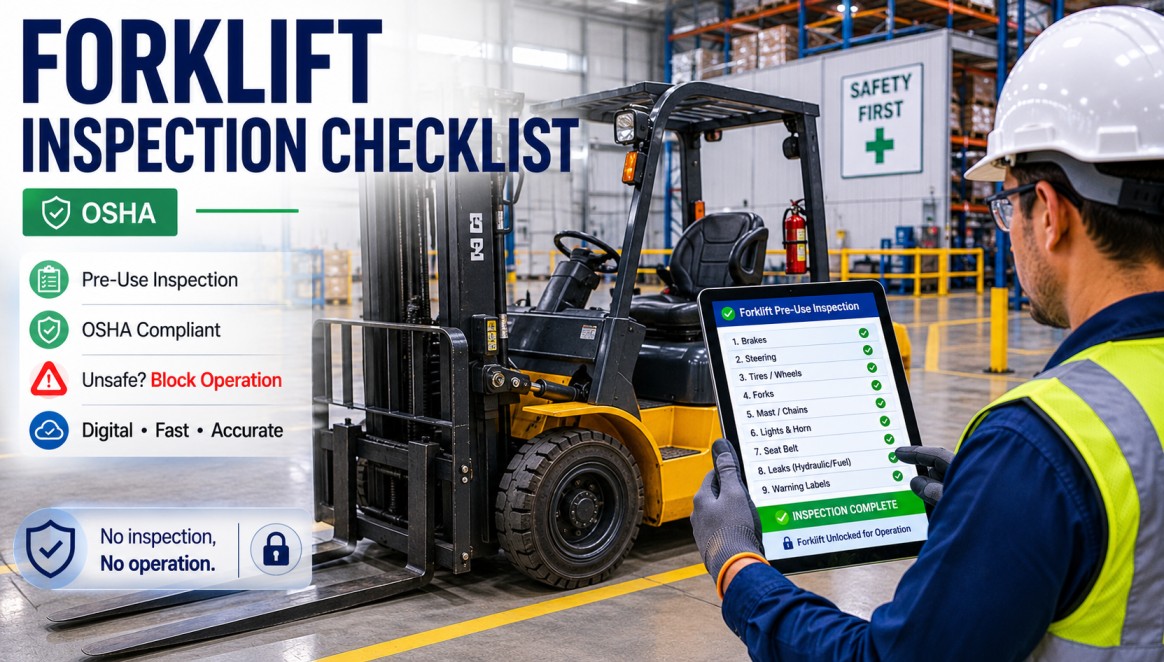
OSHA 29 CFR 1910.178(q)(7) requires that powered industrial trucks be inspected before each shift — or at minimum once daily for continuous operations — and that any truck found to be unsafe be removed from service immediately until repaired. This requirement is not a recommendation; it is a citation-level obligation that carries penalties of up to $16,131 per violation for serious violations and up to $161,323 for willful violations. This forklift inspection checklist gives operators and safety managers a complete OSHA-compliant daily pre-use framework covering all six inspection areas: documentation, power system, mast and forks, drive system, safety devices, and operational test — with 30 checkpoints aligned to OSHA 1910.178 and ANSI/ITSDF B56.1.
Block Every Forklift From Operating Until the Digital Pre-Use Check Is Complete
iFactory's forklift inspection module enforces the daily pre-use check at the device level — the operator cannot log a lift until the OSHA daily forklift inspection is completed on their tablet or phone. Defects trigger immediate out-of-service tagging and supervisor notification.
Nameplates, Capacity & Operator Documentation
The OSHA forklift inspection requirement begins before the operator touches the controls. OSHA 1910.178(e) requires that the data plate — showing rated capacity, weight, and attachment limits — be permanently attached and legible at all times. An illegible or missing data plate is itself an OSHA violation. The operator's certification status must also be current; operating a forklift without a valid licence is a separate citation category.
Data Plate Present & Legible
OSHA 1910.178(e)(1) — data plate must show rated capacity, weight, and any derating for attachments. Faded, missing, or obstructed data plates require immediate correction before operation.
Operator Certification Current
OSHA 1910.178(l) — operators must be trained and evaluated before operating powered industrial trucks. Certification must be renewed every three years or after any accident or observed unsafe operation.
Pre-Use Inspection Form Completed
Written or digital inspection record must be completed and signed by the operator before first lift of the shift. Date, truck ID, and operator ID must be recorded.
Previous Defects Reviewed
Open defects from previous shift must be resolved before operating. Any truck tagged out of service must not be returned to service without documented supervisor or maintenance clearance.
Capacity Not Exceeded
Load capacity must not exceed the rated capacity shown on the data plate for any combination of load weight, load centre, and attachment in use. Exceeding capacity is a serious OSHA violation.
Truck ID Logged
Truck identification number or asset tag recorded on the inspection form — ensures defects are traceable to the specific unit and not confused with similar trucks in the fleet.
Power System — Engine, Battery & Hydraulics
Power system deficiencies are the most common source of forklift fires and breakdowns. OSHA 1910.178(e)(1) specifically requires inspection of the fuel system, cooling system, and hydraulic system for leaks before every shift. A hydraulic hose failure while a load is elevated can cause sudden mast drop — one of the leading causes of fatality in forklift incidents. Battery condition checks on electric trucks are equally critical: a low or damaged battery mid-shift creates both a breakdown risk and, for wet-cell batteries, a hydrogen gas exposure risk during charging.
Engine Oil Level
Oil level within operating range on dipstick. No oil leaks under truck — check engine pan, drain plug, and valve cover. Operate only within marked range.
Coolant Level
Coolant reservoir at correct level. Hoses intact, no cracks or soft spots. No coolant puddling under truck. Check only when engine is cold.
Fuel / Battery Charge
Propane: no fuel odour, tank connector not leaking, tank secured in bracket. Electric: charge level sufficient for shift, electrolyte at correct level in each cell (lead-acid), terminal connections tight.
Hydraulic Fluid Level
Fluid within operating range on sight glass or dipstick. Inspect all cylinders, hoses, and fittings for leaks — especially tilt and lift cylinder seals.
No Fluid Leaks Under Truck
Walk around entire truck and inspect floor beneath before operating. Any unidentified fluid on the floor requires investigation before first lift.
Battery Connections & Cables
Electric trucks: connections tight, cables intact with no cracked insulation, no corrosion at terminals. Battery hold-down hardware in place and secure.
Mast, Forks & Attachments — The Load-Handling System
Fork and mast failures cause more forklift fatalities and serious injuries than any other mechanical defect. ANSI/ITSDF B56.1 requires that forks be removed from service when blade wear exceeds 10% of the original thickness, when the fork angle deviates from the original angle by more than 3 degrees, or when any visible crack is present. None of these defects are visible without a close physical inspection — a walk-around glance from the operator's seat is not sufficient to meet the OSHA pre-use inspection standard.
Fork Blade Condition
No visible cracks, bends, or notches on either fork. Blade thickness at heel not reduced by more than 10% of original. Any crack is an immediate out-of-service condition.
Fork Angle & Level
Both forks level and even when raised. Fork angle not deviated more than 3° from original 90°. Uneven forks indicate carriage bar wear.
Fork Pins & Locking Clips
Fork positioning locks and retaining clips in place on all forks. Forks must not be able to slide outward or disengage from the carriage under load.
Mast Chains
Chains lubricated with no rust. Both chains at equal tension — sag difference indicates wear or broken link. No stretched, twisted, cracked, or missing links.
Mast Operation
Raise, lower, and tilt functions operate smoothly without jerking, noise, or hesitation. Tilt cylinder seals not leaking. Mast rollers and track free of debris.
Attachment Security
Any attachment properly mounted, locking pins in place, hydraulic connections tight. Attachment data plate present and shows derating. Carriage backrest extension in place for loads that could fall backward.
Steering, Brakes & Tyres
Brake and tyre failures are the primary mechanical contributors to forklift tip-over incidents — the leading cause of operator fatality. OSHA 1910.178(q)(7) requires brake inspection before every shift. A forklift with a low brake pedal, spongy brake feel, or worn drive tyres is an immediate out-of-service condition. The stability triangle of a forklift depends on correct tyre inflation, even tyre condition, and responsive steering — any deviation from normal in these systems must be reported before operating.
Service Brake
Pedal travel firm and consistent — not spongy or hitting the floor. Truck decelerates evenly. Brake does not pull to one side.
Parking Brake
Engages positively and holds truck stationary on flat surface and on rated operating grade. Lever or button operates without excessive force.
Steering
Responsive with no excessive freeplay. No pulling, stiffness, or hydraulic noise. Steering cylinder not leaking.
Drive Tyre Condition
No chunking, cuts, or cords exposed on either drive tyre. Cushion tyres not split at band. Pneumatic tyres at correct inflation. Tyre not shifted on rim.
Steer Tyre Condition
Steer tyres seated and inflated correctly. No damage or separation. Correct tyre type for floor surface.
Wheel Fasteners
All lug nuts present, no cracked or missing nuts. No wheel wobble when raised off ground. No corrosion indicating loose fasteners.
Safety Devices, Lights & Operator Restraint
OSHA 1910.178 requires specific safety devices to be operational on every powered industrial truck. The overhead guard must be in place whenever loads are handled — it is not optional in warehouses where loads could fall. The operator restraint system must be functional — OSHA 29 CFR 1910.178(e)(1) requires restraint systems on sit-down counterbalanced forklifts. The backup alarm requirement depends on plant-specific hazard assessments, but is required wherever pedestrian traffic cannot be controlled by other means.
OSHA 1910.178(e)(1) requires an overhead guard on all forklifts unless the load or stacking height physically prevents it — and that exception is narrow. A missing, bent, or cracked overhead guard is an immediate citation. Any impact damage to the overhead guard requires engineering assessment before the truck returns to service.
Lap bars, seatbelts, or side restraints must latch and release correctly. A restraint that does not engage is worse than none — it creates false security. If the belt will not latch, the truck is out of service.
Backup alarms must activate automatically on reverse — not require the operator to trigger them manually. Blue LED safety lights visible at floor level (pedestrian warning lights) must be operational where installed. These devices exist because the operator's view behind a loaded forklift is severely limited.
Horn must produce a clearly audible sound when operated. Headlights and tail lights required where visibility is insufficient — OSHA 1910.178(h)(2). All lighting circuits checked before first use of each shift.
Defect Reporting & Out-of-Service Protocol
Defect reporting is the final and most critical step of any OSHA daily forklift inspection. OSHA 1910.178(q)(7) requires that any truck found to be unsafe be removed from service until repaired. "Remove from service" means physically tagged, locked where practical, and not operated by any person until an authorized mechanic clears it. The defect must be logged with the date, description, truck ID, and operator name. A verbal report to a supervisor without written documentation does not satisfy the OSHA inspection record requirement.
Any defect that makes the truck unsafe — brake failure, mast chain crack, leaking hydraulic cylinder, damaged overhead guard — requires the operator to stop operation immediately and attach an out-of-service tag. No other operator may use the truck until the tag is removed by authorized maintenance.
Defect must be documented on the daily forklift inspection form with: date and time, truck ID, defect description, location on truck, and operator name. Digital forms with photo attachment provide the strongest OSHA record.
Supervisor must be notified of any out-of-service condition before the end of the shift in which it is discovered. Supervisors are responsible for ensuring the truck is not returned to service without authorized repair.
Only trained, authorized maintenance personnel may repair a tagged forklift. Repairs must address the specific defect documented — not just clear the tag without investigation.
Maintenance signs off the repair with date, description of work performed, and parts replaced. Supervisor or safety manager countersigns before truck returns to operation. Digital records keep this trail instantly accessible.
Enforce OSHA Daily Forklift Inspections — Block Operates Until Check Is Complete
iFactory's forklift inspection checklist module enforces OSHA 1910.178(q)(7) compliance at the device level. The operator completes the daily forklift inspection on a phone or tablet — photos attached, defects auto-flagged, supervisor alerted instantly. No completed check means no clearance to operate.
Forklift Pre-Use Inspection Checklist — 30 Items
Use this OSHA forklift inspection checklist before every shift. All 30 items map to OSHA 1910.178 and ANSI/ITSDF B56.1 requirements. Any Critical item that fails is an immediate out-of-service condition — do not operate until repaired and cleared.
| # | Checklist Item | Type | Priority | Photo | Required | Critical |
|---|---|---|---|---|---|---|
| 1 | Data plate present, legible, and permanently attached — capacity, weight, and attachment data visible | Pass/Fail | High | — | ✓ | ✓ |
| 2 | Operator certified and licensed for this truck class — certification current and on file | Pass/Fail | High | — | ✓ | ✓ |
| 3 | Pre-use inspection form completed, dated, and signed before first lift of the shift | Pass/Fail | High | — | ✓ | ✓ |
| 4 | Load capacity not exceeded for any attachment in use — attachment derating applied | Pass/Fail | High | — | ✓ | ✓ |
| 5 | Previous shift defects reviewed — any open defects addressed before operating | Pass/Fail | High | — | ✓ | ✓ |
| # | Checklist Item | Type | Priority | Photo | Required | Critical |
|---|---|---|---|---|---|---|
| 6 | Engine oil level within operating range — no leaks visible under truck | Pass/Fail | High | ✓ | ✓ | ✓ |
| 7 | Coolant level within range — no coolant leaks, hoses intact and not cracked | Pass/Fail | High | ✓ | ✓ | ✓ |
| 8 | Fuel level adequate for shift — no fuel leaks at lines, connections, or tank | Pass/Fail | High | ✓ | ✓ | ✓ |
| 9 | Battery charge level sufficient for shift — electrolyte level checked (lead-acid), connections tight and free of corrosion | Pass/Fail | High | ✓ | ✓ | ✓ |
| 10 | Hydraulic fluid level within range — no hydraulic leaks at cylinders, hoses, or fittings | Pass/Fail | High | ✓ | ✓ | ✓ |
| # | Checklist Item | Type | Priority | Photo | Required | Critical |
|---|---|---|---|---|---|---|
| 11 | Forks: no visible cracks, bends, or wear on blade, shank, or heel — no deformation exceeding 10% of original thickness | Pass/Fail | High | ✓ | ✓ | ✓ |
| 12 | Fork heel wear within limits — fork angle correct, blades level and even when raised | Pass/Fail | High | ✓ | ✓ | ✓ |
| 13 | Fork pins / locking clips in place — forks cannot slide outward or fall off carriage | Pass/Fail | High | ✓ | ✓ | ✓ |
| 14 | Mast chains lubricated, even tension, no stretched, cracked, or missing links | Pass/Fail | High | ✓ | ✓ | ✓ |
| 15 | Mast operates smoothly — no jerking, sticking, or abnormal noise during tilt and lift cycle | Pass/Fail | High | ✓ | ✓ | ✓ |
| 16 | Attachment (if used) rated for truck, properly installed, and locking pins secured | Pass/Fail | High | ✓ | ✓ | ✓ |
| # | Checklist Item | Type | Priority | Photo | Required | Critical |
|---|---|---|---|---|---|---|
| 17 | Service brake holds truck on rated grade — pedal feel firm, no spongy or low-travel condition | Pass/Fail | High | ✓ | ✓ | ✓ |
| 18 | Parking brake holds truck stationary on flat and graded surface — engages positively | Pass/Fail | High | ✓ | ✓ | ✓ |
| 19 | Steering responsive with no excessive play — steering cylinder seals not leaking | Pass/Fail | High | ✓ | ✓ | ✓ |
| 20 | Drive tyres: no chunking, cuts, or separation — tread depth within minimum, no exposed cords | Pass/Fail | High | ✓ | ✓ | ✓ |
| 21 | Steer tyres: no chunking, cuts, or damage — correctly seated and fully inflated (pneumatic) | Pass/Fail | High | ✓ | ✓ | ✓ |
| 22 | Wheel lug nuts present and tight — no cracked or missing lug nuts on any wheel | Pass/Fail | High | ✓ | ✓ | ✓ |
| # | Checklist Item | Type | Priority | Photo | Required | Critical |
|---|---|---|---|---|---|---|
| 23 | Overhead guard in place and undamaged — no cracks, missing bolts, or deformation | Pass/Fail | High | ✓ | ✓ | ✓ |
| 24 | Seatbelt / operator restraint present and latches securely — retractor functional | Pass/Fail | High | ✓ | ✓ | ✓ |
| 25 | Backup alarm operational — activates automatically on reverse engagement | Pass/Fail | High | ✓ | ✓ | ✓ |
| 26 | Horn operational — sounds clearly when activated | Pass/Fail | High | — | ✓ | ✓ |
| 27 | Headlights, tail lights, and strobe / blue safety light operational where required | Pass/Fail | High | ✓ | ✓ | ✓ |
| # | Checklist Item | Type | Priority | Photo | Required | Critical |
|---|---|---|---|---|---|---|
| 28 | Operational test completed at slow speed: lift, lower, tilt, steer, brake all functional | Pass/Fail | High | — | ✓ | ✓ |
| 29 | No unusual noises, vibrations, or warning lights during operational test | Pass/Fail | High | — | ✓ | ✓ |
| 30 | Any defect found tagged out of service immediately — defect logged and supervisor notified | Pass/Fail | High | ✓ | ✓ | ✓ |
Frequently Asked Questions
What does OSHA require for daily forklift inspections?
OSHA 29 CFR 1910.178(q)(7) requires that powered industrial trucks be inspected before each shift in which they are used. If a truck is used on multiple shifts, it must be inspected at least once daily. The inspection must cover all safety-relevant systems — brakes, steering, tyres, mast, forks, overhead guard, lights, and operator restraint. Any truck found to be unsafe must be removed from service until repaired. OSHA does not mandate a specific inspection form, but requires that the inspection be documented and that defects be recorded and acted upon.
Who is allowed to conduct a daily forklift pre-use inspection?
The pre-use inspection is typically conducted by the operator who will use the truck for that shift. However, the operator must be trained and evaluated per OSHA 1910.178(l) before operating or inspecting a powered industrial truck. Some items — fuel system checks on propane trucks, battery electrolyte checks on wet-cell electric trucks, and brake system evaluations — require specific training. Supervisors are responsible for ensuring that operators conducting inspections have been trained on what to look for and what constitutes a defect requiring out-of-service tagging.
What is the OSHA forklift inspection penalty for non-compliance?
OSHA classifies forklift inspection violations under 29 CFR 1910.178. Serious violations — where the employer knew or should have known about the hazard — carry penalties of up to $16,131 per violation per instance. Willful violations — where the employer intentionally disregarded the requirement — carry penalties up to $161,323 per violation. Each uninspected forklift and each uninspected shift can be cited as a separate violation. Book a Demo to see how iFactory enforces pre-use inspection compliance automatically.
What are the most commonly cited forklift inspection deficiencies?
The most commonly cited OSHA forklift violations involve: no documented pre-shift inspection record, fork defects (wear, cracks, or bent tines) not identified or not acted upon, overhead guard damage not removed from service, tyres with chunking or cord exposure continuing to operate, missing or non-functional operator restraint systems, and battery or fuel system leaks not tagged out. Most of these defects are visible during a proper pre-use inspection — they persist because operators are not trained on what to look for, or because paper-based inspection systems make it easy to skip checks without detection.
Can a digital forklift inspection checklist satisfy OSHA documentation requirements?
Yes. OSHA does not require paper records — it requires that inspection records be maintained and accessible. A digital forklift inspection form that captures the operator name, truck ID, date and time, inspection results, defect descriptions, and corrective action status satisfies the OSHA documentation requirement. Digital records have the additional advantage of being immediately accessible during an OSHA inspection — no searching for paper forms from the shift two weeks ago. iFactory stores every daily forklift inspection record with full traceability. Book a Demo to see the inspection record format.
Replace Paper Forklift Inspection Forms with a Digital Compliance System
iFactory gives safety managers and operations teams a complete digital forklift pre-use inspection platform — OSHA-aligned daily forklift checklist, operator-facing mobile app, defect tracking, out-of-service enforcement, and inspection record retention for every truck in your fleet.