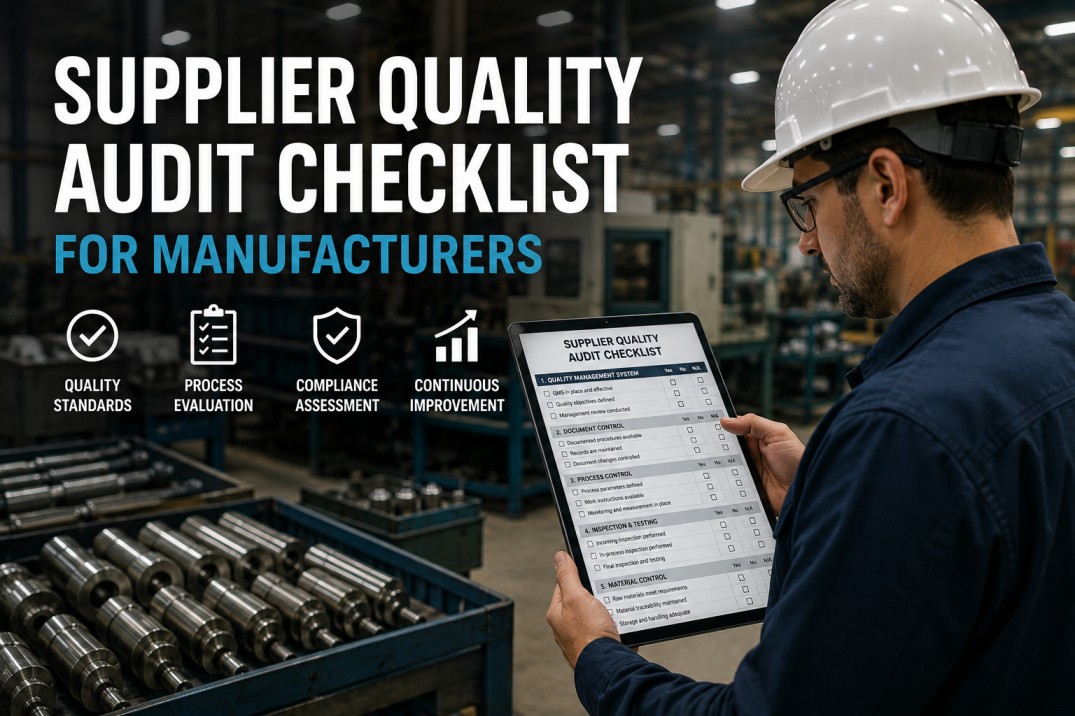
A supplier quality audit is one of the highest-leverage quality investments a manufacturer can make. It moves quality control upstream — to the point where raw materials, components, and sub-assemblies are produced.
Turn Supplier Visits Into Scored, Photo-Backed Audit Reports
iFactory digitizes your supplier quality audit — structured checklists, photo evidence capture, real-time scoring, and auto-generated SCAR reports — so every supplier visit produces actionable data, not just paper notes. Book a demo to see it on your supplier program.
Quality Management System
A supplier's QMS is the foundation that determines whether quality is a designed-in discipline or a reactive exercise. Auditors look for evidence that the quality policy is followed, objectives are measured, and the QC function has genuine authority to reject product.
Quality Policy & Objectives
Quality policy documented and communicated to all personnel. Objectives are measurable, monitored, and linked to customer requirements.
Management Commitment
Commitment shown through resource allocation, escalation of quality issues to senior management, and substantive management review meetings with documented decisions.
QC Independence & Authority
QC has documented, enforceable authority to hold, reject, or stop production independently of production management. Authority demonstrated in practice, not just written in an SOP.
Document Control
Current drawing revision at the point of use. Obsolete documents removed from production. All specification changes go through documented change control.
Internal Audit Program
Audits at defined frequency covering all QMS elements. Findings documented with objective evidence, assigned to owners, and tracked to verified closure.
Management Review
Management reviews must be conducted at planned intervals with documented inputs — quality metric trends, customer feedback, corrective action status, and audit results. Outputs must include specific decisions and assigned action items, each with a defined owner and target completion date.
Process Control & Production Capability
Process control is the area most directly predictive of outgoing product quality. Suppliers with defined, measured, and controlled processes produce consistent results — suppliers without process controls produce consistent surprises.
| Audit Element | Score | What to Verify | Evidence to Request |
|---|---|---|---|
| Control Plans | 10 pts | Control plan current at production workstation, covers all special characteristics, references correct measurement tools | Current control plan at machine vs. engineering drawing |
| Process Parameters | 10 pts | Critical process parameters defined, monitored, and within approved windows. Deviations documented and reviewed before continuing | Setup sheets, process monitoring records, deviation logs |
| Process Capability (Cpk) | 10 pts | Cpk data available for critical characteristics. Cpk ≥ 1.33 for standard; ≥ 1.67 for special characteristics. Marginal processes under active improvement | SPC charts, capability study reports, improvement plans |
| First-Piece Inspection | 5 pts | ||
| First-Piece Inspection | 5 pts | First-piece verification performed and documented at start of each production run and after setup changes. Records retained at machine. | First-piece inspection records, sign-off logs |
| In-Process Inspection | 5 pts | In-process sampling frequency defined. Actual measurements recorded — not pass/fail. Out-of-spec findings trigger immediate response. | In-process inspection records, frequency schedule |
| Mistake-Proofing | 5 pts | Poka-yoke devices present where required. Devices tested at shift start. Failures documented and investigated. | Poka-yoke verification log, device test records |
Material Traceability & Identification
Traceability is the ability to trace a finished product back to the raw materials, processes, and personnel that produced it — and forward from a raw material lot to every finished product that used it.
All incoming materials identified with part number, lot number, and status before any movement. No unidentified material in production areas.
Lot identity maintained through every operation. WIP labeled with part number, lot, and status. No commingling of different lots on the same pallet.
Finished goods labeled with part number, revision, lot/serial, date code, and quantity. CoC references the specific lot and is traceable to incoming material and process records.
Trace a finished lot back to incoming material and forward to distribution. Completing this trace in under one hour is the accepted benchmark.
The CAPA system is the ultimate test of a supplier's quality culture. Suppliers who identify nonconformances quickly, contain them before they reach the customer, investigate root causes rigorously, and verify that corrective actions.
Nonconforming product physically segregated immediately in a labeled quarantine area. Containment covers all suspect product since the last known-good inspection point.
Root cause must be identified using a defined methodology — 5-Why, Ishikawa fishbone, or fault tree analysis — and documented in writing. Analysis must address both why the defect was produced and why it was not detected.
Corrective actions target root cause, not symptom. Control plans and work instructions updated. Quality verifies implementation before the CAPA can be closed.
A defined method for verifying corrective action effectiveness must be documented at the time the CAPA is created — not added as an afterthought before closure. Effectiveness verification must be completed with objective evidence of no recurrence before the CAPA can be formally closed.
The purpose of a supplier quality audit is not to produce a score — it is to identify specific, actionable gaps in a supplier's quality system and drive their resolution before those gaps.
Supplier Quality Audit Checklist — 28 Items
Use this checklist during on-site supplier quality audits. Each row maps to a scored audit area with evidence type and criticality.
| # | Checklist Item | Type | Priority | Photo | Required | Critical |
|---|---|---|---|---|---|---|
| 1 | Quality policy documented, communicated, and understood — objectives measurable and monitored | Pass/Fail | High | — | ✓ | ✓ |
| 2 | Top management commitment evidence — quality resources allocated, issues escalated | Pass/Fail | High | — | ✓ | ✓ |
| 3 | QC has documented authority to hold, reject, or stop production independently | Pass/Fail | High | — | ✓ | ✓ |
| 4 | Current drawing revisions at point of use — obsolete documents removed from production | Pass/Fail | High | ✓ | ✓ | ✓ |
| 5 | Internal audits at defined frequency — findings tracked to verified closure | Pass/Fail | High | — | ✓ | ✓ |
| 6 | Management reviews conducted with documented inputs and action items with owners | Pass/Fail | Med | — | ✓ | — |
| # | Checklist Item | Type | Priority | Photo | Required | Critical |
|---|---|---|---|---|---|---|
| 1 | Control plan current at workstation — covers all special characteristics from PFMEA | Pass/Fail | High | ✓ | ✓ | ✓ |
| 2 | Critical process parameters defined, monitored, and within approved windows | Numeric | High | — | ✓ | ✓ |
| 3 | Process capability (Cpk) data available — Cpk ≥ 1.33 standard, ≥ 1.67 special chars | Numeric | High | — | ✓ | ✓ |
| 4 | First-piece inspection performed and documented at start of each production run | Pass/Fail | High | ✓ | ✓ | ✓ |
| 5 | In-process inspection frequency defined — actual measurements recorded, not pass/fail | Numeric | High | — | ✓ | ✓ |
| 6 | Poka-yoke devices present where required — tested at start of shift, failures documented | Pass/Fail | High | — | ✓ | ✓ |
| # | Checklist Item | Type | Priority | Photo | Required | Critical |
|---|---|---|---|---|---|---|
| 1 | All incoming materials identified with part number, lot number, and status before use | Pass/Fail | High | ✓ | ✓ | ✓ |
| 2 | Lot identity maintained through every operation — WIP labeled, no commingling of lots | Pass/Fail | High | ✓ | ✓ | ✓ |
| 3 | Finished goods labeled with part number, revision, lot/serial, date code, and quantity | Pass/Fail | High | ✓ | ✓ | ✓ |
| 4 | Supplier can trace finished lot to incoming material in under one hour — verified live | Pass/Fail | High | — | ✓ | ✓ |
| # | Checklist Item | Type | Priority | Photo | Required | Critical |
|---|---|---|---|---|---|---|
| 1 | Nonconforming product segregated immediately in labeled quarantine area with restricted access | Pass/Fail | High | ✓ | ✓ | ✓ |
| 2 | Root cause analysis uses defined methodology — addresses production cause AND escape cause | Text | High | — | ✓ | ✓ |
| 3 | Corrective actions target root cause — control plans and work instructions updated | Pass/Fail | High | — | ✓ | ✓ |
| 4 | Effectiveness verification method documented at CAPA creation — completed before closure | Pass/Fail | High | — | ✓ | ✓ |
| 5 | SCAR responses submitted within agreed deadline — actions verified by customer | Pass/Fail | High | — | ✓ | ✓ |
| 6 | No recurring nonconformances for same root cause — trending data reviewed | Pass/Fail | High | — | ✓ | ✓ |
| # | Checklist Item | Type | Priority | Photo | Required | Critical |
|---|---|---|---|---|---|---|
| 1 | Section 1 QMS score documented — total points awarded vs. maximum available | Numeric | High | — | ✓ | ✓ |
| 2 | Section 2 Process Control score documented | Numeric | High | — | ✓ | ✓ |
| 3 | Section 3 Traceability score documented | Numeric | High | — | ✓ | ✓ |
| 4 | Section 4 CAPA score documented | Numeric | High | — | ✓ | ✓ |
| 5 | Overall percentage calculated — rating assigned per scoring framework | Numeric | High | — | ✓ | ✓ |
| 6 | SCAR issued if score below 75% — re-audit date scheduled | Selection | High | — | ✓ | ✓ |
Frequently Asked Questions
What is the difference between a first-party, second-party, and third-party audit?
Book a Demo to see iFactory in action.
How often should we audit our suppliers?
Book a Demo to see iFactory in action.
What is a Supplier Corrective Action Request (SCAR)?
A Supplier Corrective Action Request is a formal written request from a customer to a supplier requiring that the supplier identify the root cause of a quality nonconformance and implement corrective actions to prevent recurrence.
What should be included in a supplier audit report?
A complete supplier audit report should include: audit date, scope, and auditor names; the audit criteria used (this checklist, a specific standard, or customer requirements); a summary score by section and overall; specific findings for each nonconformance with objective evidence — not just.
How can digital audit software improve supplier quality management?
Digital supplier audit platforms improve supplier quality management by replacing inconsistent paper-based audits with structured, scored checklists that produce comparable data across audits, auditors, and suppliers. Photo evidence is captured in context rather than in a separate email.
Make Every Supplier Visit Count — Scored Reports, Photo Evidence, Tracked Actions
iFactory digitizes your supplier audit workflow from pre-audit checklist through on-site scoring, SCAR generation, and corrective action tracking — so your supplier quality program produces measurable improvement, not just paperwork. Book a 30-minute demo to walk through your supplier audit process.
-checklist-for-manufacturers.jpg)