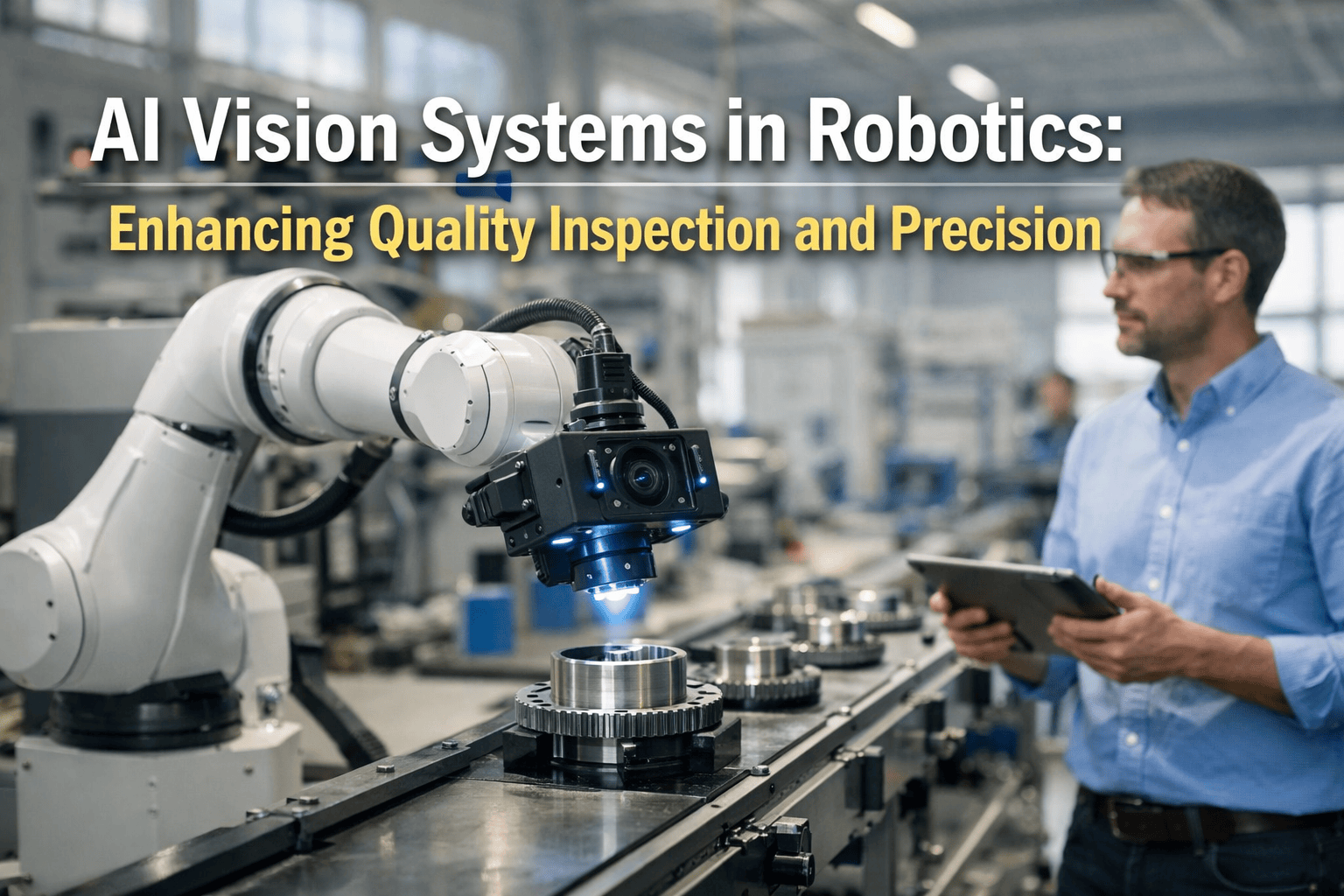
In 2026, the pursuit of zero-defect manufacturing has shifted from aspiration to requirement. Manual inspection — prone to fatigue, subjectivity, and inconsistency — cannot keep pace with production lines running at thousands of units per hour with micron-level tolerances. AI vision systems are filling this gap. Powered by deep learning and deployed on edge processors directly on the factory floor, modern vision systems detect defects in under 200 milliseconds, achieve 95–100% accuracy in controlled environments, and operate 24/7 without degradation. The global machine vision market is projected to grow from $15.83 billion in 2025 to $23.63 billion by 2030. Over 70% of manufacturers plan to deploy AI-based visual inspection within 18 months. And the technology is no longer standalone — it now feeds data directly back to robotic arms and production systems, creating closed-loop quality control that self-corrects in real time. iFactory helps manufacturers deploy AI vision-guided robotics for quality inspection — from camera selection and lighting design to model training and MES integration. Book a 30-minute consultation to start building your zero-defect production system.
AI Vision Systems in Robotics: Quality Inspection Redefined
Defect Detection in Milliseconds, 100% Inline Coverage, Zero Human Error
$23.6B
Global Machine Vision Market Projected by 2030
95–100%
Defect Detection Accuracy in Controlled Environments
<200ms
Inspection Decision Speed with Edge AI Processing
Why AI Vision Is Replacing Traditional Inspection
Traditional quality inspection — whether manual or rule-based machine vision — has reached its limits. Human inspectors fatigue after 20–30 minutes of continuous visual inspection. Rule-based systems can only catch defects they have been explicitly programmed to find. Neither approach can handle the speed, precision, and adaptability that modern production demands. AI-powered vision systems learn from data, recognize patterns no human could codify, and improve continuously with every part inspected.
✗ Human fatigue degrades accuracy within 30 minutes
✗ Only catches pre-programmed, known defect types
✗ Sampling-based — inspects 5–10% of output
✗ Cannot adapt to new products without reprogramming
✗ No data trail for root-cause analysis
✗ Speed-limited by human reaction time
✓ Consistent accuracy 24/7 — no fatigue, no shift variation
✓ Detects unknown defect types it was never trained on
✓ 100% inline inspection — every single unit checked
✓ Self-learns new products with minimal retraining
✓ Every inspection creates a digital audit trail
✓ Accept/reject decisions in under 200 milliseconds
The AI Vision Technology Stack — From Sensor to Decision
An AI vision inspection system is not a single camera. It is an integrated pipeline of imaging hardware, lighting, processing, and software — each layer purpose-built for industrial conditions. Understanding this stack is essential for deploying systems that work reliably at production speed.
CAPTURE
Industrial Cameras & Sensors
2D Area ScanSurface defects, color, assembly check
3D Structured LightDimensional metrology, warpage, volume
Line ScanContinuous web inspection (film, foil, fabric)
HyperspectralMaterial composition, contamination detection
ILLUMINATE
Precision Lighting Systems
BacklightingSilhouette inspection, edge detection
Structured Light3D surface profiling at high speed
Coaxial / DiffuseReflective surface inspection (metal, glass)
PROCESS
Edge AI & Deep Learning
CNN ModelsDefect classification, anomaly detection
YOLO VariantsReal-time object detection and localization
Edge InferenceOn-device processing, sub-200ms decisions
ACT
Robotic Response & MES Integration
Reject/SortPneumatic pushers, robotic arms divert defects
Closed-LoopFeeds corrections back to upstream process
MES/QMSDigital birth certificate for every unit inspected
Deploy AI Vision Inspection with iFactory
From camera selection and lighting design to deep learning model training and MES integration — iFactory delivers production-ready AI vision systems that catch what human eyes cannot.
Industry Applications — Where AI Vision Delivers the Highest ROI
AI vision inspection is deployed across every major manufacturing sector. The highest-ROI applications share a common pattern: high production speed, tight tolerances, and costly consequences for escaping defects.
Weld inspection, paint defect detection, dimensional compliance, assembly verification, battery cell inspection for EVs
Impact28% fewer defects reaching end-of-line
Electronics & Semiconductors
Solder joint inspection, PCB trace verification, component placement validation, wafer defect mapping at micron resolution
ImpactSub-10 micron defect detection at full line speed
Tablet inspection, fill-level verification, label compliance, foreign particle detection, serialization and traceability
ImpactFull FDA-compliant audit trail per unit
Foreign object detection, sorting and grading, packaging integrity, label verification, hyperspectral freshness analysis
ImpactFastest-growing machine vision segment
Surface scratch detection on sheet metal, coating thickness verification, weld seam inspection, dimensional gauging
Impact100% inline replaces statistical sampling
Micro-crack detection in solar cells, electroluminescence imaging, cell alignment verification, module assembly checks
ImpactYield improvement from early-stage defect catch
Vision-Guided Robotics — When AI Eyes Meet Robotic Arms
The most powerful application of AI vision is not standalone inspection — it is vision-guided robotics, where cameras and AI direct robotic arms in real time. This integration enables robots to perform precision tasks that traditional automation cannot: picking randomly oriented parts from bins, adjusting assembly positions on the fly, and sorting defective products without stopping the line.
3D vision systems generate point clouds of randomly oriented parts in bins. AI identifies each part's position and orientation, then guides the robotic gripper to pick with precision — eliminating the need for parts to be pre-oriented on feeders.
Replaces $50K+ feeder systems per station
AI vision continuously measures part positions and feeds real-time corrections to robotic arms during assembly. When tolerances vary batch-to-batch, the robot adapts its path and force — maintaining sub-millimeter precision without operator intervention.
Eliminates fixture-dependent assembly bottlenecks
AI vision classifies each product at full line speed. Defective units trigger immediate robotic diversion — sorted into rework or scrap bins by defect category. The system never stops the conveyor, maintaining throughput while achieving 100% inspection coverage.
Zero-downtime quality gating on high-speed lines
Cameras mounted directly on robotic welding or finishing arms inspect each operation in real time — detecting weld porosity, incomplete fusion, or coating inconsistencies as they happen. The robot corrects or flags immediately rather than passing defects downstream.
Catches defects at point of creation, not end-of-line
ROI & Business Impact — The Numbers That Matter
AI vision inspection delivers measurable returns across multiple dimensions. The payback period for well-targeted deployments is typically 12–24 months — with the fastest wins in defect-heavy processes or regulated industries where escaping defects carry severe financial consequences.
26%
Reduction in Human Error
Consistent AI-powered inspection eliminates the variability of manual checking across shifts and operators.
28%
Reduction in Product Defects
Integrated vision plus robotics catches defects that escape both manual inspectors and rule-based systems.
100%
Inline Inspection Coverage
Every single unit inspected — replacing statistical sampling that lets defects through by design.
50%
Reduction in Unplanned Downtime
Vision-powered predictive maintenance identifies equipment wear, cracks, and anomalies before failure.
12–24mo
Typical ROI Payback Period
Quick wins in scrap reduction, warranty cost avoidance, and throughput improvement compound from month one.
70%+
Plan AI Vision Deployment in 18 Months
Over 70% of manufacturers surveyed plan to deploy AI-based visual inspection within the next 18 months.
Implementation Roadmap — From Pilot to Full-Line Deployment
01
Define & Assess
Weeks 1–3
Identify the highest-impact inspection point — where defects are most costly, most frequent, or most difficult for humans to catch. Assess lighting conditions, line speed, part variability, and integration requirements. Define success metrics: target detection rate, false positive rate, and throughput impact.
Select camera type, resolution, and lighting configuration for the specific inspection task. Collect and label training data from production samples — both good parts and known defect types. Train deep learning models and validate accuracy against held-out test sets. Design the robotic response mechanism (reject, sort, or closed-loop correction).
03
Pilot & Validate
Weeks 8–12
Deploy the system on a single production line in shadow mode — inspecting alongside existing quality processes. Compare AI decisions against human inspectors and known defect data. Tune model thresholds to balance detection rate against false positive rate. Build operator confidence before switching to live rejection mode.
04
Scale & Optimize
Month 4+
Roll the validated system to additional lines and inspection points. Connect to MES and QMS for real-time defect dashboards and traceability. Enable continuous learning — the model improves as it inspects more parts. Implement closed-loop feedback where vision data corrects upstream processes automatically.
Frequently Asked Questions
How accurate is AI vision inspection compared to human inspectors?
AI vision systems achieve 95–100% defect detection accuracy in controlled manufacturing environments — significantly outperforming human inspectors who typically operate at 70–80% accuracy and degrade further with fatigue. AI also detects defect types invisible to the human eye, including sub-micron surface anomalies and internal material inconsistencies detectable with hyperspectral imaging.
What does an AI vision inspection system cost?
Costs vary by complexity: a single-camera 2D inspection station starts at $15,000–$50,000, while multi-camera 3D systems with robotic integration and MES connectivity can range from $100,000 to $500,000+. Most well-targeted deployments show ROI within 12–24 months through scrap reduction, warranty cost avoidance, and throughput improvement. Subscription and RaaS models are also emerging.
Can AI vision systems detect defects they have never seen before?
Yes — this is a key advantage over rule-based systems. Deep learning models trained on anomaly detection can flag parts that differ from the learned "normal" pattern, even if the specific defect type was never in the training data. The system continuously improves as it encounters new defect modes, and can be retrained with minimal data when new products or failure types emerge.
How fast can AI vision systems inspect parts on a high-speed line?
Modern edge AI systems make accept/reject decisions in under 200 milliseconds — fast enough for the highest-speed production lines in electronics, packaging, and automotive manufacturing. High-speed line-scan cameras capture continuous web materials (film, foil, fabric) at speeds exceeding 125 frames per second with full defect coverage.
Build Your Zero-Defect Production System
iFactory delivers end-to-end AI vision inspection solutions — from camera and lighting design to deep learning model training, robotic integration, and MES connectivity. See every defect. Stop every escape. Start from the first line.