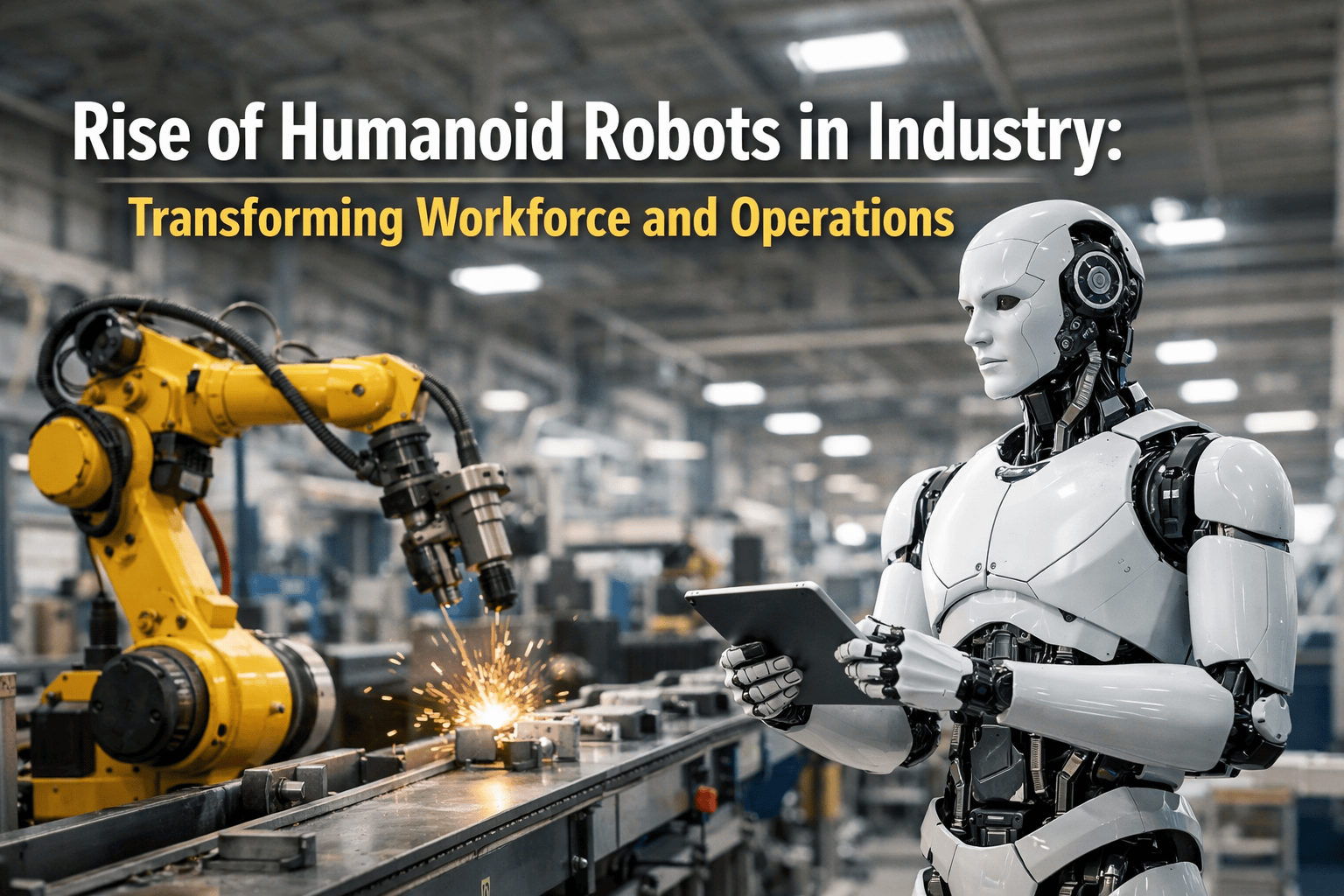
2026 is the year humanoid robots moved from demo videos to factory floors. Tesla is converting its Fremont production lines to manufacture Optimus Gen 3 at scale. BMW deployed humanoid robots in active production at its Leipzig plant — an operational decision, not a press event. Agility Robotics signed a commercial Robot-as-a-Service contract with Toyota Canada. Figure AI reached a $39 billion valuation. And Goldman Sachs projects the humanoid robot market will hit $38 billion by 2035 — with Morgan Stanley forecasting $5 trillion by 2050. The question for industrial leaders is no longer whether humanoid robots will enter their facilities. It is how to integrate them into operations before competitors do. iFactory helps manufacturers plan, deploy, and integrate humanoid robotics into existing production environments — from facility assessment to workflow design to MES integration. Book a 30-minute consultation to explore what humanoid robots can do for your plant.
Rise of Humanoid Robots in Industry
Transforming Workforce and Operations — From Pilot Programs to Production Reality
$38B
Projected Humanoid Robot Market by 2035 (Goldman Sachs)
39.2%
CAGR — Fastest-Growing Segment in Industrial Robotics
250K+
Humanoid Robot Shipments Projected by 2030
Why Humanoid Robots — Why Now?
Three forces are converging to make 2026 the inflection year for humanoid robots in industry. First, a global skilled labor crisis: Germany faces a projected shortfall of 7 million workers by 2035, Japan's working-age population has been shrinking for two decades, and manufacturers worldwide struggle to fill dangerous, repetitive, and physically demanding roles. Second, a cost collapse: humanoid manufacturing costs declined 40% year-over-year in 2025 — more than double what analysts expected — with unit prices dropping from $150,000+ to as low as $16,000–$30,000. Third, an AI breakthrough: foundation models from Google DeepMind, OpenAI, and NVIDIA now enable robots to understand natural language commands and execute complex physical tasks without traditional programming.
01
Global Labor Shortage
7M workers
Projected shortfall in Germany alone by 2035
Manufacturing employment in advanced economies fell by 1.2 million between 2020 and 2025 while production volumes recovered. 68% of Japanese small and medium factories cite labor availability as their top capacity constraint. Humanoid robots fill roles humans cannot or will not take.
02
Cost Curve Collapse
40% decline
In manufacturing costs — in a single year (2025)
Unit prices have fallen from $150,000+ to $16,000–$30,000 at the low end. Tesla targets $20,000 per Optimus at scale. Unitree already sells its G1 for under $16,000. When you have seen cost curves like this in solar and EV batteries, you know what comes next: exponential adoption.
03
AI Foundation Models
Natural language
Commands replacing traditional robot programming
Models like NVIDIA GR00T and Google RT-2 enable humanoids to understand spoken instructions and execute complex physical tasks. This eliminates the programming bottleneck that has limited robotics adoption for decades — making deployment faster, cheaper, and more flexible.
The Competitive Landscape — Who Is Building What
The humanoid robot industry has attracted the largest technology companies, automotive manufacturers, and venture-backed startups on the planet. Here is where the major players stand in 2026.
Tesla Optimus
Mass Production
StatusGen 3 production at Fremont; Texas expansion for 10M/yr
Target Price$20,000–$30,000 at scale
EdgeAutomotive supply chain + fleet AI learning from FSD
Figure AI (Figure 03)
$39B Valuation
StatusBMW factory deployment; BotQ facility for 12,000 units/yr
Target Price$30,000–$250,000 (config dependent)
Edge$1.9B funding; NVIDIA, Intel, OpenAI backing
Boston Dynamics Atlas
Commercial Launch
StatusCommercial production announced CES 2026; Hyundai deployment
Target Price~$130,000–$140,000 (2-year ROI target)
EdgeMost advanced locomotion; Hyundai industrial backing
Agility Robotics Digit
RaaS Revenue
StatusCommercial RaaS at Toyota Canada; Amazon warehouse pilots
ModelRobot-as-a-Service subscription
EdgeFirst paying commercial customers; logistics-optimized
Chinese Manufacturers
85–90% of 2026 Volume
PlayersUnitree, UBTECH, Agibot, Fourier, XPeng Iron
Pricing$5,900–$100,000 (aggressive cost competition)
Edge140+ manufacturers, 330+ models; government mandate for 2027
Prepare Your Facility for Humanoid Robotics
iFactory provides end-to-end humanoid robot integration planning — from facility assessment and workflow mapping to safety architecture and MES connectivity. Get ready before your competitors do.
Industrial Use Cases — Where Humanoids Are Working Today
Humanoid robots in 2026 are primarily deployed in manufacturing and automotive assembly (approximately 35% of all deployments), logistics and warehousing (approximately 25%), and research environments (approximately 15%). The industrialization path follows a clear progression: structured factory environments first, then commercial services, then household applications over the next decade.
Manufacturing & Assembly
Humanoids handle component insertion, quality checks, machine tending, and flexible assembly tasks on automotive production lines. BMW, Hyundai, and BYD are active deployers. Tasks involve manipulation in structured environments where the humanoid form fits human-designed workstations.
Logistics & Warehousing
Picking, packing, palletizing, and material transport in warehouse environments. Agility Robotics Digit at Amazon and Toyota facilities. Humanoid form navigates aisles, stairs, and dock areas designed for human workers — no facility reconfiguration required.
Inspection & Hazardous Environments
Walking robots inspect chemical plants, refineries, and nuclear facilities — navigating stairs, reading gauges, performing thermal scans, and detecting leaks in environments too dangerous for human workers to access routinely.
Healthcare & Service Sectors
Patient care assistance, supply transport in hospitals, eldercare mobility support, and customer-facing service roles. Labor shortages in caregiving are accelerating adoption, with Japan and South Korea leading deployment.
R&D & Data Collection
Thousands of humanoids deployed internally by manufacturers (Tesla, Figure AI) to collect real-world data that trains AI models. Every task performed feeds back into the neural network — improving all units across the fleet simultaneously.
Why the Humanoid Form Factor Matters for Industry
Traditional industrial robots excel in fixed, repetitive tasks. But they cannot navigate human-designed environments — stairs, doorways, variable workstations, mixed-traffic corridors. The humanoid form factor solves a specific problem: operating in spaces built for human bodies, using tools designed for human hands, without requiring facility redesign.
The Economics — What Humanoid Robots Cost and Return
The economics of humanoid robots in 2026 are crossing the threshold from "interesting experiment" to "compelling business case." With unit costs declining and capabilities rising, the ROI calculation increasingly favors deployment — especially in labor-constrained sectors.
Unit Cost (Enterprise)
$150K–$500K
$30K–$150K
$20K–$80K
Payload Capacity
10–15 kg
20–25 kg
30+ kg
Battery Runtime
2–4 hours
4–8 hours
8–16 hours
Hand Dexterity (DoF)
11 DoF
22+ DoF
Human-equivalent
Deployment Model
Purchase only
Purchase + RaaS
RaaS dominant
Estimated ROI Period
5+ years
2–3 years
12–18 months
The Robot-as-a-Service (RaaS) model is lowering the barrier to entry for manufacturers who cannot justify large capital expenditures. Instead of purchasing units outright, companies can subscribe to humanoid robot capabilities on a monthly basis — scaling up or down with production demand. Agility Robotics' commercial RaaS contract with Toyota Canada demonstrates that this model is already generating real revenue, not just pilot data.
How to Prepare Your Facility — A Practical Readiness Framework
Deploying humanoid robots into an existing industrial facility requires preparation across four dimensions. The manufacturers gaining first-mover advantage are those starting this work now — before humanoid capabilities fully mature and demand outstrips supply.
01
Workflow Audit
Map every production task by automation potential. Identify roles that are dangerous, repetitive, or chronically understaffed. These are your first humanoid deployment candidates. Prioritize tasks in human-designed spaces where traditional robots cannot operate.
02
Infrastructure Assessment
Evaluate floor surfaces, aisle widths, stair access, charging station placement, and wireless network coverage. Humanoids need reliable Wi-Fi or 5G for cloud AI inference, and designated charging zones for shift rotations.
03
Safety & Compliance Architecture
Define human-robot collaboration zones and safety protocols. Map to ISO/TS 15066 for collaborative operation and emerging humanoid-specific standards. Establish cybersecurity frameworks for connected robot fleets.
04
Data & Integration Layer
Connect MES, ERP, and WMS systems to receive task assignments and report production data from humanoid units. Build the OPC-UA and MQTT infrastructure that enables humanoids to operate as integrated nodes in your production network.
Frequently Asked Questions
How much does an industrial humanoid robot cost in 2026?
Prices range from approximately $16,000 for basic models (Unitree G1) to $130,000–$150,000 for advanced enterprise platforms (Boston Dynamics Atlas). Tesla targets $20,000–$30,000 for Optimus at scale. Robot-as-a-Service subscriptions offer monthly access without capital expenditure, with commercial contracts already operational at Toyota and Amazon facilities.
Will humanoid robots replace human workers?
In the near term (2026–2030), humanoid robots are augmenting human workers — primarily filling roles in dangerous, physically demanding, or chronically understaffed positions. Current deployments target labor-shortage sectors, not cost-cutting in well-staffed industries. The approach is human-robot collaboration, not replacement, with workers transitioning to supervisory and programming roles.
Which industries are adopting humanoid robots first?
Automotive manufacturing leads (BMW, Hyundai, BYD, Toyota), followed by logistics and warehousing (Amazon, Toyota Canada), inspection of hazardous industrial facilities (chemical plants, refineries), and healthcare support (Japan, South Korea). The industrialization path progresses from structured factory environments to commercial services to household applications over the next decade.
Do humanoid robots require facility modifications?
Minimal modifications compared to traditional automation. The humanoid form factor is specifically designed to operate in human-built environments — using existing workstations, tools, aisles, and stairs. Primary requirements include reliable wireless network coverage, designated charging zones, and MES integration for task management. No conveyor redesign or safety cage installation is needed.
Get Ahead of the Humanoid Robot Revolution
iFactory helps industrial manufacturers assess, plan, and deploy humanoid robotics into existing operations — from workflow mapping and facility readiness to MES integration and safety architecture. The companies that move first will define the next era of manufacturing.