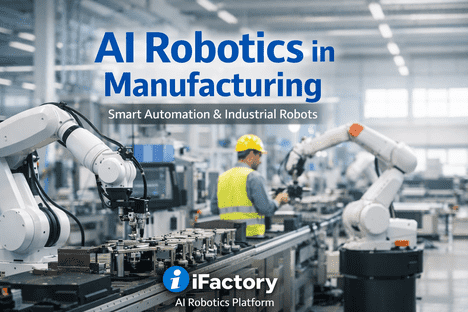
A precision electronics manufacturer in Shenzhen runs 24 hours a day with the lights off. Across 11,000 square metres, 680 autonomous robots handle material transport, component placement, soldering, inspection, and packaging — coordinating through a central AI brain that optimises production schedules, reroutes around faults, and self-adjusts quality parameters in real time. Human engineers monitor from a control room. The line runs at 86% higher output than the manned facility it replaced, with a defect rate below 0.1%. This is not science fiction. This is the smart factory in 2026 — and the manufacturers who are not building toward it are already falling behind.
Autonomous Robotics System
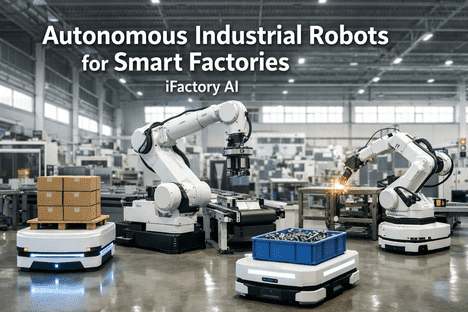
Autonomous Industrial Robots for Smart Factories
How self-navigating, self-deciding, and self-improving robots are transforming manufacturing from manual operations into intelligent, lights-out production systems
542,000
Industrial robots installed globally in 2024 alone
2x Installations vs 10 yrs ago
47%
Global smart factory adoption rate in 2026
Up 12pts YoY
Why the Factory of the Future Runs Itself
The smart factory is not a concept anymore. It is an operating model being adopted at scale — driven by labour shortages that will not reverse, production complexity that manual processes cannot handle, and customer expectations that demand speed, precision, and flexibility simultaneously. Autonomous robots are the physical layer that makes it all work.
The Forces Driving Autonomous Factory Adoption
1
The Permanent Labour Deficit
2.1 million US manufacturing jobs are projected unfilled by 2030. Robot installations have doubled in a decade while the available workforce shrinks. Autonomous systems are no longer an efficiency play — they are the only way to maintain production volume.
2
The Complexity Explosion
Product variety is increasing, batch sizes are shrinking, and changeover frequency is accelerating. Traditional fixed automation breaks under this complexity. Autonomous robots reconfigure themselves — adapting to new products in minutes, not weeks.
3
The 24/7 Imperative
Gartner estimates 60% of manufacturers will adopt some form of lights-out manufacturing by 2026. Autonomous robots enable unmanned shifts — production continues through nights, weekends, and holidays without shift premiums or fatigue degradation.
4
The Competitive Threshold
95% of manufacturers plan to invest in AI or machine learning within five years. 56% are already piloting smart factory systems. The window to gain competitive advantage from autonomous robotics is closing — it is becoming table stakes for survival.
Is your factory ready for autonomous production? Book a demo to see autonomous robotics in action.
What Autonomous Robots Do in a Smart Factory
Autonomous robots do not follow fixed scripts. They perceive their environment through sensors and cameras, make decisions through AI models running at the edge, execute tasks with adaptive precision, and improve their own performance through continuous learning. Here are the core capabilities that distinguish autonomous systems from traditional automation.
SLAM mapping
Dynamic path planning
Obstacle avoidance
Fleet coordination
Multi-zone routing
How It Works
AMRs build real-time maps of the factory floor, navigate dynamically around obstacles, people, and other robots, and coordinate fleet movement through a central AI orchestrator
Smart Factory Impact
Eliminates fixed conveyor infrastructure — material flows adapt instantly to production changes
Adaptive assembly
Variable pick-and-place
Force-aware manipulation
Tool auto-change
Multi-step sequencing
How It Works
AI-driven arms identify parts visually, determine optimal grasp strategy, execute assembly steps with force feedback, and adjust to part variation without reprogramming
Smart Factory Impact
Handles lot-size-one production at mass-production speed — true flexible manufacturing
Visual defect detection
Dimensional verification
Surface analysis
Classification & grading
Root cause correlation
How It Works
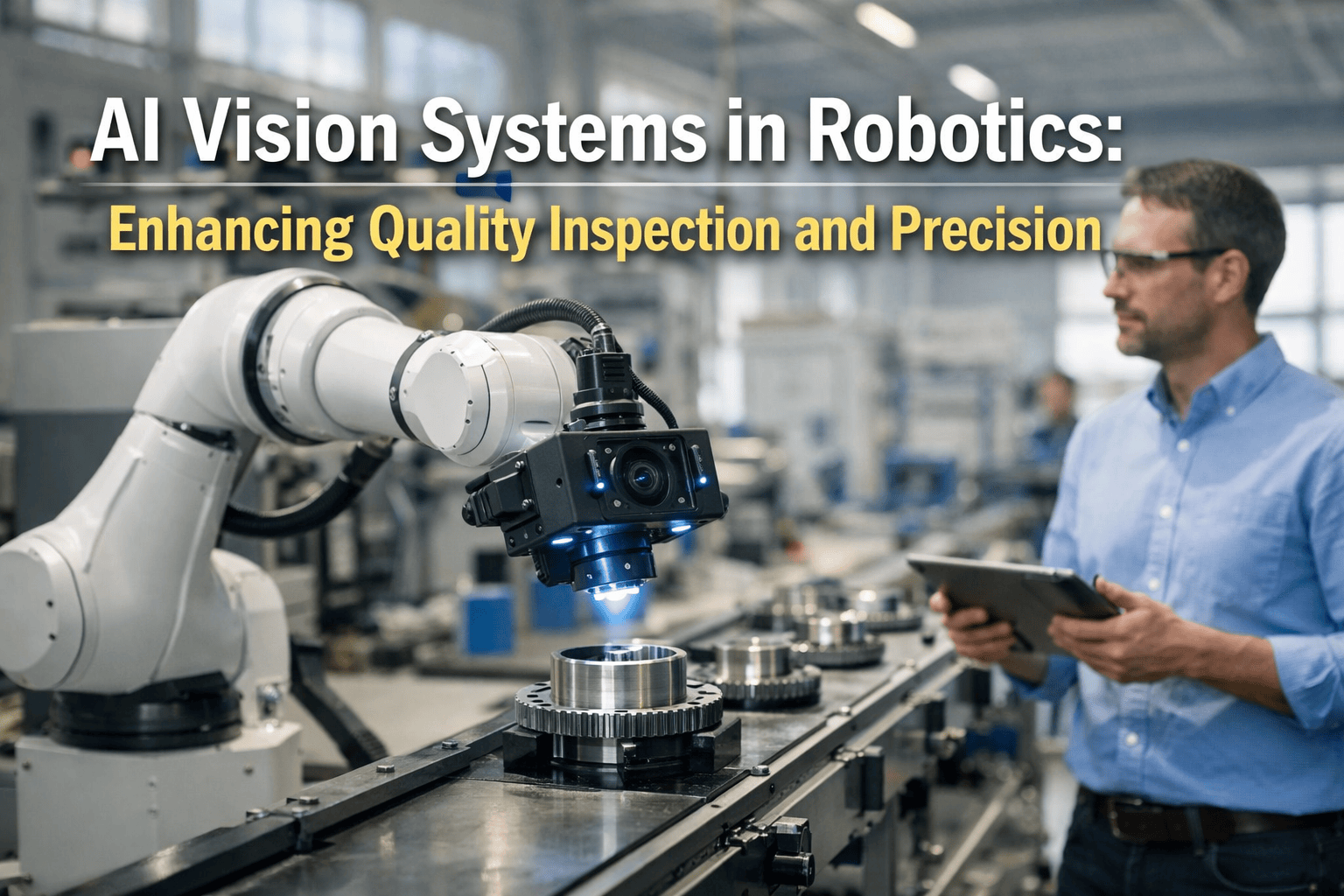
Robot-mounted cameras and AI models inspect every unit at production speed — detecting defects, measuring dimensions, and correlating quality data with upstream process parameters
Smart Factory Impact
100% inline inspection at 97–99% accuracy — zero sampling, zero escapes
Health telemetry
Vibration analysis
Thermal monitoring
Wear prediction
Auto-maintenance scheduling
How It Works
Autonomous robots continuously monitor their own health — tracking motor currents, joint temperatures, and vibration patterns to predict maintenance needs and schedule their own service windows
Smart Factory Impact
43% reduction in unplanned downtime through predictive maintenance algorithms
Safety-rated speed control
Force limiting
Proximity awareness
Teach-by-demonstration
Natural language commands
How It Works
Cobots operate cage-free alongside human workers, automatically slowing or stopping when proximity sensors detect people, and accepting new task instructions through hand-guidance or voice
Smart Factory Impact
34% labour productivity increase in mixed human-robot environments documented
Virtual commissioning
Simulation testing
Process optimisation
Layout planning
Failure prediction
How It Works
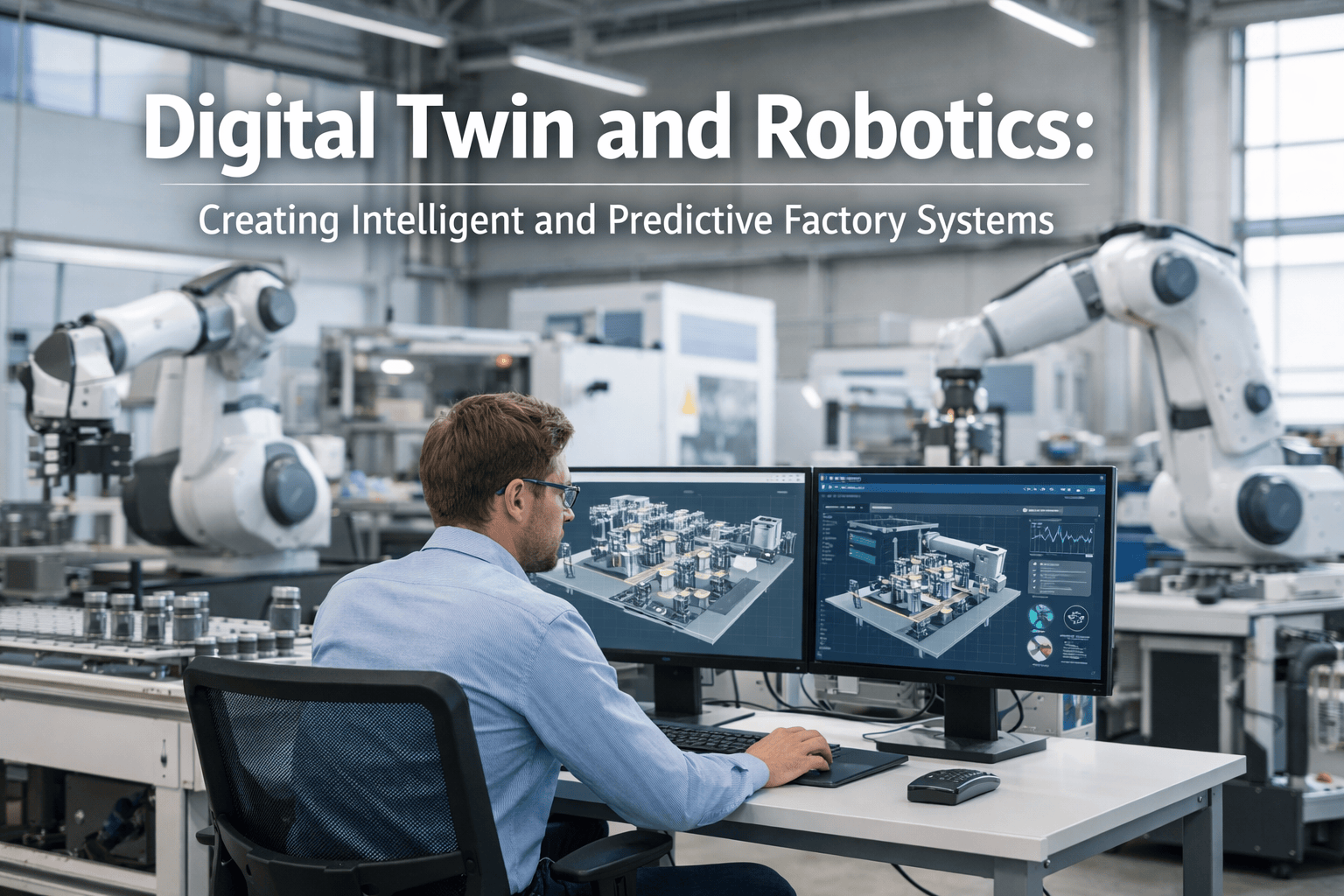
Every physical robot has a digital twin — a real-time virtual replica that enables simulation testing, virtual commissioning, and process optimisation before changes hit the physical line
Smart Factory Impact
52% reduction in commissioning time and 67% fewer startup errors documented
The Autonomous Factory Operating Model
A smart factory is not just robots doing tasks. It is an interconnected system where robots perceive, decide, act, and learn as a coordinated whole — orchestrated by a central AI that optimises across the entire production chain in real time.
Smart Factory Autonomous Operations Loop
Sense
Environment Perception
Thousands of IoT sensors, cameras, and robot telemetry streams feed real-time data into the factory AI — creating a complete digital awareness of every machine, part, and process.
Decide
AI Orchestration
Edge and cloud AI analyse sensor data, optimise scheduling, allocate robot tasks, predict failures, and adjust quality parameters — making thousands of decisions per second across the facility.
Act
Coordinated Execution
Autonomous robots execute production tasks, AMRs transport materials, inspection systems validate quality — all moving in coordinated sequence without human intervention or manual scheduling.
Evolve
Continuous Self-Improvement
Every cycle generates performance data. Machine learning models retrain continuously — optimising cycle times, energy use, quality outcomes, and maintenance schedules without manual tuning.
Build the Factory That Thinks for Itself
iFactory's autonomous robotics platform connects perception, decision-making, and execution into a single intelligent system — giving your factory the ability to run, adapt, and improve with minimal human intervention.
The Business Case for Autonomous Smart Factories
Autonomous robotics is not just a technology investment — it is the highest-leverage operational strategy available to manufacturers in 2026. The returns are documented, the payback is fast, and the compounding effect of continuous AI improvement means the gap between adopters and non-adopters widens every quarter.
Efficiency Gains
AI-driven autonomous systems deliver 31% average efficiency gains in automotive assembly. Output increases of up to 86% are documented in fully autonomous facilities versus manned equivalents — with consistent quality on every unit.
31–86% output increase
Downtime Elimination
Predictive maintenance algorithms reduce unplanned downtime by 43%. Self-monitoring robots schedule their own service windows during non-production hours. Digital twins catch process issues in simulation before they reach the physical line.
43% downtime reduction
Energy & Resource Savings
AI optimisation cuts energy consumption by 18% through intelligent scheduling and load balancing. Lights-out operation eliminates HVAC, lighting, and human-support infrastructure costs. Raw material waste drops through precision execution.
18% energy reduction
Total ROI Timeline
Average industrial robot payback has compressed from 5.3 years in 2019 to 1.3 years in 2024. Cobots achieve payback in under 7 months. Smart factory investments typically return ROI within 8–11 months through combined savings.
8–11 months payback
The Technology Stack Behind Autonomous Factories
Autonomous factory operation requires five integrated technology layers working in concert — from physical robots on the floor to the AI orchestration layer that coordinates the entire production system as a single intelligent organism.
Layer 1
Autonomous Robot Fleet
Articulated arms, cobots, AMRs, SCARA, and delta robots — each selected for specific production tasks. Autonomous navigation, tool changing, and self-charging enable continuous operation without human staging or intervention.
Layer 2
Perception & Sensing
2D/3D cameras, LiDAR, force/torque sensors, thermal imaging, and IoT environmental sensors create a complete sensory field across the factory. Over 1,500 connected devices per production line in modern greenfield facilities feed the AI layer.
Layer 3
Edge AI Processing
GPU-accelerated edge computing delivers sub-5ms processing latency for real-time robot decision-making. 72% of new automation projects now specify edge-native components. Local inference ensures autonomous operation continues through network outages.
Layer 4
Digital Twin & Simulation
Virtual replicas of every robot, cell, and production line enable simulation testing, virtual commissioning, and process optimisation before physical deployment. Over 4,200 facilities reported successful digital twin deployments in 2025.
Layer 5
Factory AI Orchestration
Central AI platform integrating MES, ERP, WMS, and quality systems. Coordinates robot fleet scheduling, production optimisation, predictive maintenance, energy management, and quality feedback — the brain that makes the factory autonomous.
See the full autonomous factory stack running on live production data. Schedule a live demonstration.
Documented Smart Factory Results
Industries Leading the Autonomous Factory Revolution
Autonomous robotics adoption is accelerating across every manufacturing sector — but the scale of deployment varies by industry complexity, production volume, and the economic pressure driving automation investment.
Automotive & EV Production
Full body-in-white welding, EV battery assembly, paint application, and final assembly. Automotive facilities deploy hundreds of coordinated robots per plant, with AI managing scheduling across multiple lines simultaneously.
Largest deployer globally — robots handle 60% of new installations in automotive
Electronics & Semiconductor
Wafer handling, precision component placement, micro-soldering, and cleanroom logistics. Autonomous systems achieve the sub-micron precision and contamination-free handling that human operators cannot sustain.
Dark factory model adopted at scale — multiple lights-out facilities operational in Asia
Food, Consumer Goods & Logistics
Mixed-SKU picking, case packing, palletising, and warehouse-to-production transport. This sector saw a 51% year-over-year surge in robotics orders, driven by labour shortages and e-commerce demand.
Fastest growing sector — 51% YoY robotics order surge in food and consumer goods
Pharma & Medical Devices
Sterile manufacturing, precision assembly, serialisation, and compliance-tracked packaging. Autonomous systems provide the traceability, repeatability, and contamination control that regulatory environments demand.
Full traceability and batch-level documentation generated autonomously
Frequently Asked Questions
What makes autonomous robots different from traditional industrial robots?
Traditional industrial robots follow pre-programmed paths blindly. Autonomous robots perceive their environment through cameras and sensors, make real-time decisions using AI, adapt to variation without reprogramming, and continuously improve through machine learning. They navigate dynamically, collaborate safely with humans, and self-monitor for maintenance needs — operating as intelligent agents rather than scripted machines.
Do we need to build a new facility for a smart factory?
No. Autonomous robotics integrates into existing facilities through phased deployment. Start with highest-impact cells — a CNC tending station, a palletising line, or an inspection point — prove ROI, then expand. AMRs navigate existing floor layouts without infrastructure changes. The technology adapts to your factory, not the other way around.
What is the ROI timeline for autonomous factory systems?
Average industrial robot payback has compressed from 5.3 years to 1.3 years between 2019 and 2024. Cobots achieve payback in under 7 months. Full smart factory investments return ROI in 8–11 months through combined efficiency gains, downtime reduction, energy savings, and labour cost optimisation. The compounding effect of continuous AI improvement accelerates returns each year.
Is lights-out manufacturing realistic for our operation?
Full lights-out operation is achievable for specific cells and lines today — CNC tending, palletising, and inspection are common starting points. Gartner estimates 60% of manufacturers will adopt some form of lights-out operation by 2026. The path is incremental: automate individual stations, connect them through AI orchestration, and expand unmanned windows progressively as confidence and capability grow.
How do autonomous robots handle product changeovers?
This is where autonomous systems excel versus traditional automation. AI vision recognises new parts without reprogramming. Cobots learn new tasks through teach-by-demonstration in minutes. AMRs adjust routing instantly. Digital twins simulate changeovers before execution. Advanced systems can reconfigure for a completely different process in as little as 15 minutes — enabling true high-mix, low-volume production at scale.
The Factory That Runs While You Sleep Is Not a Fantasy. It Is a Decision.
Your competitors are deploying autonomous systems right now. Every quarter you wait, the gap widens. See what intelligent, self-running production looks like for your operation.