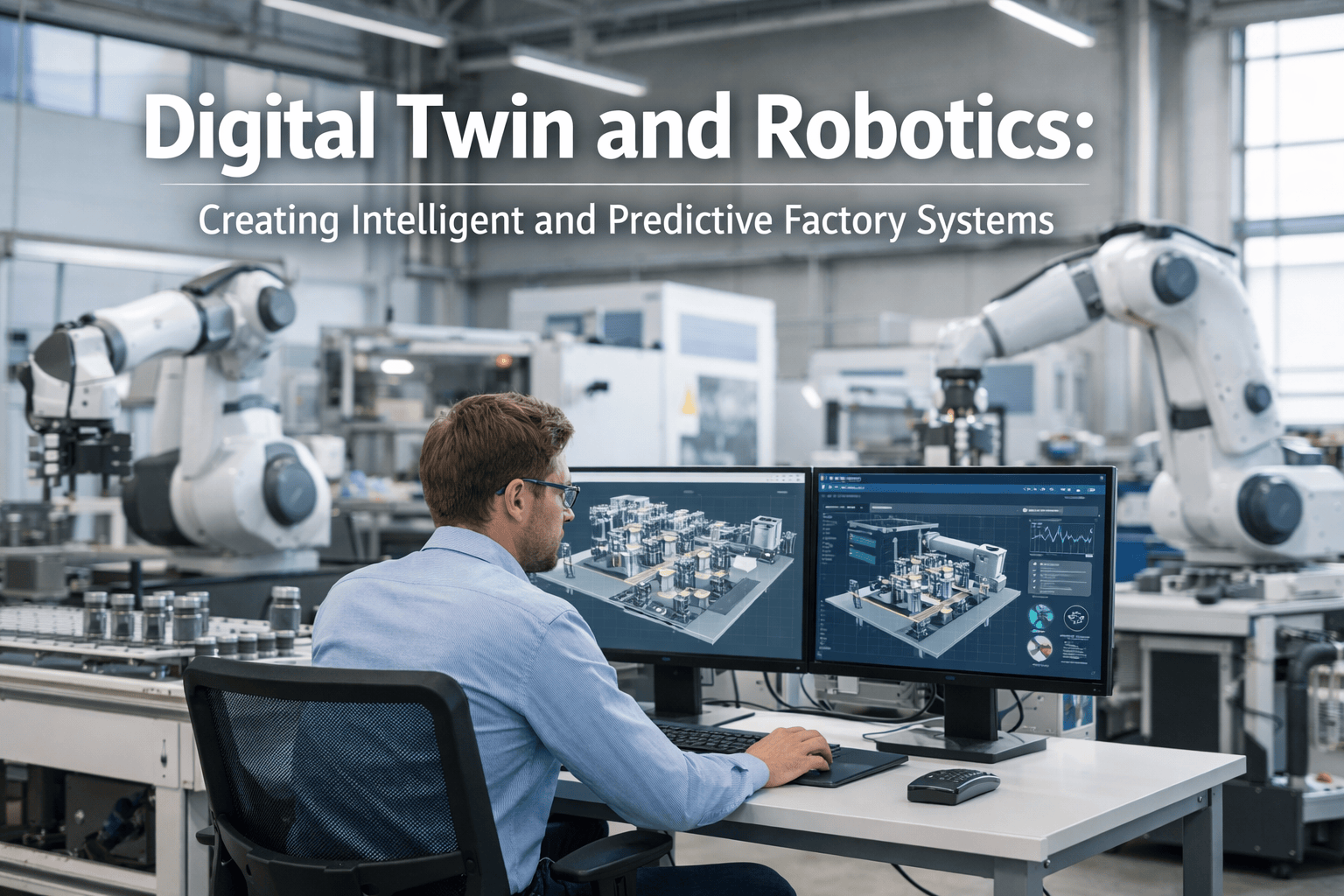
In 2026, digital twins have moved from interesting pilots to operational infrastructure. The global digital twin market is projected to grow from $21 billion in 2025 to nearly $150 billion by 2030 — with manufacturing leading adoption. BMW now completely replicates its production pipeline, facilities, processes, and logistics in a digital twin. BASF demonstrated 7,200-fold scheduling compression — from 10 hours to 5 seconds — in a proof of concept. Amazon credited digital twins for moving its Blue Jay robotics system from concept to production in just over a year. And NVIDIA reported generating 780,000 synthetic robot training trajectories in 11 hours — equivalent to 6,500 hours of human demonstration data. The convergence of digital twins, AI, and robotics is creating factories that simulate before they build, predict before they fail, and optimize before humans even know there is a problem. iFactory helps manufacturers deploy digital twin-powered robotics systems — from virtual commissioning and robot simulation to predictive maintenance and plant-wide optimization. Book a 30-minute consultation to start building your intelligent factory.
Digital Twin & Robotics: Intelligent, Predictive Factory Systems
Simulate Before You Build. Predict Before You Fail. Optimize Before You Know There Is a Problem.
$150B
Projected Digital Twin Market by 2030 (from $21B in 2025)
14.3%
Digital Twin Technology CAGR — Leading Smart Manufacturing Growth
7,200x
Scheduling Compression Demonstrated by BASF (10 hrs to 5 sec)
What Is a Digital Twin — And Why It Changes Everything for Robotics
A digital twin is not a static 3D model. It is a physics-accurate, continuously updated virtual replica of a physical asset, process, or entire factory — synchronized in real time through IoT sensor data. When paired with AI and robotics, the digital twin becomes the intelligence core of the smart factory: a living simulation where you test changes, train robots, predict failures, and optimize operations — all without touching the physical plant.
The Evolution: From Data Dashboard to Intelligent Twin
2018–2022
Data Twin
Near real-time display of asset metrics and sensor readings. Useful for visibility but limited to showing what is happening — not why or what will happen next.
2023–2026
Predictive Twin
Physics-based simulation combined with ML models. Explains cause-and-effect, predicts failures, simulates what-if scenarios, and trains robotic systems in virtual environments before physical deployment.
2027+
Autonomous Twin
Self-optimizing closed-loop systems. The twin acts, not just advises — autonomously adjusting robot paths, production schedules, energy use, and maintenance timing without human intervention.
How Digital Twins Power Robotics — 5 Core Applications
The integration of digital twins with robotic systems unlocks capabilities that neither technology can deliver alone. Together, they create a continuous cycle of simulation, deployment, monitoring, and improvement that accelerates every aspect of factory operations.
Test and debug entire robotic production cells in the digital twin before physical installation. Validate robot reach envelopes, cycle times, safety clearances, and PLC logic virtually — catching 60–80% of integration issues that would otherwise surface during physical startup. Reduces commissioning time by weeks and eliminates costly rework.
Saves 3–6 weeks of physical commissioning per robotic cell
02
Robot Path Optimization
Simulate thousands of robot trajectories in the digital twin to find the optimal path for every operation — welding, painting, assembly, material handling. AI evaluates trade-offs between cycle time, energy consumption, joint wear, and collision risk, then deploys the best path directly to the physical robot.
10–25% cycle time reduction through optimized motion planning
03
Predictive Maintenance
The digital twin continuously compares real-time sensor data (vibration, temperature, load, power draw) against the virtual model's expected behavior. Deviations signal early-stage degradation — bearing wear, motor inefficiency, gripper misalignment — weeks before failure occurs. Maintenance is scheduled precisely when needed, not on fixed intervals.
30–50% reduction in unplanned downtime; 20–30% lower maintenance costs
04
Synthetic Training Data
Train robot AI models in the digital twin using synthetic data generated from virtual environments — no physical prototypes, no real-world data collection needed. NVIDIA's Isaac platform generated 780,000 synthetic robot training trajectories in 11 hours, equivalent to 6,500 hours of human demonstration. This compresses months of training into days.
Robot training timelines compressed from months to hours
05
Plant-Wide Production Optimization
The digital twin models the entire factory as a system — robot cells, conveyors, AGVs, human workflows, energy systems, and material flow — then simulates the impact of any operational change before it is implemented. New product introductions, line rebalancing, and shift schedule changes are tested virtually and deployed with confidence.
Up to 20% productivity gain through system-level optimization
Build Your Digital Twin-Powered Factory with iFactory
From virtual commissioning and robot simulation to predictive maintenance and plant-wide optimization — iFactory delivers the digital twin platform that makes your factory intelligent, predictive, and continuously improving.
Real-World Deployments — Who Is Using This Today
Completely replicates production pipeline, facilities, processes, logistics, and supply chain in a digital twin. Uses Gen-AI integration to simulate disruptions and generate troubleshooting strategies.
Simulates production changes before physical implementation across global plants
Proved 7,200-fold scheduling compression in a digital twin proof of concept — reducing production scheduling from 10 hours to 5 seconds using AI-driven simulation.
Transforms scheduling from daily batch process to real-time continuous optimization
Used digital twins and AI-driven simulation to compress the development of its Blue Jay robotics system from multi-year timeline to concept-to-production in just over one year.
Demonstrates digital twin as accelerator for robotics development cycles
Uses digital twins to optimize factory layouts, reduce setup times, and simulate production scenarios before physical implementation. Allocated EUR 2 billion to expand its Amberg plant with digital twin controls.
Reduced setup times and operational costs while improving productivity
The Closed-Loop Architecture — How the System Works
A digital twin-powered smart factory operates as a closed-loop system. Data flows continuously from physical assets to the virtual model, AI generates insights and optimizations, and those changes are deployed back to the physical plant — creating a self-improving cycle that gets smarter with every production run.
Physical World
Robots
Sensors
PLCs
Conveyors
AGVs
Operators
Real-Time Sensor Data
Optimized Commands
Digital Twin
3D Simulation
Physics Engine
AI/ML Models
What-If Scenarios
Predictive Analytics
Optimization Engine
Analytics & Insights
Business Objectives
Business Systems
MES
ERP
QMS
SCM
Energy Mgmt
ESG Reporting
Implementation Roadmap — From First Twin to Factory-Wide Intelligence
Phase 1: Connect & Model
Months 1–3
Deploy IoT sensors on critical robotic cells and production equipment. Build the first digital twin of a single asset or production cell. Establish the data pipeline from physical sensors to virtual model. No changes to existing automation required.
Phase 2: Simulate & Predict
Months 3–6
Add predictive maintenance models to the digital twin. Begin running what-if simulations for production changes. Use the twin for virtual commissioning of any new robotic installations. Train AI models using synthetic data from the simulated environment.
Phase 3: Optimize & Expand
Months 6–12
Extend the digital twin to cover multiple production lines and the material flow between them. Connect to MES and ERP for production-integrated optimization. Deploy closed-loop control where validated AI recommendations execute automatically on low-risk processes.
Phase 4: Factory-Wide Autonomous Twin
Year 2+
The digital twin becomes the intelligence core of the entire facility — modeling every robot, conveyor, sensor, and energy system as a unified system. Autonomous scheduling, predictive quality, energy optimization, and supply chain coordination run continuously. The factory self-optimizes.
Frequently Asked Questions
What is the difference between a digital twin and a simulation?
A simulation is a one-time model run with fixed inputs. A digital twin is a continuously updated virtual replica that stays synchronized with the physical asset through real-time sensor data. It evolves as the physical system changes, enabling ongoing monitoring, prediction, and optimization — not just a single point-in-time analysis.
How does a digital twin help with robotic deployment?
Digital twins enable virtual commissioning — testing and debugging robotic cells entirely in simulation before physical installation. This catches 60–80% of integration problems that would otherwise cause delays during startup. The twin also optimizes robot paths, generates synthetic training data for AI models, and provides predictive maintenance that extends robot operating life.
Do we need to replace our existing systems to implement a digital twin?
No. Digital twin platforms sit on top of existing DCS, SCADA, PLC, and MES systems. They ingest data from your current sensors and infrastructure through standard protocols like OPC-UA and MQTT. The twin adds an intelligence layer without disrupting proven automation. Most manufacturers start with a single critical asset and expand incrementally.
What ROI can we expect from digital twin deployment?
Manufacturers report 30–50% reduction in unplanned downtime, 20–30% lower maintenance costs, 10–25% improvement in cycle times through optimized robot paths, and up to 20% overall productivity gains from system-level optimization. Virtual commissioning alone saves 3–6 weeks per robotic cell installation. Most deployments show measurable ROI within 6–12 months.
Build Your Intelligent, Predictive Factory
iFactory delivers end-to-end digital twin solutions for manufacturing — from IoT sensor integration and robotic simulation to predictive maintenance and autonomous plant optimization. Build once in simulation. Deploy with confidence. Improve continuously.