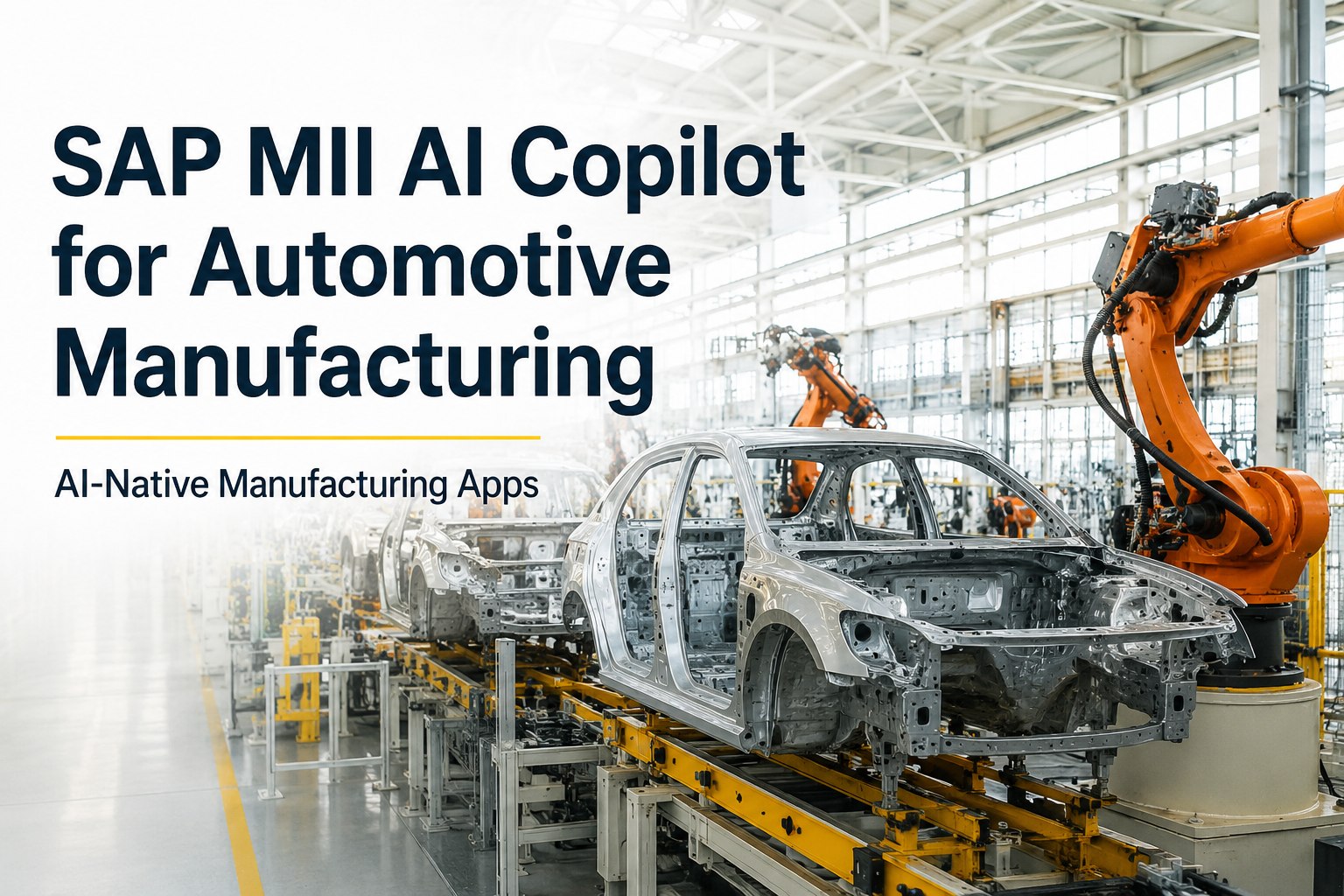
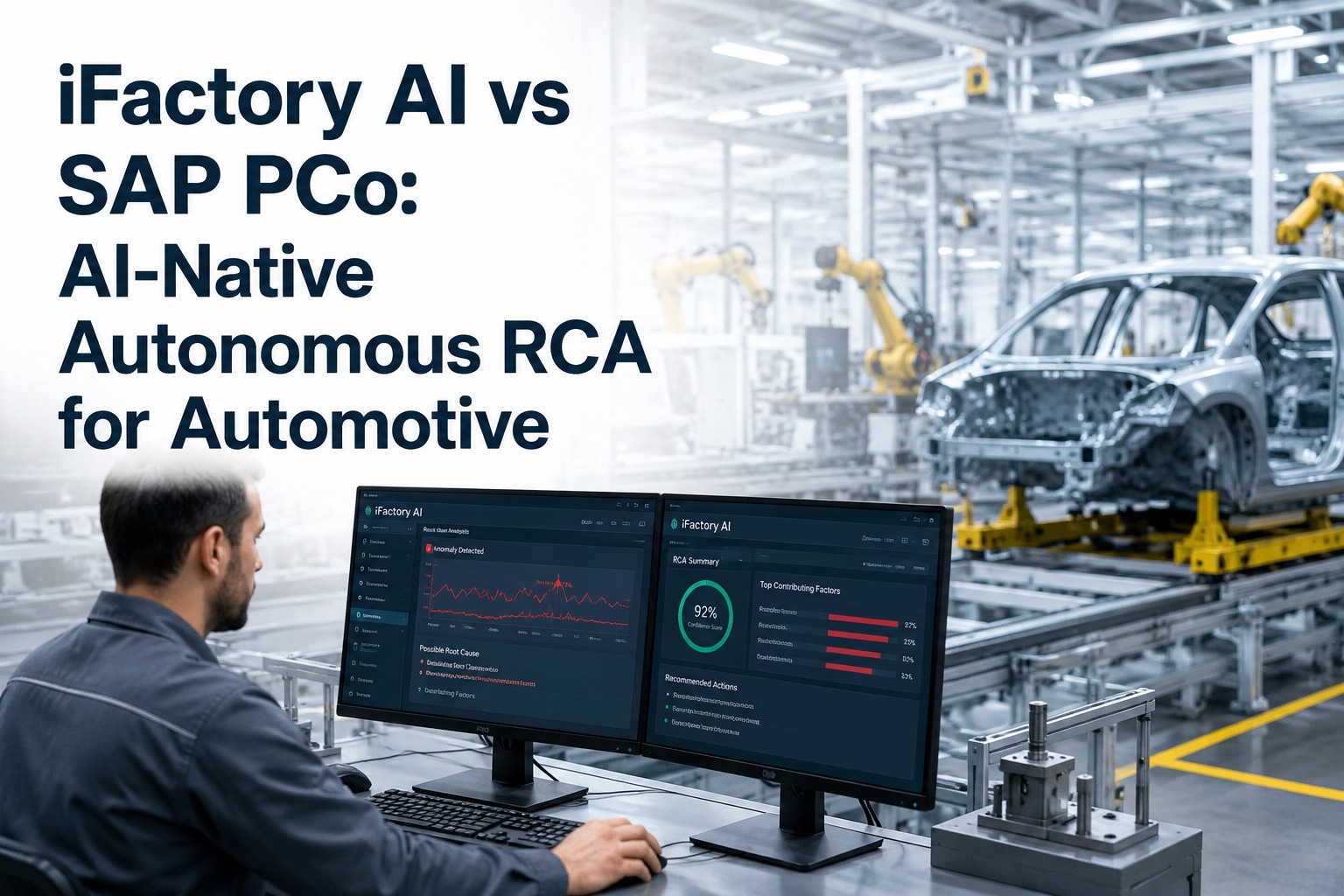
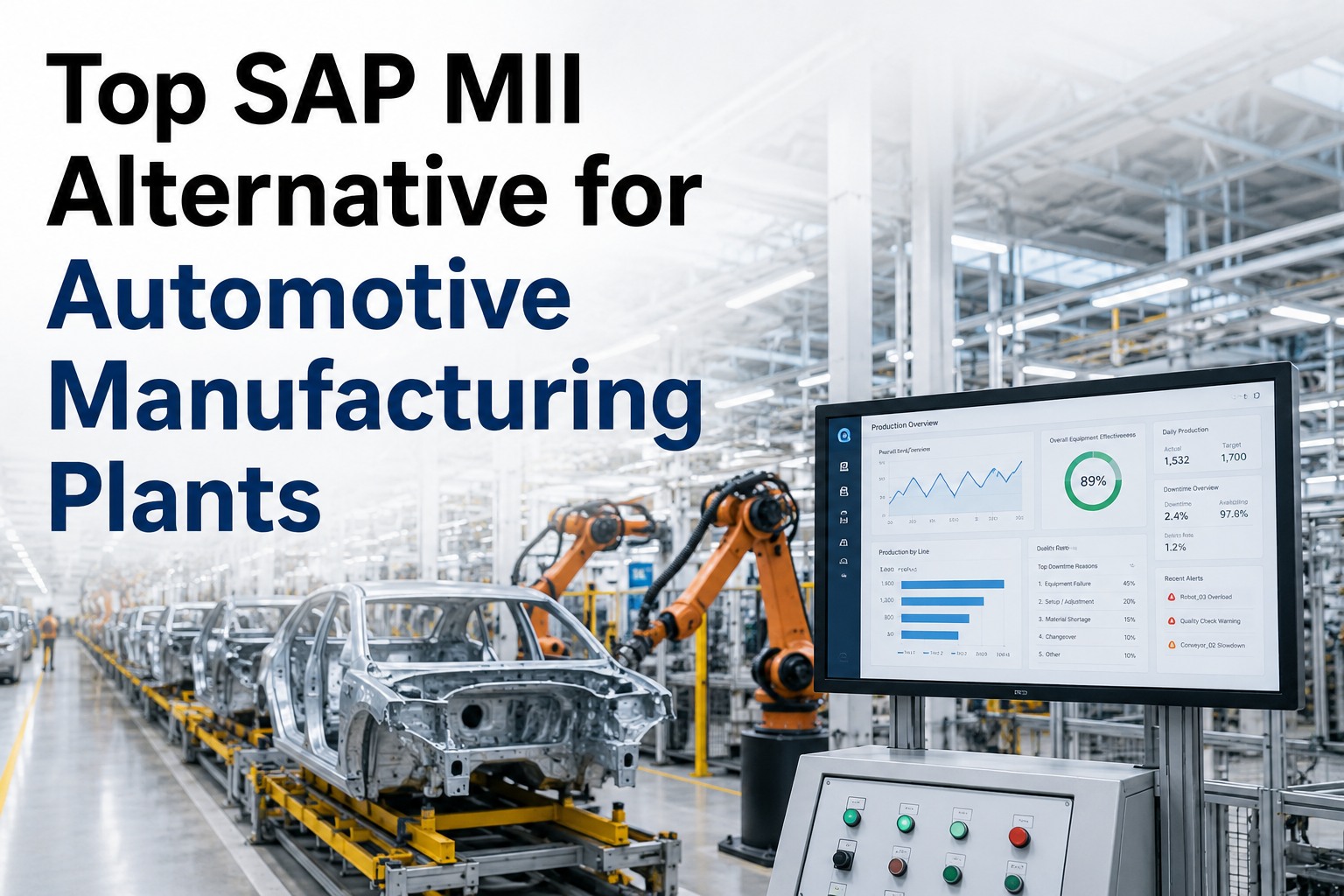
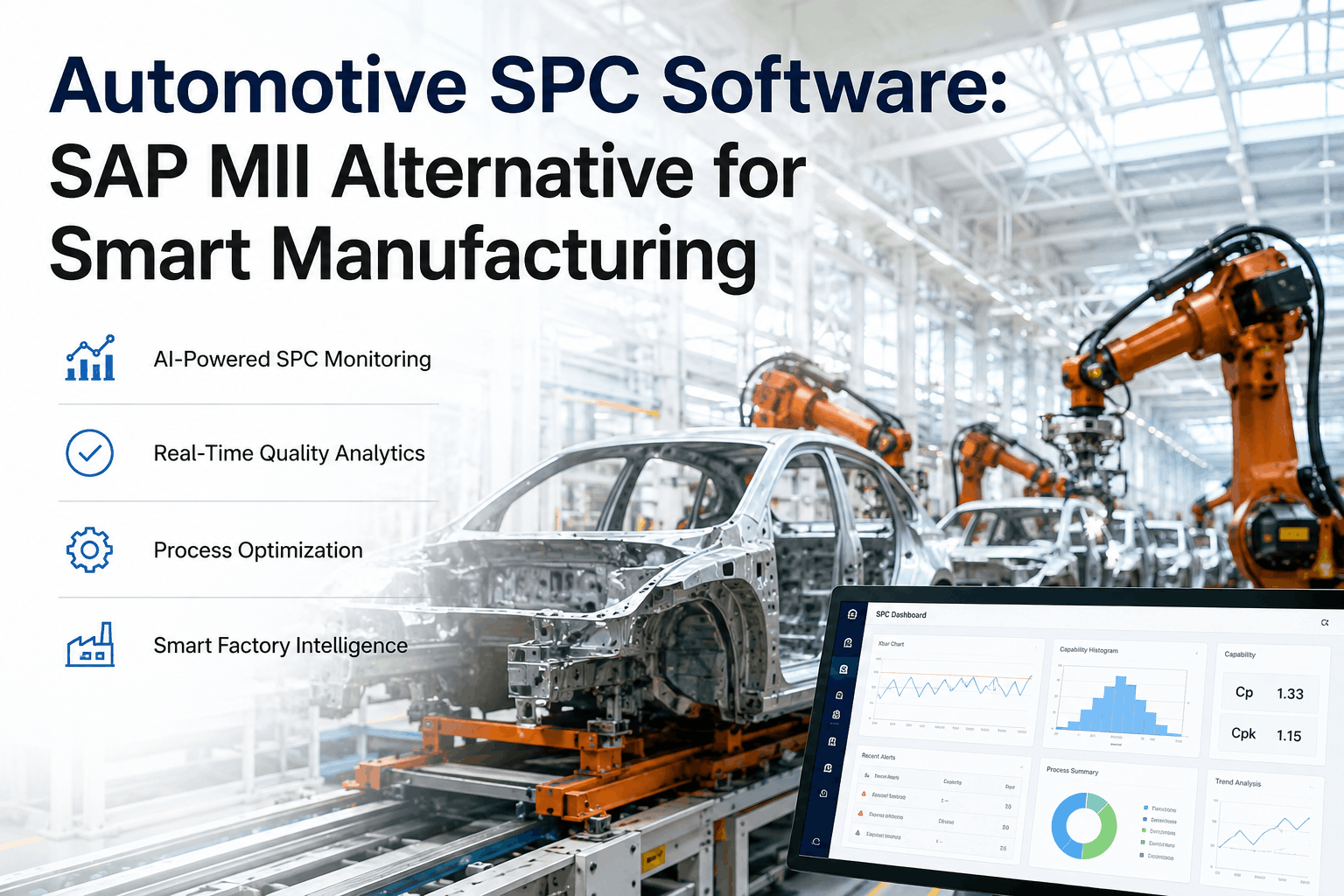
An automotive plant runs on three numbers that schedule everything: takt time, OEE, and downtime. A station misses takt and the entire line backs up. OEE drops a single point and shift leadership scrambles. A breakdown stretches past 30 minutes and the and on board lights up across three departments. For two decades, SAP MII was the place teams went to find out why — pulling up downtime dashboards, looking at OEE trends, drilling into station-level performance. The data is there. The answers are not. Operators still walk back to the station with a printout and a question. In 2026, that is no longer good enough. AI copilots — conversational AI built into the manufacturing platform — answer the operator's question in seconds, using the same data MII has been collecting all along, plus the context MII never could. 19% MTTR reduction. 6-point OEE improvement. This page walks through what an AI copilot actually does on an automotive line, how it modernizes OEE, and what the migration from SAP MII to AI-native manufacturing apps looks like. Book a 30-minute working session to see the copilot in action against your takt-time and OEE data.
19%
MTTR reduction — repair times drop from 4.2 to 3.4 hours after AI copilot deployment
+6 pt
OEE improvement reported across benchmark AI copilot deployments in discrete manufacturing
22%
Of AI-native production monitoring adoption is in automotive — the leading discrete vertical
Real-time
Takt time, OEE, and downtime — calculated continuously, not at end-of-shift
What an AI Copilot Actually Does on an Automotive Line
The phrase "AI copilot" has been overloaded by every vendor in the space. To set a clear baseline, here is what a copilot specifically does — and does not do — on an automotive manufacturing line. It is not a chatbot bolted onto a dashboard. It is a conversational interface to your historian, MES, PLCs, and tribal knowledge, with the AI doing the work of finding answers and surfacing context.
OPERATOR ASKS
"Why is Station 14 running slow this shift?"
COPILOT RESPONDS
Station 14 cycle time has drifted from 47s to 53s since 06:00. Pneumatic pressure on the clamp is 5.2 bar vs. 5.8 bar nominal. Last similar event was 11 March — root cause was a leak in valve V14-3. Recommended action: inspect V14-3. Estimated time to verify: 4 minutes.
SUPERVISOR ASKS
"What's hurting OEE today?"
COPILOT RESPONDS
Availability is down 3.2 points. Top contributor: Line 2 changeover took 38 minutes vs. 22 minutes target. Performance loss is concentrated in Stations 14 and 22 (cycle drift). Quality has held steady. Net OEE impact: -4.8 points vs. plan.
MAINTENANCE ASKS
"What's the failure history on the Line 3 welder?"
COPILOT RESPONDS
Three failures in the past 90 days. Two were tip wear, one was a coolant flow issue. Tip wear pattern correlates with a 4-hour run threshold. Coolant flow trending down 8% over the past week — flagged as a precursor. Recommended PM: tip change due in 12 hours; coolant filter inspection.
PLANT MANAGER ASKS
"Are we going to hit today's build target?"
COPILOT RESPONDS
Current trajectory: 96.4% of target. Gap is 31 units. Recovery options: extend Line 2 by 18 minutes (recommended), or shift 22 units to Line 3 (requires changeover). Line 2 extension is cheaper by $4,200 in overtime offset.
The Data Has Been in MII All Along. The Copilot Makes It Speak.
Every answer above was constructible from data your plant already collects. The copilot's job is to assemble it, correlate it, find the patterns, and put the answer where the operator can act on it — in seconds, not after a shift-end report. iFactory's copilot connects to historians, MES, PLCs, and CMMS the same way MII did, then layers conversation on top.
Why OEE in Automotive Specifically Needs Modernization
OEE is OEE everywhere. But automotive plants have a specific operational rhythm that makes legacy OEE reporting especially painful — and modern OEE especially valuable. Four reasons OEE modernization is high on every automotive plant's 2026 agenda.
01
Takt time tyranny
Automotive lines are balanced down to seconds. A 6-second cycle drift at one station propagates into a 60-second loss across a 10-station line. OEE reporting at end-of-shift cannot catch this fast enough to matter. Real-time, station-level OEE catches drift while it is still recoverable.
02
Granularity matters more than averages
Plant-level OEE hides the truth. Line-level OEE hides less. Station-level, shift-level, model-level OEE is where real improvement lives. MII can show some of this; AI-native platforms show all of it, with AI-suggested attribution for every variance.
03
Changeover is where money is lost
A 6-minute SMED gain compounds across hundreds of changeovers per year. AI copilots flag wasted steps in the changeover sequence, surface best-practice patterns from your fastest crews, and standardize them across shifts. The improvement comes from the data plants already have.
04
OEM customer mandates keep rising
Tier-1 suppliers face increasing data-sharing requirements from major OEMs — Toyota, Ford, GM, VW, Stellantis. Customer scorecards now expect real-time visibility, not monthly reports. Legacy MII cannot produce what OEM customers increasingly demand.
The OEE Modernization Stack: From Tag to Answer
Modern OEE is not a dashboard. It is a stack of capabilities — data capture, calculation logic, attribution intelligence, and conversational surface — that together transform raw machine data into actionable answers. Below is what each layer does and where it lives.
LAYER 5
Conversational Copilot Surface
Operators, supervisors, maintenance, and managers ask questions in plain language. The copilot pulls from every layer below, surfaces context, and recommends actions. Mobile, tablet, andon board, kiosk — the same answer everywhere.
LAYER 4
AI Attribution & Pattern Recognition
When OEE drops, the AI attributes the loss to availability, performance, or quality components — and then to specific stations, shifts, models, or operators. Machine digital fingerprints flag subtle behaviour changes that humans miss until they cascade.
LAYER 3
Real-Time OEE Calculation
OEE calculated continuously — not at end-of-shift. Availability, Performance, and Quality components broken out separately by station, line, shift, and model variant. Targets, plan vs. actual, and recovery options surfaced live.
LAYER 2
Context Fusion
Machine data joined with MES context (work orders, model variants, operator assignments), CMMS context (open work orders, PM schedules, failure history), and quality data (defect rates, rework). One unified view that MII assembled across many transactions.
LAYER 1
Universal Machine Connectivity
Connects to virtually any machine — legacy PLCs, modern controllers, robots, welders, presses, conveyors. OPC UA, MQTT, Modbus, native drivers. The same historian and DCS connections that MII used, with modern protocols layered on top.
The Automotive AI Copilot Use Cases That Drive Migrations
Across automotive plants moving from SAP MII to AI-native platforms, six specific copilot use cases account for most of the early ROI. Each one targets a specific operational pain that legacy OEE reporting cannot fully address.
USE CASE 01
Real-Time Takt & Cycle Time Coaching
Station-by-station cycle time tracking with AI flagging drift before it propagates. Copilot suggests likely causes — pneumatic pressure, tool wear, fixture misalignment, operator technique drift — and routes the right person to investigate.
Operational pain: 5-second cycle drift cascades into 60-second line loss before traditional reporting catches it
Copilot capability: Plain-language queries on station cycle time, drift attribution, recovery options
Outcome: Cycle drift caught in minutes, not shifts; line balancing maintained in real time
USE CASE 02
SMED Changeover Optimization
AI analyzes every changeover in your plant. Identifies wasted steps. Surfaces the patterns from your fastest crews. Recommends specific sequence changes per model variant. Standardizes best practice across shifts without forcing rigid checklists.
Operational pain: Changeover times vary 30–50% between crews; institutional best practice never spreads
Copilot capability: "What was the fastest changeover this week and what made it fast?" answered with data
Outcome: 6–18 minute average changeover reductions reported across automotive deployments
USE CASE 03
Andon & Escalation Intelligence
When andon triggers, the copilot has already pulled the relevant context — recent station behaviour, similar past events, current maintenance work orders, parts availability. Maintenance arrives at the station with answers, not questions. MTTR drops measurably.
Operational pain: Maintenance spends 40–60% of MTTR on diagnosis, not repair
Copilot capability: Context pack delivered to maintenance phone before they reach the station
Outcome: 19% MTTR reduction (4.2 to 3.4 hours) in benchmark deployments
USE CASE 04
Quality Correlation & First-Pass Yield
Vision QC results fed into the copilot alongside process parameters. AI correlates defect patterns with upstream conditions — spindle temperature spikes, torque drift, fixture wear, ambient changes. Operators get the "why" with the "what."
Operational pain: Quality defects detected late; root cause discovered after build is complete
Copilot capability: "What's driving defects on SKU-4482?" answered with correlation analysis
Outcome: First-pass yield improvements; faster CAPA cycles for customer scorecards
USE CASE 05
Predictive Maintenance on Critical Assets
Welders, presses, robots, conveyors monitored continuously. Tip wear, gun degradation, servo drift, bearing wear predicted days ahead. Copilot surfaces maintenance recommendations to the maintenance team's queue without operator intervention.
Operational pain: Unplanned downtime on critical assets disrupts takt for entire line
Copilot capability: "What's about to break on Line 4?" answered with ranked failure probabilities
Outcome: Critical-asset failures shifted from emergency to scheduled; OEE availability lifted
USE CASE 06
Operator Onboarding & Tribal Knowledge
SOPs, work instructions, training videos, OEM manuals, and historical fix notes all accessible through plain-language queries. New operators reach productivity faster. Experienced operators retain access to institutional memory. Multilingual support keeps multi-shift teams aligned.
Operational pain: New operator onboarding takes weeks; tribal knowledge walks out with retirees
Copilot capability: "How did we fix this last time?" answered with relevant history and SOPs
Outcome: Faster onboarding; preserved institutional knowledge; shift-to-shift consistency
Six Use Cases. One Conversational Surface. Same Data Your MII Has Been Collecting.
The copilot does not replace your plant's data infrastructure — it activates it. Every answer comes from your historian, MES, PLCs, and CMMS. The migration preserves the data flows MII has been running for a decade and adds the AI layer on top.
What Changes for Each Person on the Automotive Line
Technology only matters when it changes how people work. Here is the practical view from each automotive role when SAP MII OEE reporting is replaced with an AI copilot built into the platform.
LINE OPERATOR
Asks plain-language questions, gets specific answers.
No more walking to the office to look at a dashboard. The operator queries the copilot from a station tablet: "Why am I behind takt?" — gets the answer, the cause, and the recommended action in seconds.
SHIFT SUPERVISOR
Spends less time gathering data, more time on decisions.
OEE attribution is automatic. Variance explanations are pre-built. The supervisor walks into the shift huddle with answers ready, not slides to assemble.
MAINTENANCE TECH
Arrives at the station with context, not questions.
The copilot pushes a context pack to the tech's phone the moment andon triggers — similar past events, recent station behaviour, recommended parts. Diagnosis time drops; MTTR follows.
QUALITY ENGINEER
Correlates defects to upstream causes automatically.
When defect rates rise, the copilot has already correlated them with process parameters, environmental conditions, and station-level patterns. CAPA cycles compress. OEM customer scorecards improve.
PLANT MANAGER
Live target tracking with AI-suggested recovery options.
"Are we going to hit today's build?" gets a model-backed answer with concrete recovery options ranked by cost. Decisions about overtime, line shifts, and changeovers grounded in current operating reality.
CI / LEAN ENGINEER
Finds improvement opportunities the data has been hiding.
The copilot surfaces patterns no human would spot — the specific changeover step that costs minutes, the specific operator technique that improves yield, the specific shift pattern that affects MTBF. Kaizen events get sharper.
SAP MII OEE vs. AI Copilot OEE: Side-by-Side
The honest comparison framed for automotive operations specifically. SAP MII still has legitimate strengths as an integration layer. The gap on operator experience, real-time intelligence, and conversational access is where the modernization conversation lives.
The Migration Pattern for Automotive Plants
Automotive migrations cannot disrupt takt. Production must continue. OEM customer reporting must remain accurate. Below is the rhythm that works — phased, validated, aligned with model changeovers and shutdown windows.
WEEKS 1–4
Data Estate Audit & OEE Logic Mapping
Catalog every MII OEE artifact — BLS transactions, query templates, display templates, KPI definitions, alert rules. Map current OEE calculation logic line-by-line. Tag each artifact for preserve, transform, or retire. Identify quick-win copilot use cases.
WEEKS 4–10
Connectivity & OEE Logic Translation
Connect to existing PLCs, robots, welders, presses, and MES via the new platform's connector framework. Translate MII OEE calculation logic onto modern runtime. Validate against MII outputs in parallel for at least one full week.
WEEKS 10–16
Pilot Line Cutover & Copilot Activation
Cut over the pilot line. Run new and MII in parallel through one full production cycle. Activate the copilot for line operators and supervisors. Train shift teams on conversational queries. Document the first measurable OEE lift.
WEEKS 16–28
Wave-Based Plant Rollout
Roll out to remaining lines in waves aligned with model changeover windows. Each line phases in with parallel run, copilot activation, and stable-week validation before MII is retired locally. Cross-line copilot capabilities activate as lines come online.
MONTHS 7–12
Multi-Site Expansion & OEM Integration
Replicate to additional sites. Integrate with OEM customer data-sharing requirements. Surface portfolio-level dashboards. Retire MII components site-by-site as new platform delivers consistent results.
Frequently Asked Questions
Will the AI copilot work with our existing PLCs, robots, and welders?
Yes. The platform connects to virtually any machine — legacy PLCs (Allen-Bradley, Siemens, Mitsubishi, Omron, Beckhoff), modern controllers, industrial robots, weld controllers, and press monitoring systems. OPC UA, MQTT, Modbus, and native drivers are all supported. The same machine connections that MII used continue working; modern protocols layer on top.
Book a Demo for a connectivity walkthrough.
How accurate are the copilot's answers — and what happens when it does not know?
The copilot is grounded in your plant's actual data — historian, MES, CMMS, SOPs, fix history. It cites the source data behind every answer. When it lacks data to answer confidently, it says so and routes the question to the right person. Hallucinated answers are rare because the copilot is retrieval-grounded, not free-form generative.
Talk to Support about grounding architecture.
Can the copilot run on-prem so our process data and OEM customer data stay inside the facility?
Yes. The platform runs on-prem, hybrid, or cloud — your choice. For automotive Tier-1 suppliers under OEM data-residency mandates, on-prem deployment keeps everything inside the facility perimeter. The plant-knowledge model is fine-tuned on your data, on your hardware. Nothing leaves the network unless you explicitly authorize it.
Book a Demo for on-prem architecture details.
How does this work in a multi-language plant?
The copilot supports multilingual queries and responses. Operators can ask questions in their preferred language and receive answers in the same language. SOPs, work instructions, and historical fix notes are translated on demand. Multi-shift teams running different first languages stay aligned without manual translation overhead.
Talk to Support about language coverage.
Will our existing OEE calculation logic carry over from MII?
Yes. OEE calculation logic — availability, performance, quality definitions, downtime reason hierarchies, target setting — is translated onto the new platform with behavioural equivalence validation. The numbers your team trusts continue to be the numbers the new platform produces. Modernization adds AI attribution and real-time calculation on top, without changing the underlying definitions.
Book a Demo for OEE translation examples.
What is the smallest first step we can take this quarter?
A 4-week pilot on a single line. Connect the platform to existing machines. Translate OEE calculation logic. Activate the copilot for line operators and supervisors. Measure cycle time, MTTR, and OEE impact across one full production cycle. Output: defensible business case for plant-wide rollout grounded in your own data, not someone else's case study.
Talk to Support to scope it.
Real-Time OEE. Conversational Copilot. Takt-Time Visibility That Actually Helps Operators.
Automotive manufacturing in 2026 runs on speed of information, not just speed of production. AI copilots built into AI-native platforms close the gap between "the data is somewhere in MII" and "the operator has the answer now." iFactory delivers the platform, the migration playbook, and the OEE logic translation tooling engineered for automotive operations.
19% MTTR reduction; +6 point OEE improvement in benchmarks
Station-level OEE in real time, not end-of-shift
Conversational copilot for operators, supervisors, maintenance
SMED changeover optimization with best-crew patterns
On-prem deployment for OEM data-residency mandates