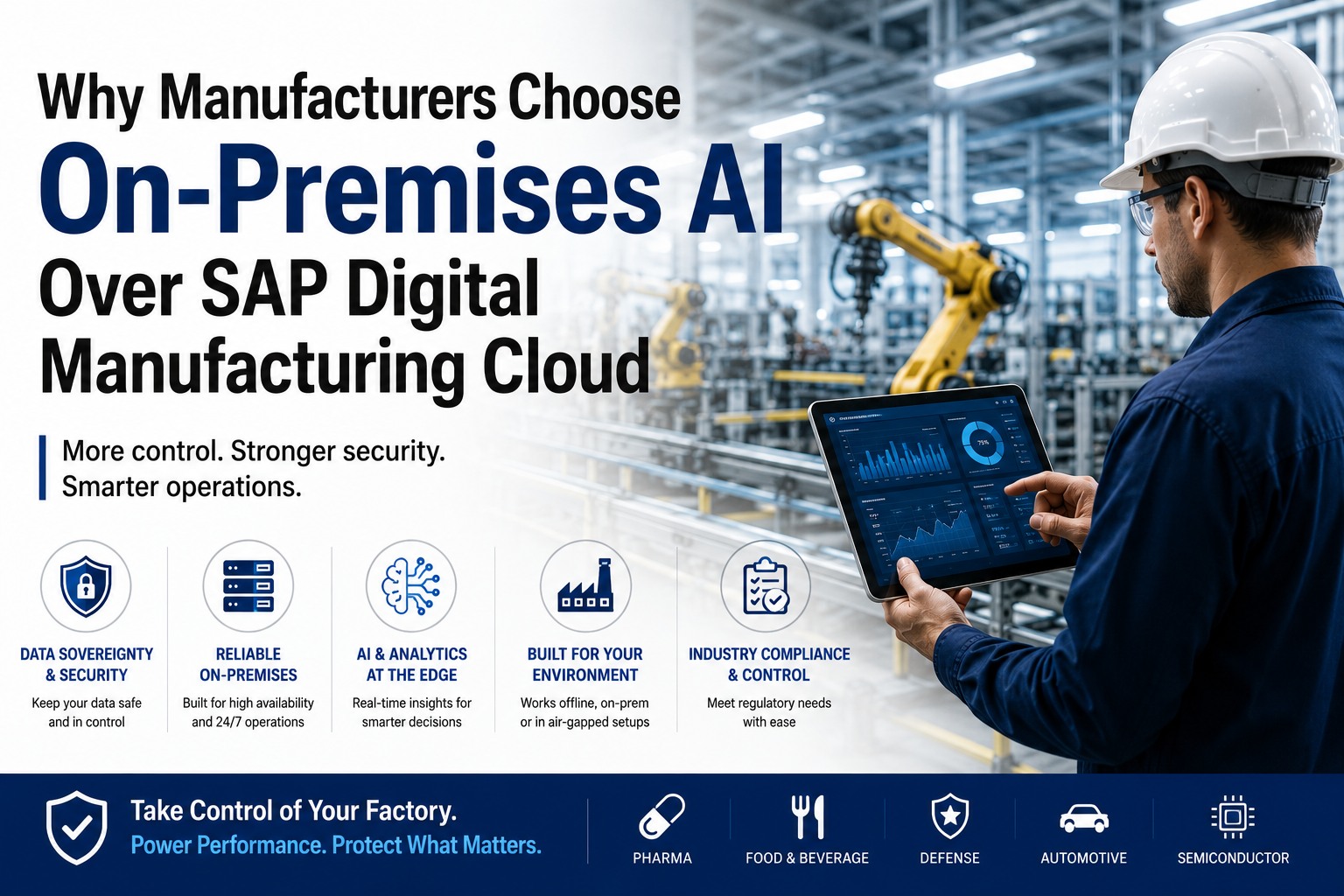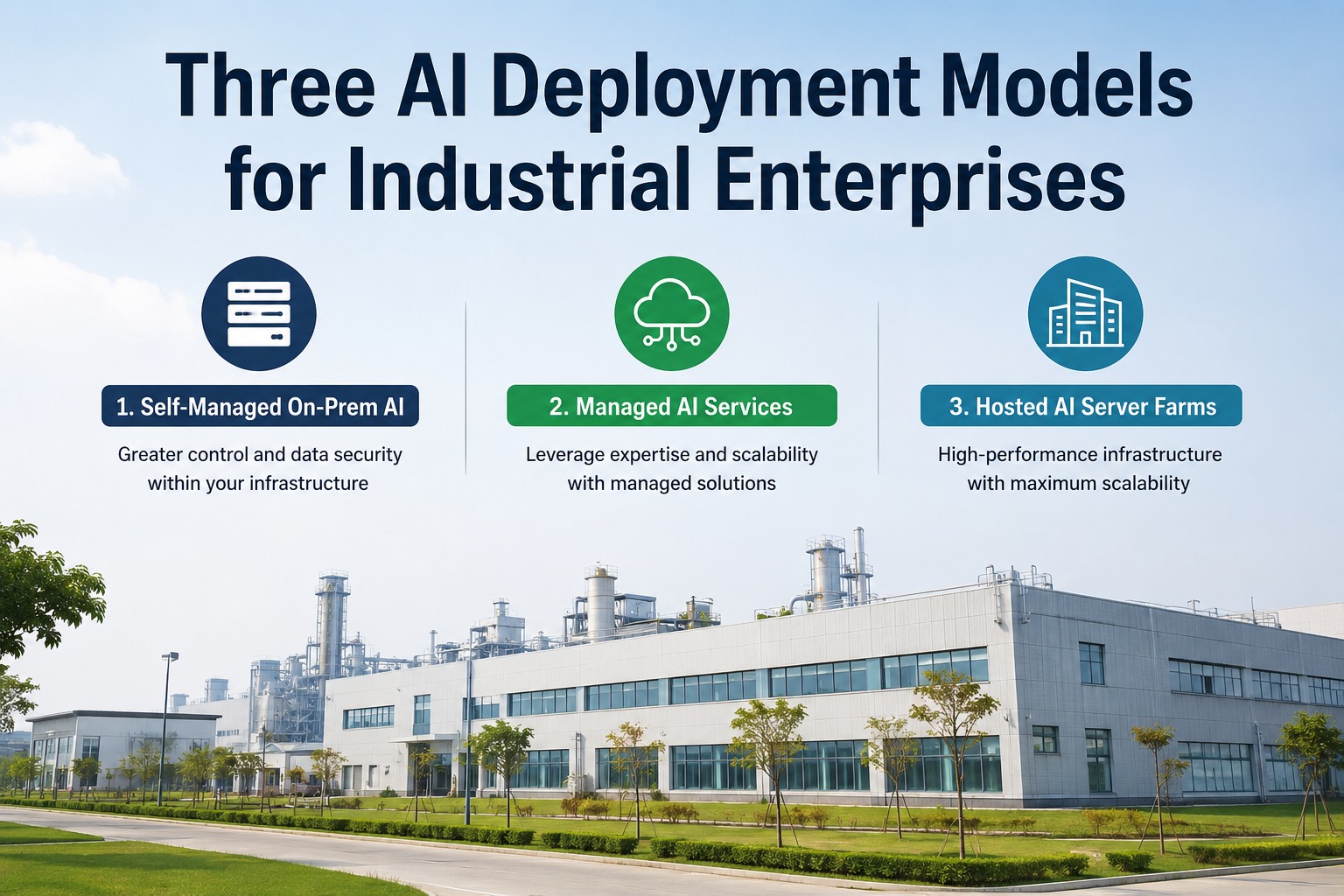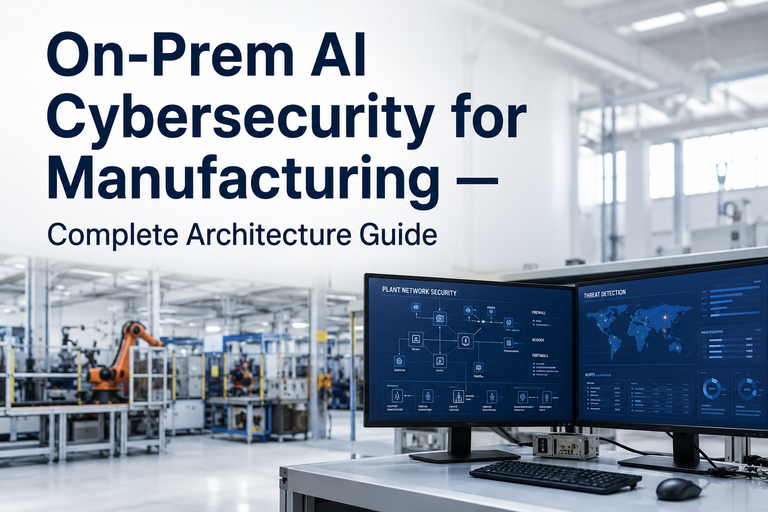
Manufacturing plants run the most complex digital environments on earth — SAP systems, PLCs, SCADA networks, historian databases, and now AI inference engines, all sharing the same infrastructure. That convergence is exactly what attackers exploit. This guide covers the complete cybersecurity architecture for on-prem manufacturing AI: how threats enter, how iFactory's layered defenses respond, and how your plant stays sovereign, compliant, and resilient — without sending a single byte of process data to the cloud.
On-Prem AI Cybersecurity for Manufacturing — Complete Architecture Guide
Manufacturing has been the single most targeted industry for cyberattacks four years running. Your AI brain holds your process recipes, equipment fingerprints, and SAP data. Here is how iFactory keeps all of it locked inside your plant — on your hardware, under your control, with zero cloud dependency.
Three Structural Weaknesses Attackers Exploit Every Time
These are not edge cases. They describe the majority of manufacturing plants running today — and all three vulnerabilities get significantly worse the moment cloud-connected AI is added to the equation.
Legacy OT Systems With No Built-In Security
PLCs and SCADA systems from the 1990s and 2000s were engineered for reliability, not security. They run flat, unencrypted protocols with no authentication layer.
IT/OT Convergence Expanding the Attack Surface
Industry 4.0 connects enterprise ERPs, cloud applications, and plant floor networks. The result: a phishing email can become a PLC compromise in under two weeks.
Production Pressure That Prevents Patching
Manufacturers cannot stop the line for security updates. Attackers know this. Ransomware demands averaged $1.16 million in 2025 — because paying is cheaper than a production halt.
How a Plant Gets Breached — Step by Step
Ransomware groups follow a repeatable playbook. Understanding each step is the first step to cutting each path. Here is the sequence — and where iFactory blocks it.
IT Perimeter Breach
Phishing email, exploited VPN, or compromised vendor credential. The attacker lands in the IT network — ERP, email, or business application.
IT to OT Pivot
Flat network architecture lets attackers move from ERP servers to SCADA and PLC systems. 75% of OT attacks originate from this IT-side pivot.
Encrypt or Disrupt
Ransomware encrypts historian data, AI model files, batch records, and MES. Production halts. 40% of OT incidents cause full operational disruption.
When your AI runs in the cloud, an attacker who compromises cloud credentials can access or poison your predictive models, quality inspection datasets, and SAP integration tokens — without ever touching your plant floor hardware.
Cloud AI Opens Three New Attack Surfaces. On-Prem Closes All of Them.
Cloud AI platforms are fast to activate. They also inherit the cloud's structural security trade-offs — trade-offs that manufacturing plants cannot afford to make.
- Process recipes and batch records leave your plant boundary
- AI model poisoning via cloud API is an active attack vector
- Vendor breach exposes your plant's proprietary process data
- No air-gap option for defense, pharma GxP, or regulated workloads
- Cloud outage means AI goes blind during production — no fallback
- Inference latency of 50–200ms degrades real-time control decisions
- All data — sensor, recipe, batch, IP — stays inside your facility
- Models run on your NVIDIA DGX hardware, inside your secured network
- Zero third-party cloud vendor data exposure of any kind
- Full air-gap mode: zero external API calls, full offline operation
- Network outage has zero impact on plant AI or production decisions
- Sub-5ms inference latency — fast enough for real-time PLC integration
Five Layers. Zero Lateral Movement. Built on the Purdue Model.
iFactory's security architecture follows IEC 62443 zoning principles, mapped directly onto the Purdue Reference Model. A breach at any layer cannot reach the next. Every conduit between levels is explicitly authorized, logged, and rate-limited.
One Platform. Three Mandatory Standards. No Compliance Gaps.
NIS2 went into force in the EU in October 2024. NIST CSF 2.0 explicitly added OT environments. IEC 62443 is now a contractual requirement for enterprise supply chains. iFactory's architecture satisfies all three simultaneously.
Industrial Control System Security
The international standard for industrial cybersecurity. Defines Security Levels SL-1 to SL-4 for ICS and SCADA environments. iFactory's zone and conduit architecture maps to SL-2 by default, SL-3 on request.
EU Network and Information Security
Mandatory for medium and large manufacturers in the EU since October 2024. Non-compliance carries fines of up to €10 million or 2% of global annual turnover. iFactory covers all required controls natively.
US Cybersecurity Framework — OT Expanded
Updated in 2024 to explicitly include OT environments. Adds a Govern function that makes cybersecurity a board-level accountability. US federal contractors in manufacturing are increasingly subject to CSF 2.0 obligations.
Security Woven Into Every Layer of iFactory
Air-Gap Mode
Full AI inference, SAP integration, model retraining, and audit logging run completely offline. Zero external API calls. Required posture for defense contractors, pharma GxP, and critical infrastructure facilities.
SAP Authorization Inheritance
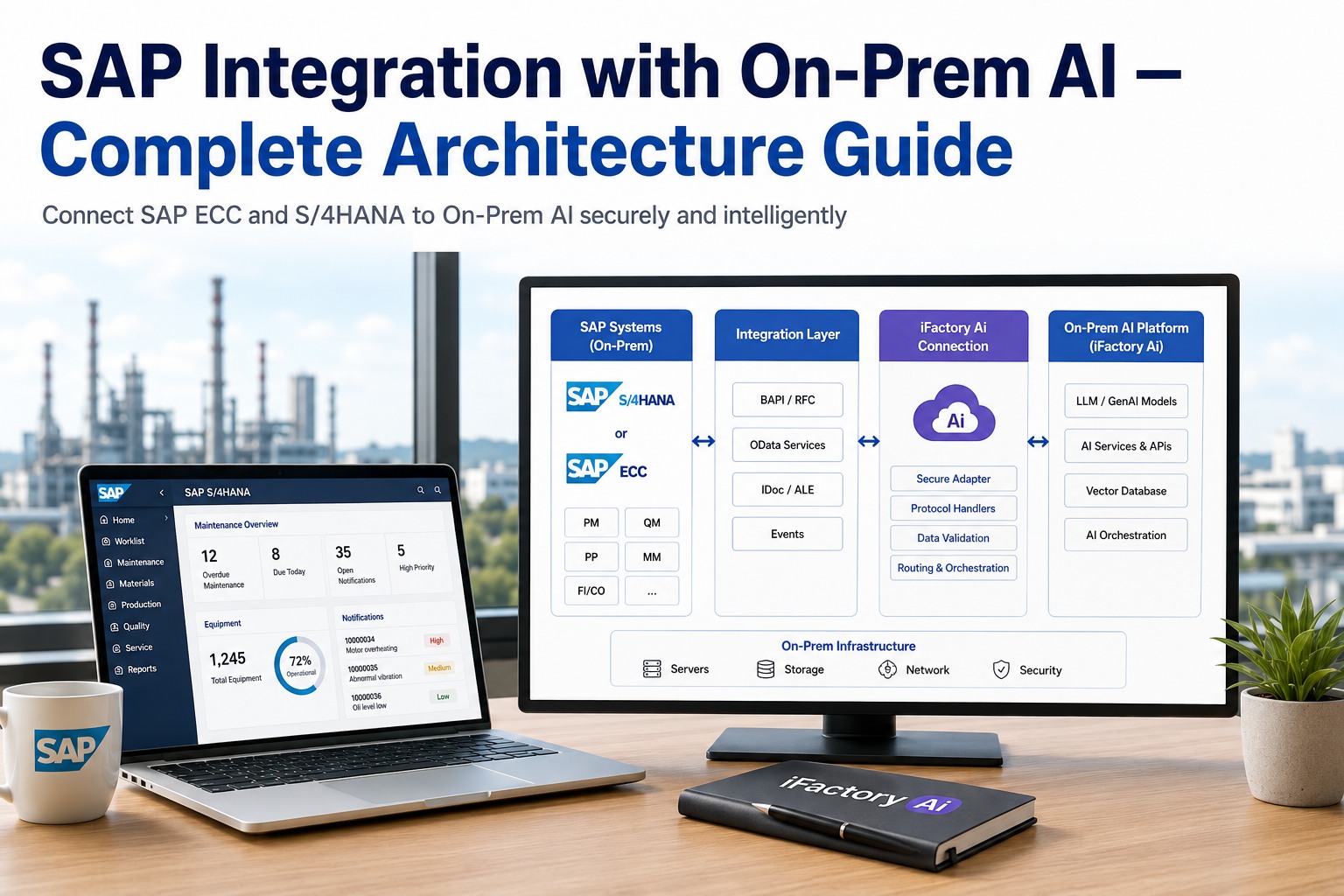
iFactory AI agents inherit SAP authorization objects in real time. When a user's role is revoked in SAP, their AI access is cut immediately — no parallel directory, no manual sync.
Immutable Audit Trail
Every AI action — prediction, work order creation, SAP posting, setpoint recommendation — is logged with user identity, timestamp, and SAP transaction reference. Immutable and tamper-evident.
Data Sovereignty by Default
Process recipes, batch genealogy, equipment fingerprints, and supplier pricing stay inside your facility. Cloud is opt-in, per data class, with an explicit audit event for every transfer.
Model Integrity Verification
Every AI model version is cryptographically signed. A tampered or poisoned model is automatically rejected at inference time — before it touches any production decision or SAP write-back.
24×7 Remote SOC Monitoring
iFactory's remote security operations center watches your deployment around the clock. Anomalous inference patterns, unauthorized API calls, and network deviations trigger automated isolation within seconds.
Frequently Asked Questions
Can iFactory run fully air-gapped with zero internet access?
Yes. The complete stack — NVIDIA DGX hardware, NeMo models, RAPIDS analytics, NIM inference, and all SAP connectors — operates entirely offline with zero external API calls. This is the standard posture for defense customers, pharma GxP environments, and any facility mandating complete network isolation.
How does iFactory enforce IT/OT separation?
iFactory deploys at Purdue Level 3 and enforces IEC 62443-compliant conduits for all cross-level communication. The Integration Hub acts as the DMZ between enterprise SAP (L4/5) and the plant control network (L1/2/3). No direct path exists between the internet and any field device. Conduit policies are logged, rate-limited, and reviewed during each deployment.
What happens to AI access when a user's SAP role is changed?
Access reflects immediately. iFactory AI agents inherit SAP authorization objects — when a user's SAP role is revoked or changed, their AI access updates on the next authenticated session. No parallel access list exists to fall out of sync.
Does iFactory produce IEC 62443 compliance documentation?
Yes. Every deployment includes a Security Architecture Review document covering zone/conduit diagrams, security level assessments, and audit log formats compatible with IEC 62443 documentation requirements. This package is available for customer audits, enterprise supply chain reviews, and regulatory submissions.
Can our plant AI be affected if a cloud vendor is breached?
Not with on-prem iFactory. The standard on-prem deployment contains zero cloud vendor dependencies — no cloud API keys, no SaaS model endpoints, no external data pipelines. A cloud vendor breach has no impact on your plant AI, your process data, or your production continuity.
Your Plant Data Never Leaves Your Plant.
Manufacturing is the most attacked industry on earth. On-prem AI is your sovereign layer — process recipes, AI models, SAP data, and sensor history under your roof, under your control, with no cloud dependency and no single point of cloud failure.