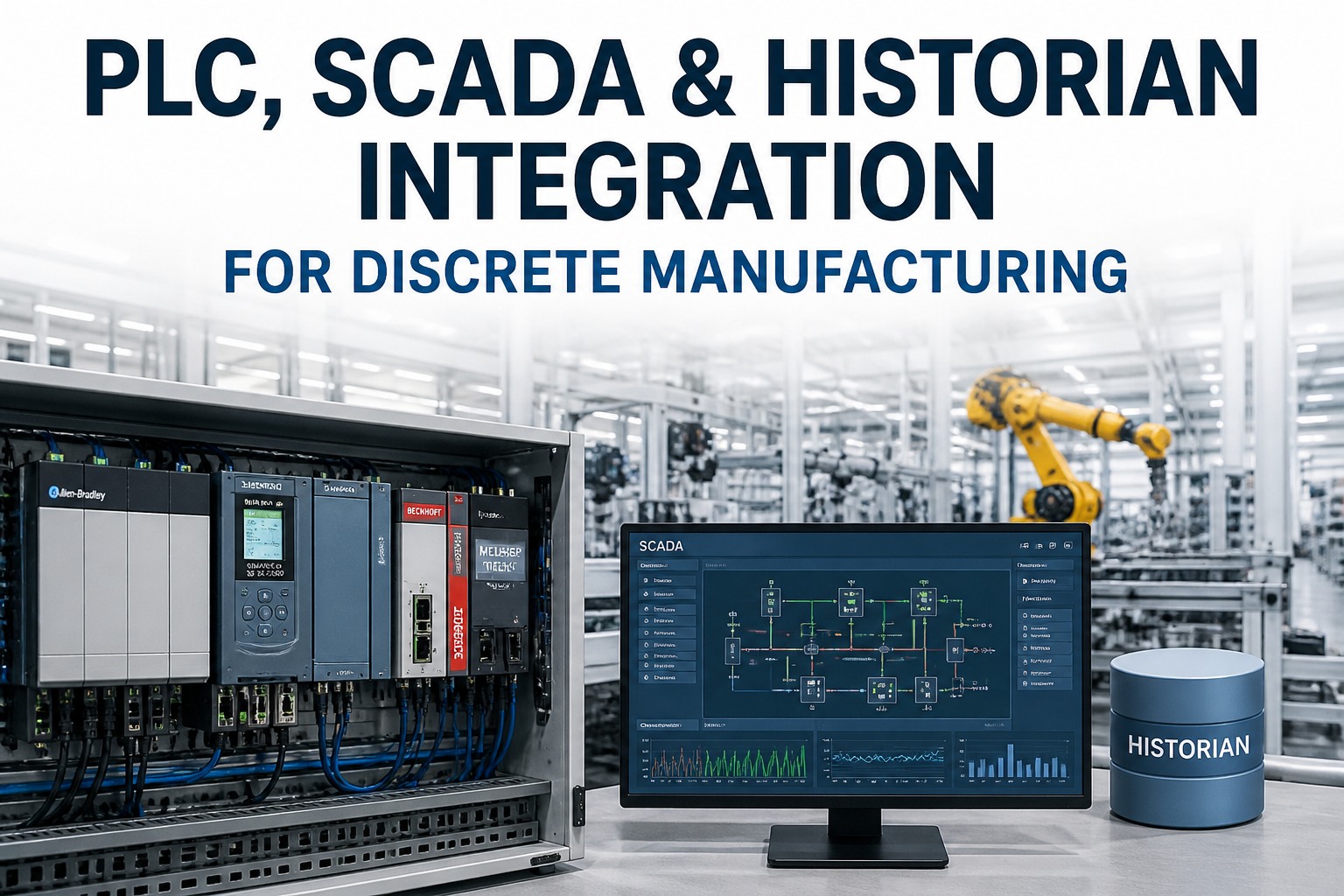
A discrete plant doesn't run on one PLC vendor — it runs on Rockwell ControlLogix in the body shop, Siemens S7-1500 in the press lines, Beckhoff TwinCAT on the robots, and Mitsubishi MELSEC on the legacy assembly stations, all backed by an Ignition or Wonderware historian that's been collecting tags for fifteen years. iFactory's integration layer talks natively to every one of them. OPC UA where it makes sense, MQTT Sparkplug B where it doesn't, native drivers where neither will do. The streaming ETL stages every tag into a time-series feature store on the GB300 plant node — context-tagged, ISA-95 modeled, ready for AI. We backfill from years of historian data so models train on real history, not just today's events. Power and a network drop at the plant DC are the only things you provide. Our network engineers handle the cabling, OT segmentation, OPC UA certificates, MQTT broker, and historian connectors. One-time CapEx — no recurring license, no per-tag billing. You own the pipeline, the data, the models. To scope your tag list, get a turnkey quote.
PLC, SCADA & Historian Integration for Discrete Manufacturing
Bridge Rockwell ControlLogix, Siemens S7-1500, Beckhoff TwinCAT, Mitsubishi MELSEC and Ignition / Wonderware historians into your AI stack — secure OPC UA + MQTT, ISA-95 contextualized, with multi-year historian backfill. Shipped to your plant, deployed by our engineers, owned by you. No cloud. No per-tag licensing. No data ever leaves your fence.
Most Plants Have Six Vendors and One Truth Problem
Rockwell on the welders. Siemens on the presses. Beckhoff on the robots. Mitsubishi on the older assembly stations. Ignition for the new SCADA. Wonderware for the old one. A historian that someone configured in 2014 and nobody fully understands. AI doesn't care about any of that — but it does care about clean, contextualized, time-aligned data. iFactory's integration layer is the bridge. Schedule a 30-minute walkthrough to map your tag landscape with our engineers.
Native Connectivity to the Four That Matter
Most "industrial AI" platforms claim "OPC UA support" and stop there. iFactory ships native drivers and certified gateways for the four PLC vendors that run 90%+ of discrete manufacturing — plus OPC UA / Modbus / MQTT for everything else. Send your PLC inventory to support — we'll match every node to a connector before quoting.
- Native EtherNet/IP CIP · tag-based access
- FactoryTalk Linx + OPC UA gateway support
- UDT (User-Defined Type) auto-mapping
- Legacy PLC-5 / SLC500 via Prosoft bridge
- Native S7comm + S7comm Plus
- OPC UA server built into TIA Portal V18+
- Certificate-based TLS (CA-signed)
- Legacy S7-300/400 via PROFINET bridge
- Native ADS protocol over TCP
- OPC UA server in TwinCAT runtime
- Symbol-based tag access (no DB offsets)
- EtherCAT slave data exposure
- Native MC Protocol (3E / 4E frames)
- OPC UA server in iQ-R + GX Works3
- SLMP for high-speed cyclic data
- Legacy Q-series via Ethernet adapter
Talk to the System That Already Has the Data
The historian is the primary data source. iFactory connects directly — no rip-and-replace, no parallel SCADA. Every existing tag, alarm, and event becomes available to the AI stack within hours of go-live.
| System | Connection Method | What We Pull | Backfill Path |
|---|---|---|---|
| Ignition (Inductive Automation) | Native MQTT Engine + JDBC + OPC UA | Live tags · alarms · UDT models | SQL bridge query, batched |
| Wonderware / AVEVA Historian | aaHistorian SDK + OLE DB | Tag history · events · summaries | OLE DB time-range queries |
| FactoryTalk Historian (Rockwell) | PI Web API + RDBMS bridge | Tag streams · asset framework | PI archive replay |
| OSIsoft PI / AVEVA PI | PI Web API + AF SDK | PI Points · Element Templates · Event Frames | Native archive backfill |
| Generic OPC UA historians | OPC UA HA (HistoryRead service) | Time-series data · A&E events | Standard OPC UA range query |
| InfluxDB / TimescaleDB / TDengine | Native API · CDC replication | Time-series + tags | API-driven, parallelized |
Historian data isn't bypassed — it's preserved. Every existing dashboard, every existing report, every existing alarm in your SCADA keeps working exactly as before. The AI stack lives alongside, not on top of. Book a session to walk through your historian's specifics.
From PLC Tag to AI Feature in < 200 ms
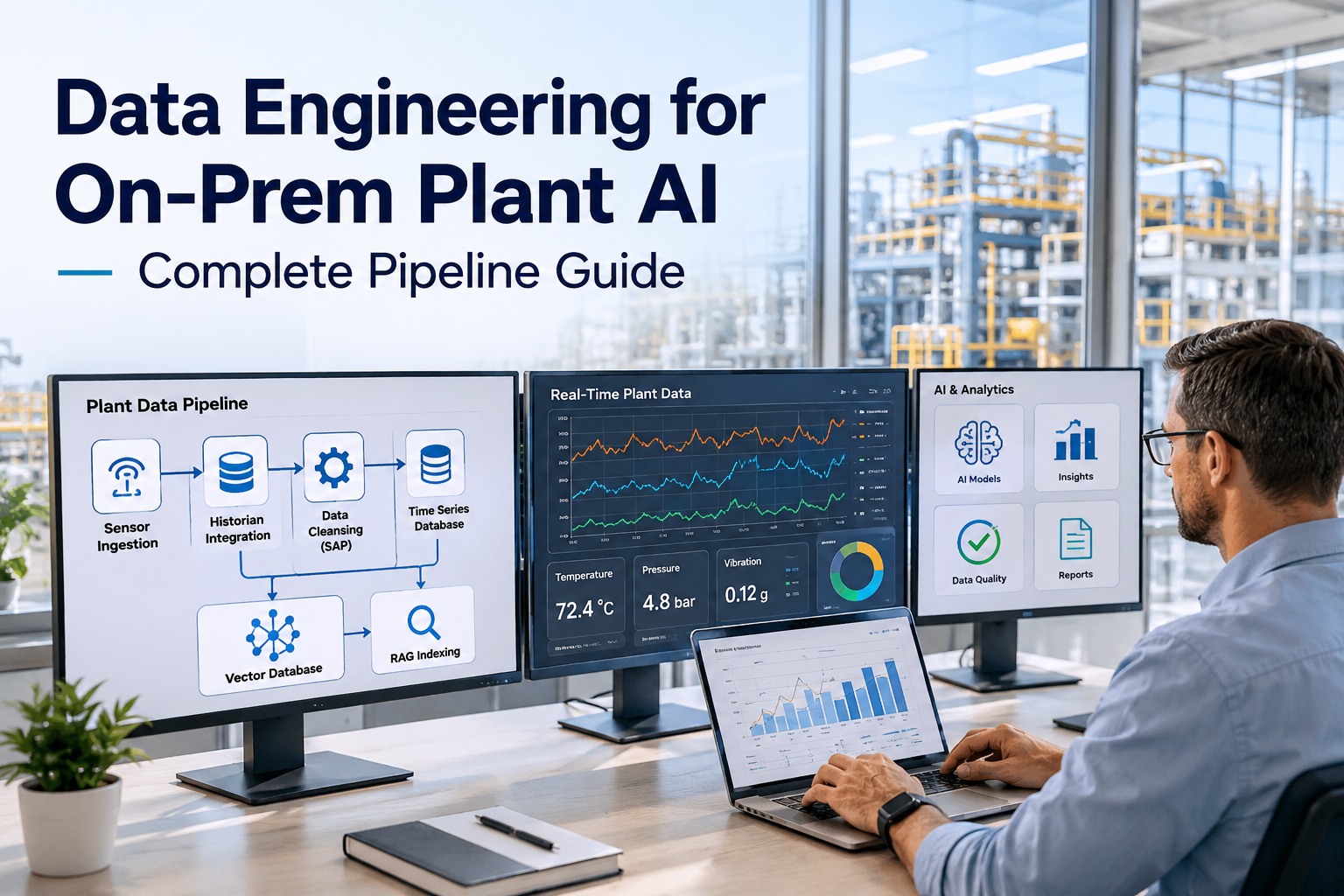
Every tag from every PLC streams through a four-stage pipeline before it ever reaches a model. Each stage is engineered to handle 100,000+ tags per second on the plant H200 node.
OPC UA subscription or MQTT Sparkplug B publish. Native drivers for Rockwell, Siemens, Beckhoff, Mitsubishi handle low-latency cyclic reads. Store-and-forward if uplink drops.
Unit conversion · timestamp alignment · ISA-95 asset hierarchy tagging · deadband filtering · interpolation. Schema enforced via canonical data model — every tag carries asset, line, area, site context.
Time-series + vector store on GB300 plant node. Compressed, partitioned by asset and time. Native AI access via PyArrow / Parquet — no SQL bottleneck for model training.
Rolling windows (1s, 10s, 1min, 1hr) computed in-memory for every modeled asset. Models query features, not raw tags — keeps inference under the takt budget.
Total budget from PLC tag change to AI feature ready: under 200 ms across the typical pipeline. That's the difference between AI that catches a defect on the next part, and AI that catches it three minutes later when the bad parts have already shipped. Talk to support for sizing on your tag count and sample rate.
OPC UA vs MQTT — When to Use Which
Both are open standards. Both ship in the iFactory stack. Each is right for different workloads. Here's the decision rule our engineers apply during architecture review.
- Best for: SCADA replacement, machine-to-machine, complex tag hierarchies
- Strengths: Rich type system, certificate-based TLS, address space modeling
- Trade-off: Heavier on bandwidth and CPU vs MQTT
- iFactory uses for: PLC subscriptions, historian backfill, asset-framework mirroring
- Best for: 50,000+ tags, multi-site, IIoT-style fan-out
- Strengths: Lightweight, pub/sub, strong message delivery guarantees
- Trade-off: Less native semantics — Sparkplug B fixes that with payload schema
- iFactory uses for: High-frequency tag streams, multi-site aggregation, edge-to-DC bridge
A typical iFactory deployment uses both — OPC UA at the PLC and historian boundary for clean semantics, MQTT Sparkplug B for the high-volume tag streams that feed the AI feature store. Our integration team sets up the topology during week 1–2 site survey. Schedule a session to architect yours.
Closing the Loop — From Inference Back to the PLC
Reading tags is the easy half. Acting on them is what changes the line. iFactory's orchestration layer writes back to PLCs through a safety-gated, audit-logged path — recommend setpoint changes, trigger rejects, request maintenance, all with operator approval and full traceability.
Streaming ETL pulls tags from PLCs, SCADA, and historian. Asset-tagged, time-aligned, ISA-95 contextualized.
AI feature window feeds models running on the GB300 plant node. Anomaly, prediction, or recommendation generated.
Operator sees recommendation in MES / HMI overlay. Approves or overrides. Plant copilot can explain the why.
Approved action writes a setpoint, triggers a reject, or generates a CMMS work order — through a safety-gated OPC UA write or MQTT command, fully audit-logged.
Safety first: writeback to PLCs is opt-in per tag, IEC 62443 zone-restricted, and never bypasses interlocks. Most deployments start in advisory-only mode and graduate to closed-loop after 4–8 weeks of shadow validation. Talk to support for the IEC 62443 audit pack.
Bootstrap From 5+ Years of Existing Data
Models trained only on today's data take months to learn seasonality, equipment drift, and rare failure modes. Models trained on five years of historian data start delivering value in week one. iFactory's backfill engine pulls every tag, every event, every alarm from your existing historian — in parallel, without affecting live operations.
Auto-discover tag tree from PI AF, Wonderware Galaxy, Ignition tag browser, or OPC UA address space. Operator confirms which tags are in scope.
Time-window-partitioned queries run in parallel against the historian — typically 16–64 concurrent streams. 5 years of 50K tags pulls in 36–72 hours without affecting live SCADA performance.
Backfilled data feeds the same ETL pipeline as live data. Models train on the full history, then graduate to live inference. Includes seasonality, ramp-up, recovery patterns.
Six Reasons OT Engineers Pick Us Over DIY ETL Builds
Most "industrial AI" vendors hand you a Python notebook and a sample CSV. Most cloud platforms expect your tags to magically appear in their lake. iFactory ships the integration layer pre-built — every PLC vendor, every historian, every protocol. Schedule a working session with our integration team.
EtherNet/IP CIP for Rockwell. S7comm Plus for Siemens. ADS for Beckhoff. MC Protocol for Mitsubishi. We use OPC UA where it's a fit — and bypass it where native is faster or cleaner.
PLC connectors, OPC UA server, MQTT broker, ETL, historian connectors, AI models — all from us. No integration tax across six vendors. Single throat to call when something needs attention.
5+ years of existing historian data pulled, contextualized, and ready for model training in 36–72 hours — included in the deployment, not a paid add-on. Models start informed, not blind.
Every tag, every alarm, every model stays inside your fence. No cloud sync, no vendor data lake, no API calls to OpenAI. IEC 62443 zoned. SOC 2 / ISO 27001 audit-ready.
Existing dashboards, existing alarms, existing reports keep working exactly as before. The AI stack lives alongside, not on top of. No rip-and-replace, no parallel SCADA.
One-time CapEx. No per-tag licensing. No per-message MQTT billing. You own the connectors, the ETL, the feature store, every byte. Talk to support for terms.
All You Provide. Seriously.
Most integration projects stall because the customer is expected to handle the OT segmentation, OPC UA certificates, MQTT broker hardening, and historian credentials. iFactory inverts that. Talk to deployment support for a remote site walkthrough first.
- Power — 3-phase or rack PDU at the plant DC
- Network drop — Gigabit uplink with path to the OT zone (firewalled, VLAN-scoped)
- GB300 plant node build, ship, install
- OT/IT segmentation per IEC 62443
- OPC UA certificate authority & PKI setup
- MQTT broker hardening & TLS
- PLC driver licensing & gateway config
- SCADA / historian credentials & ACL
- ETL pipeline & ISA-95 schema
- Multi-year historian backfill
- Operator + maintenance training
From PO to Live Pipeline
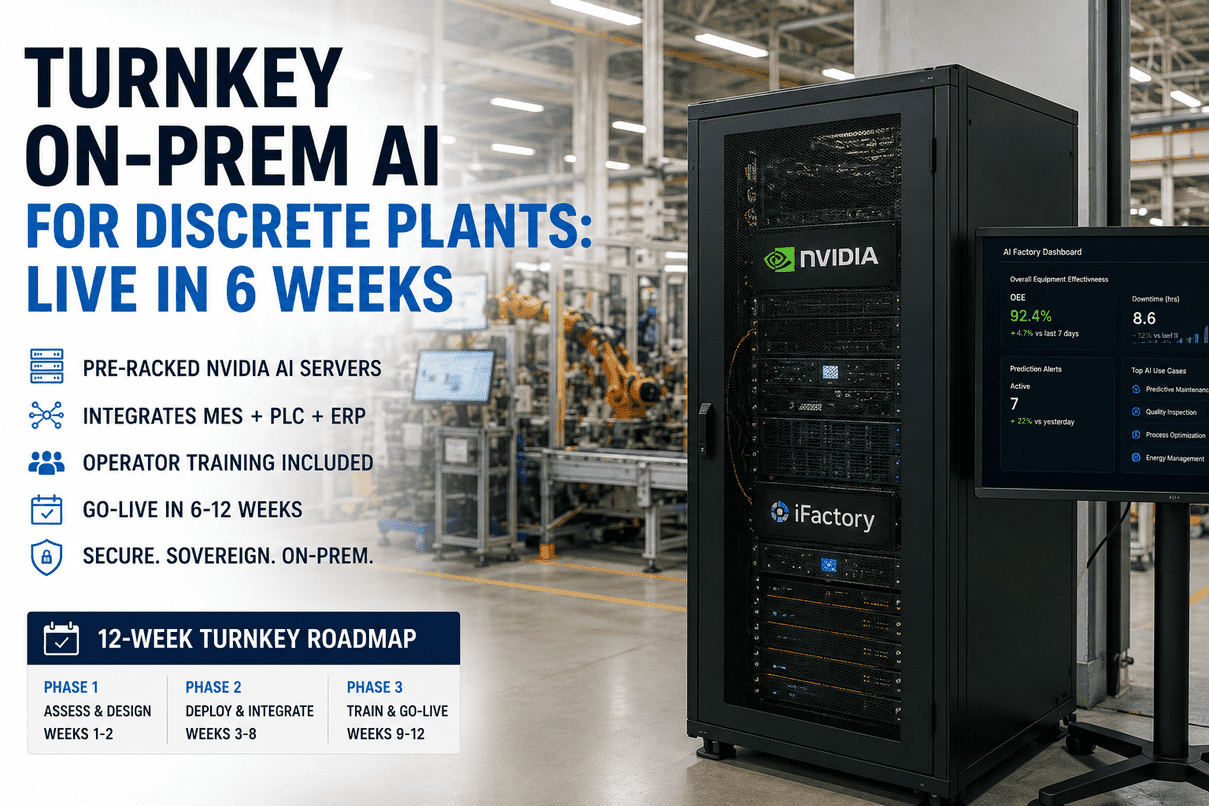
A typical integration deployment is in production within 6–12 weeks of PO — anywhere in the US, EU, India, LATAM, or APAC. Hardware ships pre-configured, our engineers handle protocol setup and historian backfill on site.
Remote walkthrough. PLC inventory. Historian audit. Tag scope. Network architecture. Fixed BOM in 5 business days.
GB300 plant node racked, ETL pre-staged with vendor connectors. Certificate authority generated. MQTT broker pre-configured.
Engineers fly in. PLC connections, OPC UA cert exchange, historian credentials, MES bridge. Backfill kicks off.
Live tag streams validated. Backfill complete. Models trained on history. Advisory mode active. Handover docs & training.
Buy It Once. Own It Forever.
No SaaS subscriptions. No per-tag licensing. No per-MQTT-message billing. Year-one support is included; everything after that is optional and at your discretion.
Plant node, connectors, ETL, broker, deployment, backfill, training, year-one support — single PO. Sits on your balance sheet as a depreciable asset.
You own the connectors, the ETL code, the feature store, the schema, every byte of plant data. Full audit rights. No vendor lock on data export.
After year one, renew remote support & ETL updates annually, run it in-house with our handover docs, or mix. The pipeline keeps running either way.
What OT & IT Buyers Ask Before Issuing a PO
No. The integration layer is read-mostly — existing dashboards, alarms, reports continue exactly as before. Writeback to PLCs is opt-in per tag and starts in advisory-only mode. Most deployments graduate to closed-loop after 4–8 weeks of validation. Talk to support about your validation methodology.
Common. Our native drivers cover S7-300/400, PLC-5, SLC500, and Q-series via Ethernet bridges. EtherNet/IP CIP, S7comm, MC Protocol, and ADS work on hardware made in the 1990s. We don't ask you to replace working PLCs.
MQTT Sparkplug B for high-volume streams, OPC UA subscriptions for structured data, native drivers for hot-path tags. The GB300 plant node ingests 100,000+ tags/sec sustained. Tag scope is set per asset — typically 5,000–15,000 tags drive 80% of the AI value.
Fixed price per plant, scoped to tag count, PLC mix, and historian backfill scope. No per-tag licensing. No recurring fees. Includes hardware, software, deployment, backfill, training, and year-one support. Get a quote — written proposal back in 5 business days.
Get a Quote on Your Tag Landscape.
Watch the integration layer pull live tags from a Rockwell + Siemens + Beckhoff plant Or send your PLC inventory and historian list — we come back with a fixed-price BOM within 5 business days. Hardware, software, on-site deployment, multi-year backfill, training, and year-one support all included. No recurring fees. You own the pipeline outright the day it goes live.