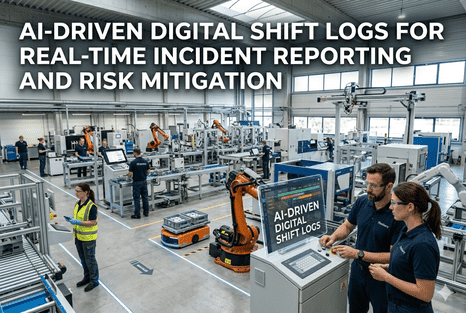
AI-Driven Digital Shift Logs for Real-Time Incident Reporting and Risk Mitigation
By Rebecca on May 27, 2026
At 3:42 AM, a compressor's vibration spiked by 18%. The IoT sensor captured it instantly. The AI model classified it as bearing degradation and auto-logged it in the shift logbook — timestamped, attributed, and linked to a work order in the CMMS — all before the operator finished their previous task. By 7:00 AM shift change, the incoming crew saw the alert, the diagnosis, and the intervention window on their AI-generated handover summary. The bearing was replaced during a planned 45-minute window at 10:00 AM. Line 4 never went dark. This is the difference between reactive incident reporting and AI-driven, real-time risk mitigation. Industrial manufacturers lose $50 billion annually to shift communication failures, and 40% of plant incidents occur during shift handover — despite it accounting for less than 5% of operational time. AI-powered shift logs are closing this gap permanently. Book a Demo to see how iFactory's AI-driven shift logbook transforms incident reporting and risk mitigation.
RISK
$50BAnnual industry losses from poor shift communication — preventable with AI
40%Of plant incidents occur during shift handover — AI closes this gap
47%Fewer emergency maintenance events with sensor-triggered work orders
The Real Cost of Reactive Incident Reporting
When incidents are reported reactively — at the end of a shift, through verbal handovers, or on paper logs — critical information is lost before it reaches the people who need it. Research shows that when 12 issues are shared in a rushed handover, only 7 are retained by the incoming shift. A single untracked vibration anomaly can escalate into a $184,000 bearing failure within hours. Across a mid-size facility, duplicated troubleshooting from undocumented incidents adds $840,000 annually.
Events Happen in Real Time — But Tracking Happens in Hindsight
Paper logbooks capture roughly 40% of what actually occurs on a shift. The remaining 60% — sensor threshold crossings, equipment anomalies, safety observations — is lost the moment the outgoing operator walks off the floor. By then, the incident has already happened, and the only question is how much it will cost.
Verbal Handovers Miss 40–60% of Actionable Information
The human brain was never designed to reliably compress 8 hours of multi-variable operational data into a 10-minute verbal summary. Incidents that are mentioned but not documented — "it was making a noise," "we kept an eye on it" — are the root cause of 28% of unplanned breakdowns occurring within 4 hours of shift change.
No Escalation Path for Critical Hazards
On paper, a supervisor noticing a leaking valve fitting or a pressure reading above threshold at the end of a 12-hour shift has seconds to decide whether to document it properly. Most of the time, that decision fails. Hazards that are observed but not escalated remain unaddressed — becoming the root cause of the next major incident.
How AI-Driven Shift Logs Mitigate Risk in Real Time
iFactory's AI-powered shift logbook doesn't just digitize paper — it transforms incident reporting from a retrospective manual task into a continuous, automated risk detection and mitigation system. Here is how the AI pipeline works:
Auto-Capture: Every Anomaly, Every Event
SCADA threshold crossings, IoT sensor anomalies, quality deviations, and operator observations are captured automatically into a unified timeline — timestamped, attributed to the asset, and classified by severity. No manual logging. No dependency on operator memory.
AI Classification: Severity in Under 3 Seconds
Every event is classified by AI against learned baselines — anomaly type, severity level, failure probability, and remaining useful life. The system flags data integrity gaps, unsigned entries, and threshold crossings in under 3 seconds from the triggering event.
Tiered Alert Escalation — No False Alarm Fatigue
Low-severity events are logged for trend analysis. Medium-severity alerts notify supervisors with annotated evidence. Critical events trigger multi-channel alerts, auto-generate work orders in the CMMS, and escalate if unacknowledged — with full documented escalation chain for every high-risk event.
Cross-Shift Intelligence & Root Cause Analysis
AI identifies recurring patterns across shifts — equipment that fails on the same shift, hazards that precede incidents, handover gaps that correlate with downtime. Root cause analysis that used to take days finishes in an hour. Every incident creates a searchable record that compounds institutional knowledge.
Stop Reacting to Incidents. Start Preventing Them.
See how iFactory's AI-driven shift logbook detects anomalies in real time, escalates critical risks automatically, and gives every shift the complete operational picture — before problems become incidents.
Three Incident Types AI Shift Logs Detect and Mitigate
iFactory's AI is purpose-trained to detect three categories of operational incidents — each with a different detection signature, escalation path, and mitigation workflow. Book a Demo to see how your specific incident types map to iFactory's detection models.
Equipment Incidents
Vibration spikes, temperature excursions, pressure drops, current signature shifts, and bearing degradation are detected by AI models trained on each asset's normal operating baseline. Anomalies are classified by severity and linked to predicted remaining useful life.
47% fewer emergencies with auto-generated work orders
Safety & Hazard Incidents
Near-misses, leaking valves, exposed hazards, permit violations, and safety observation gaps are captured in real time with photo evidence and auto-escalated based on severity. Unacknowledged critical hazards escalate automatically on a defined schedule.
Zero expired permits with real-time compliance validation
Quality & Process Incidents
SPC control chart deviations, defect rate spikes, process parameter drift, and out-of-spec conditions are flagged the moment they cross defined thresholds. Root cause analysis is accelerated by replaying the full event timeline across alarms, operator notes, and quality signals.
Paper Incident Reporting vs. AI-Driven Risk Mitigation
The gap between paper-based incident reporting and AI-driven risk mitigation is not incremental — it is transformational. Every dimension of incident detection, response, and prevention improves:
Paper / Verbal Incident Reporting
Manual detection — depends on operator memory
Incidents documented at end of shift, not in real time
No audit trail — corrected entries with initials only
Verbal escalation — average 22-minute delay
Root cause reconstructed from memory — often inaccurate
No pattern detection — each incident is an island
VS
iFactory AI-Driven Incident Mitigation
AI auto-detects anomalies from SCADA, IoT, sensors
Real-time capture — flagged within 3 seconds of event
Full immutable audit trail with who/what/when/why
Automated multi-channel alert — under 60 seconds
AI analyzes event timeline — RCA in hours, not days
Cross-shift AI pattern recognition surfaces systemic risks
See AI Incident Detection in Action
In 30 minutes, we'll walk you through iFactory's AI-driven shift logbook — real-time anomaly detection, tiered escalation, cross-shift pattern analysis, and one-click compliance reporting — customized to your facility.
Real Outcomes: What AI-Driven Incident Mitigation Delivers
47%
Fewer Emergency Maintenance Events
Sensor-triggered predictive work orders replace reactive emergency repairs. Detection-to-action lag drops from 4–12 hours to under 60 seconds.
25%
Downtime Reduction
Real-time event tracking and cross-shift intelligence cut unplanned downtime — with reason, asset, shift, and operator visibility in real time.
96%+
Compliance & Handover Rate
Mandatory digital acknowledgment and real-time compliance validation ensure every shift completes a traceable, auditable handover.
Frequently Asked Questions
iFactory's AI engine connects directly to your SCADA, IoT sensors, and CMMS systems. It learns the normal operating baseline for every monitored asset — vibration, temperature, pressure, current draw — and flags any deviation that exceeds configured thresholds. Anomalies are classified by severity, logged as structured shift events with full attribution, and routed through a tiered escalation model. Critical events auto-generate work orders, notify supervisors via mobile push, and escalate if unacknowledged. Detection-to-alert time is under 3 seconds from the triggering event. See it live in a demo →
iFactory detects three broad categories: equipment incidents (vibration spikes, temperature excursions, pressure drops, bearing degradation, current signature shifts), safety and hazard incidents (near-misses, leaking valves, permit violations, exposure events), and quality and process incidents (SPC deviations, defect rate spikes, parameter drift, out-of-spec conditions). Each category has purpose-trained AI models, severity classification rules, and escalation workflows that route the right information to the right responder automatically. Discuss your incident types →
iFactory uses a three-tier confidence architecture. Low-severity events (L1) are logged for trend analysis with no operator action required. Medium-severity events (L2) notify supervisors with annotated evidence for 4-hour review. Critical events (L3) trigger immediate multi-channel alerts with automatic escalation if unacknowledged. The AI learns from every event to continuously refine thresholds, reducing false positives while ensuring no genuine risk goes undetected. See the alert architecture →
Most facilities go live with iFactory's base incident detection and shift logging within 2–4 weeks. Template configuration, mobile rollout, and operator onboarding complete in the first week with manual entry while SCADA, CMMS, and IoT integrations finalize. AI anomaly detection and tiered escalation activate within week 3–4. Full cross-shift pattern recognition and predictive analytics typically activate within 3–6 months as AI models learn your equipment baselines. Get a deployment timeline →
Yes. iFactory connects to OPC-UA, MQTT, and REST endpoints from leading SCADA platforms (Ignition, WinCC, FactoryTalk, Wonderware) and supports bi-directional sync with SAP, Oracle, OSIsoft PI, and all major CMMS platforms. IoT sensor streams — vibration, temperature, pressure, current — feed directly into the AI engine. The shift logbook becomes the connective tissue across your operations, not another data silo. Most integrations complete within 1–3 weeks. Check your system compatibility →
Turn Incident Reporting Into Risk Prevention
iFactory's AI-driven shift logbook detects anomalies in under 3 seconds, escalates critical risks automatically, and gives every shift the complete operational picture — so incidents are prevented, not just reported. Deployment in weeks, ROI in months.