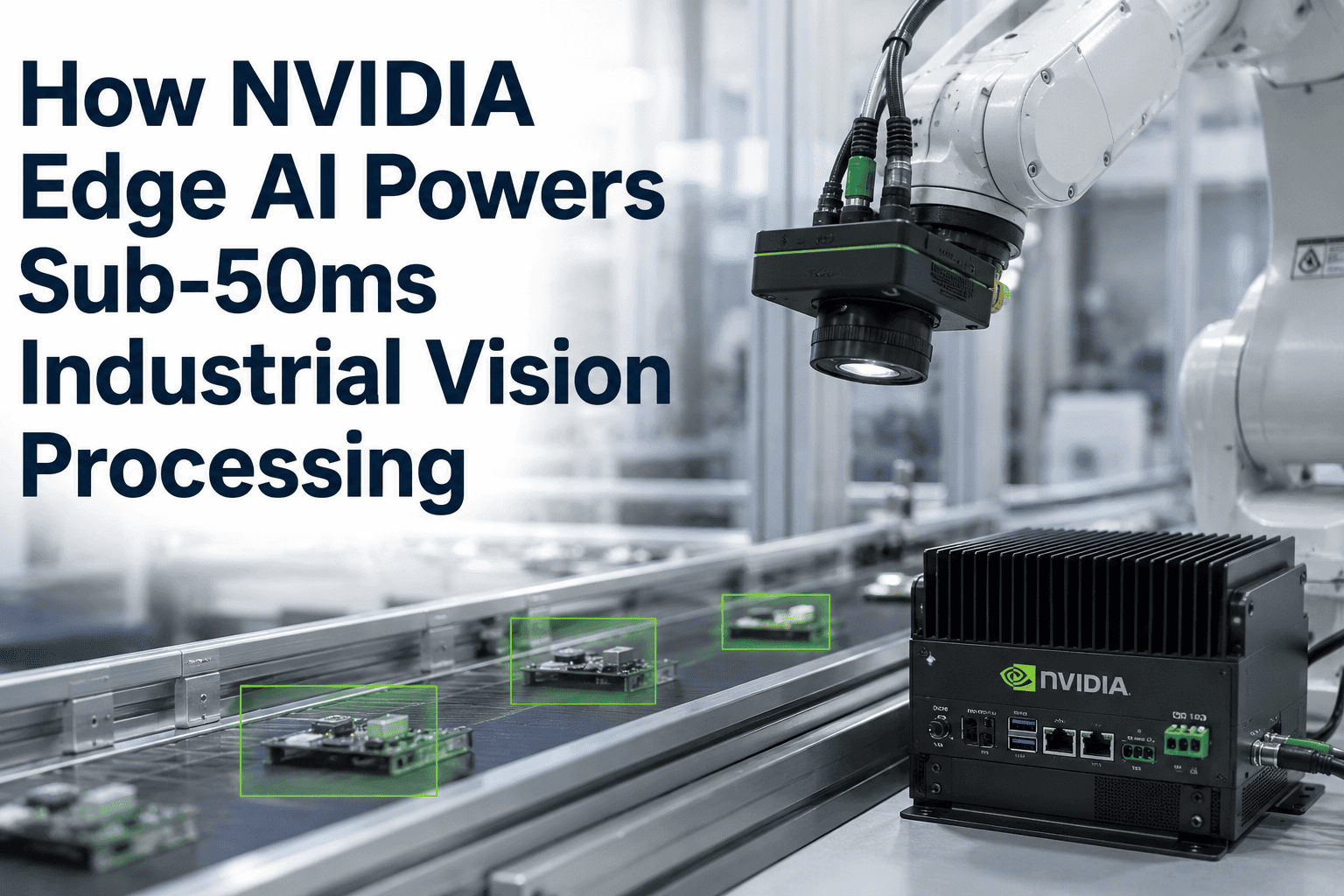
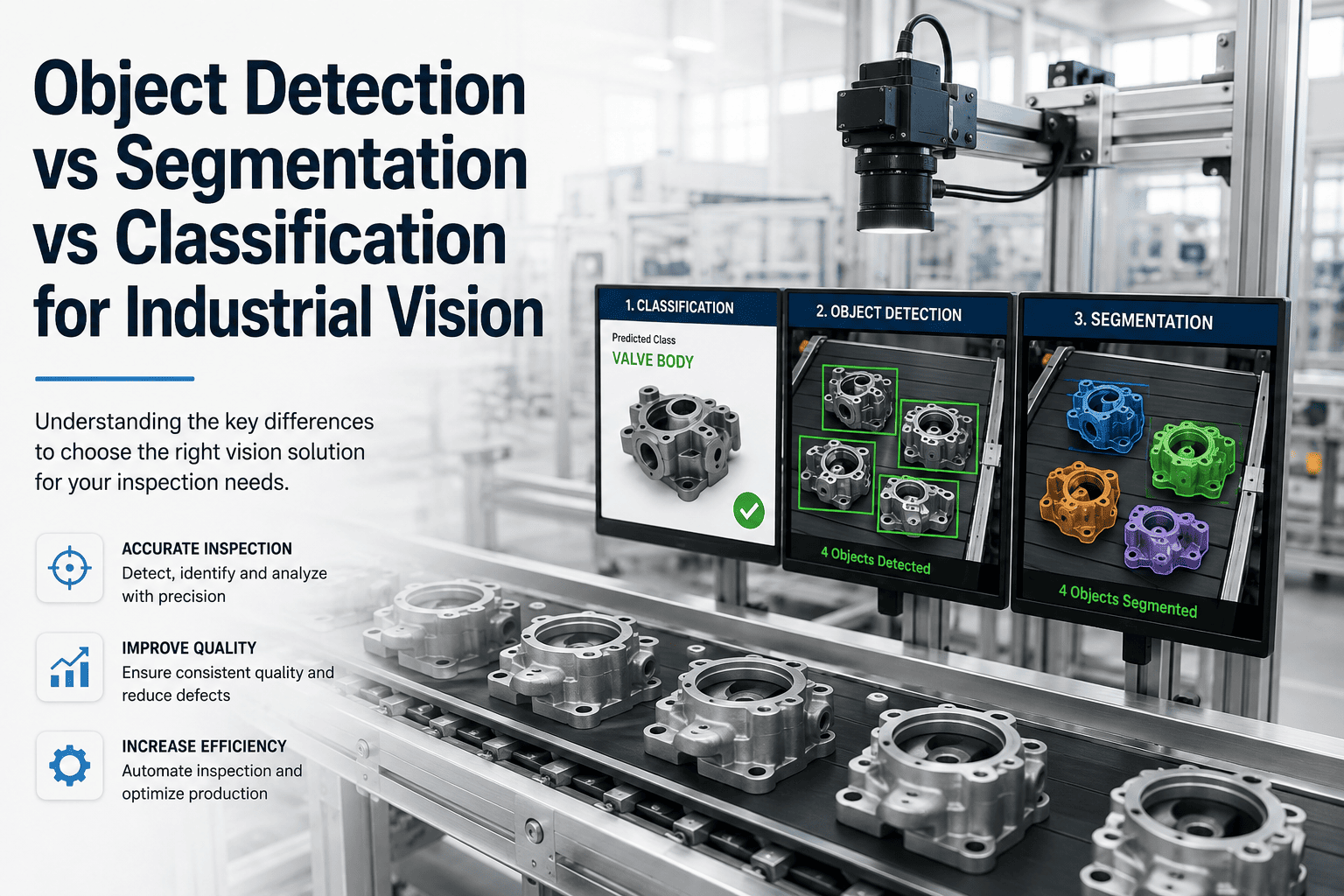
The industrial inspection model in the cloud loses to the one at the camera every time — latency is not a networking problem, it is a physics problem. When a part moves down a conveyor at 200 per minute, the inspection decision has to happen at the edge, on a device with limited GPU memory and a 15-watt power envelope, without a data-center round trip. That constraint made EfficientNet the workhorse of edge industrial vision — B0 hits 77.1% ImageNet top-1 with just 5.3M parameters, nearly 5× fewer than ResNet-50. iFactory ships EfficientNet inspection on pre-configured NVIDIA Jetson hardware with TensorRT optimization, live in 6–12 weeks — book a demo to see edge classification running at line speed.
EFFICIENTNET · COMPOUND SCALING · EDGE AI · JETSON
The Classification Model That Fits on a Jetson Nano — With Accuracy Bigger Models Take 5× the Parameters to Match
iFactory's edge-deployed EfficientNet classifier runs inline on the production line at millisecond latency, on power-efficient NVIDIA Jetson hardware, with the compound-scaling architecture that made high-accuracy vision possible on devices that never plug into a data center.
5.3M
Parameters in EfficientNet-B0 baseline
84.4%
B7 top-1 accuracy on ImageNet
8.4×
Smaller than the previous SOTA
15W
Typical Jetson edge power envelope
THE COMPOUND SCALING IDEA
Three Dimensions, One Balanced Formula — What Made EfficientNet So Different From Every CNN Before It
Before EfficientNet, every attempt to make CNNs more accurate scaled one dimension at a time — deeper (ResNet), wider (WideResNet), or higher-resolution inputs. Each worked briefly, then hit diminishing returns. EfficientNet's authors asked a different question: what if all three dimensions had to be scaled together, in a fixed ratio, so no single dimension outran the other two? That balanced scaling — compound scaling — is why EfficientNet gets the parameter count so much smaller than the CNNs it replaced.
Depth
More layers to learn deeper features
Width
More channels per layer for richer features
Resolution
Higher input resolution for finer detail
The math is what makes it work. Increasing depth by α, width by β, and resolution by γ doubles the total compute — but distributes that doubling across all three dimensions in the ratio that keeps each contributing meaningfully. Every step up the B0–B7 family doubles the FLOPs while delivering a bigger accuracy jump per FLOP than any single-dimension scaling. That is why B0 hits 77.1% at 5.3M parameters where ResNet-50 needs 26M for a lower 76%.
THE B0-B7 FAMILY
Eight Ways to Trade Accuracy Against Compute — Pick the Variant That Fits Your Edge Device
The B0–B7 family is not a marketing gradient — it is an engineering menu. Each variant sits at a specific point on the accuracy vs FLOPs curve, and choosing correctly is the difference between an inspection system that runs at line speed and one that lags behind every part.
B0
77.1%
5.3M params · 0.39B FLOPs
Jetson Nano, real-time inline classification, edge-first deployments
B1
79.1%
7.8M params · 0.70B FLOPs
Jetson Nano, 5.7× faster than ResNet-152 at higher accuracy
B2
80.1%
9.2M params · 1.0B FLOPs
Jetson TX2, balanced accuracy and edge inference speed
B3
81.6%
12M params · 1.8B FLOPs
Jetson Xavier NX, higher accuracy for complex defect classes
B4
82.6%
19M params · 4.2B FLOPs
Jetson Xavier NX, beats ResNet-50 accuracy at similar FLOPs
B5
83.3%
30M params · 9.9B FLOPs
Jetson AGX Orin, high-accuracy edge for critical inspection
B6
84.0%
43M params · 19B FLOPs
Jetson AGX Orin, precision quality-critical applications
B7
84.4%
66M params · 37B FLOPs
On-prem NVIDIA server, top-of-family accuracy for offline inspection
Your Bottleneck Is Not the Model Architecture — It Is the 15-Watt Power Envelope on the Line
iFactory selects the right EfficientNet variant, the right Jetson device, and the right TensorRT optimization for your inspection latency and accuracy targets. See edge-deployed classification running on your product images in a live demo.
PARAMETER EFFICIENCY
Why EfficientNet Beats Older CNNs at Every Point on the Accuracy Curve
The clearest way to see EfficientNet's advantage is a head-to-head against the CNNs it replaces. Every published benchmark tells the same story: at any given accuracy, EfficientNet uses a fraction of the parameters and FLOPs — which translates directly into faster edge inference.
EfficientNet-B0
77.1%
5.3M
0.39B
EfficientNet-B1
79.1%
7.8M
0.70B
Inception-v3
78.8%
24M
5.7B
EfficientNet-B4
82.6%
19M
4.2B
EfficientNet-B7
84.4%
66M
37B
Read that table row by row. B0 beats ResNet-50 with 5× fewer parameters and 10× fewer FLOPs. B4 matches ResNet-50's compute budget while adding six accuracy points. B7 matches GPipe's accuracy with 8× fewer parameters. On edge hardware, that translates into either a smaller Jetson for the same accuracy target, or the same Jetson delivering higher accuracy at line speed.
EDGE INFERENCE STACK
How EfficientNet Actually Runs on a Jetson at Production Line Speed
Getting a trained EfficientNet onto a Jetson at real inference speed is not a matter of installing PyTorch. There is a specific optimization stack — quantization, kernel fusion, TensorRT compilation — that turns a trained model into edge-deployable inference. Each step matters for latency, throughput, and power.
01
Train and Export
Fine-tune the pre-trained EfficientNet backbone on your defect classes using transfer learning. Export the trained model to ONNX format, the interchange format that TensorRT will consume for edge compilation.
↓
02
Precision Calibration
Quantize the model from FP32 to FP16 or INT8 precision using a calibration dataset from your line. INT8 quantization gives the biggest speed and memory win with minimal accuracy loss when calibrated on representative production images.
↓
03
TensorRT Compilation
Compile the ONNX model into a TensorRT engine specific to the target Jetson. TensorRT performs kernel fusion, layer optimization, and operator auto-tuning against the actual GPU on the device — a model tuned for Jetson Nano will not run optimally on Xavier NX and vice versa.
↓
04
Line Integration and Monitoring
Deploy the TensorRT engine into the iFactory inference runtime with camera integration, PLC signalling for reject actuation, MES logging for traceability, and continuous performance monitoring that flags drift before it affects yield.
EDGE INSPECTION USE CASES
Where Edge-Deployed EfficientNet Is Delivering Production Wins Today
Edge classification wins wherever the inspection decision must happen at the sensor, at the speed of the sensor, without a round-trip to any external system. These are the categories where iFactory's edge EfficientNet deployments consistently outperform cloud-connected alternatives on total latency and reliability.
HIGH-SPEED BOTTLING & PACKAGING
Bottle fill-level, cap presence, label alignment, and seal integrity classified in under 20 milliseconds per part at line speeds above 200 parts per minute. Edge inference eliminates the network hop that would make cloud-based inspection impossible at these rates.
FOOD & BEVERAGE QUALITY
Foreign-object detection, color grading, and shape classification on rapidly moving conveyors where every millisecond of latency delays a reject actuator. B0 and B1 variants run comfortably inside the Jetson Nano thermal envelope with hours of continuous inference.
AUTOMOTIVE COMPONENT INSPECTION
Machined parts, stampings, and injection-molded components classified for surface defects, dimensional variance, and missing features. B3 and B4 variants on Xavier NX deliver the accuracy that Tier-1 automotive quality standards require.
PHARMACEUTICAL PACKAGING
Blister-pack pill count, tablet integrity, and label verification in the regulated environment where every inspection decision must be recorded and auditable. Edge inference means the decision and its audit record are captured locally without cloud dependency.
ELECTRONICS ASSEMBLY
Solder joint, component placement, and connector orientation classification on SMT lines. Edge EfficientNet at line rates keeps inspection ahead of assembly, catching defects before they compound into a bad board.
DISTRIBUTED PLANT DEPLOYMENT
Dozens of inspection points spread across a plant footprint, each running an EfficientNet edge node, all feeding into a central iFactory dashboard. No cloud dependency, no per-node data-center license — just Jetson at every camera.
DEPLOYMENT BUNDLE
How iFactory Ships Edge EfficientNet Inspection to Your Line
iFactory delivers edge EfficientNet inspection as a fully integrated hardware and software bundle. The Jetson edge device, industrial camera and lighting, TensorRT-optimized model, PLC integration, operator HMI, and continuous monitoring all arrive together and go live together — not as a research kit for your team to figure out.
Hardware Bundle
Pre-configured NVIDIA Jetson edge device sized to your inspection load. Industrial camera and lighting selected for your imaging conditions. All software pre-loaded. Rack it, plug power and Ethernet, and the edge inference is live.
Model & Optimization
EfficientNet variant selected for your accuracy and latency target, fine-tuned on your defect classes, quantized to INT8 with calibration data from your line, compiled to TensorRT for the specific Jetson SKU on your device.
Integration Scope
Cabling, network, PLC and SCADA integration for reject signals, MES connectivity for defect logging, operator HMI, training for line operators, and 24×7 remote monitoring by iFactory engineers.
Live in 6–12 Weeks
Weeks 1–3: image collection, defect taxonomy, hardware installation. Weeks 4–8: model fine-tuning, quantization, TensorRT compilation. Weeks 9–12: line integration, operator training, cutover to production.
Line Operator
Reject rate on Bottling Line 2 jumped from 0.4% to 2.1% since the shift change. Is the EfficientNet model drifting?
iFactory AI
No — confusion matrix shows the increase is entirely in the "label misalignment" class, not a distribution shift. The label applicator was rewound at 14:12 and the label position is 3 mm offset from the trained baseline. Suggest recalibrating the applicator; the model itself is behaving correctly.
1000+
Clients on iFactory AI across manufacturing verticals
99.9%
Edge inspection platform uptime SLA on production
3-Phase
Structured deployment roadmap from kickoff to cutover
VARIANT SELECTION GUIDE
Which EfficientNet Variant Belongs on Which Edge Device for Which Inspection Task
The right variant depends on three variables: the accuracy your defect classification requires, the latency your line speed allows, and the compute budget of your target Jetson. The table below maps common combinations to a recommended variant.
| Inspection Scenario |
Recommended Variant |
Target Edge Device |
| High-speed inline binary defect classification |
B0 |
Jetson Nano — 5.3M params, 0.39B FLOPs, sub-20 ms inference |
| Multiclass defect classification with limited defect data |
B1 or B2 |
Jetson Nano — better accuracy with modest compute increase |
| Complex surface classification with subtle defect classes |
B3 or B4 |
Jetson Xavier NX — matches ResNet-50 accuracy at similar FLOPs |
| Quality-critical inspection with regulatory audit trail |
B4 or B5 |
Jetson Xavier NX or AGX Orin — audit-grade accuracy at edge |
| High-resolution imagery with fine defect detail |
B5 or B6 |
Jetson AGX Orin — 30–43M params, high resolution input support |
| Offline batch inspection with top-tier accuracy |
B7 |
On-prem NVIDIA server — 66M params, best-in-family accuracy |
| Ultra-tight power envelope, battery or fanless enclosure |
B0 with INT8 |
Jetson Nano — INT8 quantization keeps power under 10 W |
FREQUENTLY ASKED QUESTIONS
Questions Manufacturing Engineers Ask About Edge EfficientNet Deployment
How does INT8 quantization affect EfficientNet accuracy on our specific defect classes?
INT8 post-training quantization typically drops top-1 accuracy by 0.3 to 1.0 percentage points when calibrated against representative production images. The iFactory pipeline uses your line's own images for calibration rather than generic ImageNet samples, which keeps the accuracy delta at the low end. If a defect class shows a larger drop under quantization, iFactory retrains with quantization-aware training so the model compensates.
Book a demo to see FP32 vs INT8 accuracy on your own images.
Why choose EfficientNet over MobileNet or YOLO for edge industrial classification?
MobileNet is excellent for the smallest edge devices where every kilobyte counts, but EfficientNet delivers higher accuracy at similar compute thanks to compound scaling. YOLO is an object detection architecture, not a classification architecture — if the task is deciding whether a part is defective rather than locating defects on it, EfficientNet is the right choice. iFactory routinely deploys hybrid pipelines where YOLO detects and EfficientNet classifies the detected regions.
Contact our support team to discuss the right architecture mix for your task.
Can the edge EfficientNet system run without any cloud or internet connection at all?
Yes — this is one of the core reasons manufacturers choose edge deployment. Once the TensorRT engine is deployed to the Jetson, all inference runs locally with no external connectivity required. The model classifies defects, the Jetson signals the PLC to reject bad parts, and the audit log writes to local storage or your on-prem MES. Optional connectivity to iFactory monitoring is used only for telemetry and updates and can be disabled entirely for air-gapped environments.
Book a demo to discuss air-gapped deployment options.
What happens to inspection when the Jetson edge device needs a firmware or model update?
Model and firmware updates are managed through a staged rollout that never interrupts production. The updated TensorRT engine deploys to a shadow inference process, runs in parallel with the live model for a defined validation window, and is only promoted once accuracy on live images matches or exceeds the current model. Updates roll back automatically if any inspection metric degrades. Line supervisors get advance notice and can defer to planned downtime.
Contact our support team to see the update workflow in detail.
How does the platform handle the tradeoff between latency and accuracy at extremely high line speeds?
Every deployment starts with your line's actual throughput requirement and works backward. If the line runs at 300 parts per minute, the inference budget is 200 ms per part, and iFactory selects the largest EfficientNet variant that fits on your target Jetson after TensorRT and INT8 optimization. If accuracy at that budget is insufficient, the recommendation is a larger Jetson rather than a compromised model. Latency and accuracy are jointly engineered, not blindly traded.
Book a demo to walk through the latency-accuracy engineering for your line.
The Inspection Decision Belongs at the Camera — Not in a Data Center Six States Away
iFactory delivers edge EfficientNet classification as an integrated Jetson bundle with TensorRT optimization, PLC integration, and 24×7 remote monitoring — live on your line in 6–12 weeks, with the compound-scaling accuracy that older CNNs need 5× the parameters to match.