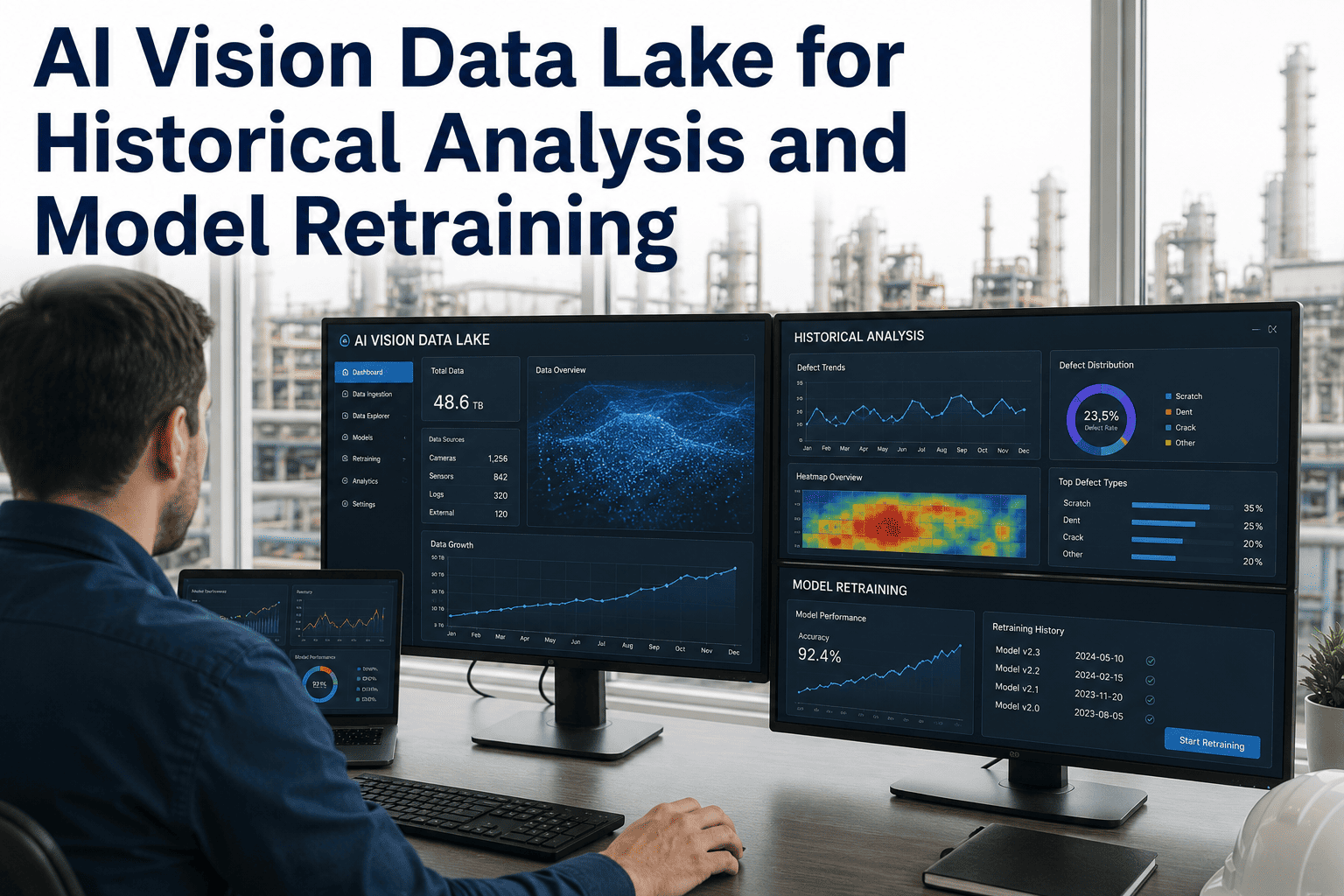
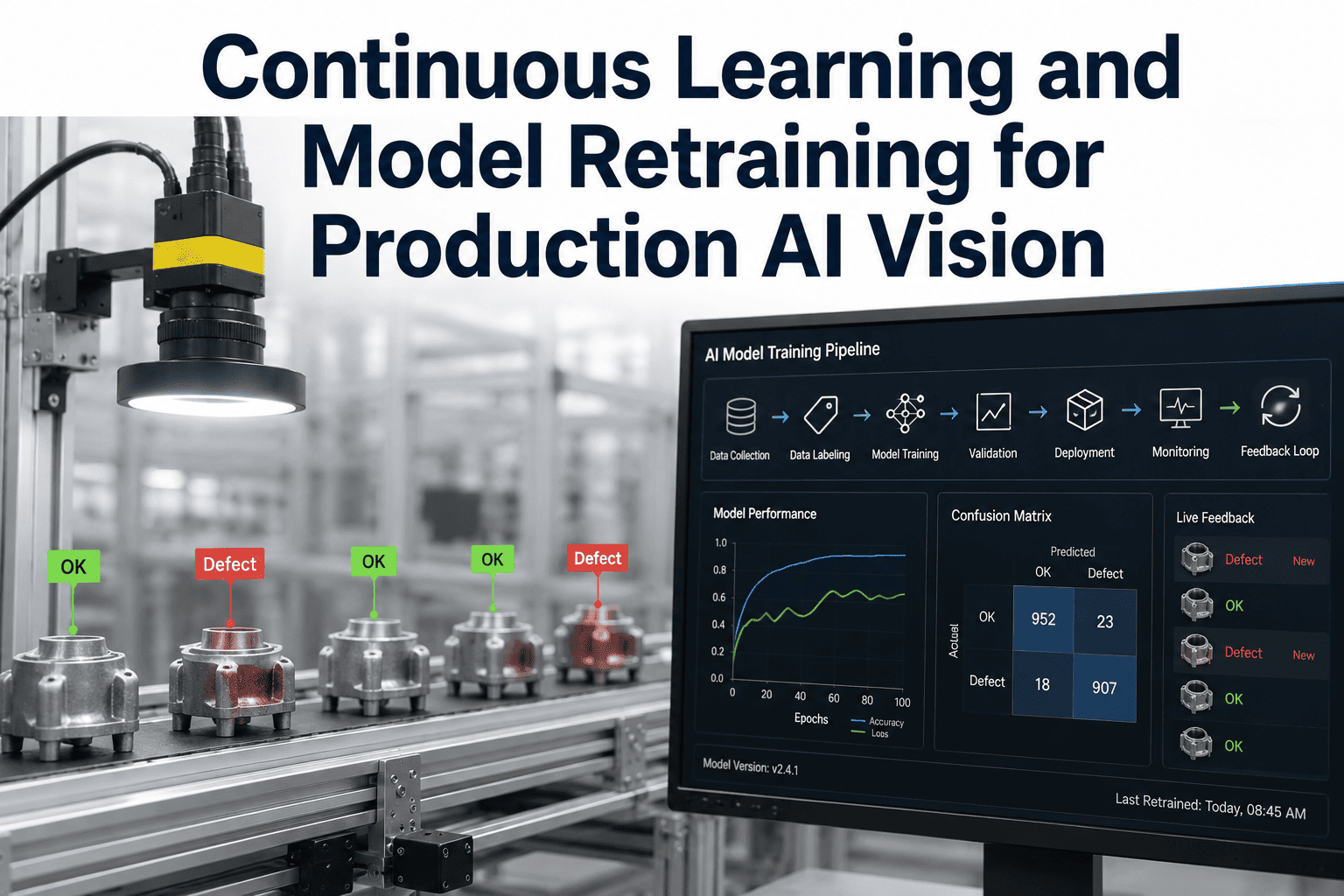
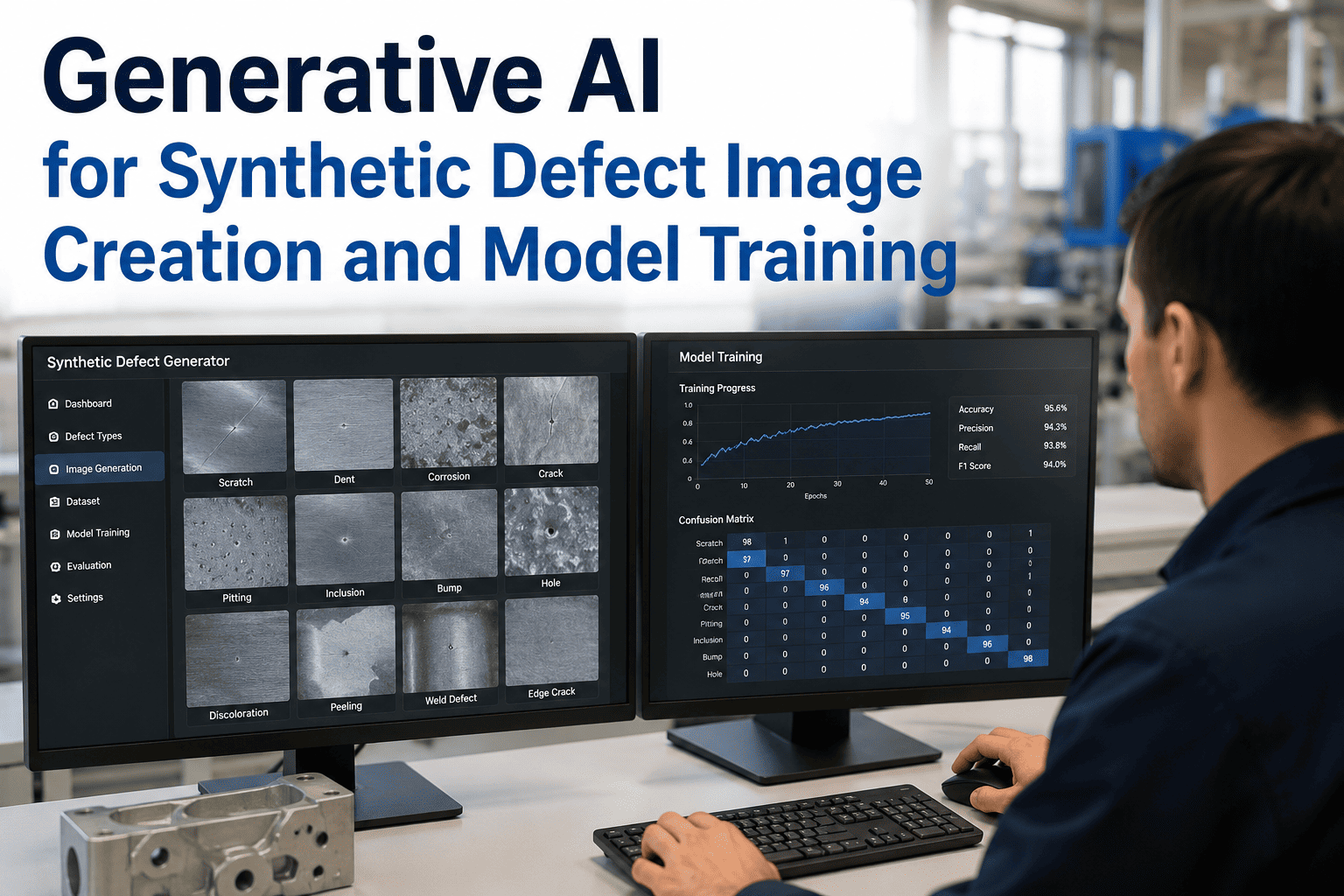
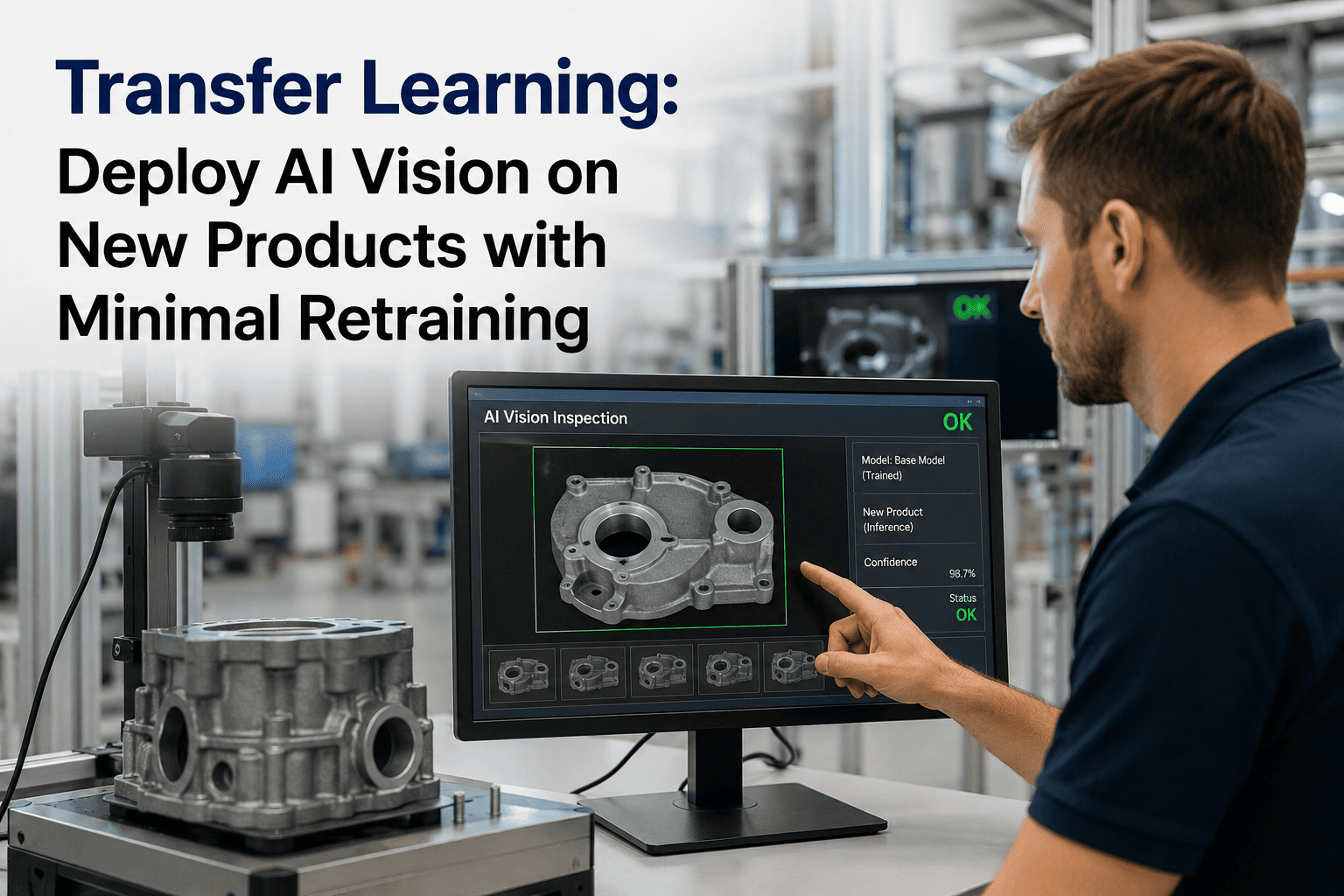
Every deep-learning textbook assumes you have a labelled dataset of ten thousand images. Every real factory arrives at the AI conversation with about twelve. That gap — between the sample volumes academic papers assume and the tiny handful of confirmed defect samples an actual production line has collected across three years of running — is the single biggest reason vision AI pilots stall before they ever reach production. The good news is that in 2026 the machine-learning field has evolved a genuinely useful toolkit for training with limited samples: transfer learning, few-shot approaches, synthetic data from digital twins, and smart augmentation, all working together on the same problem. You can book a demo to see the toolkit run against your own small defect set.
FEW-SHOT · SYNTHETIC DATA · TRANSFER LEARNING · 2026
The Reason Your Vision AI Pilot Stalled Isn't the Model — It's the Twelve Defect Images You Have to Train It On
iFactory pairs modern few-shot techniques with synthetic data generated from a digital twin of your part, so the model reaches production-grade accuracy on the samples you already have, without waiting a year to accumulate more failures on your line.
5x
Faster defect-model development at Siemens using synthetic data via NVIDIA Omniverse
99.8%
PCB defect detection accuracy reported by Pegatron on small real-sample datasets
+18.8%
mAP improvement on YOLO defect detection when synthetic data supplements real samples
Days
Not months, to move from limited samples to a validated production model
THE DEFECT DATA PARADOX
Good Production Lines Are Precisely Why You Cannot Train Traditional Vision AI on Them
The paradox at the heart of industrial vision AI is uncomfortable: the better your process is, the less data you have to train the AI that would catch its remaining failures. A line running at 99.7% first-pass yield generates roughly three defective parts per thousand — and the interesting failures, the ones that actually hurt customers, are a fraction of even that. Meanwhile, textbook computer-vision approaches were built on datasets like ImageNet with more than a million labelled examples. The gap is orders of magnitude, and it does not close by waiting.
Normal parts collected in three years of production
Confirmed defective samples for the same period
Textbook dataset assumption for CNN training
The engineering answer is not to give up and accept "we do not have the data yet". The answer is a stack of four techniques that, used together, let a model reach production accuracy on the samples you actually own.
THE FOUR-TECHNIQUE STACK
Four Complementary Techniques That Turn Twelve Defect Images Into a Production-Ready Model
None of these techniques is a silver bullet on its own. Every serious limited-data deployment layers them, because each attacks a different piece of the small-sample problem — feature learning, sample scarcity, geometric coverage, and rare-case realism.
TL
Transfer Learning
Start from a pre-trained backbone
A model already trained on millions of general images has learned edges, textures, and shape primitives that transfer directly to a new domain. Only the final classification layers need re-training on your defect samples, which turns a million-image problem into a several-hundred-image one.
FSL
Few-Shot Learning
Learn to recognise from a handful
Meta-learning and Siamese-network approaches teach the model to compare pairs of images rather than memorise thousands of examples. Once trained on many small tasks, the same architecture can adapt to a new defect class from as few as five confirmed samples.
SDG
Synthetic Data Generation
Render defects inside a digital twin
Tools like NVIDIA Omniverse Replicator render photo-realistic images of your part with programmatically injected defects — scratches, dents, missing components — in every lighting, angle, and orientation. Thousands of labelled images, days rather than years.
AUG
Smart Augmentation
Multiply what you already have
Not just flips and rotations. Modern augmentation includes CutMix, MixUp, and diffusion-based variants that produce photo-realistic new examples from every real image you have, expanding effective sample count without any new data collection.
SYNTHETIC DATA PIPELINE
From CAD File to a Trained Model, Without Waiting for the Line to Produce More Failures
The synthetic-data pipeline is the newest and most transformative technique in the stack. It is worth walking through end-to-end, because understanding the five stages is what lets an operations team scope a realistic pilot rather than treat it as vendor magic.
01
Import the Part
The CAD model or a NeRF-reconstructed 3D scan of the actual part is loaded into a rendering environment such as NVIDIA Omniverse.
02
Build the Scene
Camera position, lens, lighting, conveyor motion, and background clutter are matched to the actual inspection station so the render matches reality.
03
Inject Defects
Scratches, dents, cracks, discolouration, or missing features are programmatically generated on the part surface with controlled size, position, and severity.
04
Render at Scale
Thousands of variations are rendered overnight with automatically generated bounding boxes and segmentation masks — labelling is free because the renderer knows the truth.
05
Train & Validate
The model trains on the synthetic set, then a small held-out set of real defects validates that it generalises to the physical line, not just the render.
Skip the "We Need More Data" Wait
Send us a CAD file or a phone-camera video of one of your parts. We will show you a synthetic defect dataset and a trained model based on it before the week ends.
DECISION MATRIX · WHICH TECHNIQUE FITS WHEN
Pick the Right Combination for Your Actual Situation, Not the One That Sounds Most Advanced
The technique you should reach for first depends on two axes that every quality team can score honestly on their own data: how many confirmed defect samples they have, and how many distinct defect types the model will need to catch. This matrix is the shortcut.
DEFECT SAMPLES YOU HAVE
Higher
Lower
Higher samples · Lower variety
Transfer + Augmentation
Classic fine-tuning of a pre-trained backbone plus modern augmentation is enough here. Synthetic data adds cost without changing the outcome much.
Higher samples · Higher variety
Transfer + Synthetic Data
You have enough real anchors to validate against, so synthetic data fills the corners — rare defect types, unusual lighting, edge orientations.
Lower samples · Lower variety
Few-Shot + Augmentation
A Siamese or metric-learning approach shines here. It genuinely learns from tens of samples rather than needing thousands to converge.
Lower samples · Higher variety
Full Stack — All Four
The hardest quadrant and the one where a digital-twin synthetic pipeline earns its keep. Only the full stack of four techniques covers it well.
Lower
DEFECT TYPE VARIETY
Higher
WHAT THE RESULTS ACTUALLY LOOK LIKE
Real Numbers From Real Deployments, Not Vendor Marketing Averages
The published results across the industry point to the same conclusion: the limited-data problem is largely solved when the stack is applied properly. Three data points worth writing down.
5x
Siemens · NVIDIA Omniverse
Defect-detection model development accelerated from months to days once synthetic data from Omniverse Replicator was integrated into the training pipeline for large-scale industrial parts.
99.8%
Pegatron · Small-Dataset PCB
PCB defect detection accuracy achieved on printed circuit boards using NVIDIA Metropolis for Factories with small real-sample datasets — a use case that used to be considered unsolvable.
+18.8%
YOLO · Synthetic Augmentation
Peak mAP improvement on YOLO-family defect detectors when synthetic defect data generated on 3D-reconstructed parts was blended with a small real-sample training set.
PITFALLS TO AVOID
Four Failure Modes That Quietly Sink Limited-Data Vision Projects
The techniques work, but they can be applied badly. These are the four failure modes we see repeatedly on projects that start well and stall in the shadow-run phase.
01 · SIM-TO-REAL GAP
Rendering that looks nothing like the actual line
Synthetic data is only useful if the render matches the actual camera, optics, and lighting on the inspection station. A pristine studio render trained without domain randomisation fails the first time real conveyor grease enters the scene.
02 · DATA LEAKAGE
Same defect image appearing in training and validation
With small sample counts and heavy augmentation, it is dangerously easy to let two augmented variants of the same source image end up in training and validation. Reported accuracy climbs, real accuracy does not.
03 · CLASS COLLAPSE
Model learns to predict the majority class every time
When 10,000 normal parts sit next to 12 defective ones in the training set, a naive classifier can score 99.9% accuracy by predicting "normal" every time. Loss weighting, focal loss, or explicit resampling are non-negotiable.
04 · NO REAL HOLD-OUT
Validating on synthetic data instead of physical samples
Every project needs a small, protected set of real physical defect samples reserved for final validation. If the model is only tested on more synthetic data, its production-line accuracy is unknown at cutover time.
SIX-QUESTION READINESS CHECKLIST
Before Kicking Off a Limited-Data Vision Project, Answer These Six Questions
Every stalled pilot we have inherited had at least two of these questions unanswered on day one. Getting them answered up front is the single highest-leverage thing an operations sponsor can do.
1
How many confirmed defect samples do we have on file, broken down by defect type and severity?
2
Is there a clean CAD model, or a way to build a NeRF scan, of the part the model needs to inspect?
3
What are the exact camera, lens, and lighting used at the inspection station today?
4
Which defect types are business-critical to catch versus nice-to-have to flag?
5
What precision and recall thresholds must be cleared before the model can replace manual inspection?
6
Who is responsible for reserving and labelling the physical hold-out set for final validation?
FREQUENTLY ASKED QUESTIONS
The Questions Quality and Engineering Leaders Ask About Limited-Sample Vision AI
How few defect samples can we realistically start with?
The honest answer depends on how visually distinct the defect is. For clearly separable defects — big scratches on a smooth surface, missing components on a PCB — production-grade models have been trained on as few as five to ten real samples per class when paired with transfer learning and synthetic data. Subtle defects like fine-grained surface finish variation typically need more, though the pipeline shortens the wait significantly. You can
book a demo to get a realistic sample-count target for your specific defect class.
Does synthetic data actually generalise to the physical line?
It does when the pipeline is built correctly. The key is domain randomisation — deliberately varying lighting, textures, camera angles, and background elements across the rendered set so the model does not overfit to any single rendering condition. Published results across the industry show synthetic-plus-real training beating real-only training on the same held-out real samples. Without domain randomisation, however, the sim-to-real gap is very much a real risk.
Contact our support team to review the render fidelity needed for your part.
Do we need a CAD file of every part, or can we work from photos?
Both paths work. A CAD file gives the fastest and highest-fidelity synthetic pipeline because the geometry is exact and the surface materials can be assigned directly. When CAD is not available or is licensing-restricted, a NeRF-based reconstruction from a short handheld smartphone video of the physical part produces a usable 3D mesh that Omniverse can then decorate with programmatic defects. You can
book a demo to see both approaches side by side on a sample part.
How long before we know whether the model will work in production?
Most limited-sample pilots reach a first shadow-run stage within two to four weeks of kickoff, and a go or no-go decision on production cutover within another two to four weeks after that. The synthetic-data leg of the pipeline typically produces its first thousand-image training set in days rather than months, so the bottleneck stops being data collection and becomes model validation.
Talk to our support team to scope a realistic timeline against your defect class and volume.
Will the model keep working when new defect types appear on the line?
Not automatically, and any vendor claiming otherwise is overselling. What the limited-data pipeline gives you instead is a fast on-ramp: when a new defect type appears, you can add a handful of confirmed real samples, generate matching synthetic variations, and retrain in days rather than restart a data-collection project from scratch. That short retrain cycle is what turns a static model into a genuinely long-lived one. You can
book a demo to see how a new defect class gets folded into an existing model.
START WITH WHAT YOU ALREADY HAVE
Send Us Twelve Defect Images. We Will Show You a Working Model Before the Week Ends.
The whole point of the limited-data stack is that you do not need to wait for more failures on your line to start. Bring the samples you already own, a CAD file or a phone video, and let the pipeline do the heavy lifting.
01
Share the defect samples and part model you already have
02
Watch synthetic variations render in a live Omniverse scene
03
See a trained model score your real held-out samples
04
Leave with a scoped rollout plan for your inspection line