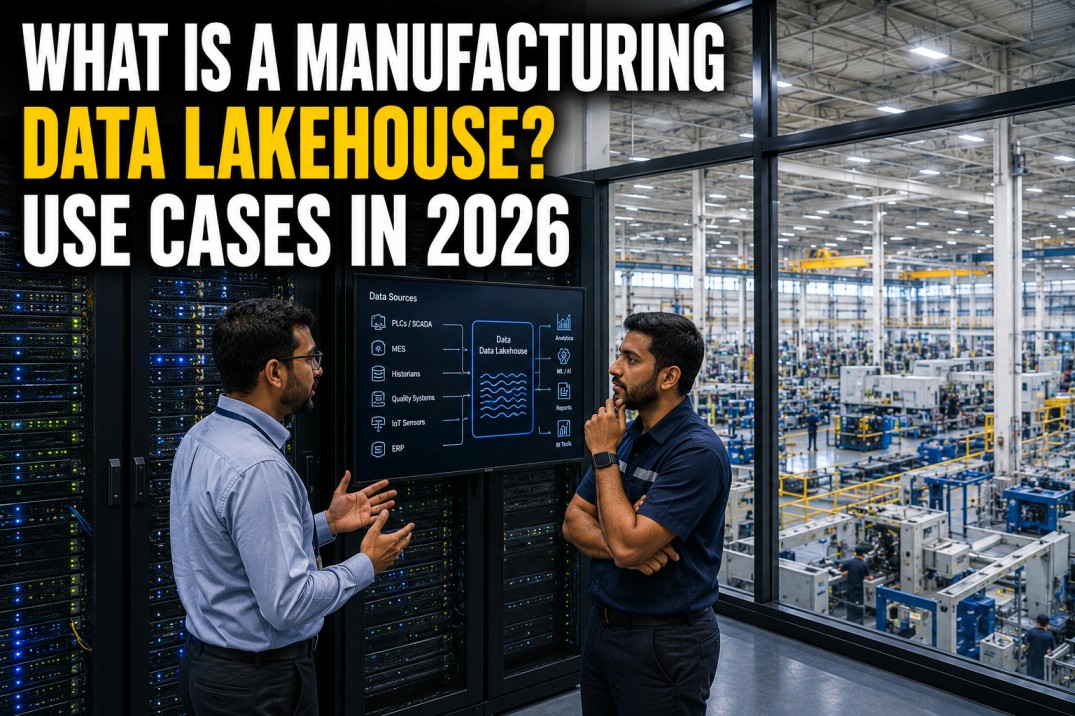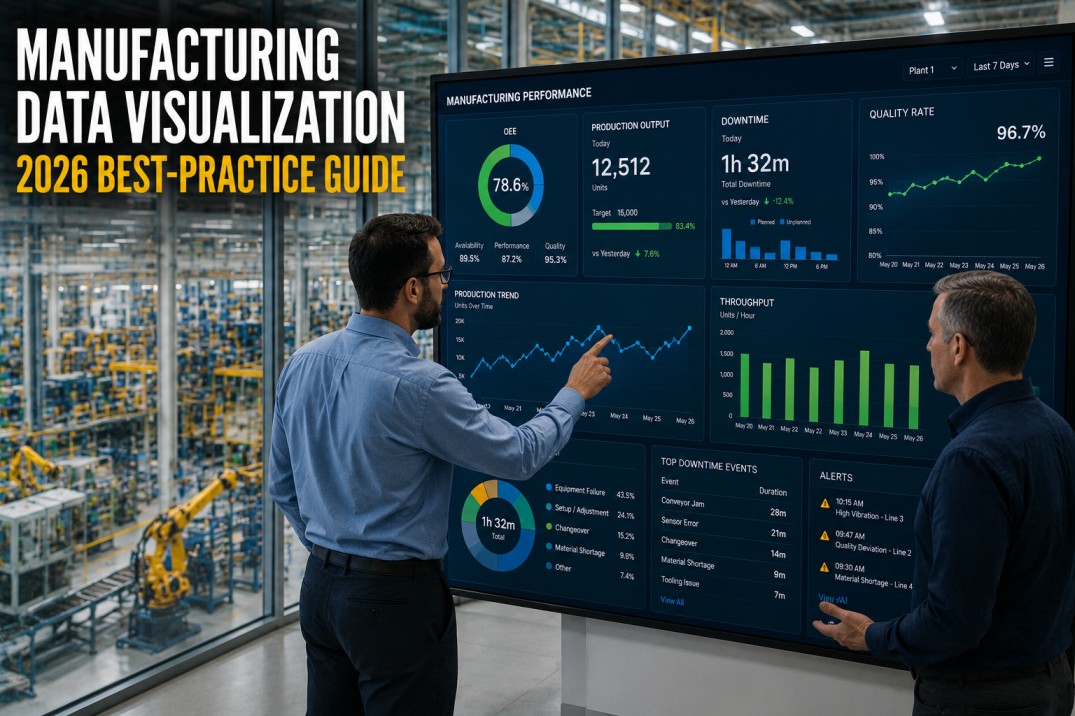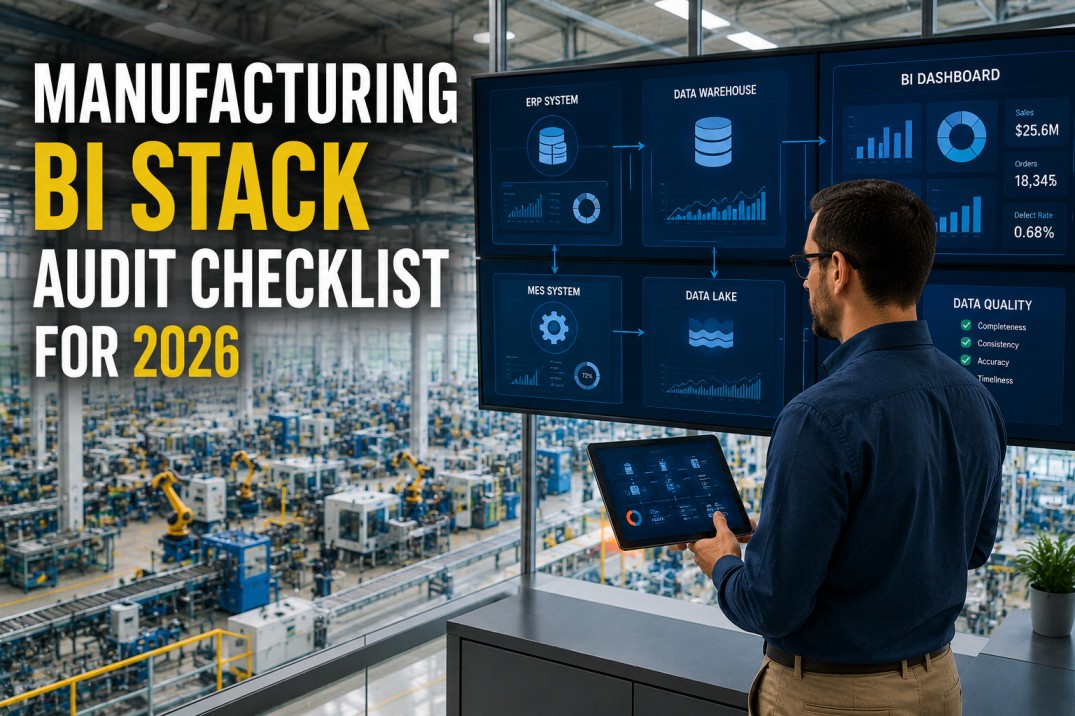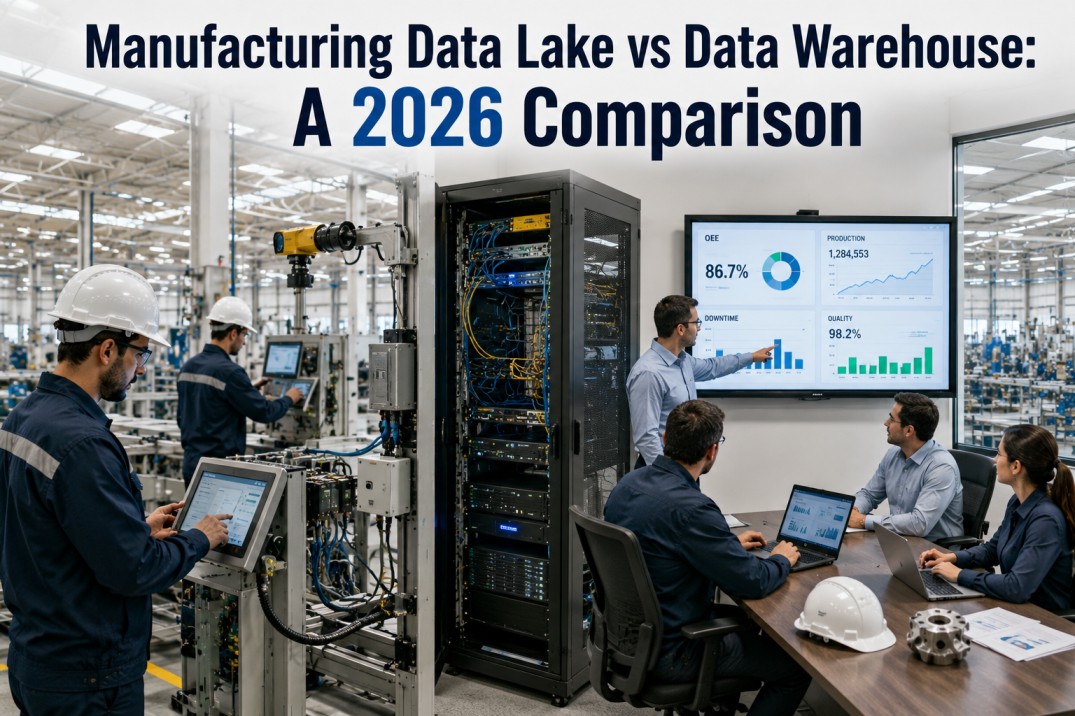
Manufacturers today generate more data than ever — from PLCs and SCADA systems on the plant floor to ERP, MES, CMMS, and quality systems at the operations layer. The question of where to store and process this data for analytics has become a critical architectural decision. Data lakes and data warehouses each emerged to solve different problems: warehouses for structured, governed, query-ready reporting; lakes for raw, schema-on-read exploration of diverse data types. In 2026, the line between them is blurring — lakehouse architectures, edge processing, and hybrid fabrics are reshaping what's possible. This page compares data lake vs data warehouse for manufacturing, breaks down the seven key architectural considerations, and shows how iFactory unifies both approaches at the edge and in the cloud for plant-wide analytics.
Get Started
Unify Your Plant Data — Lakes, Warehouses, and Everything in Between
iFactory's manufacturing analytics platform connects to both data lakes and data warehouses, unifying plant-floor time-series data with operational business data in a single, governed analytics layer. No more deciding between lake or warehouse — iFactory works with both.
Architecture Comparison: Data Lake vs Data Warehouse vs Lakehouse
The fundamental architectural difference between a data lake and a data warehouse determines which manufacturing use cases each supports best. A data lake stores raw, schema-on-read data in its native format — ideal for the time-series sensor logs, SCADA historian blobs, and unstructured machine data that factories generate continuously. A data warehouse stores structured, schema-on-write data that has been cleaned, transformed, and optimised for BI queries — perfect for production reporting, financial reconciliation, and compliance dashboards. The lakehouse combines both: a single platform that stores raw data like a lake but adds ACID transactions, schema enforcement, and BI-performance indexing like a warehouse. The three cards below show how each architecture maps to the manufacturing data stack.
Dimension Comparison: 14 Key Decision Criteria
Choosing between a data lake, data warehouse, or lakehouse for a manufacturing analytics deployment requires evaluating across multiple dimensions. The scrollable table below compares all three approaches across fourteen criteria, with the recommended winner highlighted for each row based on the typical manufacturing use case. Use this reference to map your plant's data profile — time-series volume, reporting frequency, governance requirements, and team maturity — to the right architecture.
| Criterion | Data Lake | Data Warehouse | Lakehouse |
|---|---|---|---|
| Data format | Raw / native (Parquet, Avro, JSON, CSV, binary) | Structured tables (SQL, columnar) | Both raw + structured on same store |
| Schema approach | Schema-on-read | Schema-on-write | Both read + write with schema enforcement |
| Ingestion latency | Streaming native (Kafka, Kinesis, Edge) | Batch-centric (ETL/ELT windows) | Streaming + batch with ACID |
| Storage cost per TB | $5–15 / TB / mo (object store) | $20–50 / TB / mo (compressed columnar) | $5–20 / TB / mo (open format) |
| Query performance | Medium (needs indexing / partitioning) | Fast (pre-joined, aggregated, materialised) | Fast with caching / phoenix indexes |
| ACID transactions | Limited (file-level) | Full (row-level) | Full (Delta / Iceberg / Hudi) |
| Governance & lineage | Manual (external catalog) | Built-in (role-based, audit) | Built-in (Unity Catalog, Polaris) |
| ML & data science | Native (Python, Spark, notebooks) | Limited (export required) | Native + governed features |
| Time-series support | Native (Parquet with partitioning) | Via extension (timescaledb, etc.) | Native with Delta / Iceberg time travel |
| Real-time streaming | Native, no schema barrier | Via streaming ingest pipelines | Streaming + ACID on lake storage |
| BI tool connectivity | Requires SQL engine (Presto, Trino, Spark SQL) | Direct ODBC / JDBC, native connectors | Direct via SQL endpoints |
| Data transformation | ELT (transform after load) | ETL (transform before load) | Both ELT and ETL on same lake |
| Multi-site replication | Object store replication | DW-native sync / VPN | Open format + catalog sync |
| Team skill requirement | Data engineers + data scientists | BI analysts + SQL developers | Converged — fewer specialised roles |
Compare Your Options
Map Your Plant's Data Profile to the Right Architecture
Every plant has a unique data mix — high-frequency sensor streams, batch production records, quality logs, and financial summaries. iFactory helps you evaluate which architecture fits your specific volume, velocity, variety, and governance requirements — starting with a 30-minute data architecture assessment.
Manufacturing Use Case Decision Matrix
Not every manufacturing analytics use case demands the same data architecture. The decision cards below map six common plant-floor scenarios to the recommended approach — lake, warehouse, or lakehouse — based on data velocity, variety, governance requirements, and consumer needs. Use this matrix as a quick-reference guide when designing or evolving your plant's data infrastructure.
Manufacturing Analytics Technology Stack Layers
The manufacturing analytics stack spans five distinct layers, each of which may sit on a data lake, warehouse, or lakehouse foundation. Understanding which layer belongs where — and how data flows between them — is essential to designing a coherent architecture that serves both operational and analytical consumers without duplication or governance gaps. The stack visualisation below maps each layer to its typical data store, with iFactory's edge-to-cloud fabric connecting every layer in a unified pipeline.
Full-Stack Coverage
From Edge Sensors to Executive Dashboards — One Unified Stack
iFactory covers the entire manufacturing analytics stack: edge ingestion from any PLC, SCADA, or MES; open-format storage on lake or warehouse; governed semantic layer with standardised KPIs; and pre-built dashboards for every role on the plant floor. Stop stitching tools together — iFactory is the stack.
Total Cost of Ownership: Lake vs Warehouse vs Lakehouse
Total cost of ownership for a manufacturing data platform extends far beyond storage pricing. The six-factor comparison cards below break down TCO across the dimensions that matter most to plant-level budgets: storage, compute, ingestion, transformation, governance, and team. Each card shows a proportional horizontal bar for all three architectures, using a common scale so you can visually compare where each approach costs more or less over a three-year horizon.
Hybrid Integration Patterns for Plant Data
Most manufacturers don't choose purely lake or purely warehouse — they run hybrid patterns that combine the strengths of both. The four integration cards below represent the most common data architecture patterns observed across discrete and process manufacturing plants in 2026. Each card describes the topology, the typical data flow, and when this pattern is the right choice for a plant or enterprise analytics programme.
Migration Roadmap: From Legacy DW to Modern Lakehouse
Migrating a manufacturing analytics platform from a legacy data warehouse (or disjointed lake + DW) to a modern lakehouse is a multi-phase journey. The six-step roadmap below represents the typical progression observed across iFactory's manufacturing deployments, from initial assessment to full production with legacy retirement. Each milestone includes typical duration and key outcomes.
Plan Your Migration
Move from Legacy Data Warehouse to Modern Lakehouse — One Plant at a Time
iFactory's manufacturing analytics platform is built on open lakehouse architecture (Delta Lake / Iceberg) and supports every step of the migration roadmap — from initial assessment and pilot deployment to multi-plant rollout and legacy retirement. Start with a single plant in weeks, not months.
Frequently Asked Questions
What is the difference between a data lake and a data warehouse in manufacturing?
A data lake stores raw data in its native format (Parquet, JSON, CSV, binary blobs) using a schema-on-read approach, making it ideal for time-series sensor logs, SCADA historian data, and unstructured machine data. A data warehouse stores structured, transformed data using schema-on-write, optimised for BI queries, production reporting, and governed analytics. In manufacturing, data lakes excel at storing high-volume, high-velocity plant-floor data at low cost, while data warehouses deliver fast, governed reporting for production, quality, and financial metrics. The lakehouse combines both approaches into a single, ACID-compliant platform.
When should a manufacturer choose a data lake over a data warehouse?
A manufacturer should choose a data lake when the primary use case involves high-volume, high-velocity data from the plant floor — PLC signals every millisecond, SCADA historian archives, vibration spectra, thermal images, or any unstructured data. Data lakes are also the right choice when data science teams need schema flexibility for exploratory ML, root cause analysis, or anomaly detection models. If the team is comfortable with Spark, Python, and ELT patterns and does not require ACID compliance for every dataset, the lake is the most cost-effective and flexible option.
What is a lakehouse architecture and why does it matter for manufacturing?
A lakehouse is a data architecture that combines the flexibility and low-cost storage of a data lake with the ACID transactions, schema enforcement, and BI-performance indexing of a data warehouse. It achieves this through open table formats like Delta Lake, Apache Iceberg, or Apache Hudi that run on top of object storage (S3, ADLS, GCS). For manufacturing, the lakehouse matters because it solves the historical trade-off between keeping raw time-series data for ML and having governed, queryable datasets for dashboards — both live on the same copy of data without duplication or costly ETL between systems.
Can I run both a data lake and a data warehouse together?
Yes — many manufacturers run a dual architecture where raw plant data lands in a data lake for ML exploration and long-term archival, while curated datasets are loaded into a data warehouse for governed BI reporting and dashboards. This pattern avoids putting raw, ungoverned data directly into the warehouse while still giving BI teams the fast, structured queries they need. The trade-off is higher total cost (two platforms to manage), data duplication, and potential governance gaps between the two stores. Increasingly, manufacturers are converging on the lakehouse to eliminate this dual-platform complexity while keeping both capabilities.
How does iFactory support both data lakes and data warehouses?
iFactory's manufacturing analytics platform is designed as an open lakehouse architecture that supports both data lake and data warehouse patterns natively. The platform ingests plant-floor data through edge agents into Delta Lake / Iceberg tables on object storage (lake layer), exposes governed, ACID-compliant datasets through a semantic catalog for BI consumption (warehouse layer), and supports direct Spark and Python access for data science workloads — all on a single copy of data. iFactory also integrates with existing data warehouse investments (Snowflake, Redshift, Azure Synapse, BigQuery) through federated query and bi-directional sync, so manufacturers can adopt lakehouse capabilities incrementally without rip-and-replace.
What is the typical cost difference between lake, warehouse, and lakehouse for a mid-size plant?
For a mid-size manufacturing plant generating roughly 500 GB to 2 TB of new data per month, a data lake costs approximately $500–2,000/month in storage and compute (object store + Spark/Trino). A data warehouse for the same plant typically costs $2,000–6,000/month due to higher storage costs and compute scaling. A lakehouse — combining the same object store with managed Delta/Iceberg tables — typically falls in the $1,000–3,500/month range, with the exact cost depending on query volume, concurrent users, and whether the warehouse features (materialised views, caching) are actively used. These are ballpark estimates; actual costs vary significantly by cloud provider, region, data compression ratios, and pipeline complexity.
Start Today
Stop Choosing Between Lake and Warehouse — iFactory Unifies Both
Whether you're starting fresh with a data lake, scaling an existing data warehouse, or ready to adopt a lakehouse, iFactory gives you a single platform that works with all three. Edge ingestion, open-format storage, governed semantics, and pre-built dashboards for every manufacturing role — all backed by a team that understands plant-floor data. See it in action on your data in a 30-minute personalised demo.