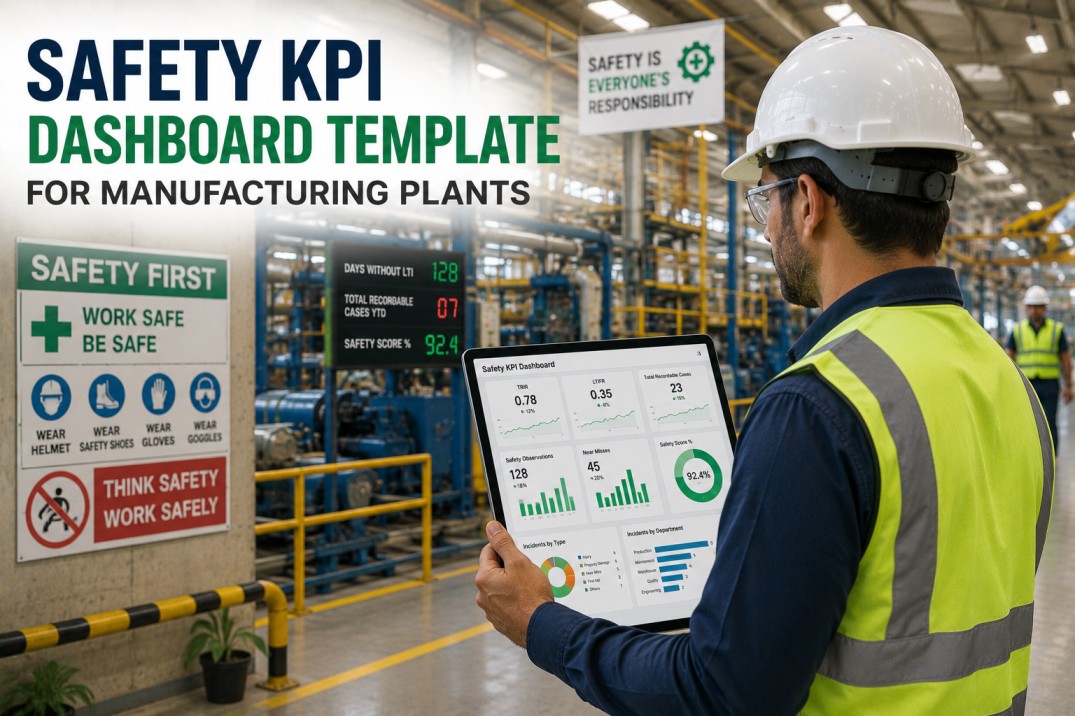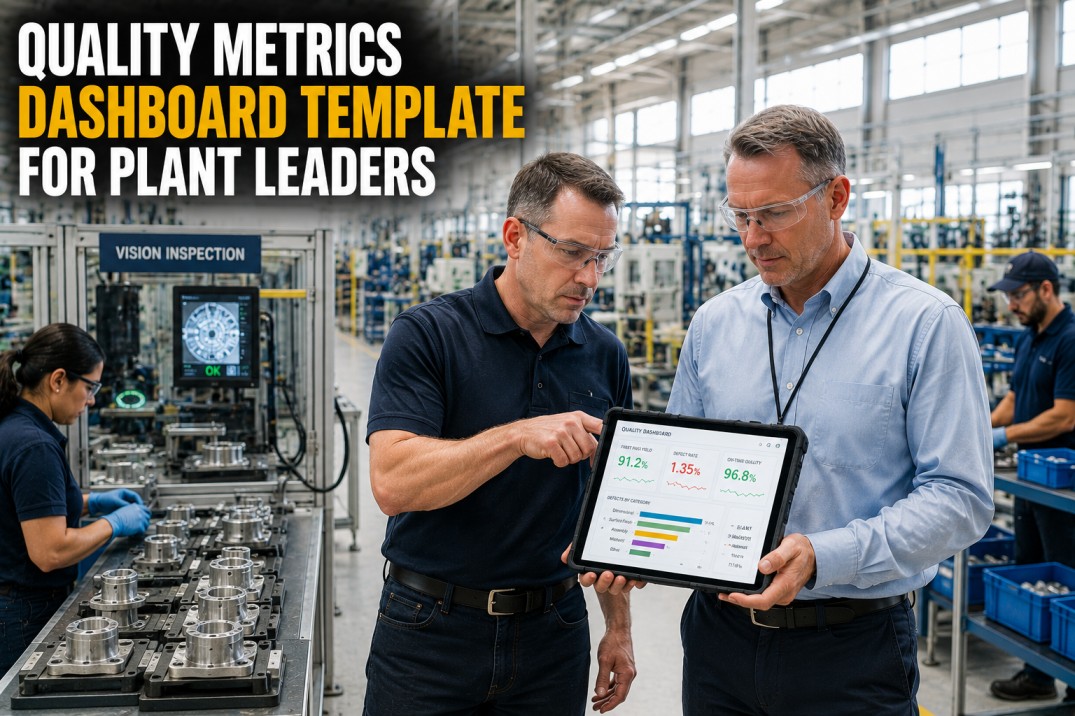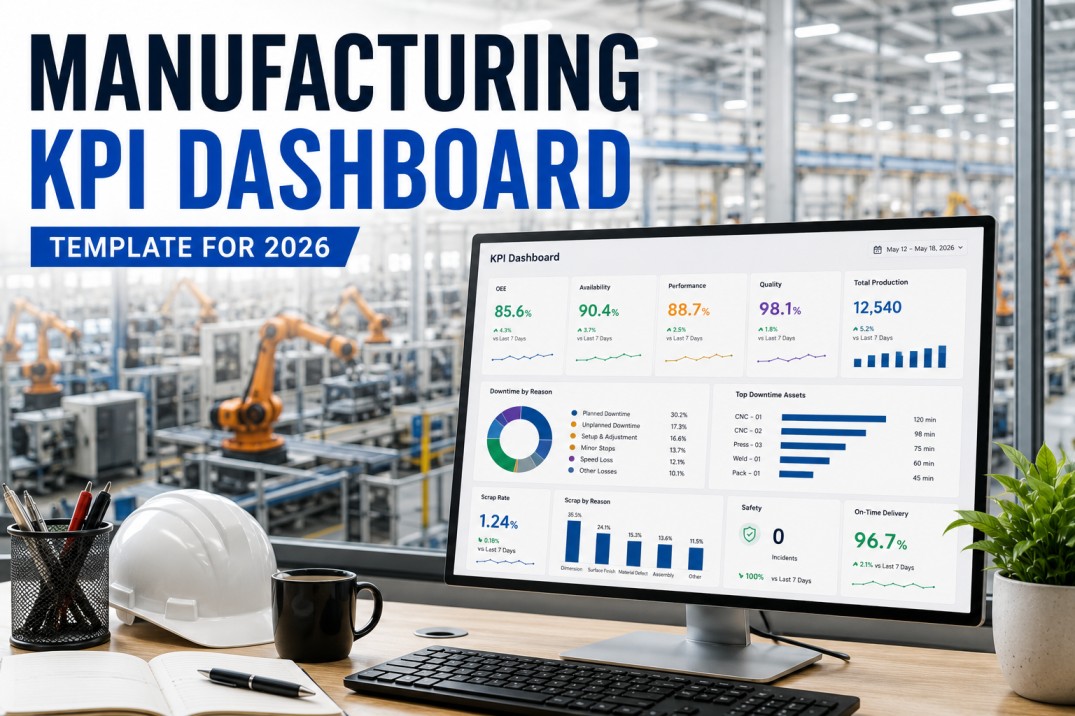
A manufacturing executive dashboard is not the same as an operational dashboard. Where an operator dashboard shows shift-level detail and a plant manager dashboard shows daily performance, an executive dashboard must answer three questions in under five seconds: Are we profitable? Are we safe? Are we delivering? This page provides a ready-to-use manufacturing executive dashboard template designed for CEOs and COOs, covering financial performance, operational efficiency, safety, and customer delivery. Each of the seven dashboard components below is structured to support board-level review while enabling drill-down when a metric demands attention. iFactory ships this dashboard pre-configured with your real plant data.
Executive Dashboard Scoreboard
The executive scoreboard occupies the top section of every CEO and COO dashboard. These four metrics must be visible without scrolling, colour-coded by threshold, and accompanied by a trailing 12-month trend direction indicator. If any of these four metrics is red, the executive should know before the first coffee of the day. iFactory places these cards at the top of every executive dashboard, pulling data from ERP, quality, safety, and production systems in real time.
EBITDA Bridge: From Revenue to Profit
An EBITDA bridge answers the single most important question a CEO or COO can ask: "What is happening to our profitability, and why?" The waterfall chart below traces the journey from total revenue to EBITDA by subtracting each major cost category. This visual structure is the financial foundation of every executive dashboard template — replacing static profit and loss statements with a dynamic view that shows how each cost element affects the bottom line. iFactory generates this bridge automatically from your ERP data, updating in real time as financial close data flows in.
OEE Performance by Site
OEE is the single most widely used metric for manufacturing operational performance, but an aggregate number hides more than it reveals. An OEE of 78% might be the result of high Availability (92%) but low Performance (85%) and Quality (83%). The executive dashboard template breaks OEE into its three components for each site, so the CEO or COO can immediately see whether a low OEE site is suffering from downtime, speed loss, or quality defects — and direct resources accordingly.
Safety Metrics with Trailing Trend
Safety is the first item on every executive dashboard — not because it is the most measurable, but because it is the most important. Leading organisations track four safety metrics at the executive level, each shown with a trailing 12-month trend so the CEO can see not just the current rate but the direction of travel. A single number tells you where you are; a trend line tells you whether your safety programmes are working. iFactory's executive dashboard includes these four cards with automatic trend computation from your incident reporting system.
On-Time In-Full Delivery by Plant
Customer delivery performance is the ultimate external validation of plant operational health. If OEE tells you how efficiently you are running, OTIF tells you whether that efficiency translates into customer satisfaction. The executive dashboard template tracks OTIF at the plant level with a rolling 4-week view, so the CEO or COO can spot deteriorating performance before it becomes a customer escalation. Each cell shows the weekly OTIF percentage with an inline attainment bar that provides immediate visual context.
| Plant | Week 1 | Week 2 | Week 3 | Week 4 | Monthly Avg |
|---|---|---|---|---|---|
| Chicago | 95% | 93% | 97% | 96% | 95.3% |
| Dallas | 90% | 87% | 85% | 88% | 87.5% |
| Atlanta | 92% | 94% | 96% | 91% | 93.3% |
| Phoenix | 93% | 91% | 89% | 92% | 91.3% |
| Seattle | 78% | 82% | 85% | 86% | 82.8% |
| Denver | 94% | 96% | 93% | 95% | 94.5% |
Financial Summary: Quarter Comparison
The financial summary section of the executive dashboard template provides a quarter-over-quarter view of the four most important financial metrics for any manufacturing operation. Each card shows the current quarter value, the prior quarter value, and a visual comparison bar that makes the delta immediately obvious. Unlike a traditional financial report that requires reading rows of numbers, this structure lets the CEO or COO see at a glance whether margins are expanding, costs are under control, and revenue is growing.
Strategic Action Register
An executive dashboard that only shows metrics without linking to actions is a report, not a dashboard. The strategic action register is the closure mechanism — it tracks the key initiatives that are underway to move the metrics in the right direction. Each action item includes a priority level, assigned owner, target completion date, and current status. iFactory integrates this register with the underlying KPI data, so when a metric improves, the dashboard can link the improvement back to the specific action that drove it.
| Priority | Initiative | Owner | Target | Status |
|---|---|---|---|---|
| P1 | Reduce Dallas plant downtime by improving PM compliance from 72% to 90% | J. Martinez, Plant Mgr | Q3 2026 | In Progress |
| P1 | Implement automated quality inspection on Paint Shop Line 3 to reduce defect rate | S. Chen, Quality Dir | Q4 2026 | Planned |
| P2 | Deploy connected-worker tablets on Assembly A and B for real-time data capture | T. Williams, Ops Dir | Q3 2026 | In Progress |
| P2 | Migrate Seattle weekly OTIF reporting from Excel to automated iFactory dashboard | L. Park, Analytics Lead | Q2 2026 | Completed |
| P2 | Standardise safety incident reporting across all six plants to enable cross-site benchmarking | R. Brown, EHS Dir | Q3 2026 | In Progress |
| P3 | Integrate ERP financial data into executive dashboard for real-time EBITDA visibility | M. Gupta, IT Dir | Q4 2026 | Planned |
Executive Dashboard FAQ
What is the difference between an executive dashboard and an operational dashboard?
An executive dashboard is designed for strategic decision-making and focuses on aggregate, cross-plant metrics that answer questions about profitability, safety, customer delivery, and overall operational health. It typically covers a trailing 12-month view with quarter-over-quarter comparisons. An operational dashboard is designed for tactical decision-making at the plant or line level, showing shift-level and daily data needed to run the operation in real time. The two dashboards share data but serve different audiences: the executive dashboard shows the "what" and "why", while the operational dashboard shows the "how" and "when".
Which KPIs should a manufacturing CEO dashboard include?
A minimum-viable manufacturing CEO dashboard should include four KPIs: EBITDA margin (financial health), OEE (operational efficiency), TRIR (safety performance), and OTIF delivery rate (customer satisfaction). These four metrics cover the four pillars that every CEO is ultimately responsible for: profit, productivity, people, and customers. Additional KPIs such as revenue growth, working capital turnover, carbon footprint, and employee turnover can be added depending on the industry and the CEO's strategic priorities.
How often should an executive dashboard update?
Executive dashboards should update at the cadence of their slowest data source. Safety and delivery metrics can update daily or weekly since the underlying data is typically available within 24 hours. Financial metrics like EBITDA margin typically update monthly in line with the financial close cycle. The most effective executive dashboards batch these cadences into a single view, showing daily metrics at full frequency while financial metrics display "as of last close" with the close date clearly labelled. iFactory handles multi-cadence refresh automatically, so executives always see the most current data available for each metric.
What is the target OEE for world-class manufacturing?
World-class OEE is generally considered to be 85% or higher, based on the original Seiichi Nakajima benchmarks and decades of industry data since. However, this benchmark varies significantly by industry — discrete manufacturing plants often achieve 80-85%, while process industries can exceed 90%. A more useful benchmark is year-over-year improvement: the executive dashboard should track whether each plant's OEE is improving, stagnating, or declining, regardless of the absolute number. A plant at 65% OEE that improved 8 points in 12 months may be a better story than a plant at 88% OEE that has been flat for three years.
How do you calculate EBITDA margin for a manufacturing plant?
EBITDA margin is calculated as EBITDA divided by total revenue, expressed as a percentage. EBITDA itself is Earnings Before Interest, Taxes, Depreciation, and Amortisation — essentially net operating profit. For a manufacturing plant, this means starting with total revenue, subtracting the cost of goods sold (raw materials, direct labour, manufacturing overhead) and operating expenses (SG&A, R&D, facility costs), then adding back depreciation and amortisation. The resulting EBITDA divided by revenue gives the EBITDA margin, which is the most widely used metric for comparing profitability across plants of different sizes and capital structures.
Deploy This Dashboard
Stop Reviewing Spreadsheets. Start Reviewing Your Business.
You now have a complete manufacturing executive dashboard template designed for CEOs and COOs — executive scorecard, EBITDA bridge waterfall, OEE by site with component breakdown, safety metrics with trailing trends, OTIF delivery by plant, financial quarter comparison, and a strategic action register. The next step is deploying these components as a live executive dashboard connected to your actual ERP, quality, safety, and production systems. iFactory ships a pre-built executive dashboard from your existing data on day one, configured for your organisational structure and metric definitions. Book a 30-minute personalised demo and we will show you your executive dashboard during the call.