Computer Vision for Chemical Process Areas and Tanks
By David Cook on July 9, 2026
A foam layer builds silently inside a reactor at three in the morning. The level transmitter reads normal — it is measuring liquid, not foam. The pressure gauge reads normal — the vent is still open. By the time foam reaches the overhead line and carries product into the condenser, the batch is contaminated and the downstream column is fouled. The foam was visible through the sight glass for forty minutes before it carried over, but nobody was looking at three in the morning. An iFactory AI vision system was — and it would have fired the alert at the first frame where foam crossed the threshold, triggered the antifoam dose, and logged the event with a timestamp and a photo. That is what computer vision does for a chemical plant: it watches the things that instruments cannot measure and operators cannot watch continuously.
iFactory · Chemical Plant AI Vision
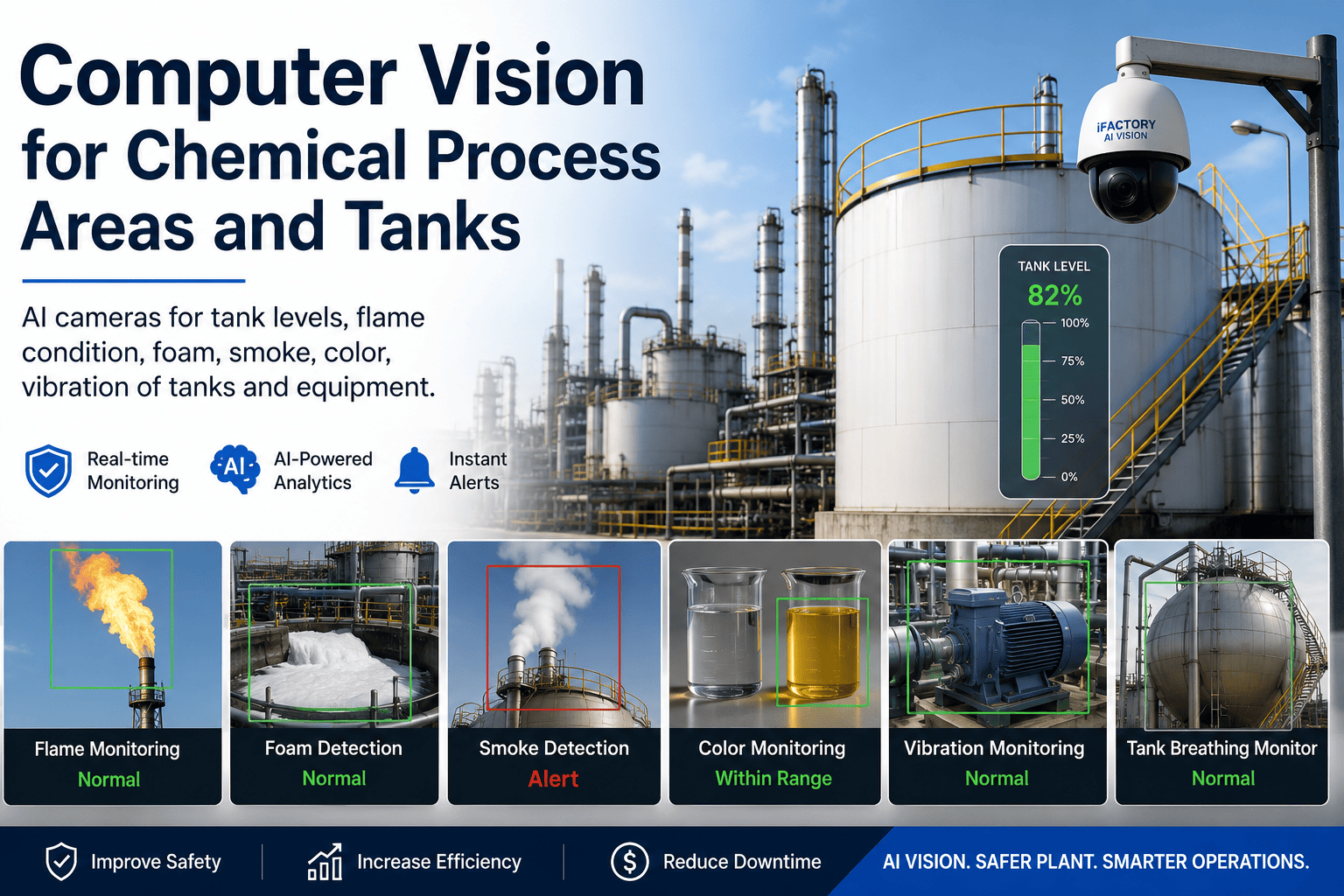
AI Cameras That See What Instruments Cannot Measure: Tank Levels, Flame Condition, Foam, Smoke, Colour, Vibration
Traditional sensors measure pressure, temperature, and flow. But foam carryover, flame instability, smoke onset, colour change, and tank breathing are visual phenomena — and they need eyes, not gauges. On-prem AI vision monitors them 24/7 from your existing cameras.
A chemical plant is heavily instrumented — but instruments measure physical quantities along a single axis. A pressure transmitter cannot see foam. A thermocouple cannot see flame colour. A level gauge cannot tell whether the surface is clean liquid or a churning emulsion. These six phenomena are visual by nature, and they have been monitored by human eyes through sight glasses and CCTV screens since the plant was built. AI vision replaces the human stare with a model that never blinks, never gets tired, and fires an alert in the same second it detects a change.
Foam and carryover
Foam builds in reactors, distillation columns, and fermenters — invisible to level transmitters until it enters the overhead system.
AI detects foam presence, measures foam height, analyses bubble structure, and triggers antifoam dosing or feed-rate reduction before carryover.
Flame condition
Furnace and flare flame colour, shape, and stability reveal combustion quality — incomplete combustion, flame impingement, and flameout risk.
AI tracks flame colour spectrum, flicker frequency, and shape envelope continuously. Detects instability or colour shift seconds before a flame scanner trips.
Smoke and vapour release
Smoke from overheated equipment, fugitive emissions, or incipient fire is visible before heat or gas sensors respond — especially outdoors.
AI identifies smoke plumes and vapour clouds in real time from standard cameras. Triggers alert at the earliest visual frame — minutes ahead of traditional sensors.
Tank level and breathing
Sight glasses, overflow indicators, and tank breathing patterns reveal fill state and vapour pressure behaviour that electronic gauges may miss or lag.
AI reads sight glass markings, detects overflow before it reaches the bund, and monitors tank breathing rate to flag pressure or temperature excursions inside the vessel.
Product colour change
Colour of a product stream, a reaction mixture, or a waste discharge changes with composition, contamination, or reaction progress — a direct quality indicator.
AI compares current colour against the learned baseline for each product. Detects drift that indicates off-spec product, contamination, or incomplete reaction before the lab result arrives.
Equipment vibration
Excessive vibration in pumps, compressors, agitators, and piping is visible as blur, oscillation, or displacement — long before a bearing seizes.
AI measures displacement from video at sub-pixel resolution — comparable to laser vibrometry. Detects developing imbalance, misalignment, or looseness without contact sensors.
How It Works: Existing Cameras, New Intelligence
Most chemical plants already have CCTV coverage across tank farms, process areas, loading racks, and flare stacks. The cameras are there — but the video feeds into monitors that nobody watches continuously. AI vision connects to those existing IP cameras via ONVIF or RTSP, runs deep learning models on a local GPU server, and converts the video from a passive recording into an active monitoring system that generates alerts, logs events, and integrates with your DCS and CMMS.
Cameras
Existing IP cameras, thermal cameras, or new purpose-built units. No proprietary hardware required. Standard ONVIF/RTSP protocols.
On-prem AI server
NVIDIA edge GPU processes video streams locally. Multiple detection models run simultaneously on the same hardware — foam, flame, smoke, level, colour, vibration.
Alerts and integration
Detections trigger DCS alarms, CMMS work orders, mobile notifications, and dashboard events. Every alert includes the source frame, timestamp, confidence score, and detection class.
Want to see AI vision running on your existing CCTV feeds? Talk to a vision specialist — we will connect to a sample camera and show the detection models live.
Where to Deploy First
Not every camera in the plant needs AI. The highest-value deployments are at locations where visual anomalies lead to safety events, product losses, or environmental releases — and where human monitoring is intermittent or impractical. These five areas deliver the fastest return.
Tank farm
Overflow, breathing rate, vapour release, bund condition, valve position
Flame shape, colour spectrum, stability, smoke at stack
Combustion + emissions
Loading and unloading
Hose connection, spill detection, tanker position, overflow at fill point
Safety + environmental
Rotating equipment
Pump and compressor vibration, seal leakage, coupling misalignment
Reliability + maintenance
What Changes When AI Watches the Plant
The shift from passive CCTV to active AI vision changes the plant's detection capability in four dimensions — speed, coverage, consistency, and documentation.
Detection speed
Smoke visible for minutes before a human notices on a monitor bank
Alert fires on the first video frame where smoke is detected — sub-second response
Coverage
Operator watches 16 screens and focuses on none
Every camera analysed simultaneously — no screen goes unwatched
Consistency
Detection depends on who is on shift and how alert they are at 3 AM
Same detection accuracy at 3 AM as at 3 PM — no fatigue, no distraction
Documentation
Incident report written after the fact from memory
Every detection logged with source frame, timestamp, and classification — audit-ready
Ready to turn your existing CCTV into an active safety and quality system? Book a demo — we will show the detection models running on chemical process scenarios.
Why On-Prem for Video Analytics
Video is the highest-bandwidth data stream in any plant. Streaming it to the cloud for analysis is impractical, expensive, and introduces a security risk that no chemical plant should accept. On-prem AI processes the video locally, stores only the alerts and annotated frames, and keeps the raw footage inside your network.
Bandwidth
A single 1080p camera at 15 fps generates roughly 5 Mbps of data. A plant with 50 cameras would need 250 Mbps of continuous upload to the cloud. On-prem processes locally and stores only events — reducing data volume by orders of magnitude.
Privacy
Video of your process areas, tank farm, and equipment is sensitive operational intelligence. On-prem ensures that raw video never leaves your plant perimeter — only classified alerts and annotated frames are stored.
Latency
A smoke detection alert that arrives 30 seconds after the cloud processes the frame is 30 seconds too late. On-prem inference delivers sub-second detection — the alert fires before the operator could have seen it on a monitor.
Frequently Asked Questions
Can this work with our existing CCTV cameras?
Yes. The AI platform supports existing IP cameras via standard ONVIF and RTSP protocols. The processing happens on the edge GPU server, not on the camera. Most plants deploy without replacing a single camera — the intelligence is added to the existing video infrastructure, not the hardware.
How many cameras can one server handle?
A single NVIDIA edge GPU server typically handles 20-50 camera streams depending on resolution and the number of detection models running per stream. Multiple models — foam detection, smoke detection, vibration analysis — can run simultaneously on the same stream. For larger plants, additional servers scale linearly.
How accurate is AI smoke detection compared to traditional sensors?
Published models achieve 91% mean average precision for fire and smoke detection from standard video. Unlike point sensors that require heat or smoke to physically reach the detector, vision-based detection identifies smoke plumes at the earliest visual stage — covering far larger areas from a single camera position and detecting outdoor events where traditional sensors are ineffective.
Does the system generate false alarms from steam or process vapour?
The model trains on your plant's specific visual environment — learning the difference between normal steam venting and abnormal smoke, between routine process vapour and fugitive emissions. During the initial training period, false positives are tuned out by showing the model examples of normal operations at your facility. Accuracy improves continuously as the model sees more data from your cameras.
How long does deployment take?
A typical chemical plant is live in 6-12 weeks. Weeks 1-3: camera inventory, network connection, edge server installation. Weeks 3-6: model training on your plant's visual environment, tuning for steam vs smoke, normal vs abnormal. Weeks 6-12: live detection with operator validation. Turnkey on-prem: pre-configured NVIDIA AI server, 1000+ industrial clients, 99.9% uptime.
Your cameras are recording. Let AI start watching.
See AI Vision Running on Your Chemical Plant's Cameras
Bring your camera layout and your highest-risk process areas. We will connect the AI to a sample feed and show foam detection, smoke identification, and flame monitoring running live on your video. Turnkey on-prem AI: pre-configured server, live in weeks, 1000+ clients, 99.9% uptime.