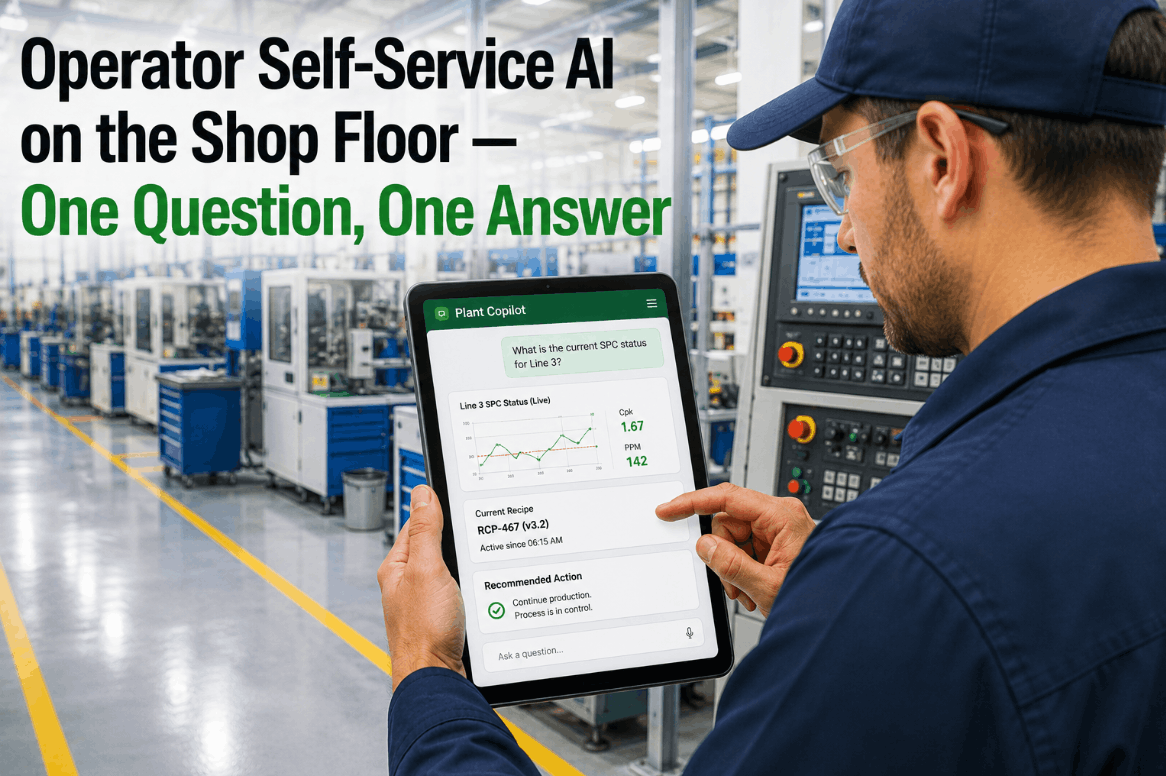
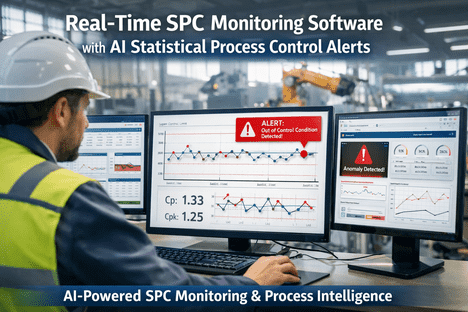
Out-of-control conditions belong in the operator's hand — not in a quality engineer's inbox the next morning. When an SPC violation fires at 2:17 AM on the third shift and the alert lands in a desktop email thread that nobody reads until 8:00 AM, that process has been running out of control for nearly six hours. Across a high-volume line, six hours of undetected special-cause variation is not a data quality problem — it is a scrap, rework, and potential customer-escape problem. iFactory's Plant Copilot delivers SPC alerts directly to the operator's line-side tablet the moment an out-of-control condition is detected — with the specific Western Electric rule that fired, the recommended corrective action for that parameter, and an electronic sign-off that closes the loop and creates an audit trail before the next cycle runs.
Put SPC Alerts Where They Belong — At the Line
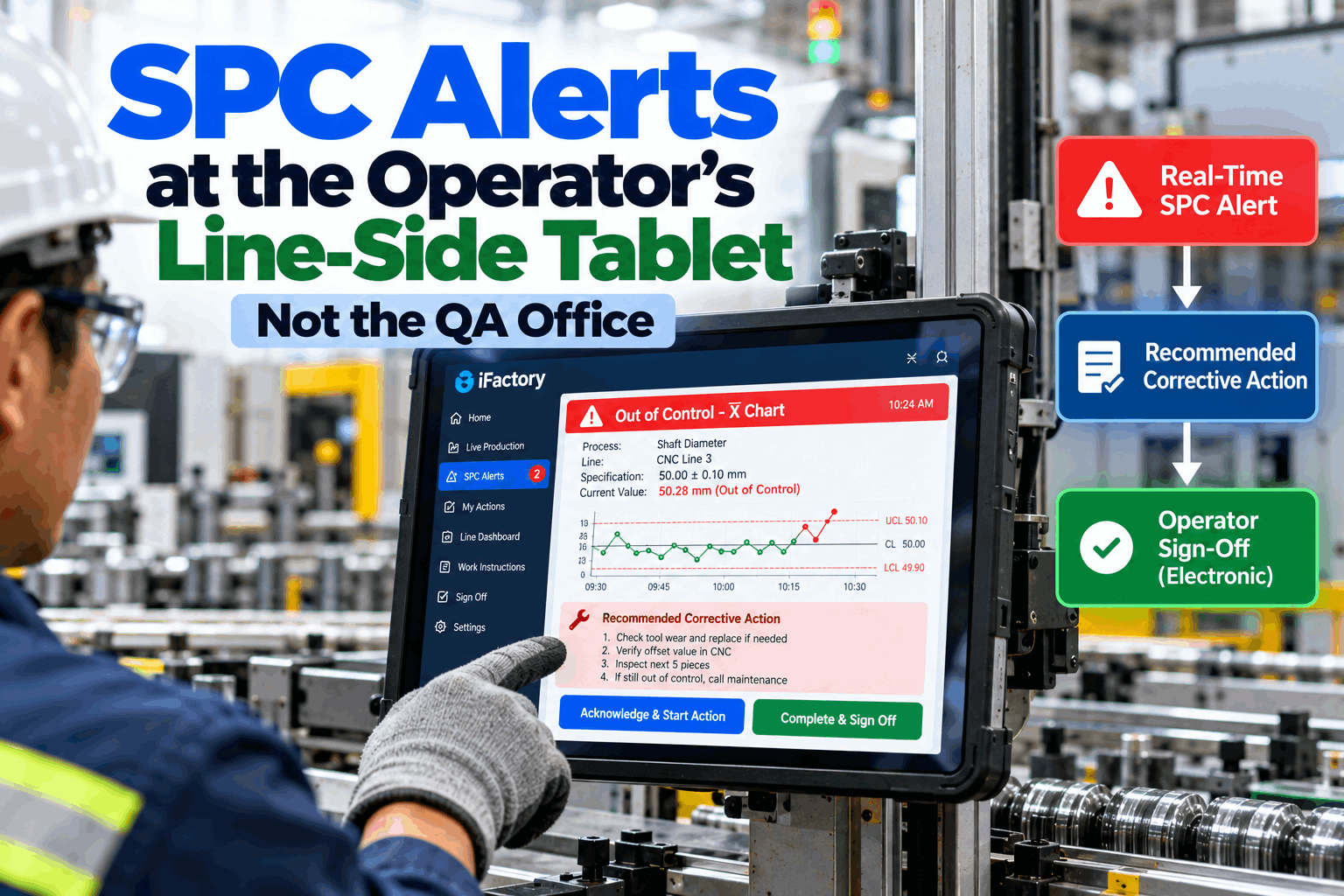
iFactory delivers out-of-control alerts with corrective action guidance and electronic sign-off directly to the operator's tablet — closing the quality loop at the source, not the QA office.
Why SPC Alerts in the QA Office Don't Protect the Line
Most SPC implementations have a fundamental routing problem. The people closest to the process — the operators and shift supervisors who can actually do something about an out-of-control condition — are the last to know it exists. Alerts go to quality engineers who are managing multiple lines. Notifications sit in email dashboards that nobody checks between shifts. Control chart violations get logged, reviewed at the morning meeting, and acted on twelve hours after the special cause entered the process. That is not statistical process control — it is statistical process documentation.
Shift supervisors running high-volume discrete or process manufacturing lines understand this gap viscerally. When a dimension starts drifting at the beginning of a shift and the SPC system's alert routes to a quality inbox, the supervisor has no signal. The operator has no guidance. The process runs. By the time anyone reviews the charts, the corrective window has closed and the scrap has already been made. Book a Demo to see how iFactory reroutes that alert directly to the line before the next part runs.
SPC alerts route to quality engineers and supervisors on desktop dashboards — not to the operator standing at the machine who can act on the signal in seconds.
Most SPC alerts communicate a violation — but not what to do about it. Operators receive an alarm with no recommended action, creating hesitation, escalation delays, and inconsistent responses.
Without electronic sign-off at the line, there is no verifiable record that the operator received the alert, understood the condition, and completed the corrective action — creating audit exposure.
Unacknowledged SPC violations carry over between shifts with no visibility. The incoming shift supervisor inherits an out-of-control process with no context, no corrective history, and no alert trail.
How Plant Copilot Delivers SPC Alerts at the Line-Side Tablet
iFactory's Plant Copilot is the operator-facing layer of the real-time SPC engine — a line-side tablet interface that receives out-of-control alerts the moment a Western Electric rule fires, surfaces the specific parameter and violation type in plain language, and presents the recommended corrective action from the configured reaction plan for that characteristic. The operator acknowledges the alert, completes the corrective action, and signs off electronically — all within the same workflow, before the next measurement cycle. Shift supervisors who Book a Demo consistently identify this closed-loop sequence as the single most impactful change to their shift quality management workflow.
Who Receives What — iFactory's Role-Based Alert Routing
SPC alerts are only useful if they reach the right person in time to act. iFactory's alert routing is configured by role, shift, parameter type, and rule severity — so operators receive line-specific parameter alerts, supervisors receive escalation notifications for unacknowledged conditions, and quality engineers receive summary dashboards — each receiving the right signal at the right level of detail. Book a Demo to walk through how alert routing is configured for your specific line structure and shift schedule.
| Violation Type | Primary Alert Recipient | Alert Content | Escalation If Unacknowledged | Response Required |
|---|---|---|---|---|
| Rule 1 — Point beyond ±3σ | Operator (immediate) | Parameter, value, chart, corrective action | Supervisor — 5 min | Contain + Sign-off |
| Rule 2 — 2 of 3 beyond ±2σ | Operator (immediate) | Trend direction, parameter, reaction plan | Supervisor — 10 min | Adjust + Sign-off |
| Rule 3 — 4 of 5 beyond ±1σ | Operator (immediate) | Sustained shift notice, guidance steps | Supervisor — 15 min | Investigate + Sign-off |
| Rule 4 — 8 pts same side CL | Operator (immediate) | Mean displacement, recommended reset | Quality Eng. — 20 min | Check setup + Sign-off |
| Rule 5 — 6 pts trending | Operator + Supervisor | Drift alert, tool wear / wear indicator | Quality Eng. — 20 min | Monitor + Sign-off |
| Cpk drops below 1.33 | Supervisor + Quality Eng. | Capability index, affected parameter, Cpk trend | Plant Manager — 30 min | CAPA auto-opened |
What the Shift Supervisor Gains From Line-Side SPC Alerts
For a shift supervisor managing four or five production lines with operators spread across a large floor, the practical question is not whether SPC alerts are valuable — it is whether the quality response infrastructure can work fast enough to matter. Line-side tablet alerts change the math entirely. Instead of chasing quality signals after the fact, the supervisor's dashboard shows real-time alert status across every line — who has acknowledged, what corrective action was taken, and which open violations still need attention. The shift handover report is generated automatically from the alert record — no manual assembly required.
SPC violation fires. Alert routes to the quality engineer's desktop. Engineer is on a different line. Violation sits unacknowledged. Process continues running out of control until the next scheduled review.
SPC violation fires. Alert appears on the line-side tablet within two seconds. Operator receives the rule that fired, the corrective action, and signs off. Supervisor sees acknowledgment in real time. Process is corrected before the next cycle.
What Shift Supervisors Know That SPC System Designers Often Miss
The gap between when a SPC violation occurs and when an operator learns about it is where most preventable escapes are born. I've managed third shifts where the SPC system was technically running and recording every violation — and the operator had no idea any of it was happening because all the alerts went to a desktop in the quality office. When we moved to line-side tablet alerts with corrective action guidance built in, our first-shift-to-response time dropped from an average of four hours to under three minutes. The difference is not the statistics — it is the routing.
SPC Alerts at the Line Are Not a Feature Upgrade — They Are the Point
Statistical process control has always been a shop-floor discipline. The control chart was designed to be read at the machine, not reviewed at a desk the following morning. When SPC alerts are routed away from the operator and into management inboxes, the system loses its only real value: the ability to interrupt a running process before the defect is made. iFactory's Plant Copilot restores that original intent — putting the out-of-control alert, the corrective action, and the sign-off directly in the operator's hand, at the moment it matters, with a complete audit trail created automatically.
For shift supervisors who are accountable for quality outcomes on every cycle of every shift — not just the ones that make it into the morning report — line-side SPC alerts are the infrastructure that makes real-time quality management possible. If your current SPC system routes violations to a desktop nobody checks until dayshift, Book a Demo to see what closed-loop operator alerting looks like on your specific line configuration.
SPC Operator Alerts — Common Questions Answered
Stop Routing SPC Alerts to Inboxes Nobody Checks Until Morning
iFactory's Plant Copilot puts out-of-control alerts, corrective action guidance, and electronic sign-off directly on the operator's line-side tablet — in under two seconds, on every shift, for every parameter you monitor.