When a blast furnace goes down unexpectedly, the clock starts running at a devastating pace. In heavy manufacturing—steel mills, automotive plants, aerospace facilities, and metal processing operations—every minute of unplanned downtime translates directly into lost revenue, wasted materials, and cascading supply chain disruptions. According to Siemens' 2024 True Cost of Downtime report, the world's 500 largest companies lose approximately $1.4 trillion annually due to unplanned downtime—equivalent to 11% of their total revenues. For heavy industry specifically, downtime costs have risen 4x since 2019, now reaching $59 million annually per plant.
The stakes for quality are equally severe. A single undetected defect in a steel coil, automotive component, or aerospace part can trigger recalls costing hundreds of millions of dollars, destroy customer relationships, and create safety hazards that put lives at risk. Traditional quality inspection methods—relying on human visual inspection—achieve only about 80% accuracy, leaving a dangerous gap that AI-powered solutions are now closing. This guide explores how artificial intelligence is transforming heavy manufacturing operations, delivering measurable reductions in both downtime and quality losses while generating ROI that justifies investment within months rather than years.
The True Cost of Downtime & Quality Failures
Heavy manufacturing environments present unique challenges that make AI adoption both more complex and more valuable than in lighter industries. Extreme temperatures near furnaces and rolling mills, heavy vibration from massive equipment, continuous operation schedules that allow no margin for error—these conditions demand AI solutions specifically engineered for industrial resilience. Yet manufacturers who overcome these challenges are achieving transformative results: 70% reductions in equipment breakdowns, 90%+ defect detection accuracy, and ROI measured in months rather than years.
The Downtime Crisis in Heavy Manufacturing
Unplanned downtime in heavy manufacturing isn't just an inconvenience—it's an existential threat to profitability and competitiveness. The financial impact varies dramatically by sector, but the pattern is consistent: costs have escalated far faster than inflation, driven by complex supply chains, energy price volatility, and increasingly demanding customer expectations for on-time delivery.
Downtime Costs by Heavy Manufacturing Sector
Idle production lines halt entire supply chains. A single plant shutdown can disrupt deliveries to multiple OEMs within hours.
Steel mills, metal processing, and heavy equipment manufacturers face catastrophic losses from furnace shutdowns and rolling mill failures.
Refinery and processing downtime costs fluctuate with global oil prices but consistently rank among highest in manufacturing.
Beyond direct costs, aerospace downtime creates certification delays, contract penalties, and potential safety concerns.
The root causes of unplanned downtime in heavy manufacturing reveal why traditional maintenance approaches consistently fail. Equipment in these environments operates under extreme stress: temperatures exceeding 1,500°C in steel furnaces, constant vibration from rolling mills, 24/7 operation schedules that leave no room for gradual degradation to manifest as warning signs visible to human operators. By the time traditional monitoring detects a problem, the damage is often already catastrophic.
Primary Causes of Unplanned Downtime in Heavy Manufacturing
Mechanical breakdowns, bearing failures, motor burnouts, and component fatigue
Operator mistakes, incorrect machine settings, failure to follow procedures
Material variations, quality deviations requiring line stops, changeover problems
Material shortages, delayed deliveries, incorrect specifications
System failures, cyberattacks affecting OT systems, software malfunctions
AI-Powered Predictive Maintenance: Preventing Failures Before They Happen
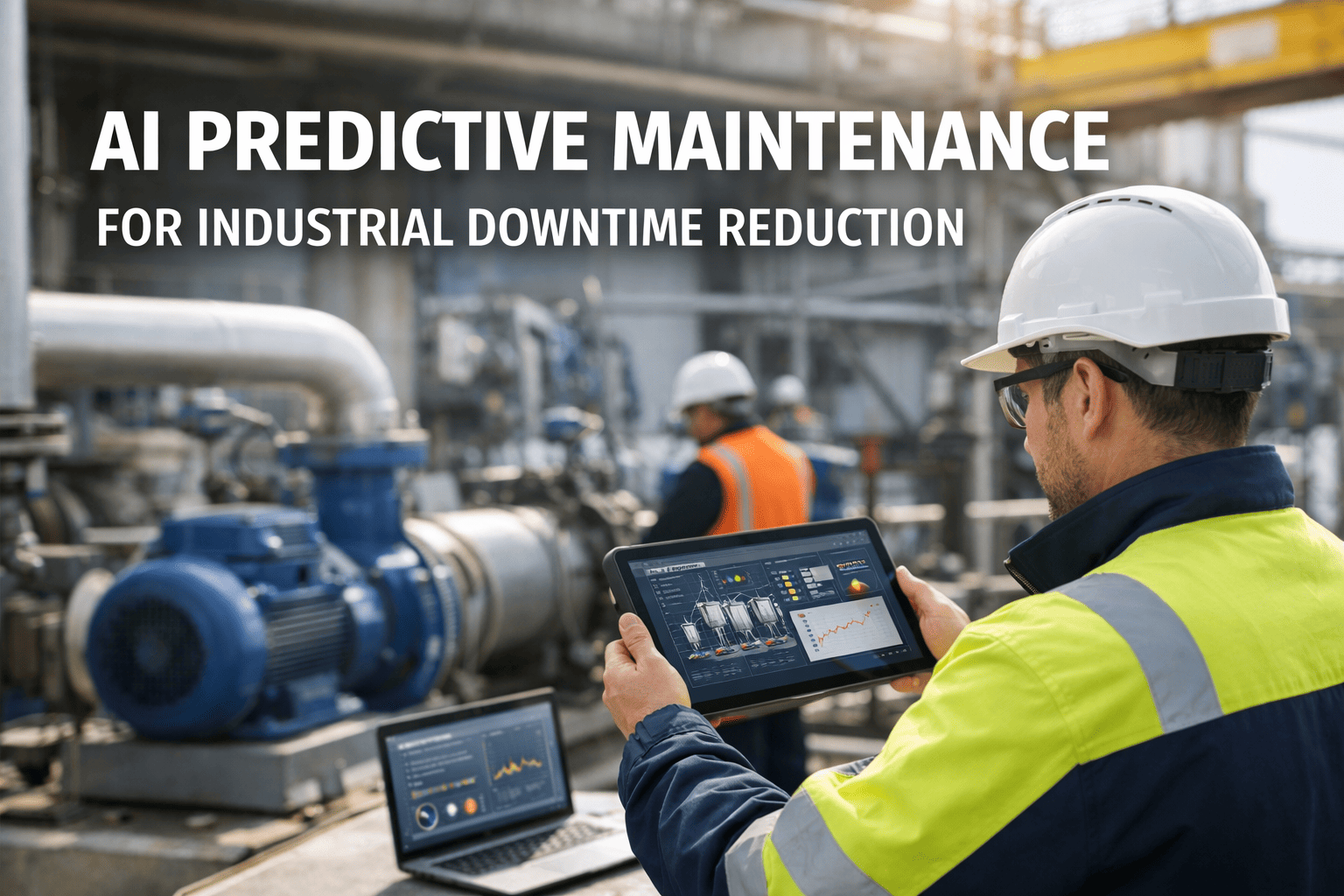
Predictive maintenance represents the highest-impact AI application in heavy manufacturing, directly addressing the 42% of downtime caused by equipment failures. Unlike reactive maintenance (fixing after failure) or preventive maintenance (scheduled maintenance regardless of condition), AI-powered predictive maintenance analyzes real-time sensor data to predict exactly when equipment will fail—enabling repairs during planned downtime rather than emergency shutdowns.
AI Predictive Maintenance: The ROI Case
Documented Benefits
The technology stack powering AI predictive maintenance in heavy manufacturing has matured significantly. High-quality wireless sensors engineered with IP67 ratings and heat-resistant designs can now operate reliably near furnaces, conveyors, and rolling mills—environments that would have destroyed earlier sensor generations. These sensors continuously monitor vibration signatures, thermal fluctuations, current profiles, and acoustic patterns, feeding data to AI algorithms trained to detect the subtle anomalies that precede equipment failure.
How AI Predictive Maintenance Works in Heavy Manufacturing
Data Collection
Industrial-grade sensors monitor vibration, temperature, pressure, current, and acoustic patterns from critical equipment 24/7
AI Analysis
Machine learning algorithms analyze billions of data points, comparing real-time readings against known failure patterns
Predictive Alerts
System generates actionable alerts with predicted failure timeframes—often 30+ days in advance
Scheduled Repair
Maintenance scheduled during planned downtime, preventing catastrophic failures and emergency shutdowns
Real-world implementations demonstrate the transformative impact. Tata Steel implemented AI-powered predictive maintenance to monitor their rolling mills, analyzing vibration and temperature data to identify potential machinery failures before they occurred. The result: a 15% reduction in unplanned downtime and substantial savings in maintenance costs. BMW's Regensburg plant reports that AI-supported systems save teams "more than 500 minutes" (over 8 hours) of disruption per year at that single facility. For steel mills and metals processing plants, providers report average ROI of 8x from predictive maintenance implementations.
AI-Powered Quality Inspection: From 80% to 99%+ Accuracy
Quality failures in heavy manufacturing carry consequences that extend far beyond immediate production costs. A single defective automotive component can trigger recalls affecting millions of vehicles. An undetected flaw in aerospace materials can create safety hazards with catastrophic potential. Traditional human visual inspection—still the dominant quality control method in many facilities—achieves only about 80% accuracy under optimal conditions, with performance degrading significantly during extended shifts as inspector fatigue sets in.
The Quality Inspection Gap: Human vs. AI Performance
- Performance varies between individuals
- Accuracy degrades with fatigue during shifts
- Limited to visible surface defects
- Speed limited by human processing capacity
- Inconsistent subjective judgment
- Consistent performance 24/7
- No fatigue degradation
- Detects microscopic defects (0.1mm)
- 1,000+ units/minute inspection speed
- Objective, repeatable results
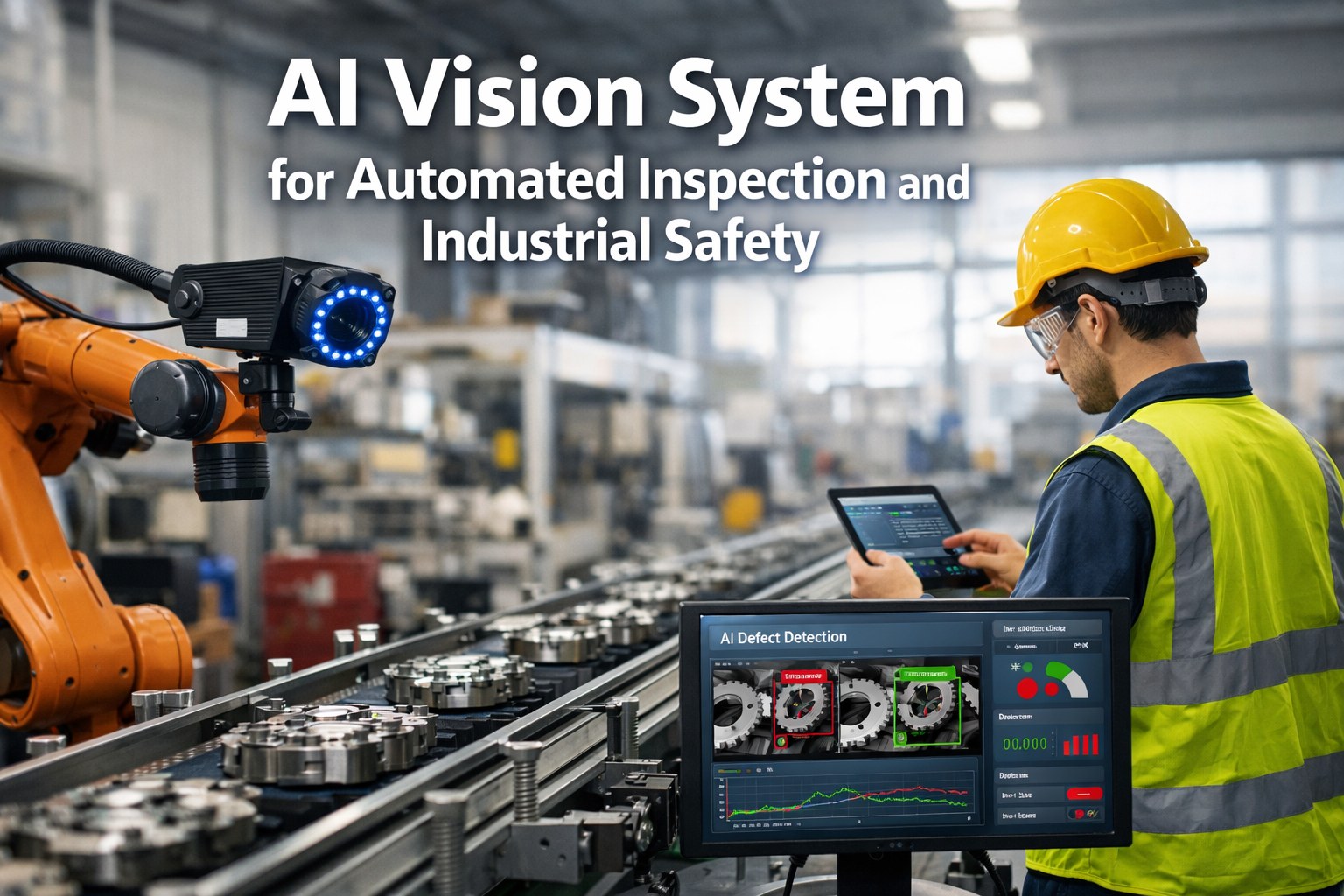
AI vision systems achieve their superior performance through deep learning algorithms trained on vast datasets of both acceptable products and various defect types. Unlike traditional machine vision that requires pre-defined criteria and consistent defect types, AI-based systems learn patterns and can identify anomalies even when they haven't been previously encountered. This makes them particularly valuable in heavy manufacturing environments where product designs, materials, and defect manifestations frequently change.
AI Quality Inspection Applications in Heavy Manufacturing
Steel & Metal Processing
Surface defect detection on coils, sheets, and bars during hot rolling. AI identifies scratches, cracks, inclusions, and deformations in real-time.
Automotive Components
Inspection of castings, machined parts, and assemblies. AI detects dimensional deviations, surface anomalies, and missing components.
Aerospace Materials
Detection of porosity, cracks, and structural anomalies in metal additive manufacturing and composite materials.
Weld Inspection
Automated inspection of welding seams for porosity, incomplete fusion, cracks, and geometric deviations.
The financial case for AI quality inspection is compelling. Intel reports that their AI vision inspection system saves $2 million annually in scrap avoidance alone. Foxconn achieved an 80% improvement in defect detection rates. A Japanese automotive parts manufacturer reached 95% defect detection accuracy while reducing labor costs by 30%. The AI visual inspection market reflects this value creation, growing from $1.7 billion in 2024 to a projected $12 billion by 2035—a 19.4% CAGR driven by proven ROI across heavy manufacturing sectors.
The Cost of Poor Quality (COPQ) in Heavy Manufacturing
World-class manufacturers target less than 5%
COPQ Components
Industry-Specific AI Applications
While the core technologies—predictive maintenance and AI vision—apply across heavy manufacturing, each industry faces unique challenges that require specialized implementations. Understanding these sector-specific applications helps manufacturers identify the highest-impact opportunities for their operations.
AI Applications by Heavy Manufacturing Sector
Steel & Metals
AI predicts silicon levels in castings, enabling 40% reduction in silicon variation and consistent metallurgical properties
Continuous vibration and temperature analysis detects wear patterns, reducing unplanned downtime by 15%+
Real-time detection of defects in wire rods, coils, and sheets during hot rolling process
Automotive
AI analyzes sensor data from assembly line robots, predicting wear and scheduling maintenance proactively
Vision AI inspects castings, stampings, and assemblies at speeds impossible for human inspectors
Automated inspection of thousands of weld points per vehicle for consistency and structural integrity
Aerospace
AI detects porosity, cracks, and anomalies in metal 3D-printed components with 90%+ accuracy
Predictive maintenance on jet engines, hydraulic systems, and landing gear using real-time sensor data
AI simulates how metals and composites respond under different conditions, reducing testing time significantly
Implementation Roadmap: From Pilot to Scale
Successful AI implementation in heavy manufacturing requires a strategic, phased approach that balances quick wins with long-term capability building. The most common failure mode is attempting to implement too broadly too quickly—overwhelming teams, straining budgets, and creating skepticism before value can be demonstrated. Industry data shows that organizations achieving the best results start with focused pilots on critical assets, prove ROI within 6-12 months, then scale systematically.
Heavy Manufacturing AI Implementation Roadmap
Assessment & Pilot
- Identify 3-5 critical assets with highest downtime impact
- Deploy industrial-grade sensors on pilot equipment
- Establish baseline metrics (current downtime, defect rates)
- Launch focused predictive maintenance pilot
- Begin collecting training data for AI models
Scale & Integrate
- Expand sensor deployment to additional critical equipment
- Implement AI quality inspection on highest-value production lines
- Integrate with existing CMMS, ERP, and MES systems
- Train maintenance teams on AI-driven workflows
- Establish human-in-the-loop validation processes
Optimize & Transform
- Deploy digital twins for process simulation and optimization
- Implement plant-wide predictive maintenance coverage
- Advanced AI for production planning and scheduling
- Integrate supply chain data for end-to-end visibility
- Continuous model improvement and refinement
Critical success factors for heavy manufacturing AI implementation include selecting sensors engineered for harsh industrial conditions (IP67 ratings, heat-resistant designs), ensuring robust data infrastructure capable of handling high-frequency sensor streams, and building cross-functional teams that include both production and IT personnel. Organizations that establish these cross-functional teams experience 52% faster deployment and higher user acceptance rates than those treating implementation as purely technical projects.
Critical Success Factors for AI Implementation
Industrial-Grade Hardware
Sensors with IP67 ratings and heat-resistant designs that withstand extreme manufacturing environments
Data Infrastructure
Edge computing for real-time processing plus cloud integration for advanced analytics and model training
Cross-Functional Teams
Combined production and IT teams achieve 52% faster deployment and higher acceptance rates
System Integration
Seamless connection with existing CMMS, ERP, MES, and SCADA systems for unified operations
Ready to Reduce Downtime and Quality Losses?
iFactory provides heavy manufacturers with the integrated AI platform needed to predict equipment failures, automate quality inspection, and optimize production operations. Our industrial-grade solutions are engineered for the extreme conditions of steel mills, automotive plants, and aerospace facilities—delivering measurable ROI within months.
Frequently Asked Questions
What is AI predictive maintenance and how does it differ from preventive maintenance?
AI predictive maintenance uses machine learning algorithms to analyze real-time sensor data—including vibration signatures, thermal fluctuations, current profiles, and acoustic patterns—to predict exactly when equipment will fail. Unlike preventive maintenance, which schedules repairs based on time intervals regardless of actual equipment condition, predictive maintenance enables repairs only when needed, during planned downtime. This approach reduces unnecessary maintenance by up to 40% while preventing 70-75% of unexpected breakdowns. The AI models continuously learn from equipment behavior, improving prediction accuracy over time and often detecting degradation patterns 30+ days before catastrophic failure would occur.
What ROI can heavy manufacturers expect from AI implementation?
ROI from AI in heavy manufacturing is consistently strong, with 95% of predictive maintenance adopters reporting positive returns and 27% achieving full payback in less than one year. The US Department of Energy documents potential 10x ROI from comprehensive implementations. Specific benefits include: 70-75% reduction in equipment breakdowns, 35-45% reduction in unplanned downtime, 25% lower maintenance costs, and 20-30% extended equipment life. For quality inspection, manufacturers report 83% reduction in defect escape rates, with companies like Intel saving $2 million annually in scrap avoidance. Metals and processing plants average 8x ROI from predictive maintenance partnerships. Most organizations see initial benefits within 3-6 months, with full ROI typically achieved within 12-18 months.
How accurate is AI quality inspection compared to human inspectors?
AI-powered vision systems consistently outperform human visual inspection by significant margins. While traditional human inspection achieves approximately 80% accuracy under optimal conditions—with performance degrading during extended shifts due to fatigue—AI systems achieve 90-99%+ accuracy consistently, 24/7. In controlled studies, AI systems detected 37% more critical defects than expert human inspectors working under optimal conditions. AI can detect surface defects as small as 0.1mm with 99.8% accuracy, surpassing the theoretical maximum performance of human inspectors. Additionally, AI systems process products at speeds of 1,000+ units per minute, compared to the much slower pace of manual inspection, while eliminating the subjective variability between individual human inspectors.
What are the biggest challenges in implementing AI in heavy manufacturing environments?
Heavy manufacturing presents unique implementation challenges including: (1) Harsh operating conditions—extreme temperatures, heavy vibration, and continuous operation require industrial-grade sensors with IP67 ratings and heat-resistant designs; (2) Legacy system integration—connecting AI platforms with existing CMMS, ERP, MES, and SCADA systems that weren't designed for real-time connectivity; (3) Data quality and volume—managing the massive data streams from industrial sensors while ensuring data accuracy and completeness; (4) Skills gap—maintenance teams unfamiliar with AI-driven workflows need clear training and demonstrated ROI to overcome cultural resistance; (5) Upfront investment—sensors, data infrastructure, and AI platforms require significant capital, though ROI typically justifies investment within 12-18 months. Organizations that establish cross-functional teams including both production and IT personnel experience 52% faster deployment success.
How do AI systems handle the extreme conditions in steel mills and foundries?
Modern AI systems for heavy manufacturing are specifically engineered for extreme industrial conditions. High-quality wireless triaxial vibration sensors feature IP67 ratings (dust-tight and water-resistant) and heat-resistant designs that operate reliably near furnaces, conveyors, and rolling mills where temperatures can exceed 1,500°C in proximity. These sensors gather real-time vibration data along three axes with high resolution at slower speeds, ensuring consistent monitoring even in harsh conditions. Edge computing processes data locally, enabling sub-second response times without requiring constant cloud connectivity—critical in low-connectivity zones common in heavy industrial facilities. The AI algorithms are trained specifically on heavy manufacturing data patterns, understanding the unique signatures of equipment like blast furnaces, rolling mills, heat treatment systems, and dust collection equipment.
What types of equipment benefit most from AI predictive maintenance in heavy manufacturing?
The highest-impact applications for AI predictive maintenance in heavy manufacturing include: (1) Rolling mills and drives—precision systems prone to wear from high loads and constant operation, where failure halts entire production lines; (2) Material handling systems—conveyors, cranes, and uncoilers that keep raw materials moving throughout the plant; (3) Heat treatment and furnaces—where inefficiency compromises metallurgical properties and increases energy consumption; (4) Rotating equipment—pumps, motors, fans, and compressors where vibration analysis detects imbalance, misalignment, looseness, and bearing wear; (5) Cooling and quenching systems—where pump or fan failures ruin product quality and cause extended downtime; (6) Dust collection and environmental systems—where failures create compliance issues or force production shutdowns. These assets are often single points of failure where a run-to-fail approach creates unacceptable operational and safety risks.
The Competitive Imperative
Heavy manufacturing stands at an inflection point. The $1.4 trillion annual cost of unplanned downtime, combined with the 20-30% of revenue lost to poor quality, represents an enormous opportunity for manufacturers who embrace AI-driven solutions. Early adopters are already capturing this value—achieving 70% reductions in equipment breakdowns, 90%+ quality detection accuracy, and ROI measured in months rather than years.
The technology has matured. Industrial-grade sensors now withstand the extreme conditions of steel mills and foundries. AI algorithms trained on billions of data points detect failure patterns invisible to human analysis. Vision systems inspect products at speeds and accuracy levels impossible for manual inspection. The question for heavy manufacturers is no longer whether AI will transform operations—it's whether you'll lead that transformation or struggle to catch up with competitors who moved first.


.png)