Every hour your production line runs without AI-driven intelligence, you are bleeding revenue you cannot see. Defects escape. Downtime compounds. Manual bottlenecks strangle throughput. The manufacturers closing the gap are not working harder — they are deploying AI in manufacturing to see further, decide faster, and scale smarter than any human workforce alone can achieve. This guide translates the 2026 landscape of artificial intelligence in manufacturing into financial outcomes, deployment paths and a decision framework your leadership team can act on today.
AI in Manufacturing · Complete 2026 Guide
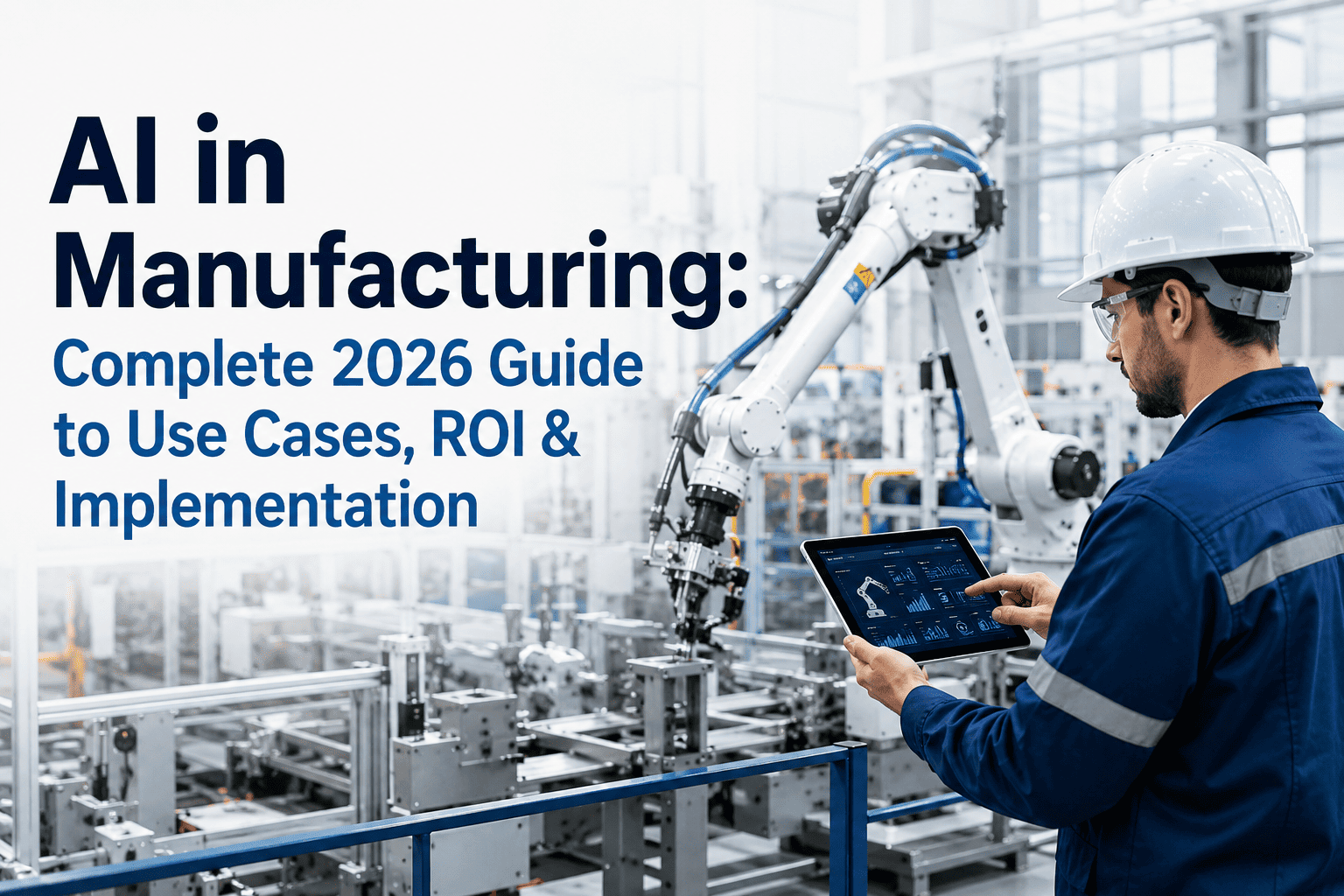
AI in Manufacturing: Complete 2026 Guide to Use Cases, ROI & Implementation
From predictive maintenance to AI visual inspection — the definitive enterprise roadmap for deploying artificial intelligence across your factory floor and measuring the financial return at every stage.
374%3-Year ROI · Forrester
7–8 moAverage Payback Period
$691KAnnual Labor Savings / Line
99%+AI Detection Accuracy
What You Will Learn
- Why manufacturers lose 20–30% of revenue to hidden operational inefficiency
- The 7 highest-ROI AI use cases proven across automotive, electronics, pharma, and food
- A head-to-head comparison: legacy operations vs. AI-optimized factories
- The financial model behind a $50M plant deployment
- A 6-week implementation path that proves value before full rollout
The Hidden Revenue Leak Most Plants Never Measure
Industry research consistently places Cost of Poor Quality (COPQ) at 15–25% of annual revenue for mid-market manufacturers. For a $50M plant, that is $7.5M to $12.5M leaving the building every year through scrap, rework, warranty claims, and customer churn — none of it appearing as a single line item on any P&L.
Human inspectors make pass/fail decisions in 200–300 milliseconds under factory lighting. By hour six of a shift, their accuracy has dropped 15–25%. Inter-inspector agreement on defect severity sits at 55–70%, meaning the same part may pass one shift and fail the next. This is not a training problem. It is a biological one — and it is costing your operation money every single day.
AI in manufacturing addresses the biological limit directly. A modern computer vision system inspects 10,000+ parts per hour at sub-100ms latency, holds 99%+ detection accuracy across every shift with zero drift, and catches sub-millimetre defects down to 50 microns that no human eye can reliably see at line speed.
Executive Summary: AI Manufacturing ROI by the Numbers
⚙
$2.5M
Annual Savings
A $50M plant reducing defect escape by 25% on a typical 20% COPQ baseline recovers $2.5M per year from scrap and warranty alone.
?
$2M
Intel Wafer Case
Intel publicly reports $2M in annual savings from a single AI wafer vision inspection deployment — one station, one product line.
?
2.3% → 0.1%
Defect Escape Rate
An electronics manufacturer eliminated $1.8M of annual warranty exposure by cutting its defect escape rate from 2.3% to 0.1%.
?
22%
OEE Lift · BMW
BMW documented a 22% Overall Equipment Effectiveness improvement alongside a 30–40% reduction in defects at AI-enabled production stations.
Legacy Friction vs. AI-Optimized Excellence
The table below contrasts the operational reality of a traditionally managed plant against a factory running smart manufacturing AI on the same floor space, the same headcount, and within the same capital budget cycle.
Operational Dimension
Legacy Friction — The Old Way
AI-Optimized Excellence — The New Way
Defect Detection
70–80% human accuracy · degrades 15–25% after 2 hrs
99%+ AI accuracy · zero degradation · 24/7/365
Inspection Speed
2–3 parts per minute per inspector
10,000+ parts per hour at sub-100ms latency
Minimum Defect Size
0.5–1.0mm practical human limit at line speed
50 microns — sub-millimetre, every part, every shift
Unplanned Downtime
Reactive maintenance · average $260K per hour downtime
Predictive alerts 14 days ahead · 35–45% downtime reduction
Quality Consistency
55–70% inter-inspector agreement on severity
100% consistency — same model, same decision, every time
New Defect Adaptation
Weeks of retraining; line holds during updates
Active learning captures anomalies; retrains in background
Annual Cost per Station
$30K–50K per inspector · rises with headcount scaling
$30K–200K one-time CapEx · low ongoing OpEx
Traceability
Paper logs · delayed root cause · no image evidence
Full digital audit trail · annotated images · instant recall
See the comparison run live on your product line
Our specialists will map your highest-impact inspection station and model the ROI before you commit to any hardware.
7 Highest-ROI AI Use Cases in Manufacturing (2026)
Not all AI manufacturing use cases deliver equal returns. The seven applications below are ranked by documented financial impact across production environments — each with a proven deployment pattern that de-risks adoption at the plant level.
01
AI Visual Inspection & Defect Detection
Computer vision models running on edge GPUs inspect every unit at production speed — catching scratches, cracks, dimensional errors, contamination, misalignment, and 8 additional defect classes that human inspectors miss at shift-end fatigue levels.
See the AI visual inspection platform →ROI Signal: $1.8M warranty exposure eliminated · 99%+ accuracy · 7–8 month payback
02
Predictive Maintenance & Equipment Health Monitoring
Machine learning models trained on vibration, temperature, current draw, and acoustic sensor data predict failures 7–21 days before they occur — eliminating the $260K/hour average cost of unplanned downtime in discrete manufacturing.
ROI Signal: 35–45% downtime reduction · 20–25% maintenance cost reduction
03
AI-Driven Process Optimization & Yield Management
Reinforcement learning models continuously tune process parameters — temperature, pressure, feed rate, cycle time — to maximize first-pass yield without human intervention. Semiconductor fabs and chemical processors report 8–15% yield improvements within 90 days.
ROI Signal: 8–15% yield lift · reduces raw material consumption 10–18%
04
Demand Forecasting & Supply Chain Intelligence
AI models integrating ERP, market signals, weather, and logistics data generate demand forecasts with 15–30% lower error than statistical baselines — reducing safety stock requirements and eliminating both stockouts and overproduction waste simultaneously.
ROI Signal: 15–30% forecast error reduction · 10–20% inventory carrying cost reduction
05
Autonomous Quality Sorting & Reject Management
Vision-guided robotic arms sort, reroute, or reject parts based on real-time AI classification — replacing manual sorting stations with 24/7 autonomous cells that log every decision with full image evidence for regulatory audit trails.
Request an audit for your sorting line →ROI Signal: 85% fewer customer complaints · eliminates 2–4 FTE per line
06
Energy Consumption Optimization
AI scheduling engines shift energy-intensive production cycles to off-peak tariff windows, reduce idle power draw on unoccupied equipment, and optimize compressed air and HVAC systems — delivering 12–22% energy cost reductions without capital expenditure.
ROI Signal: 12–22% energy cost reduction · typically 6–9 month payback
07
Production Scheduling & OEE Maximization
Machine learning schedulers optimize job sequencing, changeover sequencing, and resource allocation across multi-product lines — lifting Overall Equipment Effectiveness by 15–25% in documented deployments without adding shift capacity.
ROI Signal: 15–25% OEE improvement · 22% documented at automotive deployments
Impact Across Three Dimensions: Workflow · Cost · Scale
⚡
Workflow Acceleration
- Inspection cycles compressed from minutes to milliseconds
- Root cause identification reduced from days to minutes
- Defect images auto-routed to CMMS with zero manual entry
- PLC reject signals fire in under 100ms — no human in the loop
- New product qualification time cut 40–60% via model transfer
?
Measurable Cost Reduction
- $691K average annual labor savings per production line
- $500K+ scrap reduction in first year at mature deployments
- $1–2M warranty claim elimination documented in electronics
- 35–45% unplanned downtime reduction via predictive maintenance
- 374% three-year ROI · 7–8 month payback · Forrester verified
?
Enterprise-Grade Scalability
- Single station deployment proves ROI before multi-line rollout
- Edge GPU compute scales without cloud dependency or data risk
- Integrates with SAP, Oracle, Maximo, and any REST-capable CMMS
- Active learning adapts to new product variants without full retrain
- Air-gap capable deployment for defense and regulated environments
Which use case fits your plant first? Talk to a specialist.
Book a Demo →
Industry-Specific AI Deployment Results
Every sector carries different defect taxonomies, tolerance standards, and regulatory requirements. Industry 4.0 AI deployments are most successful when the model architecture and lighting geometry are matched to the specific inspection challenge — not genericized across product families.
Automotive
Paint defects, weld quality, assembly verification, fastener torque markers detected at line speed with structured and dark-field lighting geometries.
30–40% defect reduction · 22% OEE lift · BMW documented
Electronics
Solder joint cracks, component misalignment, PCB surface scratches, and shorts caught via coaxial and diffuse illumination on sub-millimetre tolerances.
Defect escape 2.3% → 0.1% · $1.8M saved annually
Semiconductor
Wafer indentations, grinding marks, contamination particles, bubble defects, and mount shift detected at 50-micron resolution across every wafer.
$2M annual savings · Intel wafer inspection case
Food & Beverage
Seal integrity, label placement, fill level consistency, and foreign object detection running on FDA-compliant lines with full traceability logging.
85% fewer packaging complaints · recall risk eliminated
Pharmaceutical
Capsule integrity, tablet surface defects, vial contamination, and label compliance verification — audit-ready image archives for 21 CFR Part 11 environments.
Tens of millions saved in reduced product recalls annually
Aerospace
Composite layup flaws, weld porosity, fastener verification, and surface integrity checks across titanium, CFRP, and aluminum structures at AS9100 standards.
AS9100 audit-ready output · zero-escape quality targets met
The 6-Week Path from Install to Validated ROI
Enterprise AI manufacturing implementation historically required 6–12 months to produce a single working station. The modern deployment pattern inverts this — one critical inspection station goes from camera mount to production-live in six weeks, proving ROI before any multi-line commitment is made.
Week 1
Install
Position camera at highest-impact station. 30 minutes per camera. Configure optimized lighting geometry. Connect to plant network and CMMS integration layer.
Weeks 2–3
Capture
Collect 500–2,000 labeled images across good, marginal, and defective parts. Active learning minimizes labeling effort and prioritizes highest-variance samples.
Week 4
Train
Fine-tune CNN or Vision Transformer model on your labeled production dataset. Initial accuracy target: 92%+. Model validated against held-out test images from your line.
Week 5
Shadow Run
AI runs in parallel with manual inspection. Outputs compared in real time. Edge cases resolved. Target 99%+ recall achieved before production handover.
Week 6
Go Live
AI takes over production inspection. Continuous active learning pushes accuracy from 90–92% to 99%+ within the first live week. ROI validated and documented.
Every Defect Your Inspectors Miss Is a Defect Your Customer Finds
Start With One Camera. Prove ROI in 6 Weeks. Scale When It Does.
Book a 30-minute session with an iFactory AI specialist. We will review your highest-impact inspection station, walk through the camera and lighting configuration, and map the 6-week pilot path that delivers validated ROI before you commit to a full rollout.
Forrester-verified 374% ROI · 7–8 month payback · 6-week from install to live · 99%+ accuracy

.jpeg)

