Every hour your legacy SCADA system runs without predictive intelligence, your competitors are capturing the uptime, energy savings, and OEE gains you are leaving on the floor. In 2026, the factories winning on margin are not the ones with the most machines — they are the ones with the most connected, data-driven supervision layer. If your SCADA platform is still reacting to failures instead of predicting them and you are not running a modern factory. You are running an expensive gamble.
iFactory Intelligence Series
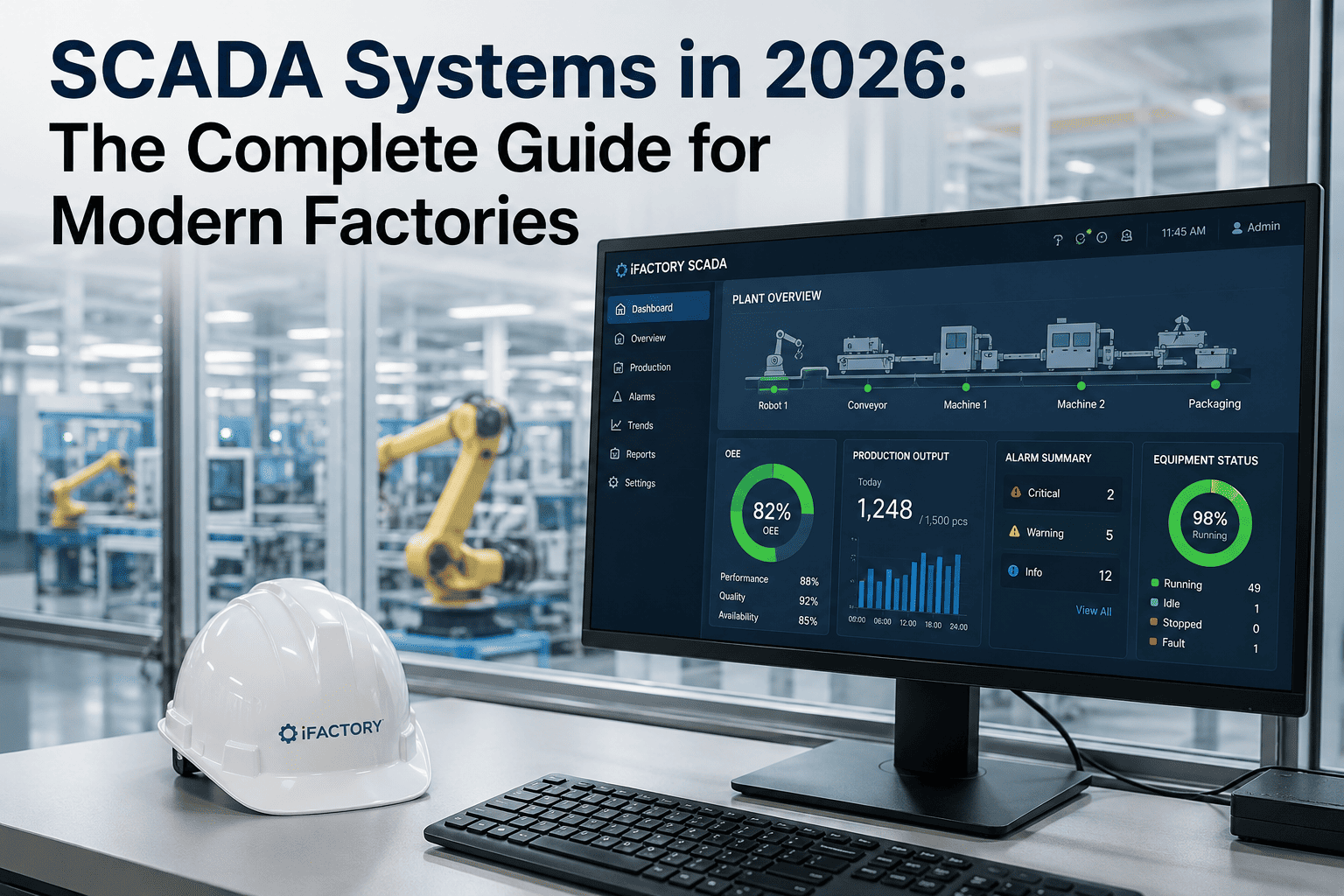
SCADA Systems in 2026: The Complete Guide for Modern Factories
Architecture, OPC-UA integration, OEE tracking, cybersecurity, and how AI-powered SCADA is redefining supervisory control across industrial operations.
68%
of manufacturers cite SCADA modernisation as a top-3 priority in 2026
$4.2M
Average annual loss from unplanned downtime in mid-size plants
40%
OEE improvement achievable with AI-integrated SCADA platforms
3×
Faster incident response with modern SCADA alarm management
What Is a SCADA System — and Why the Definition Has Changed
SCADA — Supervisory Control and Data Acquisition — was originally designed to monitor and control physical processes from a central location. In its classic form, a SCADA system collected sensor data from PLCs and RTUs, displayed it on operator HMI screens, and allowed remote actuation of field devices. That definition served manufacturing well for decades.
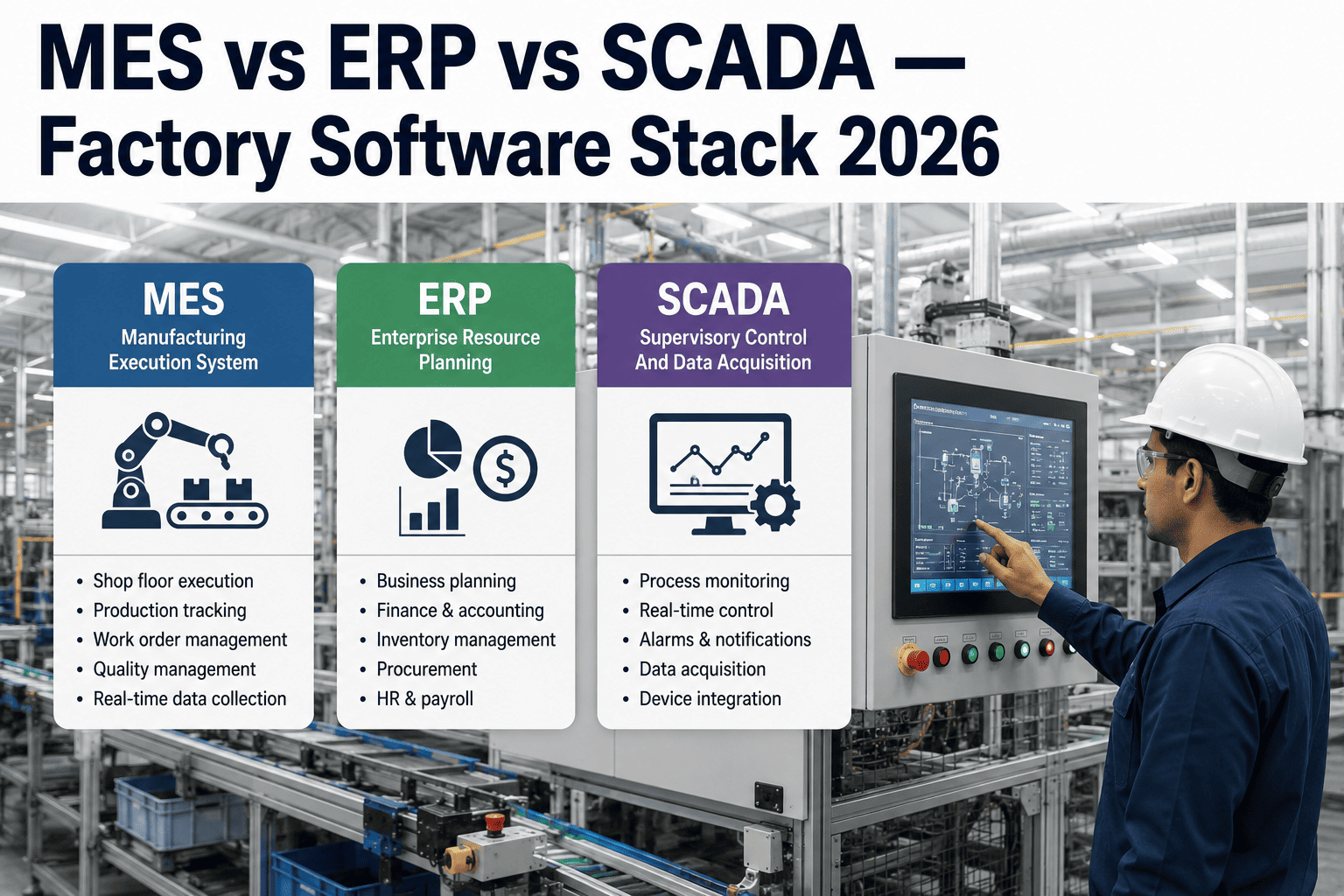
In 2026, SCADA is no longer just a supervisory layer. It is the real-time intelligence backbone of the modern factory. Today's SCADA systems integrate with cloud platforms, AI analytics engines, digital twin environments, and enterprise ERP systems — transforming raw sensor telemetry into actionable operational decisions at every level of the organisation.
Modern SCADA is not a monitoring tool — it is a decision-support platform. Factories that treat it as the former are spending capital to watch problems happen. Factories that leverage it as the latter are preventing problems before they start.
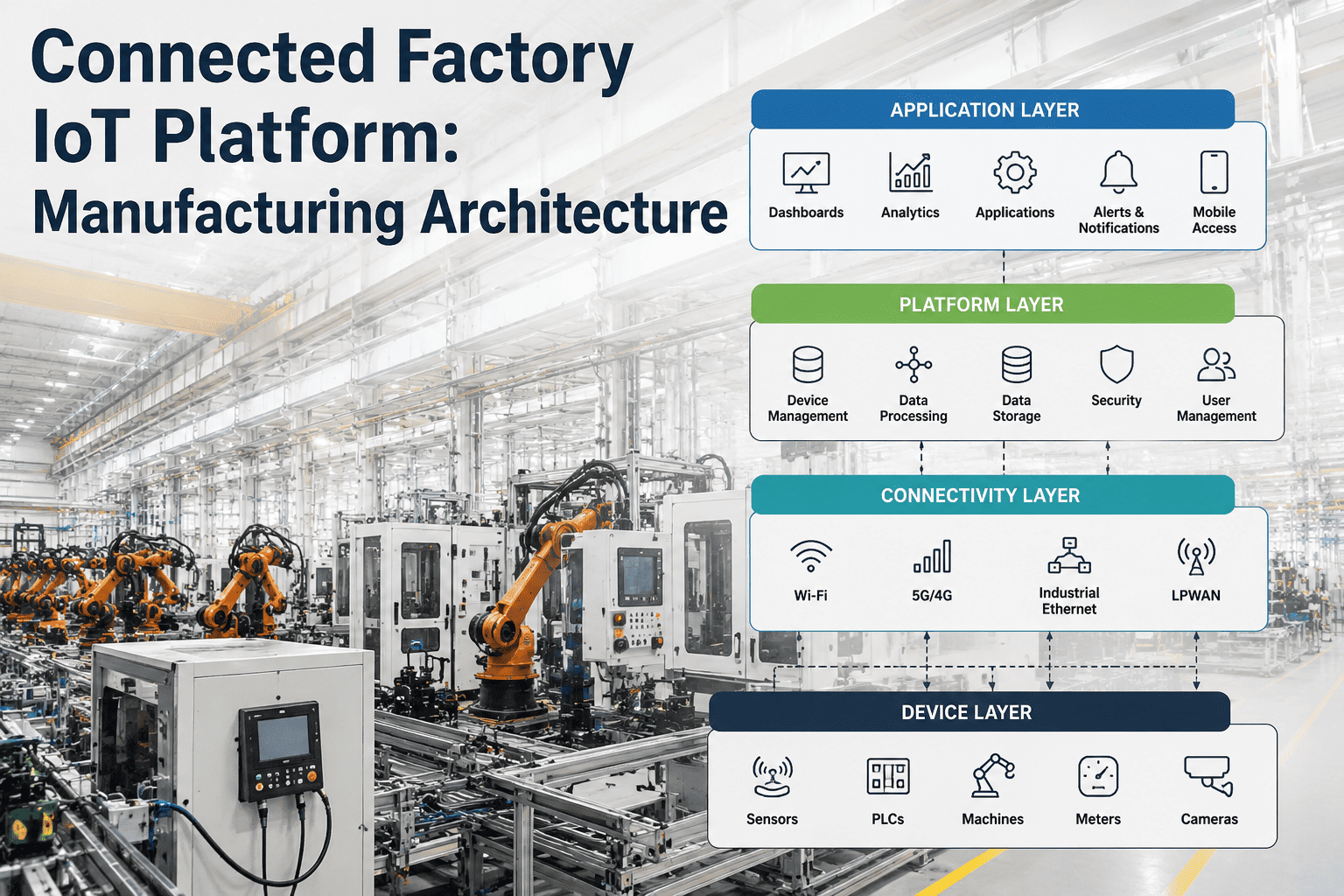
The Four-Layer Architecture of a Modern Industrial SCADA System
Understanding how SCADA is structured helps operations and IT leaders identify where gaps exist in their current deployments — and where the greatest ROI opportunities lie.
01
Field Layer
Sensors, actuators, PLCs, and RTUs that interface directly with physical equipment. This layer generates raw process data — temperature, pressure, vibration, current draw, flow rates — that feeds every layer above it. Data quality at this layer determines analytical accuracy everywhere else.
02
Communication Layer
Industrial protocols — OPC-UA, MQTT, Modbus, DNP3, EtherNet/IP — that transport data from field devices to the SCADA server. In 2026, OPC-UA has become the gold standard for secure, interoperable machine-to-machine communication across heterogeneous environments.
03
SCADA Server and Historian
The processing and storage core — where data is aggregated, contextualised, and historised. Modern SCADA servers connect to cloud data lakes, enabling long-term trend analysis, AI model training, and cross-site benchmarking that on-premise historians alone cannot support.
04
Analytics and HMI Layer
Operator dashboards, alarm management consoles, KPI displays, and — in AI-integrated deployments — predictive alert interfaces. This is where SCADA data becomes human-readable insight. The quality of this layer determines whether operators act on data or ignore it.
See how iFactory's AI platform integrates with your existing SCADA infrastructure — without rip-and-replace.
Book a Demo
Legacy SCADA vs. AI-Integrated SCADA: The Performance Gap
The difference between a factory running legacy supervisory control and one running an AI-integrated SCADA platform is not incremental. It is structural. The table below maps the operational gap across seven critical dimensions.
| Dimension |
Legacy SCADA |
AI-Integrated SCADA |
| Failure Detection |
Reactive — alarm fires after failure occurs |
Predictive — alerts 14-21 days before failure |
| Alarm Management |
High false-positive rates cause alarm fatigue |
AI-tuned thresholds eliminate noise, surface real threats |
| Data Utilisation |
Historians store data rarely analysed |
Continuous AI model training on live historian data |
| OEE Visibility |
Periodic reports, often 24-48hr delayed |
Real-time OEE dashboards with root-cause attribution |
| Integration Depth |
Siloed from ERP, CMMS, and financial systems |
Bi-directional feeds to ERP, CMMS, ESG reporting |
| Security Posture |
Flat networks, limited segmentation, legacy protocols |
IEC 62443 architecture, encrypted OPC-UA, zero-trust segmentation |
| Maintenance Model |
Calendar-based or run-to-failure |
Condition-based, AI-scheduled with auto-generated work orders |
OPC-UA: Why It Is the Backbone of Modern SCADA Integration
OPC Unified Architecture has become the lingua franca of industrial interoperability — and for good reason. Unlike its predecessor OPC-DA, which was Windows-specific and COM-dependent, OPC-UA is platform-agnostic, natively encrypted, and built for both horizontal machine-to-machine and vertical plant-to-cloud communication.
Vendor-Neutral Interoperability
OPC-UA connects PLCs, sensors, historians, and cloud platforms from different manufacturers without custom middleware. A Siemens PLC, a Rockwell historian, and an AWS IoT endpoint can all communicate on the same semantic information model.
Built-In Security
OPC-UA natively supports message signing, encryption, and certificate-based authentication. This eliminates the open communication vulnerabilities that have made legacy SCADA environments a primary target for industrial cyberattacks.
Cloud-Native Scalability
OPC-UA over WebSockets (OPC-UA PubSub) enables direct plant-to-cloud data streaming without polling overhead. This architecture supports the high-frequency, high-volume data flows required for AI model training and digital twin synchronisation.
SCADA and OEE: Closing the Real-Time Visibility Gap
Overall Equipment Effectiveness remains the single most important productivity metric in manufacturing — yet most plants calculate it from shift reports compiled hours after the fact. By the time OEE data reaches a production manager, the losses it reflects have already compounded. Modern SCADA systems eliminate this lag entirely.
Availability
SCADA tracks planned vs. unplanned downtime at the machine level in real time — flagging the exact moment a line stops, logging the cause code, and updating OEE calculations instantaneously. No more end-of-shift manual entry.
Performance
Speed losses and micro-stoppages that never appear in shift logs are captured at the PLC level. AI models correlate performance degradation with upstream variables — tool wear, material variation, environmental conditions — enabling targeted intervention.
Quality
Integration between SCADA process data and quality inspection systems enables real-time correlation between process parameter deviations and defect rates. Root cause analysis that previously took days now completes in minutes.
Want to see real-time OEE tracking in action across your production lines?
Request a Demo
Industrial Cybersecurity: The SCADA Risk Most Manufacturers Underestimate
The convergence of IT and OT networks has dramatically expanded the attack surface of modern SCADA environments. Industrial cyberattacks increased by 87% between 2022 and 2025, with SCADA systems among the most targeted assets. The consequences are not just operational — they are financial, regulatory, and reputational.
Common Vulnerability Patterns
- Legacy SCADA servers running unpatched operating systems
- Flat OT networks with no segmentation between control zones
- Remote access via insecure VPN tunnels without MFA
- Cleartext industrial protocols (Modbus, DNP3) on routable networks
- Default vendor credentials never rotated after commissioning
IEC 62443-Aligned Best Practices
- Network segmentation into defined Security Levels (SL1-SL4)
- OPC-UA with certificate-based authentication and TLS encryption
- Zero-trust remote access with role-based least-privilege controls
- Continuous anomaly detection on OT network traffic
- Regular vulnerability assessments and patch management cadence
How iFactory's Platform Integrates with Your Existing SCADA Infrastructure
One of the most common barriers to SCADA modernisation is the assumption that it requires a full system replacement. It does not. iFactory's AI-powered platform is designed as an intelligence layer that sits above your existing SCADA and PLC infrastructure — augmenting it with predictive analytics, digital twin capabilities, and enterprise integration without touching your control logic.
1
Connect via Standard Protocols
iFactory ingests data from your existing SCADA historians, PLCs, and sensors via OPC-UA, MQTT, REST APIs, and database connectors. No rip-and-replace. No plant shutdown. Integration typically completes in 2-4 weeks.
2
AI Models Learn Your Baselines
Machine learning models establish normal operating envelopes for each connected asset using your historical SCADA data. The platform begins surfacing anomalies and predictive alerts within 4-6 weeks of connection.
3
Dashboards, Alerts, and Work Orders
Operators and maintenance teams interact with AI-enriched dashboards that overlay predictive intelligence on familiar SCADA views. Condition-triggered work orders flow automatically into your CMMS — no manual transcription.
4
Enterprise Data Flows
SCADA-derived asset health data feeds upward into ERP, financial, and ESG reporting systems — closing the loop between operational performance and business outcomes. Leadership dashboards show OEE, maintenance costs, and energy in financial terms.
Selecting a SCADA Platform in 2026: Six Criteria That Determine Long-Term Value
Not every SCADA platform is built for the demands of AI-integrated, cloud-connected, cybersecure operations. Evaluating platforms on the following criteria separates short-term deployments from long-term competitive infrastructure.
01 — Protocol Breadth
Support for OPC-UA, MQTT, Modbus, EtherNet/IP, DNP3, and REST APIs. Proprietary-only platforms create vendor lock-in that constrains future flexibility.
02 — AI and Analytics Depth
Native ML capabilities for anomaly detection, predictive maintenance, and RUL projections — not bolted-on third-party modules. The models should train on your data, not generic benchmarks.
03 — Cybersecurity Architecture
IEC 62443 compliance, role-based access control, encrypted communications, and audit logging should be platform-native, not afterthoughts requiring additional configuration.
04 — Cloud and Edge Flexibility
Support for edge processing where latency is critical, cloud aggregation for cross-site analytics, and hybrid architectures that allow both. Rigid cloud-only or edge-only platforms limit deployment options.
05 — Enterprise Integration
Bi-directional connectors to SAP, Oracle, Maximo, and leading CMMS platforms. SCADA data that stays in the OT layer cannot drive business-level decisions.
06 — Time to First Value
The best platform is the one that delivers measurable results before executive patience runs out. Phased deployment roadmaps with 4-6 week value milestones separate deployable solutions from perpetual pilots.
iFactory PLC/SCADA Integration
Your SCADA System Should Be Predicting Failures — Not Just Recording Them
iFactory connects to your existing SCADA infrastructure via OPC-UA and standard APIs — adding AI-powered predictive analytics, real-time OEE tracking, and enterprise integration without disrupting your operations. First measurable value in 4-6 weeks.
4-6wk
Time to first value
40%
OEE improvement potential
$3.5M
Annual savings potential
10-30×
Return on investment