Every year, manufacturers lose millions to the wrong control architecture — not because better options don't exist, but because engineering teams inherit legacy systems, procurement teams default to familiar vendors, and no one stops to ask: is this the right system for what we actually need to do? Choosing between a PLC, SCADA, and DCS isn't a procurement decision. It's a strategic one. Get it wrong and you pay in downtime, integration debt and capped scalability for the next decade.
iFactory PLC/SCADA Integration Intelligence
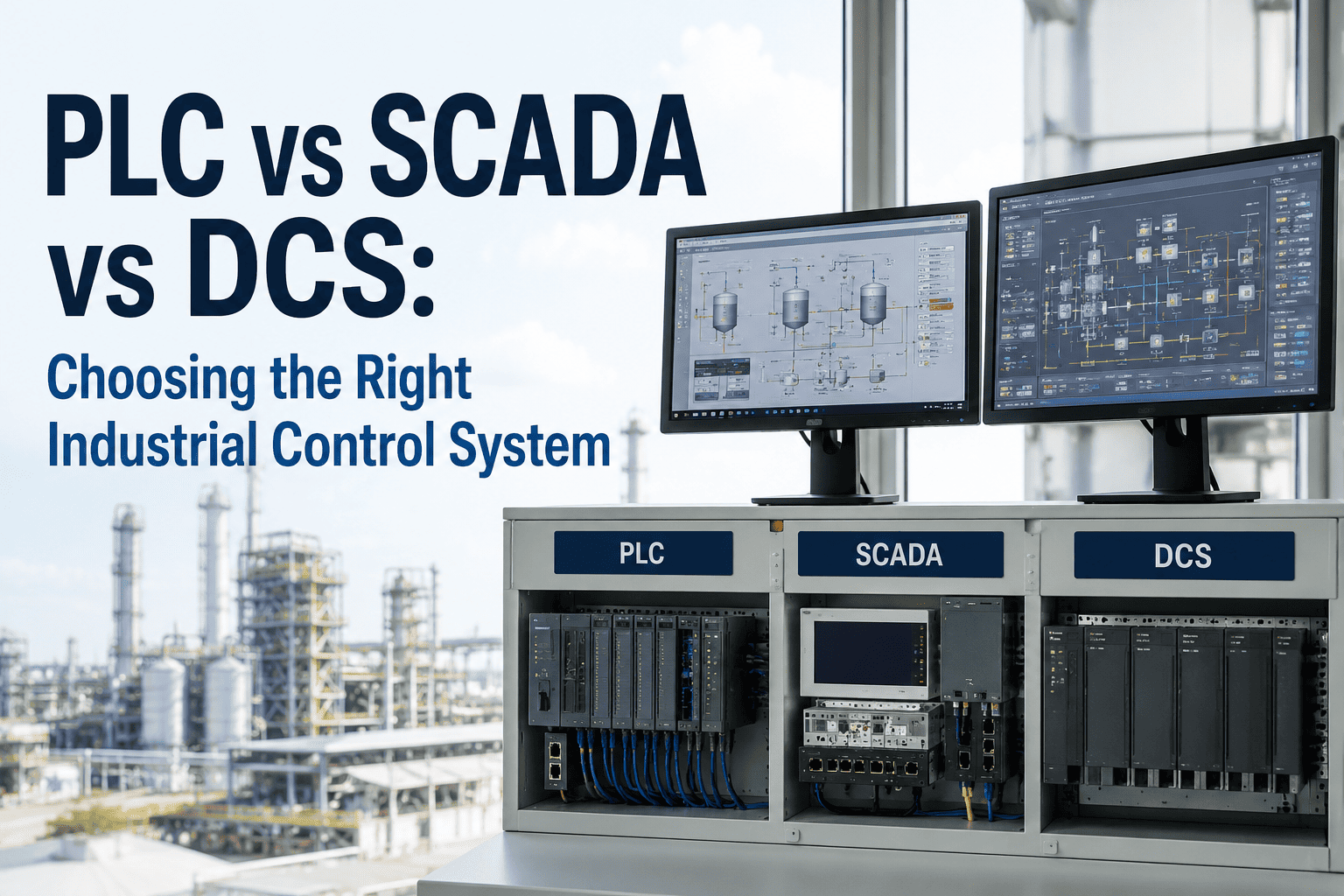
PLC vs SCADA vs DCS: Choosing the Right Industrial Control System
Architecture, latency, cost, and best-fit use cases — a complete decision framework for discrete and process manufacturing engineers and operations leaders.
3
Systems compared in depth
10x
Integration cost reduction with right architecture
40%
Downtime reduction from correct system selection
$2M+
Avg. cost of wrong control system over 5 years
What Each System Actually Does — And What It Doesn't
The PLC vs SCADA vs DCS debate persists because each system evolved to solve a different problem. Conflating them leads to overengineered point solutions or dangerously under-monitored process environments. Here is what each architecture was built for.
PLC
Programmable Logic Controller
Designed for discrete, high-speed machine control. PLCs execute deterministic ladder logic in milliseconds — ideal for assembly lines, packaging, press operations, and any application requiring precise sequencing and fast cycle times.
- › Scan cycles of 1–10ms for real-time control
- › Hardened for harsh floor environments
- › Vendor ecosystems: Siemens, Allen-Bradley, Mitsubishi
- › Best for: discrete manufacturing, robotics, motion control
SCADA
Supervisory Control and Data Acquisition
A supervisory layer, not a controller. SCADA aggregates data from PLCs, RTUs, and field devices across distributed assets — providing centralised visibility, alarm management, and operator control across geographically dispersed infrastructure.
- › Operates over wide-area networks and telemetry links
- › Historian integration for trend analysis and reporting
- › Platforms: Ignition, iFIX, Wonderware, WinCC
- › Best for: utilities, pipelines, water treatment, substations
DCS
Distributed Control System
Purpose-built for continuous process control where a plant-wide, tightly integrated architecture is required. DCS platforms distribute control logic across multiple controllers with a unified engineering environment — critical where process uptime and safety integrity are paramount.
- › Redundant controllers and field networks by design
- › Integrated safety instrumented system support
- › Vendors: Honeywell, Emerson DeltaV, ABB 800xA
- › Best for: oil and gas, chemicals, pharmaceuticals, power
The Decision Matrix: Which System Belongs Where
The right control system is determined by four primary factors: process continuity requirements, geographic distribution of assets, control loop complexity, and integration strategy. Use this matrix to benchmark your environment.
| Criteria |
PLC |
SCADA |
DCS |
| Primary Function |
Machine-level discrete control |
Supervisory monitoring and acquisition |
Plant-wide continuous process control |
| Response Latency |
1–10ms deterministic |
1–60 seconds supervisory |
100ms–1s process control |
| Geographic Scope |
Single machine or cell |
Multi-site, wide-area |
Single plant, tightly integrated |
| Redundancy |
Optional, add-on cost |
Server-level redundancy |
Built-in at controller and network level |
| Engineering Complexity |
Low to medium |
Medium — integration dependent |
High — unified engineering environment |
| Upfront Cost |
$5K–$80K per cell |
$50K–$500K platform |
$500K–$5M+ plant-wide |
| AI/Digital Twin Readiness |
Via OPC-UA or MQTT bridge |
Native historian connectivity |
Deep process data via DCS APIs |
| Ideal Industry |
Discrete, automotive, packaging |
Utilities, infrastructure, mining |
Oil and gas, pharma, chemicals, power |
Legacy Friction vs Optimised Excellence: The Real Cost of the Status Quo
Most facilities are not operating with the wrong system in isolation — they are operating with the wrong system compounded by years of bolt-on fixes, proprietary data silos, and integration workarounds that accumulate technical debt faster than any single project can clear it. Here is what that friction costs, and what optimised architecture delivers.
Legacy Friction — The Old Way
Data Visibility
Islands of data per system — PLC historians not connected to SCADA, DCS data inaccessible to enterprise MES or ERP. Operators make decisions on incomplete information.
Alarm Management
Alarm floods from disconnected systems. No correlation across PLC faults and SCADA events. Operators develop alarm fatigue, critical alerts missed.
Maintenance Posture
Reactive — fault after failure. No condition data flowing from PLC I/O or DCS field devices into any predictive maintenance tool.
Integration Cost
Custom point-to-point integrations between every system. Each upgrade breaks adjacent connections. Ongoing integration maintenance consumes engineering resources.
AI Readiness
Near zero — no unified data layer, inconsistent timestamps, proprietary protocols blocking any ML pipeline from accessing real-time operational data.
Optimised Excellence — The New Way
Data Visibility
Unified operational data layer via OPC-UA and MQTT bridges PLC, SCADA, and DCS into a single digital twin platform. Every asset visible in real time from a single pane of glass.
Alarm Management
Correlated, contextualised alerts from AI models that understand asset behaviour across systems. Signal-to-noise ratio optimised. Critical events surface, nuisance alarms suppressed.
Maintenance Posture
Predictive — condition data from PLC I/O and DCS field devices feeds AI models. Failures predicted 14–21 days in advance. Maintenance scheduled on actual condition, not calendar.
Integration Cost
Standard protocol adapters — OPC-UA, MQTT, REST APIs. One integration layer connecting all systems. Upgrades managed at the platform level, not rebuilt from scratch.
AI Readiness
Full AI pipeline — unified, timestamped operational data feeds digital twin models. Predictive maintenance, energy optimisation, and process analytics operational within weeks.
How iFactory Integrates Across PLC, SCADA, and DCS Environments
iFactory's AI-powered digital twin platform is protocol-agnostic by design. Whether your facility runs Allen-Bradley PLCs, an Ignition SCADA deployment, or a Honeywell DCS, iFactory connects via native industrial protocols and begins delivering predictive intelligence without replacing your existing control infrastructure.
Workflow Acceleration
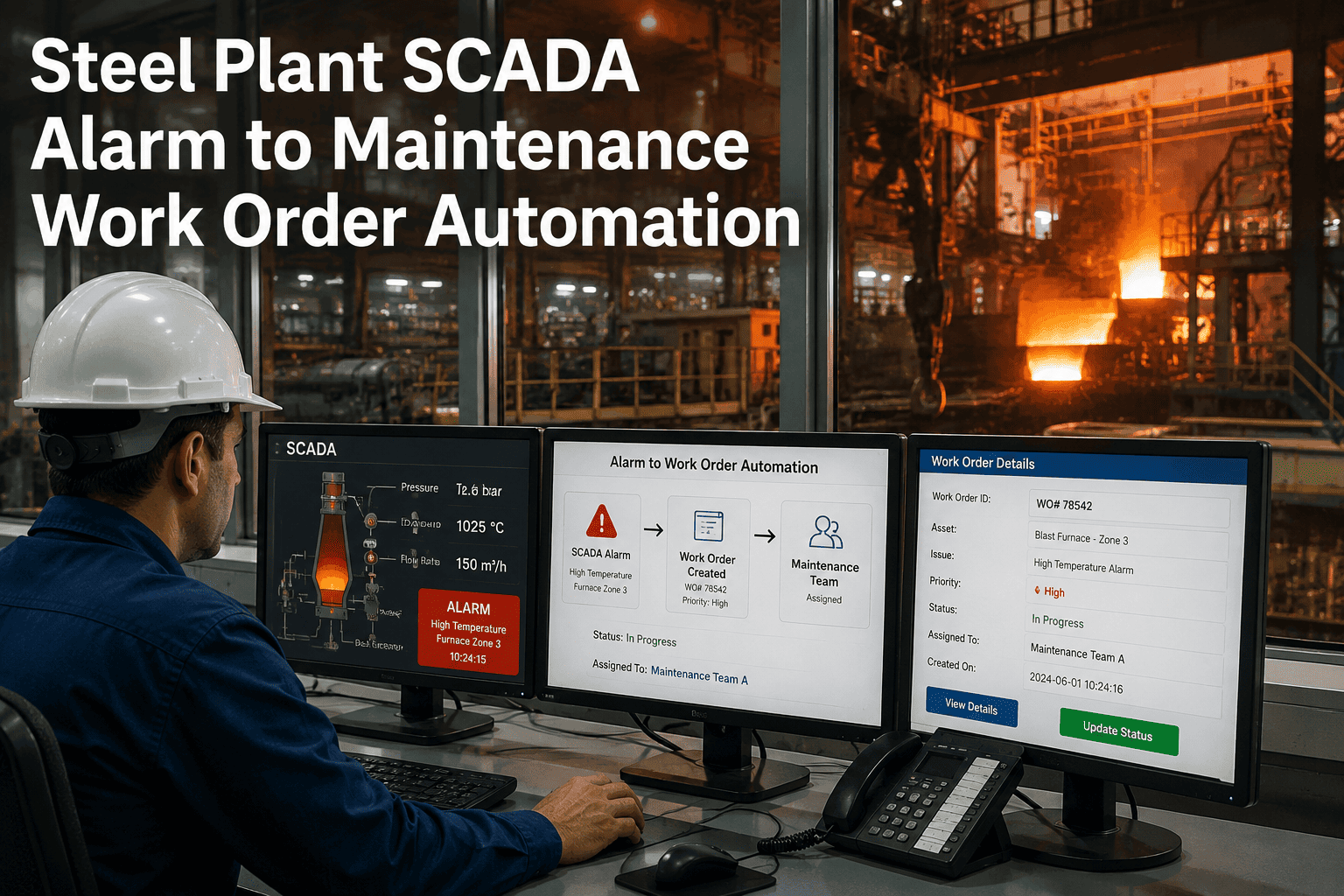
Condition data from every PLC, SCADA historian, and DCS controller feeds a unified AI layer. Maintenance engineers receive work orders generated automatically from real asset condition — not schedules.
Overhead Reduction
Eliminate integration maintenance overhead from proprietary point-to-point connections. One standardised integration layer — OPC-UA and MQTT — replaces years of custom middleware and the engineering hours that maintain it.
Output and Growth
Predictive maintenance across your PLC and DCS asset base eliminates unplanned downtime. Energy optimisation across SCADA-monitored infrastructure reduces utility spend. Combined: 15–35% OEE improvement within 12 months.
PLC/SCADA Integration: Common Architecture Patterns That Work
The most successful industrial AI deployments do not replace control systems — they augment them with a data and intelligence layer that sits above existing infrastructure. Here are the three integration patterns iFactory supports most frequently.
01
PLC + Digital Twin via OPC-UA
The most common entry point for discrete manufacturers. OPC-UA server deployed on existing PLC infrastructure — Allen-Bradley, Siemens, or Mitsubishi. iFactory ingests tag data in real time. AI models train on machine operating patterns within 4–6 weeks and begin anomaly detection without any modification to existing PLC programs or machine control logic.
02
SCADA Historian Integration for Distributed Assets
For utilities, water treatment, or multi-site manufacturers operating SCADA platforms, iFactory connects directly to the historian — OSIsoft PI, Ignition historian, or Wonderware — via REST API. Historical process data trains predictive models. Real-time SCADA tag feeds provide live condition monitoring. No SCADA configuration changes required.
03
DCS Process Data via Vendor APIs
For continuous process industries — refining, chemicals, pharmaceuticals — iFactory integrates with DCS platforms via vendor-provided APIs. Honeywell Experion, Emerson DeltaV, and ABB 800xA all support data export layers. Process variables, regulatory loop performance, and equipment condition data flow into iFactory's AI engine, enabling process optimisation analytics beyond what native DCS tools provide.
Frequently Asked Questions
Can iFactory integrate with both PLC and DCS systems in the same facility?
Yes — this is a common configuration in hybrid facilities where PLCs control discrete packaging or material handling operations while a DCS manages upstream continuous processes. iFactory ingests data from both via OPC-UA and DCS vendor APIs, presenting a unified asset health view across all control architectures in a single platform.
Do we need to replace our SCADA system to implement predictive analytics?
No. iFactory is additive, not a replacement. Your SCADA continues to provide operator control and supervisory visibility. iFactory connects to the SCADA historian and tag streams to add AI-driven predictive maintenance, anomaly detection, and energy analytics on top of your existing infrastructure — with zero disruption to current operator workflows.
How long does a PLC/SCADA integration with iFactory typically take?
For a typical PLC integration via OPC-UA: 1–2 weeks for connection and data validation, 4–6 weeks for AI model baseline training, and first anomaly detection alerts within 6–8 weeks of project start. SCADA historian integrations are often faster due to existing structured data. DCS integrations vary by vendor API availability — typically 2–4 weeks for connection establishment.
What if our PLCs run proprietary protocols without OPC-UA support?
iFactory supports protocol translation via industrial gateways for older or proprietary protocols — including Modbus RTU, Profibus, DeviceNet, and legacy Allen-Bradley DH+ networks. A protocol gateway bridges the legacy device to a modern OPC-UA or MQTT endpoint. This adds 1–2 weeks to integration timelines but does not require PLC replacement or reprogramming.
The Right Architecture Changes Everything
Connect Your PLC, SCADA, or DCS to AI — Without Replacing What Works
iFactory integrates with your existing control infrastructure via OPC-UA, MQTT, and native DCS APIs — delivering predictive maintenance, energy optimisation, and autonomous workflows within weeks, not years.
6–8wk
Time to first predictive alerts
Zero
PLC or DCS replacements required
35%
Average OEE improvement at 12 months
10–30x
Return on integration investment