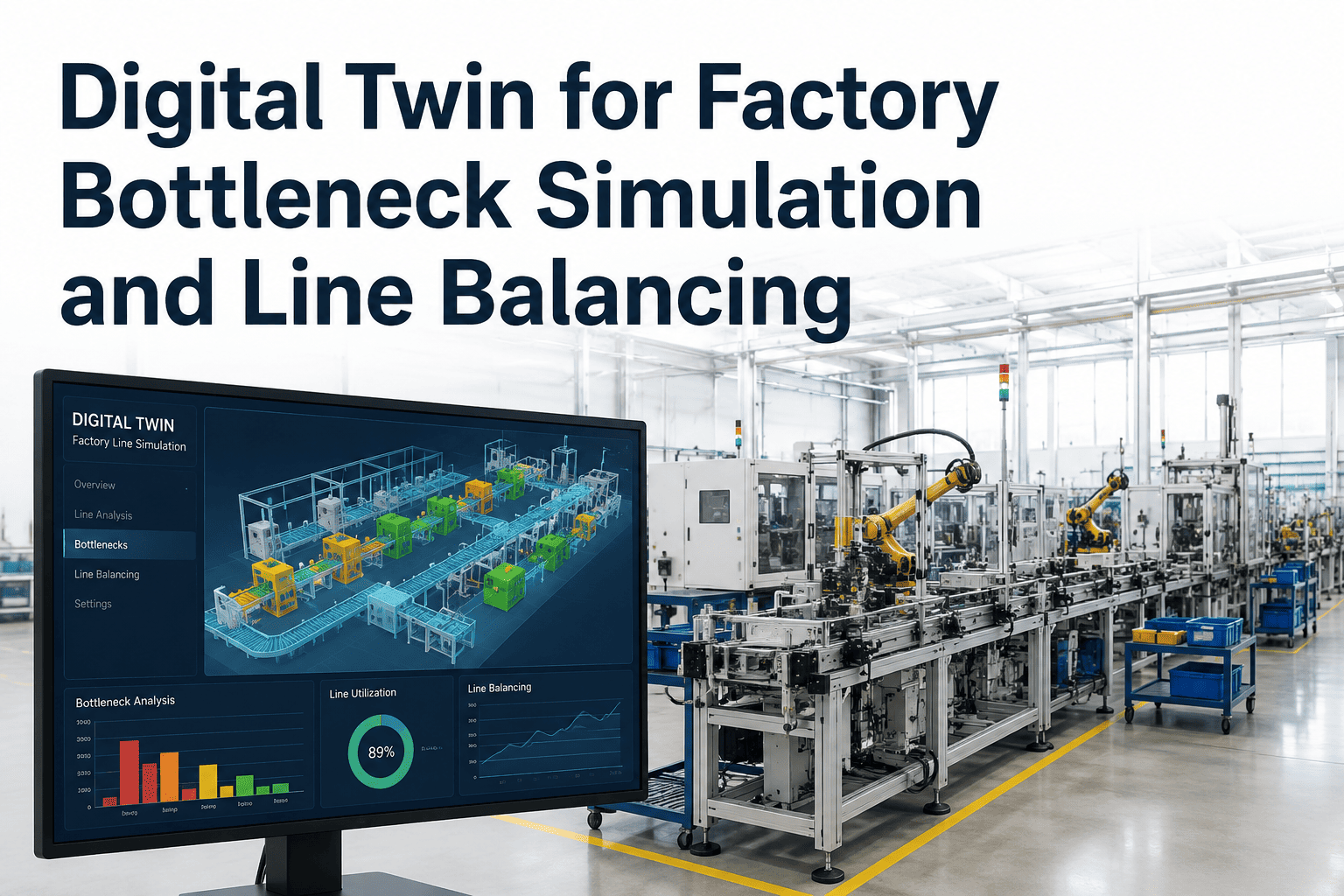
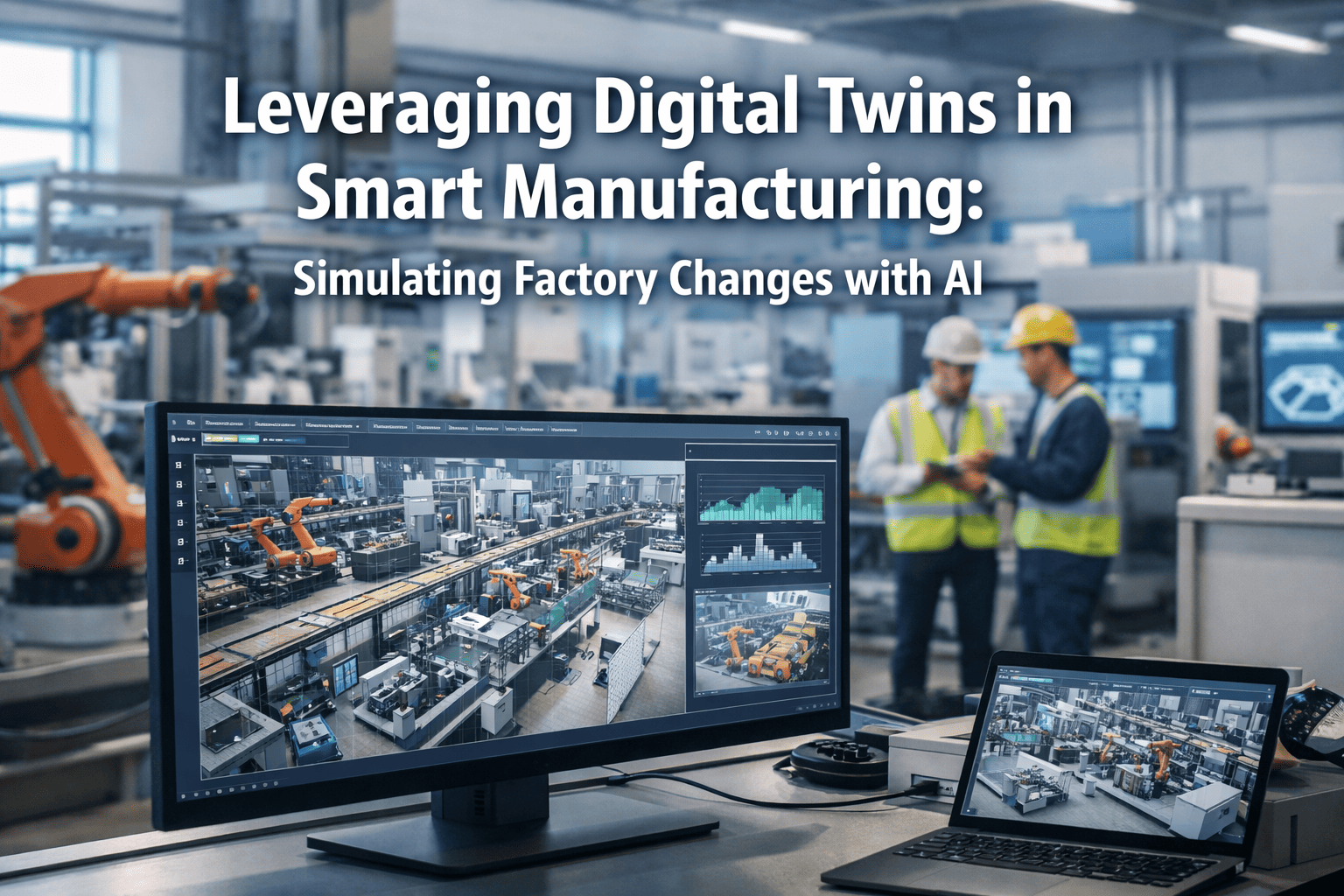
Every hour your production line runs without a digital twin, you are flying blind — making scheduling, maintenance, and throughput decisions based on lagging indicators, gut instinct, and spreadsheets last updated three shifts ago. The cost is not theoretical. Plants operating without simulation-driven visibility report unplanned downtime events that average $260,000 per hour in lost output, scrapped material and emergency labour. OEE scores stuck in the 55–65% range are not an equipment problem. They are an information problem — and AI-powered digital twin simulation solves it.
iFactory Digital Twin Intelligence
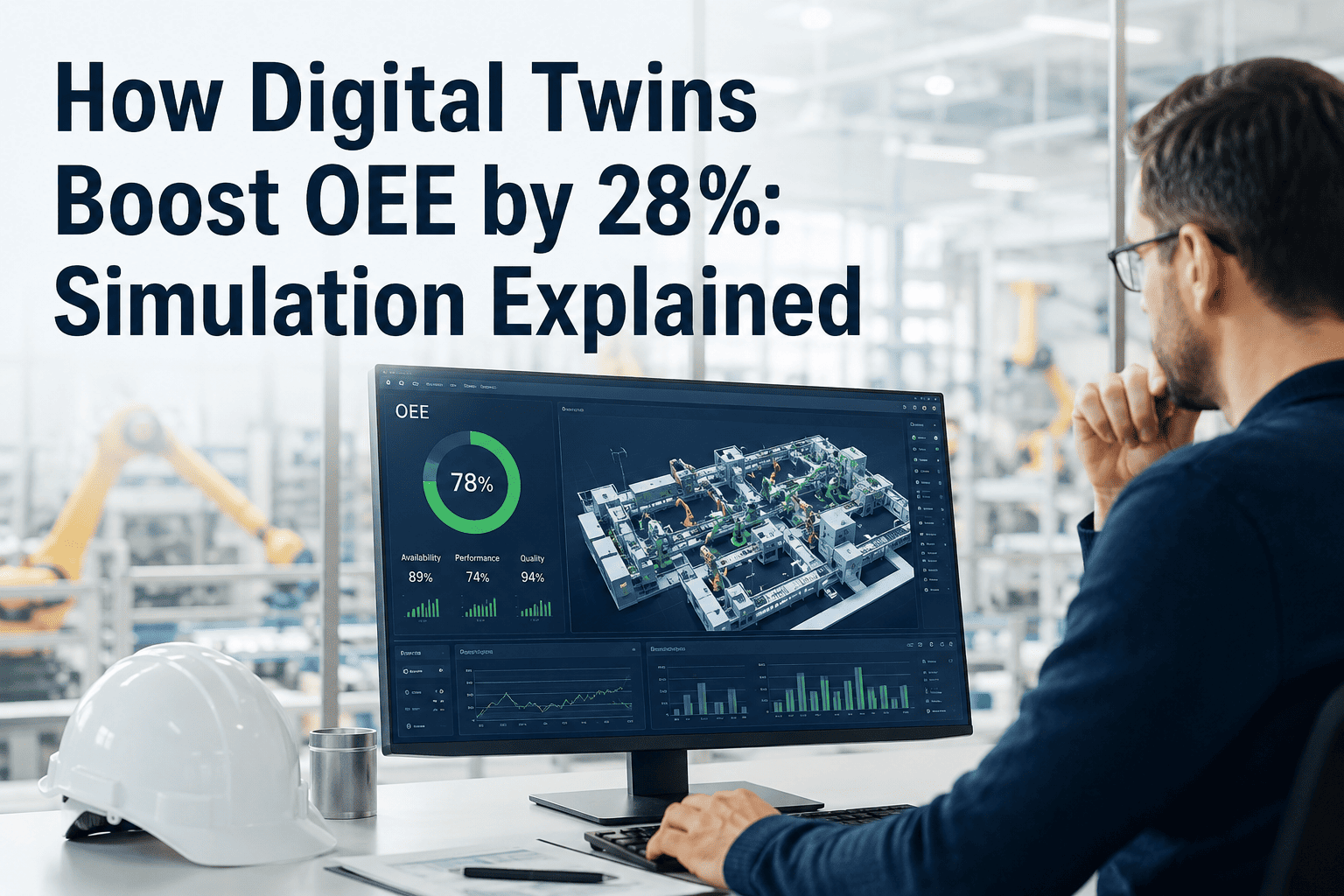
How Digital Twins Boost OEE by 28%: Simulation Explained
Discover how factory simulation models identify hidden bottlenecks, optimise throughput, and deliver measurable OEE gains — with real deployment steps and validated ROI benchmarks.
28%
Average OEE uplift via simulation
4–6wk
Time to first actionable bottleneck insight
95%
Predictive maintenance adopters report positive ROI
10–30x
Return on investment at full scale
What OEE Actually Measures — and Where Plants Lose It
Overall Equipment Effectiveness is the product of three factors: Availability (uptime versus planned production time), Performance (actual throughput versus theoretical maximum), and Quality (good units versus total units produced). A world-class OEE score is 85%. Most manufacturers operate between 55% and 65%. The gap between where you are and 85% is not random — it is a pattern of specific, repeatable losses that simulation makes visible.
Availability Losses
- Unplanned breakdowns from deferred maintenance
- Changeover and setup time exceeding targets
- Material shortages causing line starvation
Performance Losses
- Hidden bottlenecks constraining line speed
- Minor stoppages accumulating across shifts
- Speed reduction from suboptimal parameters
Quality Losses
- Startup scrap during changeovers
- In-process defects from drift in process parameters
- Rework loops consuming capacity and labour
Digital twin simulation addresses all three loss categories simultaneously. By creating a continuously updated virtual replica of your production environment, the platform identifies which specific assets, sequences, or parameters are responsible for each loss bucket — and quantifies the financial impact before any physical change is made.
Book a free OEE diagnostic session with iFactory engineers →
How Digital Twin Simulation Works: The Technical Architecture
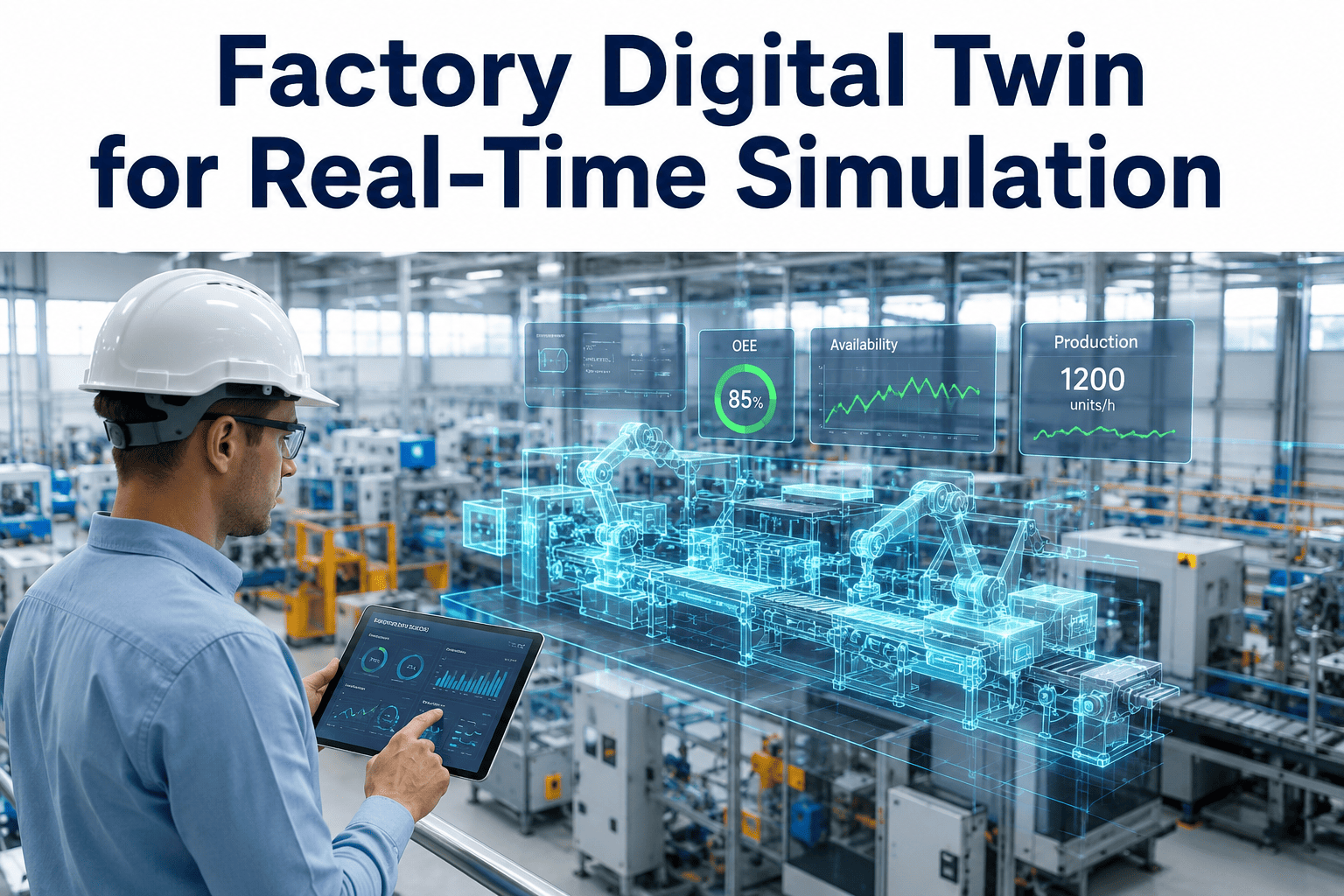
A process digital twin is not a static 3D model. It is a living computational system that ingests real-time operational data, maintains a physics-informed model of your assets and processes, runs continuous what-if simulations, and surfaces actionable recommendations to operators and planners. The architecture has four distinct layers.
01
Data Ingestion Layer
OPC-UA, MQTT, and REST API connectors pull real-time streams from SCADA systems, PLCs, historians, ERP, and CMMS. Vibration, temperature, current, pressure, and flow sensors feed into a unified time-series data store. Sampling rates from 100ms to 1-second intervals capture transient events traditional reporting misses entirely.
02
Physics and ML Model Layer
Hybrid models combine first-principles physics equations (heat transfer, mechanical wear, fluid dynamics) with machine learning models (LSTM networks, gradient boosting, transformer architectures) trained on historical operational data. This hybrid approach delivers predictions grounded in engineering reality while improving continuously as more data accumulates.
03
Simulation and Optimisation Engine
Discrete-event simulation and agent-based models run thousands of scenario permutations per second. The engine evaluates schedule sequences, maintenance timing, speed setpoints, and changeover sequences against the twin model to identify configurations that maximise throughput and OEE under current constraints.
04
Decision Intelligence Layer
Recommendations surface through operator dashboards, maintenance planning interfaces, and generative AI assistants that respond to natural language queries. Auto-generated work orders, schedule adjustments, and parameter change recommendations flow into CMMS and ERP systems via bi-directional API integration.
Legacy Operations vs. Simulation-Driven Excellence
The performance gap between plants running traditional reactive operations and those deploying digital twin simulation is not incremental — it is structural. The table below captures the most consequential differences across six operational dimensions.
| Operational Dimension |
Legacy Friction (Old Way) |
Optimised Excellence (New Way) |
| Bottleneck Identification |
Monthly line balance reviews using shift-end reports. Bottlenecks identified after losses have already accumulated over weeks. |
Continuous simulation flags constraint assets in real time. Bottleneck shifts detected within minutes of occurrence. |
| Maintenance Scheduling |
Calendar-based PM schedules regardless of actual asset condition. Over-maintenance wastes budget; under-maintenance causes failures. |
Condition-based work orders auto-generated from twin health scores. Maintenance executed when needed — neither too early nor too late. |
| Changeover Optimisation |
Changeover sequences based on historical practice and operator experience. Significant variability between shifts and crews. |
Simulation identifies optimal changeover sequence and parameter pre-sets. Consistent execution guided by twin recommendations regardless of crew. |
| Production Scheduling |
Schedules built in ERP without visibility into real-time asset condition or constraint dynamics. Plans regularly disrupted by unplanned events. |
Schedules generated by simulation engine that accounts for current asset health, predicted maintenance windows, and capacity constraints. |
| Energy Consumption |
Energy monitored at facility level. No correlation between asset operating parameters and specific energy waste events. |
Asset-level energy monitoring correlates consumption with condition and output. Identifies 15–22% energy savings through parameter optimisation. |
| Capital Planning |
Asset replacement decisions based on age and engineering judgment. No data-backed remaining useful life estimates or TCO modelling. |
Twin-generated RUL projections and TCO models feed CAPEX planning. Refurbish-vs-replace decisions backed by quantified financial analysis. |
See the simulation engine live on your own process data.
Book a Demo
The Three Simulation Models That Drive OEE Gains
Not all simulation delivers equal value. iFactory's digital twin platform deploys three complementary model types, each targeting a different category of OEE loss. Used in combination, they account for the full 28% average improvement documented across deployments.
Model 1
Discrete-Event Process Simulation
Simulates production flow as a sequence of discrete events — machine cycles, buffer states, transport moves, and operator interventions. Identifies where work-in-progress accumulates, where starvation occurs downstream, and which assets create systemic constraints regardless of their individual OEE scores. Typical OEE contribution: 8–12 percentage points from throughput recovery.
Model 2
Predictive Failure and RUL Modelling
LSTM and gradient boosting models trained on sensor streams predict failure events 14–21 days in advance with 90%+ accuracy as training data matures. Remaining Useful Life (RUL) projections update continuously with each production cycle. Maintenance interventions are scheduled into planned windows rather than disrupting production. Typical OEE contribution: 10–14 percentage points from availability recovery.
Model 3
Process Parameter Optimisation
Correlates process parameter settings (speed, temperature, pressure, tension) against quality outcomes using the twin's historical data. Identifies the parameter envelope that maximises good-part yield while maintaining throughput. Recommends setpoint adjustments in real time as input material properties or environmental conditions shift. Typical OEE contribution: 4–8 percentage points from quality loss reduction.
Impact Across Three Dimensions: Workflow, Overhead, and Growth
Workflow Transformation
- Operators receive prioritised, context-aware alerts instead of raw alarm floods
- Maintenance planners work from AI-generated work orders with correct parts and procedures
- Production schedulers use simulation-validated plans rather than best-guess sequences
- Shift handover time reduced as twin provides live operational context
Overhead Reduction
- Maintenance labour costs cut 25–35% through elimination of unnecessary preventive tasks
- Emergency parts procurement reduced as predictive alerts allow planned purchasing
- Energy costs reduced 15–22% through asset-level consumption optimisation
- Compliance documentation auto-generated — ISO 55000, OSHA, ESG reporting
Output and Growth
- OEE gains of 28% translate directly to increased capacity without capital investment
- New asset commissioning accelerated 30–40% using virtual twin testing pre-installation
- Cross-facility benchmarking identifies best-practice configurations replicable at scale
- Annual savings of $1.2–3.5M at full deployment with 10–30x return on investment
Deployment Roadmap: From First Sensor to Full Simulation
Simulation-driven OEE improvement follows a predictable phased deployment. Each phase delivers measurable value before the next begins, ensuring the business case remains visible to leadership throughout the journey.
Weeks 1–4
Foundation and Data Collection
Audit sensor infrastructure. Deploy vibration, temperature, and current monitors on 10–20 critical assets at $50–100 per point. Establish OPC-UA and MQTT integrations with existing SCADA and historians. Define 3–5 measurable OEE KPIs with documented baselines.
→
Weeks 5–12
Condition Monitoring Live
AI models learn normal operating patterns. Real-time health dashboards go live. First anomaly detection alerts validated by maintenance team within 4–6 weeks. First avoided failure or eliminated unnecessary maintenance event typically occurs in this phase.
→
Months 3–6
Predictive Simulation Active
LSTM models begin predicting failures 14–21 days in advance. Discrete-event simulation identifies process bottlenecks and throughput constraints. Parameter optimisation recommendations go live. ROI business case validated for full-scale expansion.
→
Months 6–18
Enterprise Scale and ROI
Coverage scales to 200+ assets. Auto-generated work orders feed CMMS. Financial systems receive twin data for TCO and CAPEX planning. Full 28% OEE improvement realised. Annual savings of $1.2–3.5M. 10–30x return on total investment.
Frequently Asked Questions
How quickly will we see OEE improvement after deployment?
Condition monitoring alerts typically begin within 4–6 weeks, with the first measurable OEE improvement from avoided downtime occurring in Phase 2 (weeks 5–12). Full simulation-driven optimisation across all three OEE components is typically realised by months 6–12. The 28% figure represents mature deployment performance — early phases deliver meaningful gains on the path to full potential.
Do we need to replace our existing SCADA or CMMS?
No. iFactory's digital twin platform integrates via standard APIs alongside existing operational technology. SCADA, historians, ERP, and CMMS systems continue operating as before — the twin adds a simulation and intelligence layer on top. Over time, AI-generated work orders and schedule recommendations feed back into your CMMS without any rip-and-replace disruption.
What sensor infrastructure do we need to get started?
The most common starting point is limited existing instrumentation. Industrial vibration sensors now cost $50–100 each and can be installed wirelessly without plant shutdown. A comprehensive pilot covering 10–20 assets typically requires $15–40K in additional sensors installed within 1–2 weeks. The platform also maximises value from whatever SCADA and historian data you already have.
How is simulation accuracy validated before we act on its recommendations?
Simulation models are validated against historical operational data before go-live, with accuracy benchmarks documented for each asset type. During Phase 2, anomaly detection alerts are explicitly validated against maintenance team knowledge to tune false positive rates. Predictive failure models are held to a 90%+ accuracy gate before Phase 3 expansion proceeds. Recommendations are always presented with confidence scores so operators can apply appropriate judgment.
Start Recovering Your Hidden Capacity
Your 28% OEE Gain Starts with 12 Sensors and a 30-Minute Conversation
iFactory's simulation-driven digital twin platform deploys in phases — delivering measurable OEE improvement from week six and full ROI within 12–18 months. Every phase funds the next through documented savings.
$3.5M
Annual savings potential
10–30x
Return on investment