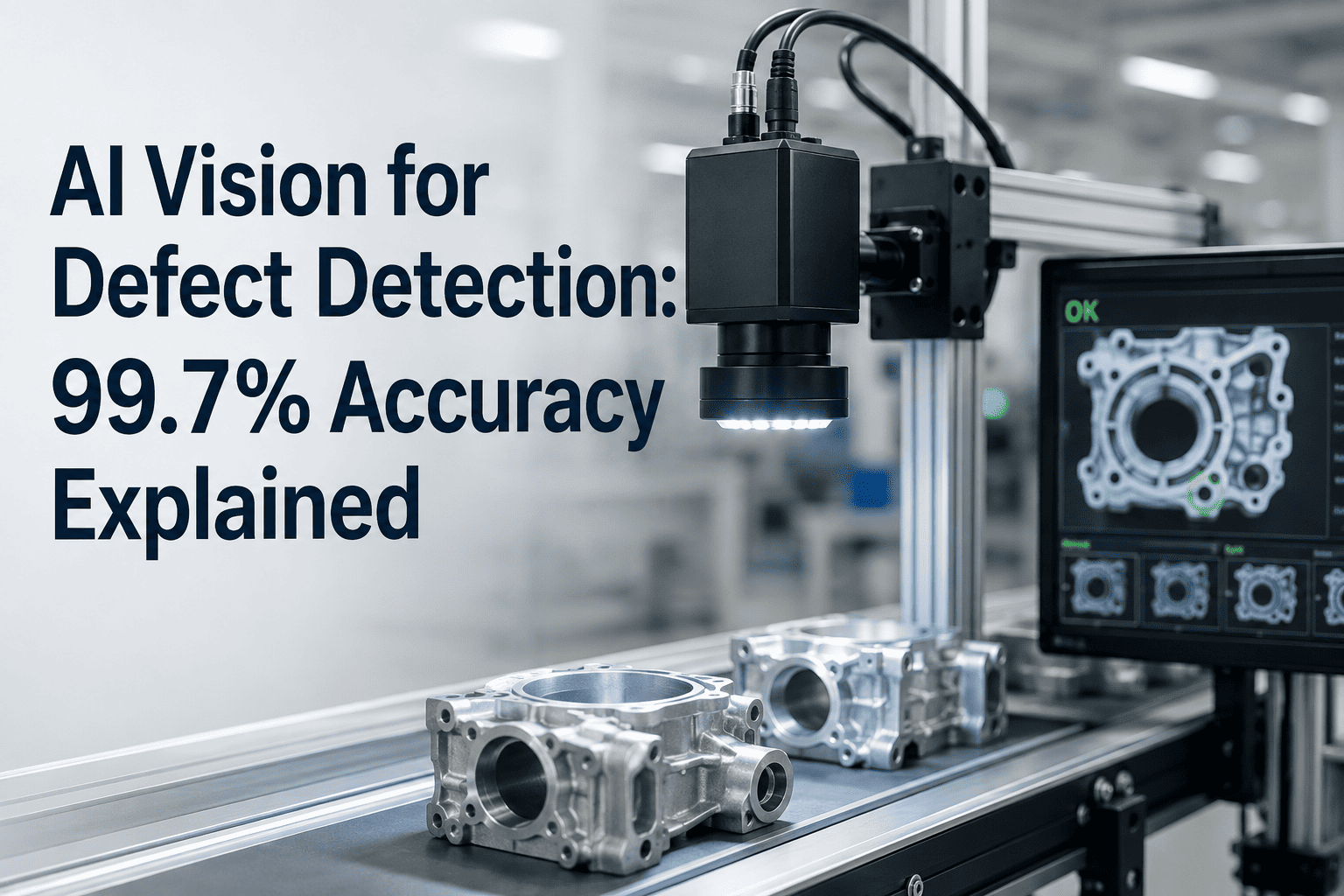
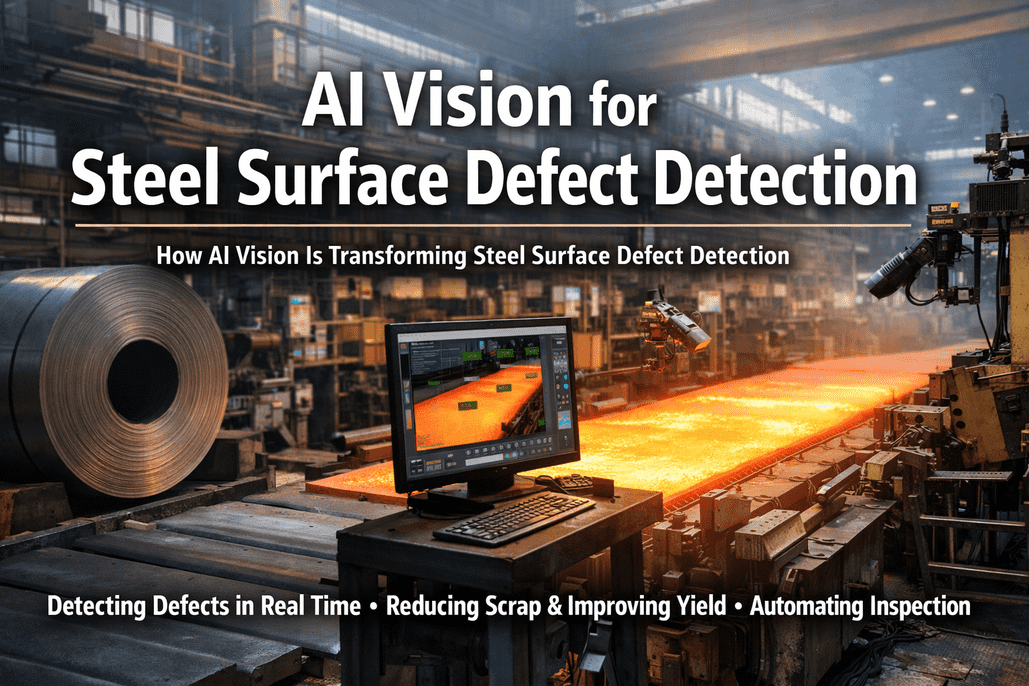
AI Vision for Defect Detection: 99.7% Accuracy Explained
By Dave on May 7, 2026
Every second your production line runs with a human inspector squinting at conveyor belts, you are paying for a system that misses 15-38% of surface defects — and shipping the evidence to your customers. A single field recall in automotive or medical devices can cost $50M-$500M in direct expenses alone, before reputational damage compounds the loss. The uncomfortable truth is that manual visual inspection — the backbone of quality control in most manufacturing facilities — operates at 70-85% accuracy under ideal conditions and those conditions rarely exist on a real factory floor. AI vision defect detection changes this calculus entirely, delivering 99.7% detection accuracy at throughput speeds no human team can match. This article explains the technology behind those numbers, what it costs to deploy, and why manufacturers who delay adoption are underwriting their competitors' market share gains.
iFactory AI Vision Intelligence
AI Vision for Defect Detection: 99.7% Accuracy Explained
How deep learning vision systems identify cracks, scratches, porosity, and dimensional deviations at line speed — and what that accuracy means for your scrap rate, recall exposure, and customer satisfaction scores
Manual inspection feels controllable because you can see the inspectors working. What you cannot see is what they are missing. Human visual acuity degrades 15% after two hours of repetitive inspection tasks. Lighting variation across shifts produces inconsistent results even from the same inspector. And no human eye resolves a 0.1mm surface crack on a component moving at 600 parts per minute.
Inspector Fatigue
Detection accuracy drops from 85% to under 65% within a single shift. Night shifts perform 22% worse than day shifts on identical defect sets.
Throughput Ceiling
A human inspector maxes out at 200-300 parts per hour with meaningful accuracy. AI vision cameras inspect 1,200+ parts per minute without degradation.
Recall Exposure
Every missed defect that reaches a customer is a warranty claim, a field replacement, or a regulatory action. AI vision documents every inspection decision with full audit trails.
How AI Vision Achieves 99.7% Accuracy: The Technology Stack
The 99.7% accuracy figure is not a marketing claim derived from a single product category under controlled lab conditions. It is the aggregate result of deep learning models trained on millions of defect images across surface inspection, dimensional verification, and assembly completeness checks. Understanding the architecture explains why the number holds at production speed.
01
Convolutional Neural Networks for Surface Anomaly
CNNs analyse pixel patterns across multiple scales simultaneously, identifying cracks as narrow as 0.05mm, porosity clusters in cast components, and surface contamination invisible to the naked eye. Pre-trained on 50M+ industrial defect images, these models transfer to new part types within 200-500 training images rather than the millions required to train from scratch.
02
Structured Light and Multi-Spectral Imaging
Standard RGB cameras miss subsurface defects. iFactory's AI vision system combines structured light projection for 3D surface mapping with near-infrared and UV imaging channels. This multi-spectral approach detects delamination, internal porosity, and coating thickness variations that surface-only inspection systems pass as conforming.
03
Adaptive Lighting Compensation
Ambient light variation is the primary cause of false positives in fixed-threshold vision systems. iFactory's AI layer continuously calibrates detection thresholds against current lighting conditions, eliminating the shadow-induced false rejects that cause operators to distrust — and override — automated inspection results.
04
Real-Time Model Retraining at the Edge
When a human quality engineer marks an AI decision as incorrect — whether a false reject or missed defect — that feedback immediately enters the model's training pipeline. The system retrains at the edge without cloud round-trips, meaning accuracy improvements deploy within hours rather than waiting for quarterly model updates.
Defect Categories: What AI Vision Detects and What It Misses
Transparency about detection limits matters as much as accuracy claims. AI vision excels at specific defect categories and requires careful configuration for others. Understanding the boundary conditions prevents deployment mismatches between system capability and inspection requirements.
Defect Type
AI Vision Accuracy
Human Inspector Accuracy
Speed Advantage
Surface scratches (>0.1mm)
99.8%
71%
240x faster
Surface cracks (>0.05mm)
99.4%
64%
240x faster
Porosity (cast components)
98.9%
58%
240x faster
Dimensional deviation (>±0.1mm)
99.7%
80%
180x faster
Assembly completeness
99.5%
88%
120x faster
Colour/coating uniformity
99.1%
76%
200x faster
Subsurface micro-cracks
91.2%
12%
180x faster
Legacy Inspection vs. AI Vision: The Operational Gap
The gap between manual inspection and AI vision is not merely a technology difference — it is a systemic difference in how quality data flows through your operation. The comparison below maps the operational impact across every dimension that affects cost, throughput, and compliance.
Legacy Friction — Current State
Optimised Excellence — AI Vision
Inspector-dependent. Accuracy varies by shift, fatigue level, and individual skill. No two inspectors apply the same standard.
Model-consistent. Every part assessed against identical criteria at every hour of every shift. Zero inspector variability.
200-400 parts/hour maximum inspection throughput. Bottleneck forces line slowdowns or skip-inspection decisions during peak production.
1,200+ parts/minute inline inspection at full production speed. Quality inspection is no longer the throughput constraint.
Paper records or manual CMMS entries. No structured defect trend data. Root cause analysis relies on memory and anecdote.
Every defect automatically classified, timestamped, located on the part, and stored. SPC charts update in real-time. Root cause alerts fire within minutes of pattern detection.
Recall exposure unquantified. When a customer complaint arrives, tracing the production batch and inspection record requires days of manual investigation.
Full inspection audit trail per serial number. Customer complaint linked to production record within minutes. Recall scope defined by data, not assumption.
False reject rate of 8-15%. Conforming parts scrapped due to inconsistent thresholds. Yield loss invisible because it blends into expected scrap rates.
False reject rate under 0.3%. Consistent thresholds eliminate unnecessary scrap. Yield improvement typically 40-70% reduction in quality-related scrap costs.
The Business Case: ROI Framework for AI Surface Inspection
Justifying AI vision investment requires translating detection accuracy into financial outcomes. The ROI calculation has three primary value streams: scrap reduction, recall avoidance, and inspection labour reallocation. Each operates independently — meaning partial deployment still generates positive returns.
Scrap Cost Reduction
Baseline: Typical manufacturer scraps 2-5% of output due to quality failures
AI vision impact: 40-70% reduction in quality-related scrap
Deployment Architecture: From Camera to Decision in 50 Milliseconds
The infrastructure behind AI vision defect detection is purpose-built for industrial environments — not adapted from consumer computer vision platforms. Understanding the deployment architecture helps operations and IT teams plan integrations with existing MES, ERP, and quality management systems.
1
Camera and Lighting Setup
Line-scan or area-scan cameras selected based on part geometry, surface finish, and line speed. Structured LED lighting arrays with diffuse, directional, and darkfield configurations. Typical installation: 2-4 weeks, zero production downtime.
2
Edge AI Processing
GPU-accelerated edge compute nodes run inference locally. No cloud round-trip required for pass/fail decisions. Full inspection decision in under 50ms. Network connectivity used for model updates and data aggregation only.
3
MES and SCADA Integration
OPC-UA and REST API connections feed defect data into existing MES in real-time. Rejection signals drive physical divert mechanisms. Quality records write directly to your existing QMS — no parallel data system required.
4
iFactory Digital Twin Sync
Vision data streams into the iFactory asset twin, correlating surface defect patterns with upstream process parameters. If a heat treat oven temperature drift precedes porosity spikes by 4 hours, the system detects and alerts before defects reach inspection.
Implementation Timeline and What to Expect
AI vision deployment follows a faster trajectory than most operations teams expect — primarily because modern deep learning models require significantly less training data than first-generation machine vision systems. A typical single-line deployment from site survey to production sign-off takes 6-10 weeks.
Weeks 1-2
Site Survey and Camera Specification
Line speed measurement, part geometry documentation, defect catalogue review with quality team. Camera type, count, and lighting configuration finalised. Hardware ordered.
Weeks 3-4
Hardware Installation and Image Collection
Cameras and lighting installed during scheduled downtime or weekend window. 200-500 images of conforming and non-conforming parts collected for initial model training.
Weeks 5-6
Model Training and Threshold Calibration
Initial CNN model trained on collected images. False positive and false negative thresholds calibrated with quality team sign-off. Shadow mode operation begins — AI runs parallel to human inspection without controlling divert mechanisms.
Weeks 7-10
Live Operation and Model Maturation
AI takes control of divert decisions with human audit overlay. Model retrains continuously from flagged corrections. Accuracy typically crosses 99% within 3-4 weeks of live operation. Formal sign-off and handover to operations team.
Frequently Asked Questions
What defect size can AI vision reliably detect?
With appropriate camera resolution and lighting, iFactory's vision system reliably detects surface defects as small as 0.05mm — approximately the width of a human hair. For sub-surface defects using structured light, reliable detection begins around 0.1mm. Resolution capability scales with camera selection; high-resolution line-scan cameras push detection limits to 0.02mm for critical applications.
How many training images are required to deploy?
Transfer learning from iFactory's pre-trained industrial defect models reduces training data requirements dramatically. Most deployments achieve production-quality accuracy with 200-500 images of the specific part. Complex multi-defect applications may require 1,000-2,000 images. The system continues learning from production data after go-live, so initial accuracy improves automatically over the first 4-8 weeks.
What is the total cost to deploy AI vision on one production line?
A single-line deployment including cameras, lighting, edge compute hardware, installation, and iFactory platform licensing typically runs $80,000-$180,000 depending on line speed, part complexity, and number of inspection stations. For most operations, the scrap reduction and labour savings alone produce payback within 6-9 months. Multi-line deployments benefit from shared platform infrastructure that reduces per-line costs by 30-40%.
How does the system handle new part numbers or design changes?
New part numbers require a new model trained on that part's geometry and acceptable variation. For variants of existing parts — different materials, finishes, or dimensions — the existing model often transfers with 50-100 additional training images. Design changes that affect the inspection surface require model update, typically completed within 24-48 hours using images of the modified part.
Can AI vision replace human inspectors entirely?
For inline surface and dimensional inspection, AI vision replaces the inspection function entirely at significantly higher accuracy. Human quality engineers remain essential for model oversight, threshold governance, root cause analysis, and customer communication. The reallocation — from tedious repetitive inspection to analytical quality engineering — is typically welcomed by quality teams and reduces inspector turnover in facilities where repetitive inspection is a retention problem.
Zero Defect Manufacturing Starts Here
Deploy AI Vision on Your Most Critical Line in 6-10 Weeks
iFactory's AI Vision system brings 99.7% surface defect detection accuracy to your production line — with deployment in weeks, not quarters. Book a performance audit to see the ROI calculation for your specific operation.