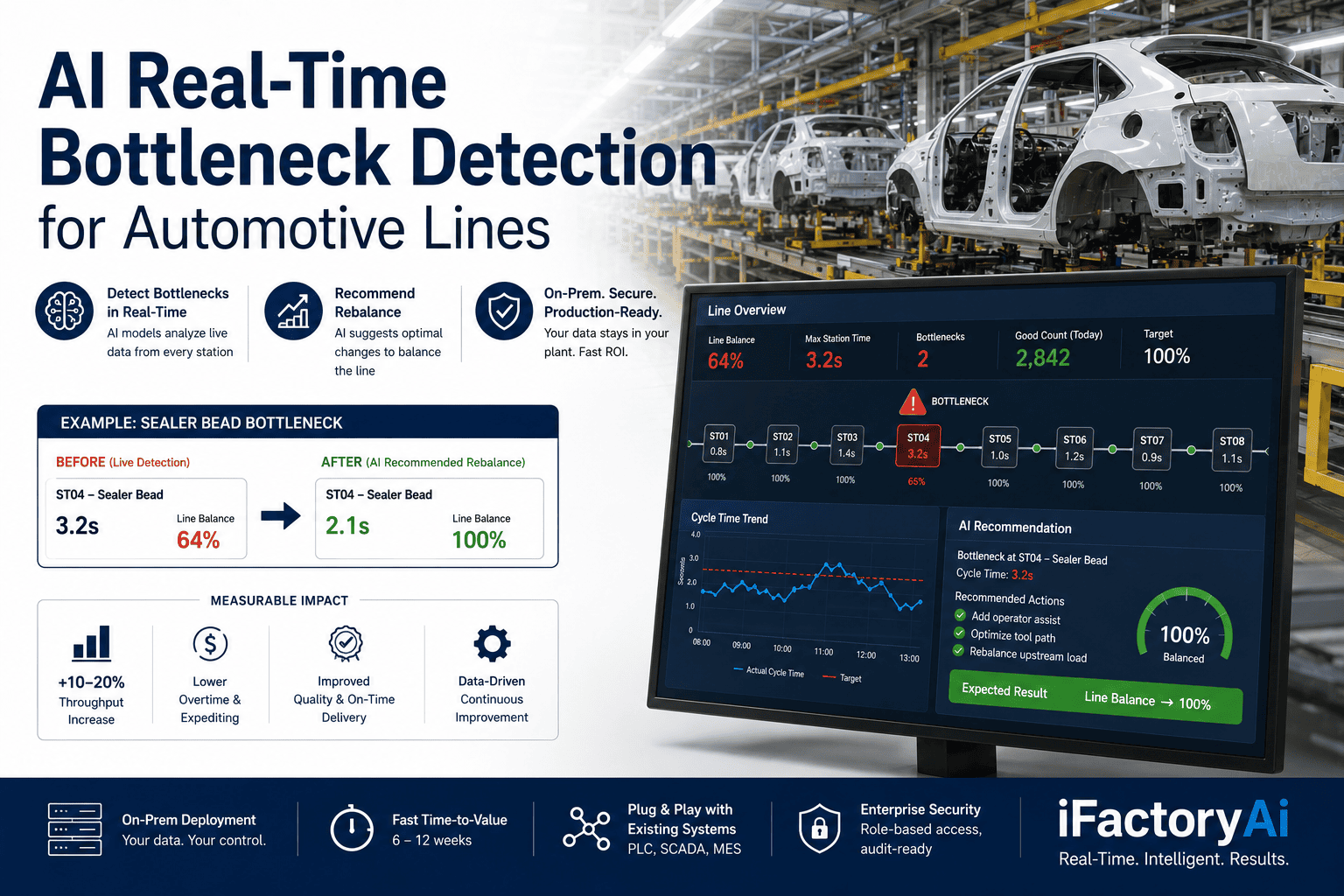
A 3.2-second sealer bead operation, moved one station down the line, is the difference between an automotive body shop running at 78% balance and one running at 100%. The catch is that nobody on the floor sees the bottleneck in seconds — they see it in the JPH report at end of shift, by which point the imbalance has already cost real units. An iFactory AI bottleneck detection module watches every station against takt in real time, names the binding station the moment it slips, and recommends the specific rebalance — down to the operation, down to the second — that closes the gap. The AI runs on-prem inside the plant, learns each line's own behavior, and ships its first production recommendation inside six to twelve weeks.
iFactory AI · Real-Time Bottleneck Detection
AI Bottleneck Detection & Rebalance Recommendation for Automotive Lines
Surface the binding station live. Recommend the exact operation to move. Move a 3.2-second sealer bead from S3 to S5 and the line balance goes from 78% to 100% — on-prem AI, 6 to 12 weeks to production.
3.2 s
move that balances the line
100%
line balance after rebalance
On-prem
AI, never leaves the plant
6-12 wks
to first production recommendation
What "Bottleneck" Means on an Automotive Line
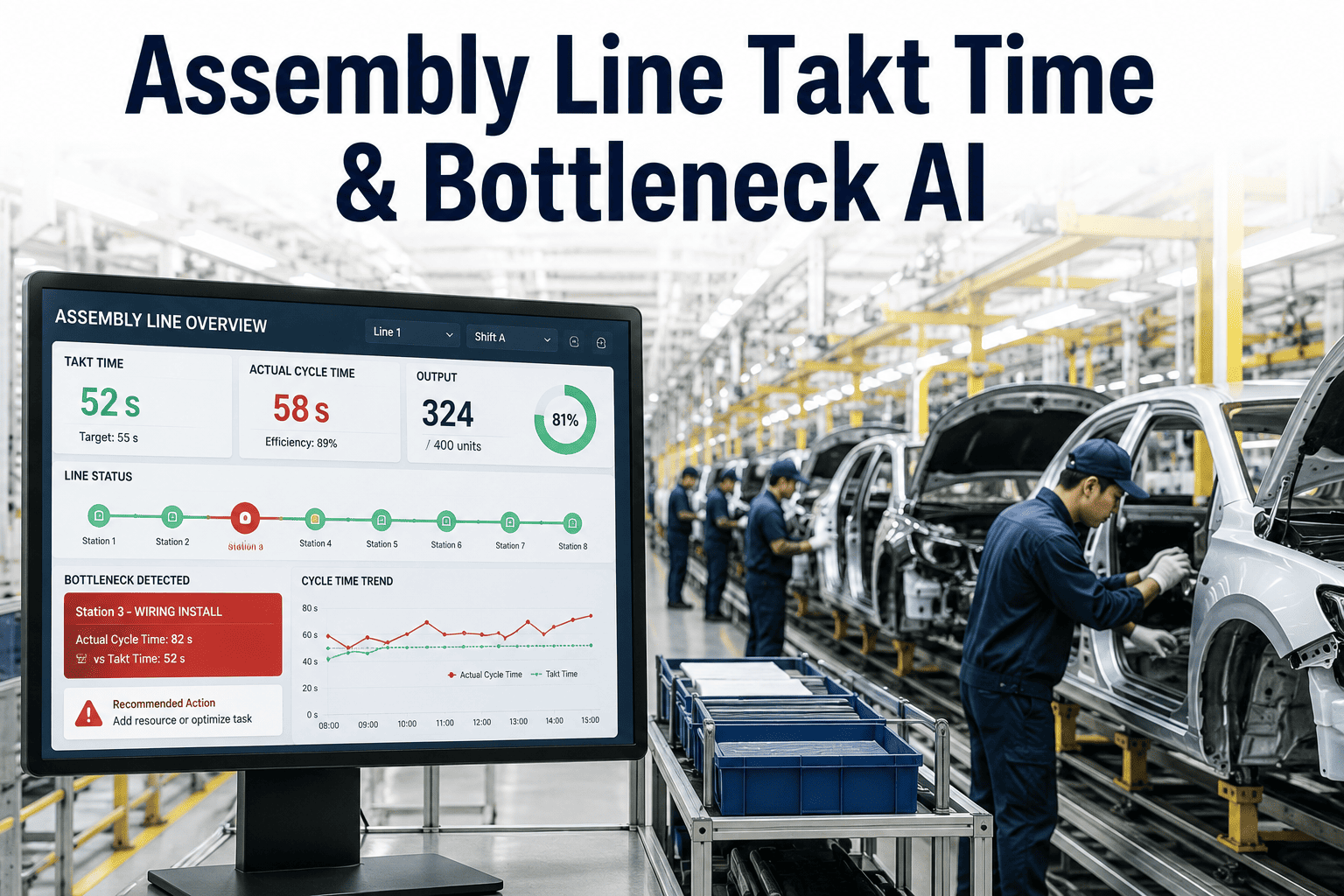
On an assembly line, the bottleneck is the station whose cycle time is closest to — or above — takt. Every other station runs faster than the binding one, which means every second the bottleneck slips is a second the entire line loses. Mixed-model bodies, option content variation, operator-to-operator dispersion, and tool wear all push individual station cycle times around constantly, so "the bottleneck" isn't one station — it's whichever station is binding right now. A shift floor manager walking the line can spot one binding station per pass. The AI watches all of them, every cycle, against the live takt.
Live Line Balance — The View That Names the Bottleneck
The chart below is the live line balance view that drives every other action on this page. Each row is a station; each bar is its current cycle time. The dashed takt line is the rate the line was designed to run at. Any bar past the takt line is a bottleneck — and any rebalance recommendation starts from this exact picture, updated cycle by cycle.
Line Balance — Body Shop Section 4
Live · cycle 14,287 · target takt 60 s
Bottleneck · Station 3
From Detection to Recommendation
Spotting the bottleneck is the easy part. The hard part is knowing what to move, where to move it to, and being confident the move actually closes the gap without creating a new bottleneck downstream. The AI generates a specific, station-and-operation-level recommendation along with a confidence score. The example below is the recommendation the AI produced for the body shop section above.
Before
Imbalanced
63 s
S3 cycle (above takt)
Station 3 sealer bead operation pushing cycle time 3 s above takt; downstream slack at Stations 5 and 6.
AI Recommendation
→
Move 3.2 s sealer bead operation
Station 3 → Station 5
Confidence 94%
After
Balanced
All stations within takt. Station 5 absorbs 3.2 s of sealer work; no new bottleneck created downstream.
Want this view on your line, with your stations and your takt? Talk to an automotive specialist and we'll scope the connector against your existing PLCs.
Why On-Prem AI for Automotive
Cloud is a non-starter for almost every Tier-1 and OEM site. Four constraints drive the architecture, and the on-prem deployment exists to clear all four without a custom build for each plant.
Cybersecurity & OEM Audit
OEM cybersecurity programs increasingly require process data to never leave the supplier site. On-prem AI ships with the data sovereignty box already ticked — no cross-border transfer, no third-party cloud, no audit finding.
Sub-Second Latency
Live bottleneck detection has to react inside one cycle. Round-tripping cycle-by-cycle data to a cloud model and back loses the responsiveness that makes the recommendation actionable in the first place.
Line-Specific Learning
A generic cloud model averages across thousands of plants. The on-prem AI trains on this line, with this option mix, with this tooling — and the recommendations reflect the actual physical reality of the work content.
Tier-1 Contract Compliance
JIT and JIS contracts carry data-handling clauses that very few cloud services satisfy without negotiation. On-prem deployment is the path of least resistance through legal, IT, and the OEM data office at once.
6 to 12 Weeks to First Production Recommendation
The deployment is short because the AI does not need a year of historical data to be useful. The first six weeks build the connection and the baseline; the next six weeks pilot recommendations against operator and engineering review, and from week twelve the recommendations are running in production.
1
Connect & Capture (Wk 1-2)
Read-only connection to existing PLCs and station counters. Cycle-by-cycle data flowing into the on-prem appliance. No new sensors, no PLC code changes, no validated-stack disruption.
2
Baseline & Model Training (Wk 3-6)
AI learns the line's normal cycle-time distribution per station, per option, per shift. Live line-balance view goes live for the planning team alongside the existing JPH report.
3
Pilot Recommendations (Wk 7-10)
First recommendations generated and routed to industrial engineering for review. Track recommendation acceptance, balance lift, and JPH delta against the pre-pilot baseline.
4
Production & Continuous Learning (Wk 11-12)
Recommendations integrated into the shift handover and rebalance workflow. AI continues to learn from accepted and rejected recommendations and the resulting line behavior.
Want this 12-week shape mapped against your line and your industrial engineering cadence? Book a demo and we'll walk you through it.
Frequently Asked Questions
Does the AI replace our industrial engineers?
No. It augments them. Every recommendation is routed to industrial engineering for review and approval — the AI surfaces the opportunity and quantifies the projected lift, the engineer validates the work-content feasibility and signs off. The combination produces more rebalance moves per quarter than either could alone, with less floor disruption and a confidence score on every one.
Will the AI work on a mixed-model line?
Yes. Mixed-model is the harder case, and it is what the AI was built for. The model tracks cycle time per option and per build sequence, so the line-balance view reflects the actual variant mix running right now — not an average that hides the binding combinations. Rebalance recommendations explicitly account for option-driven work-content variation.
How does the on-prem AI stay current without cloud updates?
The deployment includes a managed update path that does not require the line data to leave the plant. Model improvements are delivered as signed update packages; line-specific learning happens on the on-prem appliance and stays there. The architecture exists precisely so OEMs and Tier-1s can clear cybersecurity review without sacrificing the model evolution that makes the AI useful.
What if our PLCs are 20 years old?
The connector handles legacy controls including Allen-Bradley, Siemens S7, Mitsubishi, and Modicon families going back decades. Read-only OPC and Modbus integration is the most common path, with native EtherNet/IP and Profinet where available. The AI does not need modern protocol support — it needs cycle-by-cycle station event data, which almost every PLC of any era can already provide.
How do we know the recommendations are right before we move work?
Two things. First, every recommendation comes with a confidence score and an explicit projected lift the AI is committing to. Second, the pilot weeks exist to build the engineering team's trust — recommendations are reviewed and either accepted, modified, or rejected, and the AI learns from every decision. By week twelve the acceptance rate is usually well above ninety percent on the recommendations the team sees.
Stop finding the bottleneck in the shift report.
See the Live Line-Balance View on Your Body Shop
Bring one body shop section — preferably the one whose JPH has been quietly slipping. We'll connect read-only to the PLCs already on it, stand up the live line-balance view inside two weeks, and have the first AI rebalance recommendation in front of your industrial engineers by week eight. The 3.2-second move is the example. The real one will be specific to your line.
2 wks
live balance view, your line
8 wks
first AI recommendation
On-prem
no data leaves the plant
Read-only
no PLC code touched



.png)