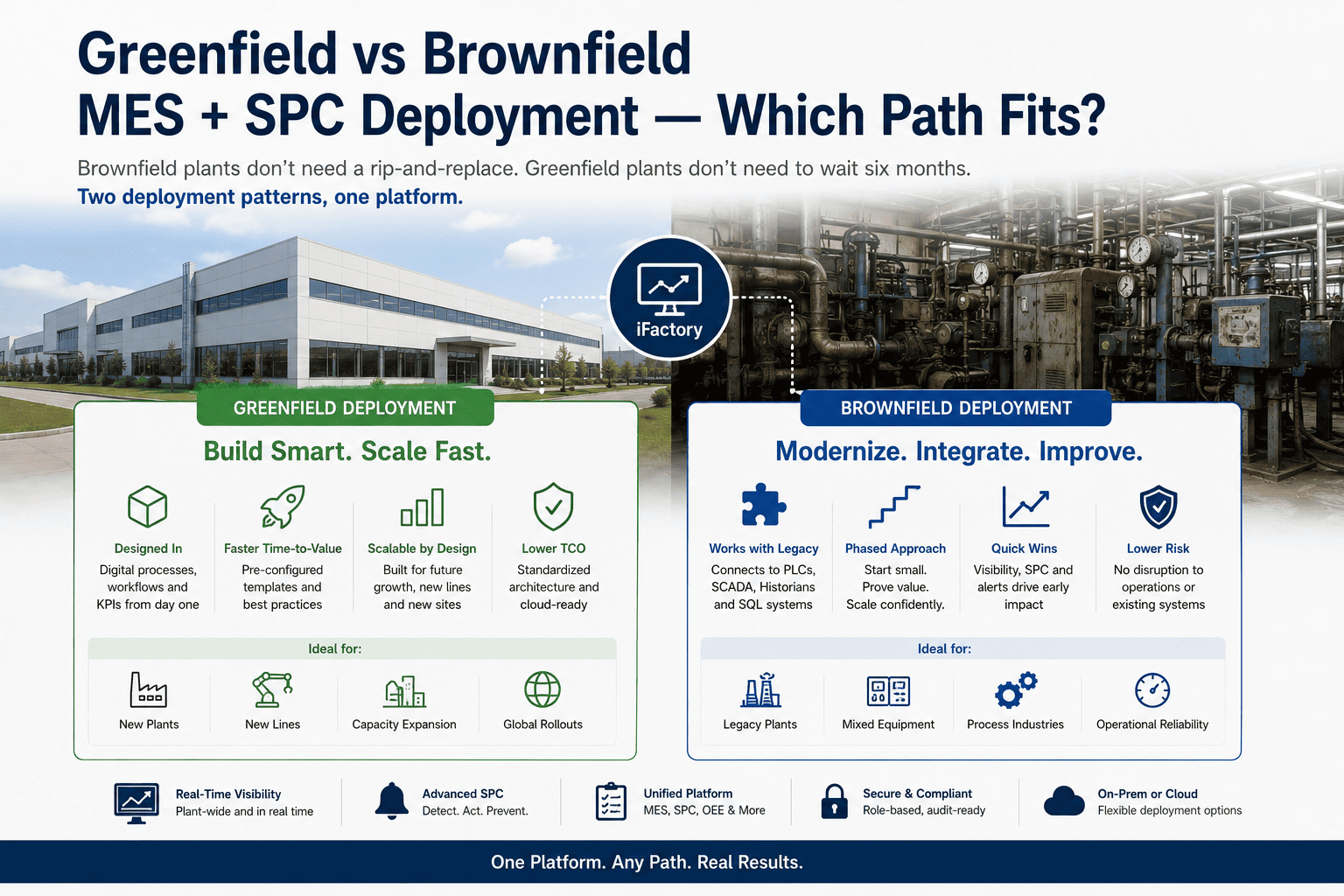
Two CIOs ask the same question and need very different answers. The one standing in front of a new plant with empty machine racks is asking how fast MES, SPC, and the historian layer can be stood up from scratch on modern protocols. The one running a thirty-year brownfield facility with PLCs from three eras and a historian nobody wants to touch is asking how value gets delivered in weeks without disturbing a single qualified line. Both questions are reasonable; the answers look very different at the connector level and identical at the platform level. An iFactory deployment supports both paths — read-only MSMQ for brownfield, native REST and OPC-UA for greenfield — runs the same SPC engine and the same AI analytics across both, and starts streaming value at day five regardless of the path. Picking the right path is the first thing the project gets right or wrong.
iFactory Deployment for Plant CIOs
Greenfield vs Brownfield MES + SPC Deployment — Which Path Fits?
Brownfield plants don't need a rip-and-replace. Greenfield plants don't need to wait six months. Two connector strategies, one platform — and the same SPC engine streaming from day five either way.
5 wks
deployment, either path
86%
of plants face the choice
Day 5
SPC engine streaming
1 + 2
one platform, two connectors
What Greenfield and Brownfield Actually Mean Here
The terms come from construction, but in deployment they describe the infrastructure context the new system enters — not the age of the facility itself. A ten-year-old plant that recently installed a modern DCS and an OPC-UA-capable historian is a greenfield integration context. A brand-new facility built with legacy equipment salvaged from a recently closed plant is a brownfield context. Getting the classification right is the first decision the project gets right or wrong, and it has very little to do with whether the building is new or old. Only 14% of manufacturers choose pure greenfield; the other 86% face this exact fork at some point in every modernization cycle.
How the Two Paths Differ, Side by Side
Six dimensions cover the practical differences. None of them is "better" or "worse" in the abstract — they are different shapes of trade-off, and the right answer depends on which constraints the CIO is actually optimizing for. The matrix below is what the conversation looks like once the marketing claims are stripped out.
Criterion
Greenfield
Brownfield
Time to first value
Same 5 weeks
Native REST + OPC-UA wired in parallel with build
Same 5 weeks
Read-only MSMQ on existing historian, no disruption
Capital expense
40-60% higher
Greenfield builds cost more upfront, plain and simple
Modest
Software layer only; uses paid-for infrastructure
Disruption to operations
None (new build)
Nothing running yet to disturb
None (read-only)
MSMQ connector reads; never writes back to validated stack
Validation burden
Full IQ/OQ/PQ
Every layer qualifies from scratch — comprehensive but slow
Connector only
Existing stack stays validated; only the new layer qualifies
Historical data available
Built fresh
12 months to baseline for trend models and SPC limits
Years on tap
Decades of historian data — baselines are instant
Long-term ceiling
Highest
Modern stack, clean data, no legacy ceiling
60-80% of potential
Capped by what the legacy infrastructure can deliver
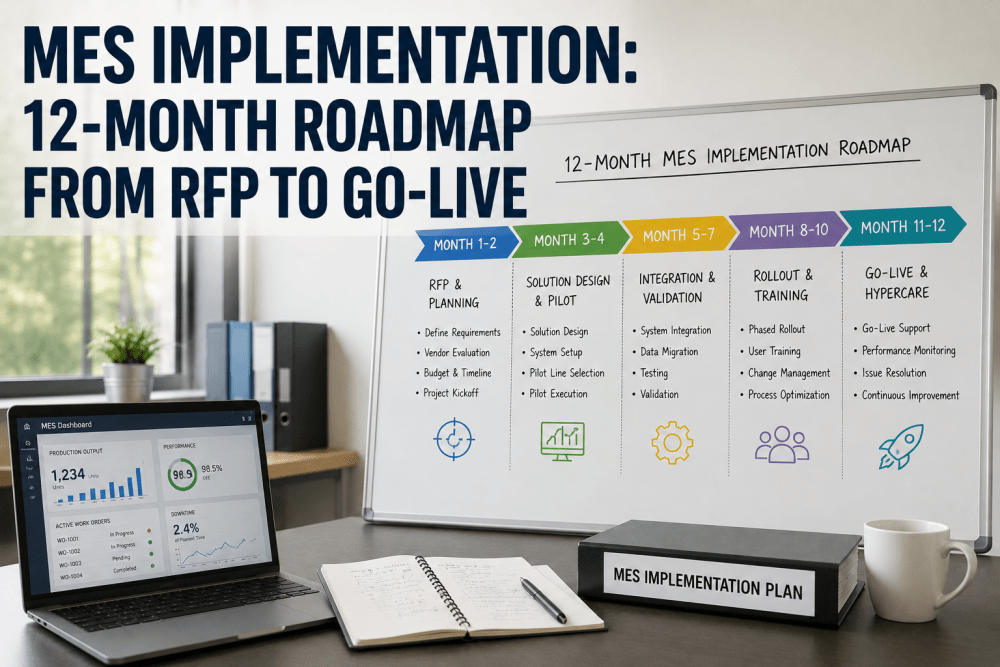
12-Week Deployment Side by Side
The shape of the first three months looks different on each path, but both paths reach a live SPC engine at week five. Greenfield uses the early weeks to wire the new digital stack; brownfield uses them to attach the read-only connector to what's already there. From week five forward, the two converge — same modules, same UI, same analytics — and the rollout cadence is what differs.
Greenfield
Wk 1
Network & OPC-UA design
Wk 3
Edge devices configured
Wk 8
MES modules + training
Brownfield
Wk 1
MSMQ connector attached
Wk 3
Dashboards alongside existing
Wk 5
SPC rules on legacy data
Wk 8
Additional lines online
Wk 12
Full plant coverage
Want this 12-week shape scoped against your site's specifics? Talk to a specialist and we'll lay the milestones over your current state.
Two Connector Strategies, One Platform
The platform on top is identical. The connector underneath is what's different. Brownfield deploys a read-only MSMQ connector that consumes data the existing historian already produces, without writing anything back. Greenfield deploys a native REST and OPC-UA integration that ships with the new digital stack. Both feed the same SPC engine, the same OEE module, the same AI analytics, and the same UI from week five forward.
Greenfield
Native REST + OPC-UA
What it doesDirect ingestion from modern PLCs, DCS, and edge devices via OPC-UA and REST endpoints — the modern industrial protocols.
Risk profileClean stack from day one. No legacy compromises and no historian ceiling on the data structure.
Best fitNew facilities, major retrofits, sites that just installed a modern DCS or OPC-UA historian.
Trade-offHigher capex upfront. Historical data has to be built fresh — 12 months to mature baselines.
Brownfield
Read-Only MSMQ Connector
What it doesSubscribes to messages from the existing historian and MES. Never writes back into the validated stack.
Risk profileZero disruption to qualified lines. The validated stack stays untouched; only the new layer qualifies.
Best fitPlants with mature historians, validated control loops, multi-decade PLCs that nobody wants to disturb.
Trade-offLong-term ceiling at 60-80% of what a modern stack could deliver. Some signals stay inaccessible.
Curious which connector strategy fits your existing infrastructure? Book a demo and we'll walk through the integration shape.
When to Pick Which Path
The classification is rarely about whether the building is new. It is about what kind of stack the new system is integrating with. Four scenarios cover almost every site iFactory deploys against.
Scenario 1
New facility being built, equipment still being specified
→
Greenfield path
Native REST + OPC-UA from day one. Specify modern protocols into the procurement package and avoid creating a brownfield problem before the plant opens.
Scenario 2
Mature plant, recently installed modern DCS + OPC-UA historian
→
Greenfield path
The infrastructure context is greenfield even though the facility isn't. Native REST + OPC-UA reads cleanly off the new stack and avoids the legacy ceiling.
Scenario 3
30-year-old plant, mix of PLCs from multiple eras, validated lines
→
Brownfield path
Read-only MSMQ connector layers on top without touching validated control. Decades of historian data become baseline material on day one.
Scenario 4
Multi-site rollout, mix of greenfield and brownfield contexts
→
Per site, both
Classify each site independently. Same iFactory platform across the portfolio; connector strategy chosen per site based on the integration context.
Common Mistakes on Each Path
Each path has its own characteristic failure modes. The greenfield mistakes usually come from over-scoping; the brownfield mistakes usually come from underestimating what the existing infrastructure can deliver. The pattern below is what kills deployments on each side.
Greenfield mistakes
Over-scoping the New Build
Specifying every protocol and module before requirements stabilize
Waiting for full validation before any value gets delivered
Treating the rollout as a single waterfall instead of staged go-lives
Ignoring brownfield sister sites that share data and process knowledge
Specifying legacy equipment under cost pressure and creating a brownfield problem at launch
Brownfield mistakes
Underestimating What's Already There
Attempting to rip and replace the historian instead of reading from it
Touching qualified PLC code in pursuit of "cleaner" data
Skipping the connector-only validation in favor of a full re-qualification
Over-promising transformation that the legacy ceiling cannot deliver
Treating the read-only connector as a stepping stone, then never moving past it
Want your last modernization stalemate diagnosed against this pattern? Talk to a specialist and we'll walk through where it went sideways.
Frequently Asked Questions
Does the iFactory platform actually deploy in five weeks on both paths?
Yes, with the same SPC engine streaming from day five regardless of path. The connector strategy is what changes — read-only MSMQ for brownfield, native REST and OPC-UA for greenfield — but the platform layer above the connector is identical. The five-week figure assumes the integration context is classified correctly at kickoff; that single decision is the largest variable in the timeline.
Can a plant start brownfield and migrate to greenfield later?
Yes, and that is one of the most common patterns. The brownfield connector keeps the validated stack untouched and delivers value immediately. As the plant retrofits in modern DCS, PLC, or historian components on its own schedule, the integration shifts to native REST and OPC-UA piece by piece. Because the platform layer doesn't change, the migration is incremental and doesn't require a re-implementation.
Why does brownfield have a long-term ceiling at 60-80%?
Because some signals the modern platform could use simply aren't available in the legacy stack — older PLCs don't expose certain process variables, older historians lump data at lower resolution than modern equivalents, and certain SPC and AI features need higher sample rates than the legacy infrastructure was ever built to deliver. Brownfield captures most of the value; the ceiling is the part that requires hardware modernization to unlock.
How does the connector strategy affect validation in regulated industries?
Significantly. The brownfield read-only MSMQ connector means the validated stack is untouched — only the new platform layer qualifies, which is a much narrower scope than re-validating the existing DCS or historian. Greenfield qualifies every layer from scratch, which is comprehensive but slower. For pharma, food, and other regulated environments, brownfield's narrow validation scope is often the deciding factor.
What if our infrastructure context isn't obvious — is it greenfield or brownfield?
Most sites are mixed. The classification is per integration point, not per facility. A plant with a modern OPC-UA historian and 30-year-old PLCs upstream is a greenfield context at the historian and a brownfield context at the PLC layer. The iFactory deployment handles both within the same platform — that is precisely the point of having two connector strategies under one platform.
Two paths. Same platform. Day five either way.
See Your Deployment Path Scoped Against Your Site
Bring the plant you're modernizing — or the new facility you're scoping. We'll classify the integration context, choose the connector strategy that fits, and lay out the 12-week deployment with the day-five SPC engine milestone marked. The same platform serves both paths, so the conversation moves from "which vendor" to "which connector" — and the answer is usually clear inside an hour.
5 wks
deployment, either path
Day 5
SPC engine streaming
Same
platform, modules, UI
Zero
disruption on brownfield