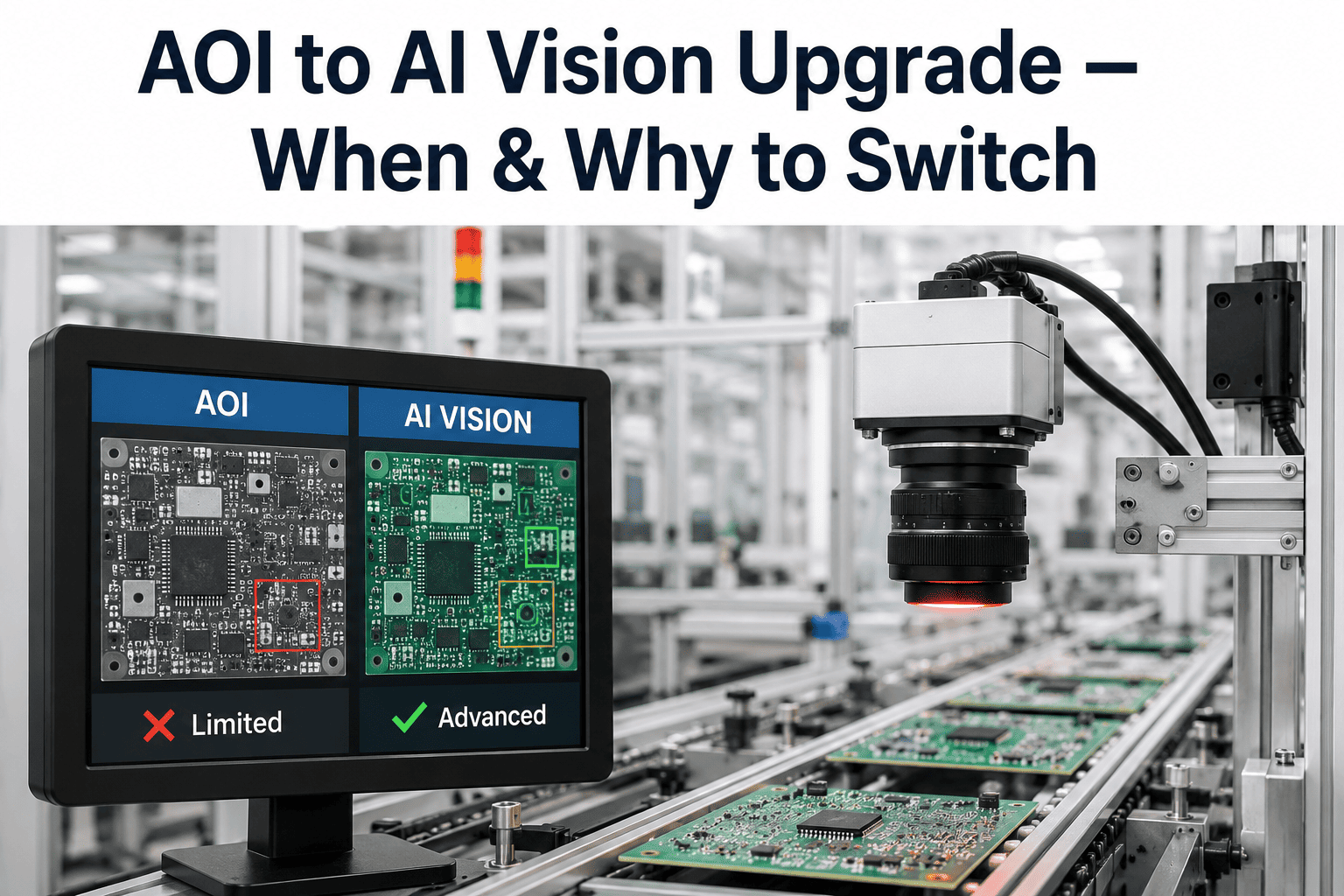
A quality engineering manager evaluating whether to upgrade from a rule-based automated optical inspection system is usually running into the same wall: the existing AOI has plateaued somewhere around 85% accuracy, and every attempt to push past that ceiling means more manual reprogramming of detection rules for each new defect variation or product change. Rule-based AOI was a genuine improvement over pure manual inspection when it was introduced, but it fundamentally depends on someone anticipating and coding every defect signature in advance, which breaks down the moment a new product, material, or defect type appears that nobody explicitly programmed for. Deep learning AI vision approaches the same inspection problem differently, learning defect patterns from data rather than requiring every rule to be hand-written. iFactory helps quality teams work through this upgrade decision with an actual framework rather than a sales pitch, and you can book a demo to see how deep learning performs against your current AOI's known failure cases.
Rule-Based AOI Has a Ceiling. Deep Learning Vision Doesn't Have the Same One
iFactory helps quality teams evaluate the real decision between staying with rule-based AOI and upgrading to deep learning AI vision, covering accuracy, adaptability, and total cost of ownership.
An AOI System Only Knows the Defects Someone Explicitly Told It About
Rule-based automated optical inspection works by comparing an image against a set of hand-coded rules and thresholds designed to catch specific, anticipated defect signatures. This approach works reasonably well for well-understood, stable products with a known defect library, but it struggles the moment conditions change: a new product variant, a material substitution, or a defect type that simply wasn't anticipated when the rules were originally written. Each of these situations typically requires a quality engineer to manually adjust thresholds or write new rules, a process that is slow, requires specialized expertise, and often introduces new false positive or false negative behavior elsewhere in the system while fixing the immediate gap.
Four Questions That Actually Determine Whether an Upgrade Makes Sense
How Often Do Products Change?
Frequent new product introductions favor deep learning, which adapts faster than manually reprogramming AOI rules for every variant.
What Is Your False Positive Rate Today?
A high false positive rate driving unnecessary rework or scrap is one of the clearest signals that rule-based thresholds have hit their limit.
Are New Defect Types Appearing?
Defects your current AOI wasn't originally coded for are a direct sign the rule library is falling behind actual production reality.
What Does Reprogramming Actually Cost?
Factor in engineering hours per rule update and how often that update is needed, not just the original AOI purchase price.
See Where Deep Learning Actually Outperforms Your Current AOI
iFactory tests against your existing system's known failure cases, so the comparison is grounded in your real production data, not a generic benchmark.
A Side-by-Side Comparison Across the Factors That Matter Most
| Comparison Factor | Rule-Based AOI | Deep Learning AI Vision |
|---|---|---|
| Typical accuracy ceiling | Plateaus around 85% | Regularly exceeds 99% with sufficient training data |
| Adaptability to new defects | Requires manual rule reprogramming | Retrains from new labeled examples |
| New product introduction | Slow, engineer-dependent setup | Faster onboarding with representative samples |
| False positive management | Manually tuned thresholds | Learned patterns reduce false positive drift |
Most Facilities Run Both Systems in Parallel Before Fully Switching Over
A responsible AOI-to-AI-vision upgrade rarely means ripping out the existing system on day one. Most facilities run deep learning vision alongside the existing AOI for a defined evaluation period, comparing detection results directly against known defect samples and the existing system's historical performance before making a full cutover decision. This lets a quality team validate the accuracy improvement against their own specific products and defect library rather than relying on vendor-provided benchmarks that may not reflect their actual production conditions. Once the parallel run confirms the expected improvement, the transition to full deep learning inspection becomes a much lower-risk decision.
Measured Outcomes From Moving to Deep Learning Vision Inspection
Questions Quality Engineers Ask About Upgrading From AOI
Make the AOI Upgrade Decision With Real Data, Not a Vendor Benchmark
iFactory evaluates deep learning vision against your own known defect cases before you commit to a full transition.
.png)