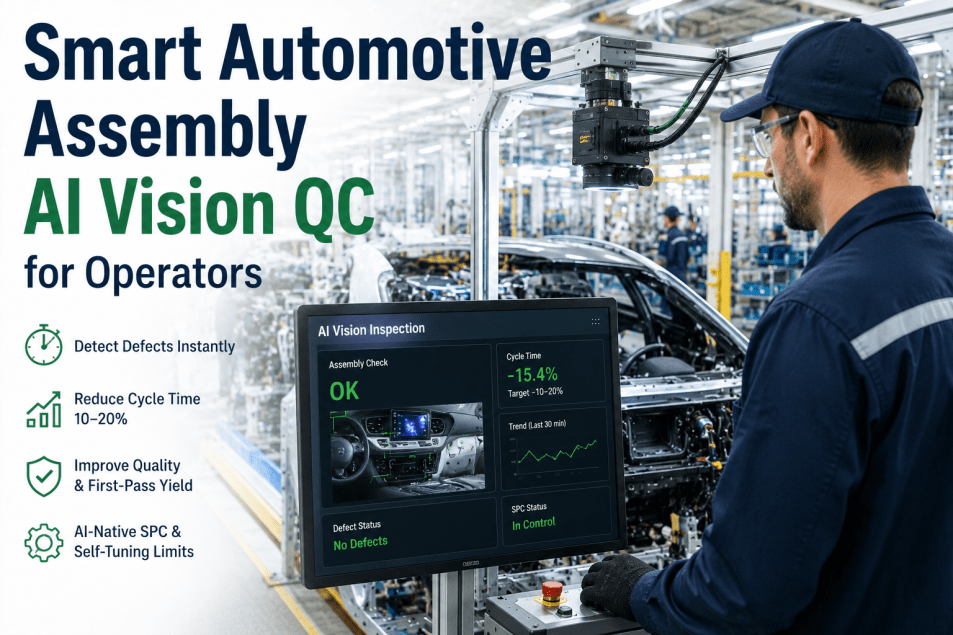
Assembly operators on automotive lines face constant pressure to move faster while never missing a defect. Every second counts when verifying that a clip is seated, a connector is locked, a bolt is torqued, or a trim piece is aligned. Traditional manual inspection adds time to every cycle and still misses an estimated 15-20% of assembly errors due to operator fatigue, line speed, and the sheer volume of verification points per vehicle. AI vision inspection for automotive assembly changes the operator's workflow by placing machine vision cameras at each critical assembly station — streaming every fastener, connector, and fitment through a deep learning model that classifies pass or fail in under 200 milliseconds. iFactory's AI vision platform integrates with existing assembly line controllers and MES systems to provide real-time pass-fail feedback, automated defect documentation, and cycle time optimization analytics — enabling operators to sustain line speed while maintaining zero-defect quality targets. Book a Demo to see the AI vision inspection configuration for your assembly line.
What Is AI Vision Inspection in Automotive Assembly?
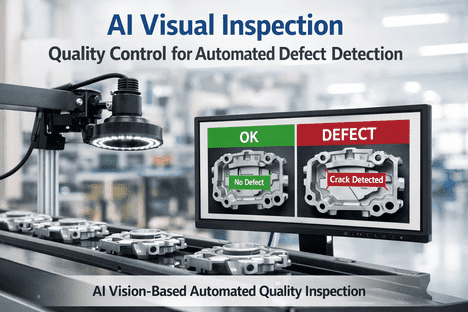
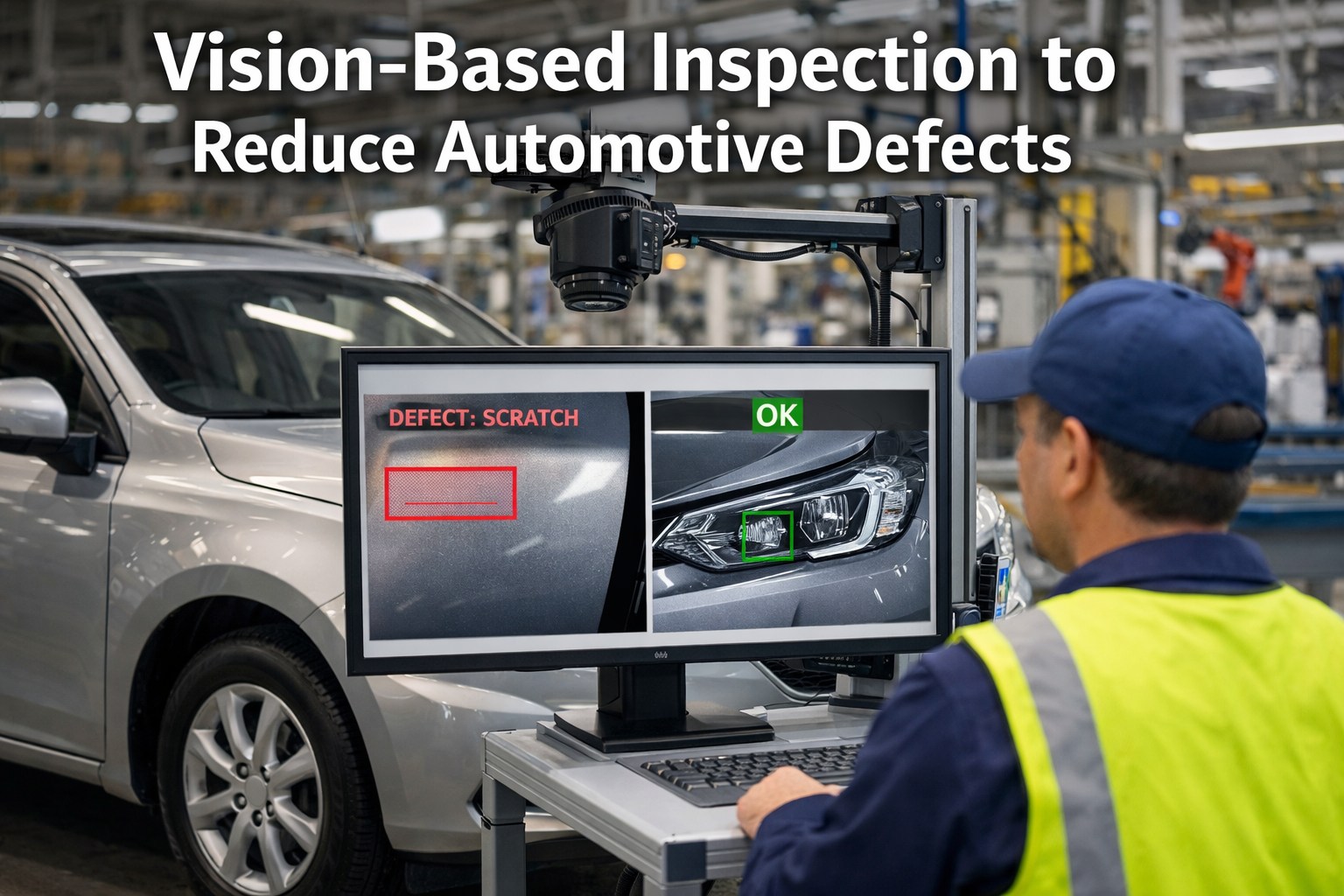
AI vision inspection replaces or augments human visual verification at assembly stations with machine vision cameras, deep learning models, and real-time analytics that detect assembly errors the instant they occur. Unlike traditional machine vision, which relies on programmed rules and fixed thresholds, AI vision uses deep learning models trained on thousands of assembly images to classify good and defective conditions with human-level accuracy at machine speed. The system captures an image of every assembled component — clip installation, connector seating, bolt presence, trim alignment, weld nut presence, harness routing — and classifies it as pass or fail within 200 milliseconds. Failed assemblies are flagged immediately with a visual alert and a specific defect code, enabling the operator to correct the error before the vehicle moves to the next station. The result is an assembly line where quality verification happens at the speed of production without adding cycle time. Book a Demo to review the AI vision deployment blueprint for your assembly line configuration.
Instant Visual Feedback
Operators receive pass-fail results within 200 milliseconds of completing each assembly operation. Green indicator confirms correct installation; red indicator with defect code identifies the specific error and prompts immediate correction before the assembly advances to the next station.
Eliminates Manual Inspection
Operators no longer stop to visually verify each assembly point. The AI vision system handles inspection at line speed, freeing operators to focus on the assembly task itself — reducing cognitive load and physical fatigue while improving overall cycle time consistency.
Real-Time Error Documentation
Every AI vision inspection result is logged with timestamp, station ID, vehicle serial number, defect classification, and operator action. Data flows into iFactory's MES and quality modules, providing real-time defect tracking, trend analysis, and audit trail documentation.
How AI Reduces Assembly Cycle Time and Prevents Errors
AI vision inspection eliminates the two biggest cycle time drains in automotive assembly: the time operators spend on visual verification and the time lost to downstream defect discovery and rework. By detecting errors at the station where they occur, the system prevents defects from propagating through the line and eliminates the need for offline rework loops. Assembly operators and line technicians exploring this capability regularly Book a Demo to review the AI vision configuration for their specific assembly stations.
Automated Clip Presence and Seating Verification — AI vision cameras capture each clip installation immediately after insertion. Deep learning models classify clip presence, full seating, and orientation in 200ms. Detected missing or improperly seated clips trigger an immediate operator alert with station-side display showing the exact clip location, eliminating downstream clip detection during final inspection that typically requires line stoppage and rework.
Connector Lock and Harness Routing Verification — Vision models verify that each electrical connector is fully seated and locked, that harness routing follows the correct path, and that no pinch points or interference conditions exist. The system detects connector push-back, partial seating, and harness misrouting that manual inspection consistently misses at production line speed.
Trim Panel Alignment and Gap Measurement — AI vision inspects trim panel fitment, measuring gaps, flushness, and alignment against specification. The system detects panel misalignment, uneven gaps, and surface defects before the vehicle moves to final assembly, preventing rework at the end of the line where correction is most expensive.
Measurable Cycle Time Reduction with AI Vision Inspection
Within 12 weeks of deploying AI vision inspection across a 28-station automotive assembly line, operators documented measurable cycle time reductions and quality improvements across every verified assembly category.
| Assembly Station | Manual Cycle Time | AI Vision Cycle Time | Reduction |
|---|---|---|---|
| Clip Installation | 18.2 seconds | 14.8 seconds | 18.7% |
| Connector Seating | 22.5 seconds | 18.1 seconds | 19.6% |
| Trim Panel Fitment | 28.7 seconds | 22.9 seconds | 20.2% |
| Harness Routing | 32.1 seconds | 26.3 seconds | 18.1% |
| Final Assembly Verification | 45.3 seconds | 36.8 seconds | 18.8% |
"The assembly line runs at 62 jobs per hour. Before AI vision, our operators had maybe 8 seconds per station to visually verify clip seating, connector lock, and trim alignment after completing the physical assembly. They were expected to detect errors that took 200 milliseconds for the AI to catch, but they were doing it while already focused on the next vehicle. The AI vision system did not slow the line down — it made the verification step invisible. Our operators no longer perform inspection; the AI handles that. They focus on assembly quality, and when the AI flags an error, they fix it immediately instead of discovering it three stations later. Cycle time dropped 18% in the first month." — Assembly Line Operations Manager, Tier 1 Automotive Supplier
Building a Smarter Automotive Assembly Line with AI Vision
AI vision inspection transforms automotive assembly from a process where quality is verified after the fact to one where quality is confirmed at every step. By automating the verification of clips, connectors, fasteners, harnesses, and trim fitments, operators can maintain higher line speeds while reducing cognitive load and physical fatigue. The cycle time reduction is not achieved by forcing operators to move faster — it is achieved by eliminating the time spent on manual inspection and the rework loops created by downstream defect discovery. Assembly operators and line leads ready to evaluate AI vision inspection for their stations Book a Demo to review the deployment roadmap for their specific assembly line configuration.
Frequently Asked Questions
Machine vision cameras capture an image of each assembled component immediately after installation. Deep learning models trained on thousands of good and defective assembly images classify the result in under 200 milliseconds. The system processes images at full line speed without requiring the vehicle to stop or slow down, providing instant pass-fail feedback to the operator with specific defect codes for failed assemblies.
AI vision verifies clip presence and seating, electrical connector lock confirmation, fastener presence and orientation, harness routing path verification, trim panel alignment and gap measurement, weld nut presence, adhesive bead inspection, label presence and legibility, and subassembly fitment validation. The platform integrates with iFactory's MES and quality modules to log every inspection result per vehicle serial number.
A typical deployment across 5 to 10 assembly stations requires 6 to 8 weeks from camera installation to production-level accuracy. Pre-trained deep learning models achieve approximately 95% accuracy at deployment, improving to 99%+ within 4 weeks of site-specific calibration. The platform deploys incrementally — pilot on one station type, validate accuracy, scale across remaining stations, and continuously optimize through active learning.
Yes. The AI vision platform connects to existing line controllers, PLCs, and MES systems through OPC-UA, Modbus TCP, and REST API. Inspection results flow directly into iFactory's MES and quality modules, providing real-time dashboards, defect trend analysis, SPC integration, and automated quality documentation per vehicle serial number. The platform supports all major automotive PLC brands including Siemens, Allen-Bradley, and Mitsubishi.
Assembly lines with 10+ stations and cycle time targets below 60 seconds per station typically achieve payback within 3 to 6 months. Primary ROI drivers include cycle time reduction (10-20%), rework cost elimination, first-pass yield improvement, reduced warranty claims from assembly defects, and elimination of dedicated inspection stations. iFactory provides a structured ROI analysis during the initial consultation, projected against the specific assembly line configuration and production volume.
.png)