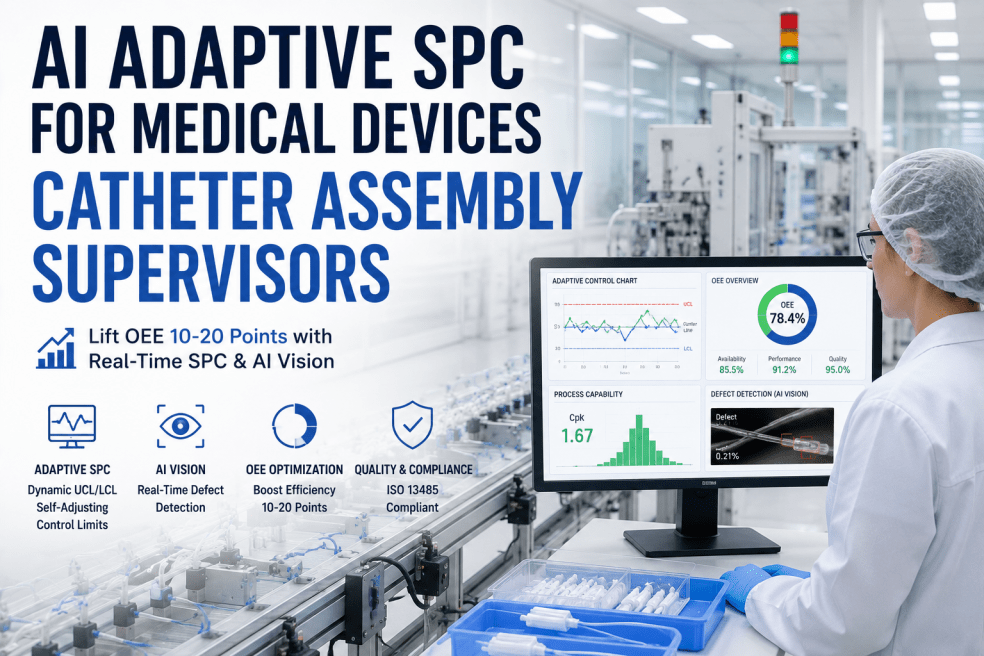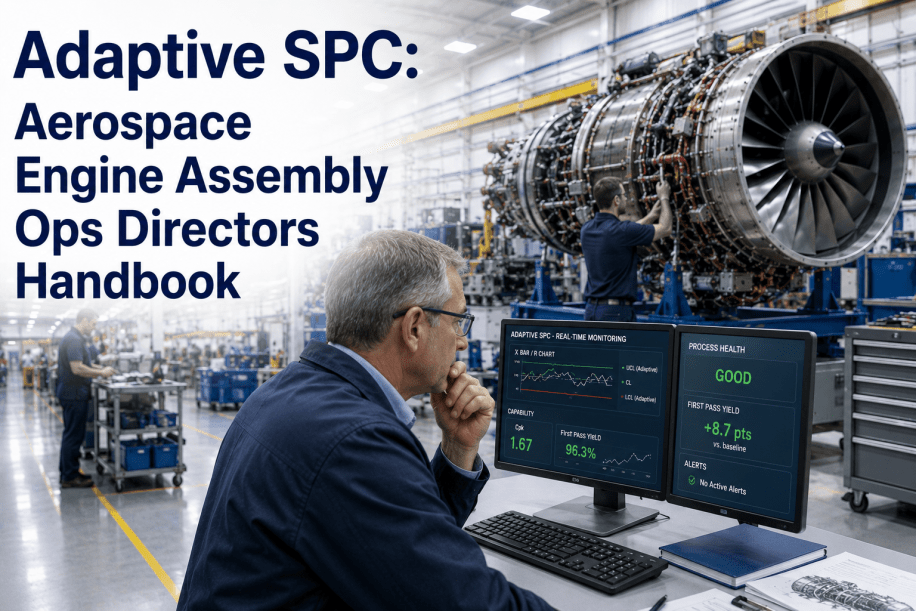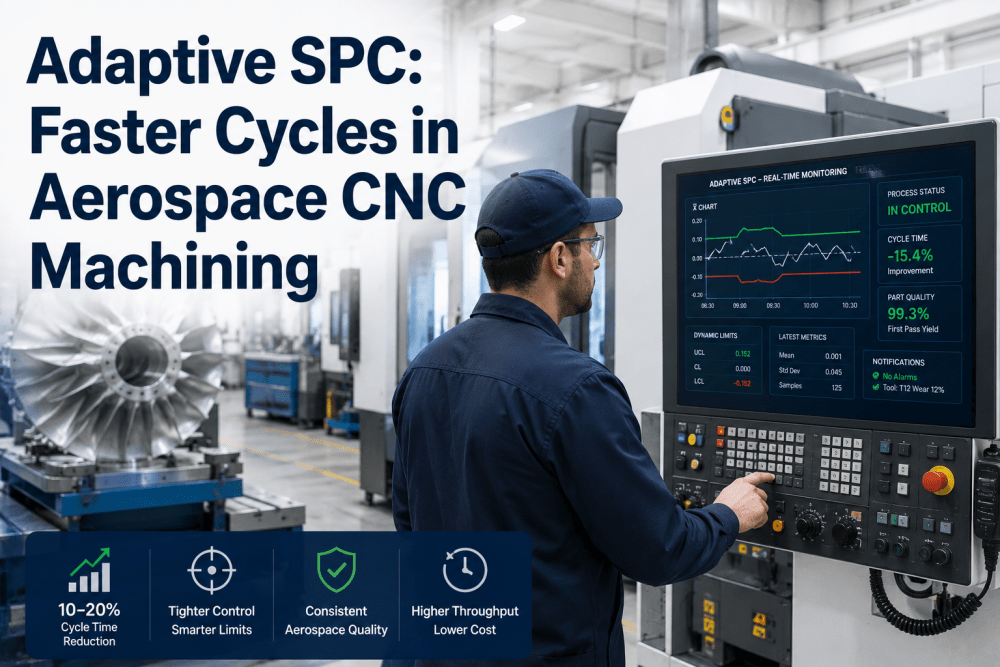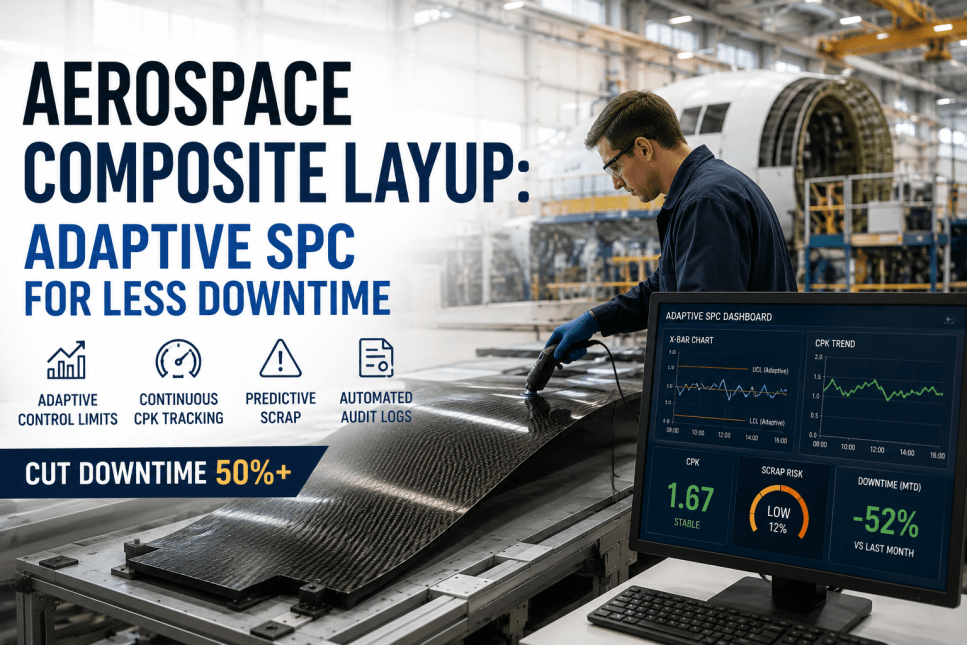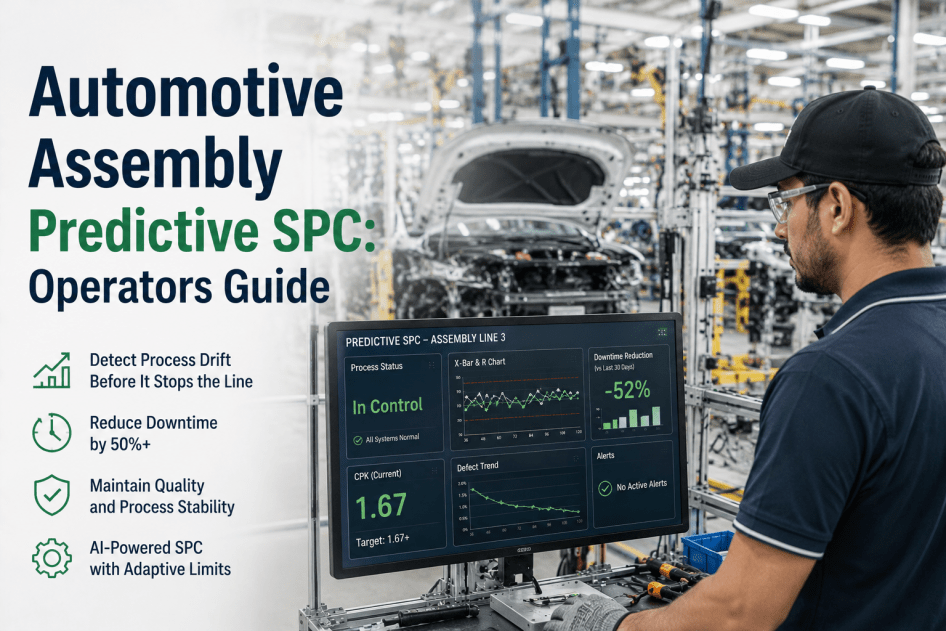
Assembly operators managing automotive lines know that unplanned downtime is the most disruptive force on the production floor. When a critical dimension drifts outside control limits, the conventional response is to stop the line, call for process engineering support, and spend 45 to 90 minutes manually reviewing control charts, correlating measurement data, and identifying the root cause. During that investigation, production stops — and every minute of downtime on a 62-job-per-hour line costs $6,000 to $9,000 in lost throughput. Predictive SPC for automotive assembly changes this by combining machine learning models with adaptive control limits that detect process drift 30 to 60 minutes before it crosses a control limit, enabling operators to correct the condition during planned cycle time rather than through unplanned line stoppages. iFactory's predictive SPC platform integrates with existing assembly line measurement systems — torque tools, press monitors, vision inspection cameras, and dimensional gauges — to provide real-time process stability dashboards, automated drift alerts, and corrective action recommendations that eliminate quality-related downtime at its source. Book a Demo to see the predictive SPC configuration for your assembly line.
What Is Predictive SPC in Automotive Assembly?
Predictive SPC replaces traditional statistical process control with AI-powered models that analyze real-time measurement data — torque values, press force curves, dimensional measurements, and vision inspection results — to detect developing trends before they cause control limit violations. Unlike conventional SPC, which alerts operators after a point falls outside control limits, predictive SPC uses machine learning algorithms trained on historical process behavior to forecast when a parameter is likely to cross its control limit based on its current trajectory. The system generates a drift alert with the specific parameter, the predicted time to violation, and a recommended corrective action — enabling the operator to adjust the process during a planned tool change or shift break rather than stopping the line for an unplanned investigation. The result is an assembly line where process stability is maintained proactively rather than restored reactively. Book a Demo to review the predictive SPC deployment approach for your assembly operations.
Real-Time Process Stability Monitoring
Every assembly parameter — torque, press force, dimension, vision pass-fail rate — is monitored in real time with control limits that adapt to process capability. Operators see a live process stability dashboard with color-coded status for every monitored station, updated with each production cycle.
Machine Learning Drift Detection
ML models analyze each parameter's trajectory — rate of change, acceleration, and proximity to control limits — to forecast when drift will cross the control boundary. Drift alerts are issued 30 to 60 minutes before the violation, with the predicted time to limit and the direction of shift.
Adaptive Control Limit Adjustment
Control limits automatically adjust based on actual process capability rather than fixed specification-based limits. When a process demonstrates sustained improvement, limits tighten to reflect true capability. When tool wear causes gradual drift, limits widen proportionally before requiring corrective action.
Automated Corrective Action Guidance
When drift is detected, the platform recommends the specific corrective action — tool change, parameter adjustment, or maintenance intervention — based on the drift pattern and historical resolution data. Operators receive clear, actionable guidance without needing to consult engineering support.
How Predictive SPC Reduces Downtime and Detects Process Drift Early
Predictive SPC addresses the two root causes of quality-related downtime in automotive assembly: the delay between drift onset and detection, and the time required to diagnose the root cause. By detecting drift early and providing actionable corrective guidance, the platform eliminates the investigation cycle entirely. Assembly operators exploring predictive SPC regularly Book a Demo to review the drift detection algorithms and alert configuration options.
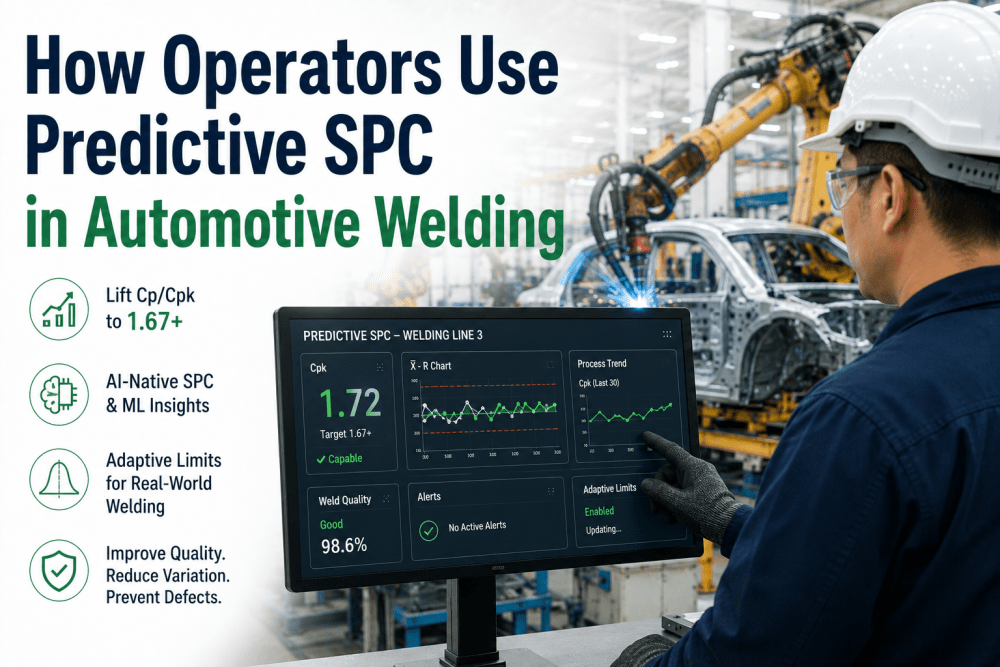
Predictive Torque Drift Detection — Torque tools generate a measurement for every fastener installation. Predictive SPC monitors each tool's torque curve parameters — peak torque, angle, rate of rise — and detects developing drift 30 to 60 minutes before values cross control limits. Common drift patterns include tool wear, lubrication degradation, and thread condition changes. Operators receive an alert with the specific tool, the drift direction, and the recommended corrective action — typically a tool recalibration or bit replacement scheduled during the next planned changeover rather than an emergency line stoppage.
Press Force and Dimensional Trend Analysis — Press force curves and dimensional measurements are monitored continuously with ML-based trend analysis. The platform detects gradual shifts in press peak force, final position, and energy absorption that indicate die wear, material variation, or lubrication changes. Dimensional measurements from in-line gauges are analyzed for mean shifts and trend direction. Corrective actions — die maintenance, material lot verification, or press parameter adjustment — are recommended before parts fall outside specification.
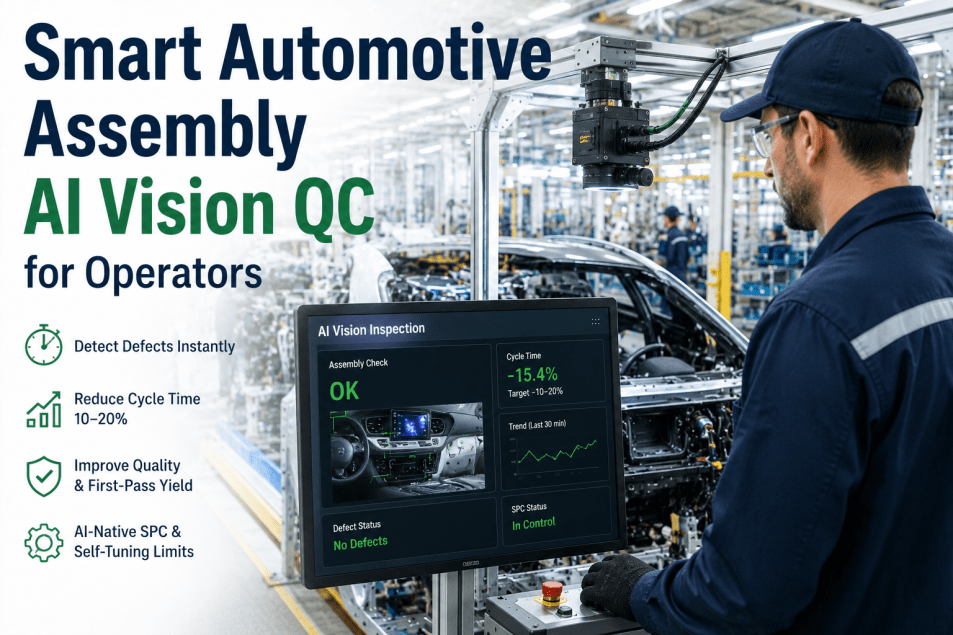
Vision-Based Assembly Verification SPC — Pass-fail rates from AI vision inspection stations are treated as SPC variables with control limits and trend monitoring. A gradual increase in false reject rate at a clip verification station, for example, may indicate lighting degradation or camera focus drift rather than an actual assembly problem. Predictive SPC detects these trends and recommends the specific corrective action — vision system recalibration, lighting adjustment, or model retraining — preventing both unnecessary maintenance calls and quality escapes.
Deployment Process — From Pilot Station to Full Line Coverage
Deploying predictive SPC across an automotive assembly line follows a structured methodology designed for minimum production disruption and maximum operator adoption.
Process Mapping & Baseline Assessment
Operations and quality teams identify critical assembly parameters, existing measurement systems, and historical SPC data availability. The iFactory platform ingests baseline data from torque tools, press monitors, vision systems, and dimensional gauges to calibrate initial control limits and ML model parameters.
Pilot Station Configuration & Calibration
A single high-volume assembly station is selected for pilot deployment. Predictive SPC models are configured with adaptive control limits, drift detection thresholds, and alert escalation rules. Operator dashboards are customized for station-specific workflows with clear corrective action recommendations.
Operator Training & Validation
Line operators and team leads receive hands-on training on the predictive SPC dashboard, alert interpretation, and corrective action procedures. The pilot runs for 4 weeks with parallel conventional SPC monitoring to validate predictive accuracy and establish operator confidence.
Line-Wide Expansion & Integration
Following pilot validation, predictive SPC is expanded across remaining assembly stations. The iFactory platform integrates with the plant MES, quality management system, and maintenance planning modules for automated alert-driven work order creation and compliance documentation.
Continuous Model Optimization
ML models are retrained weekly with new production data to improve drift detection accuracy. Control limits continue adapting as process capability improves. The platform's trend analysis engine identifies emerging patterns across stations, enabling proactive process improvement at the line level.
Measurable Downtime Reduction with Predictive SPC
Within 8 weeks of deploying predictive SPC across a 24-station automotive assembly line, operators documented measurable reductions in quality-related downtime and process variation across every monitored parameter category.
| Metric | Conventional SPC | Predictive SPC | Improvement |
|---|---|---|---|
| Quality-Related Line Stoppages | 14.6 per week | 6.1 per week | 58% reduction |
| Drift Detection Lead Time | After violation | 47 min before | Early warning |
| Investigation Time per Event | 52 minutes | 8 minutes | 85% faster |
| Parameters Within Control Limits | 82% | 94% | +12 pp |
| First-Pass Yield | 78% | 91% | +13 pp |
| Unplanned Downtime Cost per Week | $24,800 | $10,400 | 58% reduction |
"Before predictive SPC, we would catch a torque drift when the tool finally failed its control limit check — usually around 10:00 AM, after 30 to 40 fasteners had already been installed at the wrong torque. The line would stop, engineering would be called, and we would spend an hour pulling data, inspecting the tool, and deciding whether to rework the last 40 assemblies. The predictive SPC alerted us at 9:13 AM that the torque rate of rise had shifted 6% and was trending toward the control limit with an estimated 52 minutes to violation. Our operator changed the tool bit during the next planned changeover, the torque returned to nominal, and the line never stopped. That single event paid for a meaningful part of our pilot investment." — Assembly Line Operations Manager, Tier 1 Automotive Supplier
Building a Data-Driven Automotive Assembly Line with Predictive SPC
Predictive SPC transforms automotive assembly from a process where stability is verified after production to one where stability is maintained proactively through continuous AI-powered monitoring. By replacing reactive control limit violations with predictive drift alerts, operators can prevent downtime rather than respond to it — improving first-pass yield, reducing investigation time, and building a production environment where quality data drives every operational decision. Assembly operators and line leads ready to evaluate predictive SPC for their stations Book a Demo to review the deployment roadmap for their specific assembly line configuration.
Frequently Asked Questions
Traditional SPC alerts operators after a measurement point falls outside control limits, requiring an investigation to determine the root cause and corrective action. Predictive SPC uses machine learning models that analyze each parameter's trajectory — including rate of change, acceleration, and proximity to limits — to forecast when drift will cross the control boundary, issuing alerts 30 to 60 minutes before the violation occurs. This enables corrective action during planned downtime rather than requiring an emergency line stoppage.
Predictive SPC monitors torque tool parameters (peak torque, angle, rate of rise), press force curves (peak force, final position, energy), dimensional measurements (gap, flushness, position), vision inspection pass-fail rates, adhesive bead dimensions, fluid fill volumes, and electrical test results. The platform connects to existing measurement systems through standard industrial protocols without requiring new sensors.
Fixed specification limits never change regardless of actual process performance. Adaptive control limits automatically adjust based on the process's demonstrated capability — tightening when the process improves and widening when tool wear or material variation causes gradual drift. This prevents false alarms when the process is stable but operating near a fixed limit, and provides earlier warning when the process begins to degrade beyond its demonstrated capability range.
A typical deployment across a 24-station assembly line requires 8 to 10 weeks from initial data integration to production operation. Pilot deployment on a single station can be operational within 3 weeks. Pre-trained ML models achieve approximately 85% drift detection accuracy at deployment, improving to 95%+ within 6 weeks of site-specific calibration. The platform deploys incrementally — pilot, validate, expand, and continuously optimize.
Assembly lines with 15+ stations and quality-related downtime exceeding 10 hours per week typically achieve payback within 4 to 7 months. Primary ROI drivers include unplanned downtime reduction (58%), investigation time elimination (85% faster), first-pass yield improvement, reduced rework and scrap, and extended tool life through predictive rather than reactive replacement. iFactory provides a structured ROI analysis including projected downtime reduction and cost savings during the initial consultation.
.png)