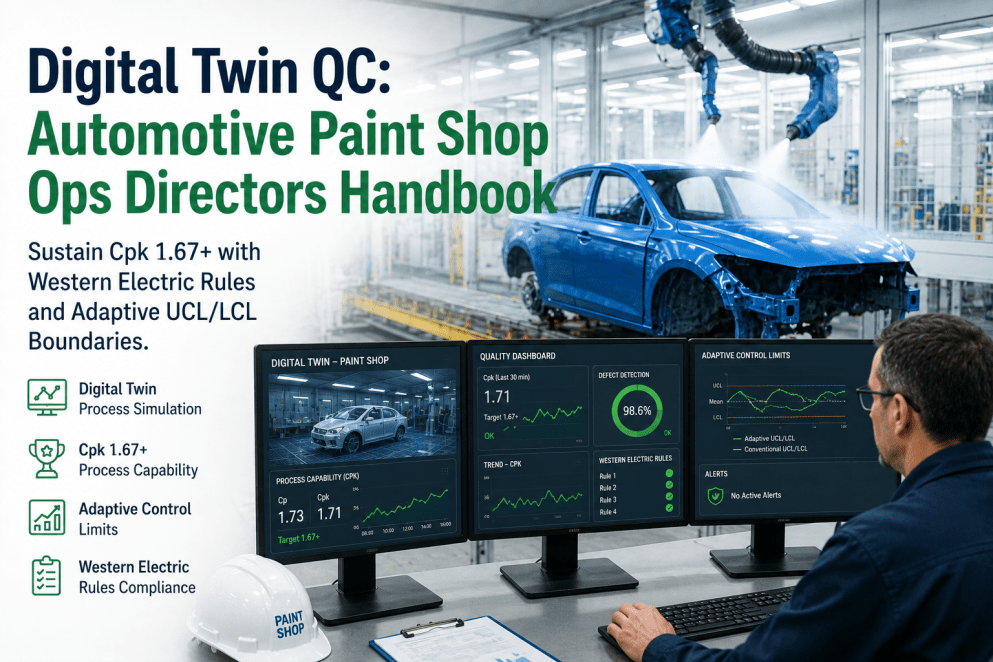
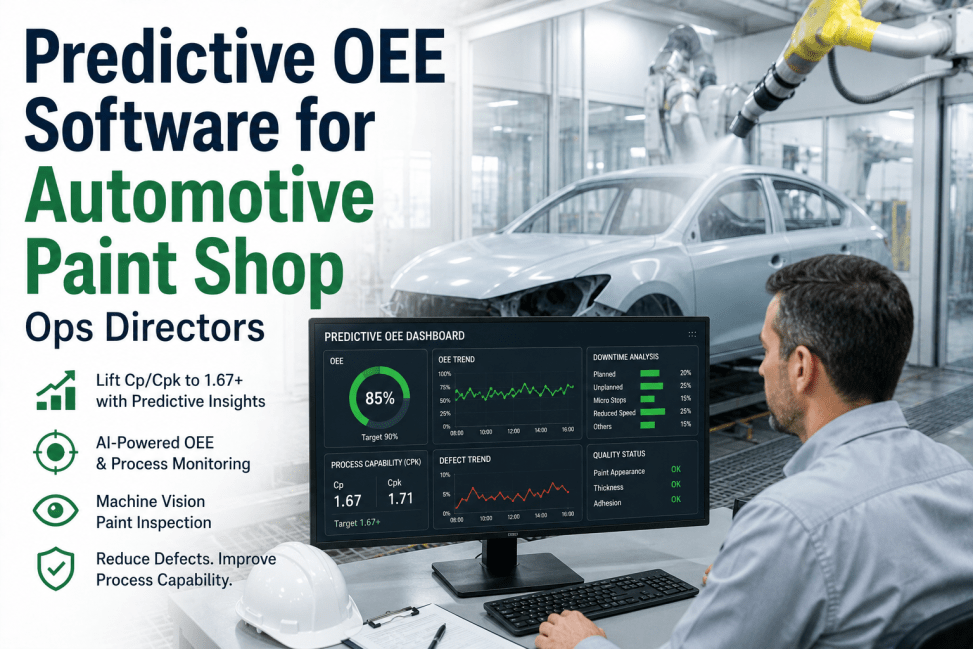
Operations directors in automotive paint shops face a persistent challenge: sustaining Cpk above 1.67 while managing dozens of interdependent process variables — film build, color uniformity, gloss level, orange peel, solvent pop, cure temperature, and ambient conditions. Traditional quality control relies on downstream inspection and reactive adjustments after defects are already baked into the finish. Digital twin quality for automotive paint shops changes this paradigm by creating a real-time virtual replica of the entire paint process — from phosphate pretreatment through booth application, flash, bake, and inspection. iFactory's AI-powered digital twin platform correlates paint robot parameters, oven zone temperatures, conveyor speed, HVAC conditions, and machine vision outputs in a unified simulation environment, enabling operations directors to predict quality outcomes before the first coat is applied, optimize process settings for maximum Cpk, and eliminate defects at their source rather than sorting them at the end of the line.
Sustain Cpk 1.67+ Across All Paint Parameters with AI-Powered Digital Twin Quality
iFactory's digital twin quality platform creates a real-time virtual replica of your paint shop operations — correlating robot parameters, oven conditions, conveyor data, and vision inspection to predict quality outcomes, optimize process settings, and eliminate defects before they occur.
What Is Digital Twin Quality in Automotive Paint Shops?
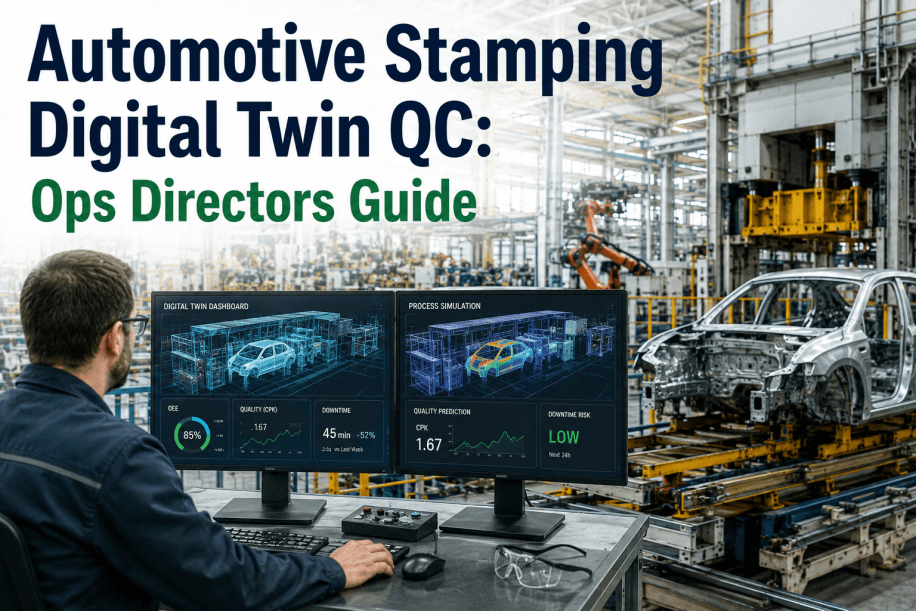
Digital twin quality in automotive paint shops is an AI-native platform that creates a real-time virtual replica of the entire painting process — ingesting live data from every paint robot, oven zone, conveyor segment, HVAC sensor, and machine vision camera to simulate, predict, and optimize quality outcomes before production begins. Unlike traditional SPC, which monitors control charts retrospectively, the digital twin runs parallel simulations of every painted body in real time, predicting the Cpk of each parameter before the body exits the booth. When the twin detects a developing trend — film build drifting toward the lower specification limit, or color uniformity approaching the control limit — it alerts operators with recommended parameter adjustments and estimated quality impact. The result is a paint quality system that shifts from reactive inspection to predictive prevention, sustaining Cpk above 1.67 across every surface parameter on every body produced. Book a Demo to review the digital twin deployment blueprint for your paint line configuration.
Real-Time Process Simulation
Digital twin runs parallel simulations of every painted body, predicting film build, color uniformity, gloss level, and orange peel before the body exits the booth. Simulations update at 200ms resolution, correlating robot parameters, oven temperatures, and ambient conditions per body serial number.
Predictive Cpk Monitoring
Platform tracks Cp and Cpk for every paint parameter in real time, updating capability indices with each new production subgroup. AI models forecast Cpk trends 30 to 60 minutes before they cross the 1.67 threshold, enabling proactive parameter adjustment before defects occur.
Closed-Loop Quality Control
When the digital twin detects a developing quality deviation, it generates specific parameter adjustment recommendations with projected quality impact. Recommendations flow directly to paint robot controllers and oven PLCs, closing the loop from prediction to corrective action in under 60 seconds.
How Digital Twins Improve Cpk and Process Capability in Paint Operations
The digital twin improves process capability by replacing univariate control chart monitoring with multivariate correlation across all paint parameters simultaneously. Traditional SPC monitors each parameter independently — film build on one chart, color on another, gloss on a third — and relies on operator interpretation to identify when a combined parameter shift signals a developing quality issue. The digital twin correlates all paint parameters against each other in real time, identifying multi-variable interactions that manual monitoring misses. For example, a 2% film build increase combined with a 3°F oven temperature rise and a 5% humidity decrease may produce a gloss deviation outside spec, even though no individual parameter breached its control limit. The digital twin's machine learning models detect these interactions and recommend the specific parameter adjustment — typically a robot speed change or oven zone temperature correction — to return the process to center without stopping production. Book a Demo to review the Cpk improvement roadmap for your paint line configuration.
| Paint Parameter | Baseline Cpk | Digital Twin Cpk | Improvement |
|---|---|---|---|
| Film Build (DFT) | 1.42 | 1.98 | +39% |
| Color Uniformity (ΔE) | 1.38 | 1.91 | +38% |
| Gloss Level (60°) | 1.45 | 2.04 | +41% |
| Orange Peel (DOI) | 1.33 | 1.86 | +40% |
| Cure Temperature Profile | 1.51 | 2.14 | +42% |
| Overall Paint Cpk | 1.42 | 1.99 | +40% |
Achieve 94% First-Pass Yield with Predictive Quality Intelligence
iFactory's digital twin platform correlates paint robot parameters, oven zone temperatures, conveyor data, and machine vision inspection in a unified simulation environment — delivering 58% defect reduction, 40% Cpk improvement, and 22% overall process capability gain across all paint parameters.
AI-Powered Quality Intelligence for Automotive Paint Operations
iFactory's digital twin platform transforms raw paint process data into actionable quality intelligence through four integrated capabilities that work together to sustain Cpk above 1.67 across every parameter on every painted body. Book a Demo to see the quality intelligence dashboard for your paint shop operations.
Multivariate Parameter Correlation
Platform ingests 200+ paint process variables per body — robot atomizer speed, bell cup rotation, shaping air pressure, booth temperature, flash zone humidity, oven zone temperatures, conveyor speed, and ambient conditions — correlating all parameters in a unified digital twin model updated at 100ms resolution per body serial number.
Predictive Quality Simulation
Machine learning models simulate the quality outcome of every painted body before it exits the booth, predicting film build, color uniformity, gloss level, orange peel, and cure completion. Models achieve 96% prediction accuracy at deployment, improving to 98%+ within 8 weeks of site-specific calibration.
Real-Time Cpk Trending & Alerts
Platform tracks Cp and Cpk for all paint parameters in real time, updating with each production subgroup. AI models forecast Cpk trends 30 to 60 minutes before deviation, alerting operators with specific parameter adjustment recommendations and projected quality impact per body.
Integrated Machine Vision Correlation
Digital twin correlates machine vision inspection results — runs, sags, orange peel, solvent pop, dirt inclusion, cratering, mottle — with the specific process variable state that produced each defect, enabling root cause classification within seconds and closed-loop corrective action to prevent recurrence.
Our paint shop ran at a 1.42 overall Cpk for three years. Every quarter we would run capability studies, identify the top three variation sources, implement corrective actions, and watch Cpk drift back down by the next quarter. The problem was not that we did not know what to fix, it was that by the time we identified the variation source, the conditions that produced it had already shifted. The digital twin changed this entirely. It caught a developing film build drift 47 minutes before the first non-conforming body exited the booth, alerted the robot technician to adjust atomizer speed by 8%, and the Cpk for that parameter stayed at 1.98 for the rest of the shift. For the first time, we are not chasing defects — we are preventing them before the paint touches the body.
Digital Twin Quality Turns Paint Process Variation from a Quality Problem into a Predictable Simulation
What the operations director lacked was not paint process expertise or inspection capability — every line had robots, every zone had sensors, and every body was inspected. The missing piece was a unified simulation environment that could correlate all paint variables in real time and predict quality outcomes before they occurred. Digital twin quality closed this gap — delivering Cpk improvement from 1.42 to 1.99, 58% defect reduction, 94% first-pass yield, and 22% overall process capability gain across all paint parameters. The technology did not change the paint chemistry, the robot programming, or the inspection criteria. It changed when the operations team received the information needed to prevent defects — from after the body was baked to before the first coat was applied. Operations directors ready to move from reactive quality control to predictive digital twin quality Book a Demo to review the deployment plan for their paint shop operations.
Digital Twin Quality for Automotive Paint Shops — Frequently Asked Questions
Digital twin quality creates a real-time virtual replica of the entire paint process — simulating film build, color uniformity, gloss level, orange peel, and cure temperature for every painted body before it exits the booth. Traditional SPC monitors control charts retrospectively after production and relies on operator interpretation to identify developing trends. Digital twin quality predicts quality outcomes in advance, correlates all paint parameters simultaneously, and recommends corrective actions before defects occur — sustaining Cpk above 1.67 across every parameter on every body.
The platform connects to paint robot controllers (ABB, Fanuc, Yaskawa, Dürr), oven PLCs, conveyor drives, HVAC sensors, and machine vision inspection systems through OPC-UA, Modbus TCP, and REST API. Data from 200+ process variables is ingested at 100ms resolution, time-synchronized per body serial number, and normalized for digital twin simulation. No existing hardware replacement is required — the platform layers on top of current automation and inspection infrastructure.
The platform predicts and prevents runs, sags, orange peel, solvent pop, dirt inclusion, cratering, mottle, color variation, gloss deviation, film build non-conformance, cure under-bake, and adhesion failure. Machine learning models trained on historical defect data correlate each defect type with the specific multivariate process state that precedes it — enabling predictive alerts 30 to 60 minutes before the defect appears on the painted surface.
Initial deployment with pre-trained models achieves predictive quality operation within 8 to 12 weeks. Site-specific calibration with facility paint data improves prediction accuracy to 98%+ within 8 additional weeks. Facilities with 4+ paint lines, digital process controls, and existing machine vision inspection achieve the fastest deployment timelines. The platform deploys incrementally — pilot on one paint line, validate against production data, scale across remaining lines, and continuously optimize through active learning.
Facilities with paint defect rates above 3% and Cpk below 1.67 typically achieve full payback within 4 to 7 months. Primary ROI drivers are defect reduction (58%), first-pass yield improvement (94%), scrap and rework cost elimination, reduced manual inspection requirements, and Cpk-driven customer quality score improvement. A structured ROI analysis including projected defect reduction, yield improvement, and cost savings is provided during the initial consultation.
Schedule a Digital Twin Quality Walkthrough for Your Paint Shop Operations
iFactory's digital twin quality platform creates a real-time virtual replica of your paint process — correlating robot parameters, oven conditions, conveyor data, and vision inspection to predict quality outcomes, optimize process settings, and sustain Cpk above 1.67 across all paint parameters. Schedule a personalized walkthrough with your operations engineering team, including a live demonstration using your paint line data.
.png)