Predictive OEE for Automotive Powertrain – Audit-Ready (QE)

By Ethan Walker on June 23, 2026

predictive-oee-automotive-powertrain-quality-engineers-quality-compliance

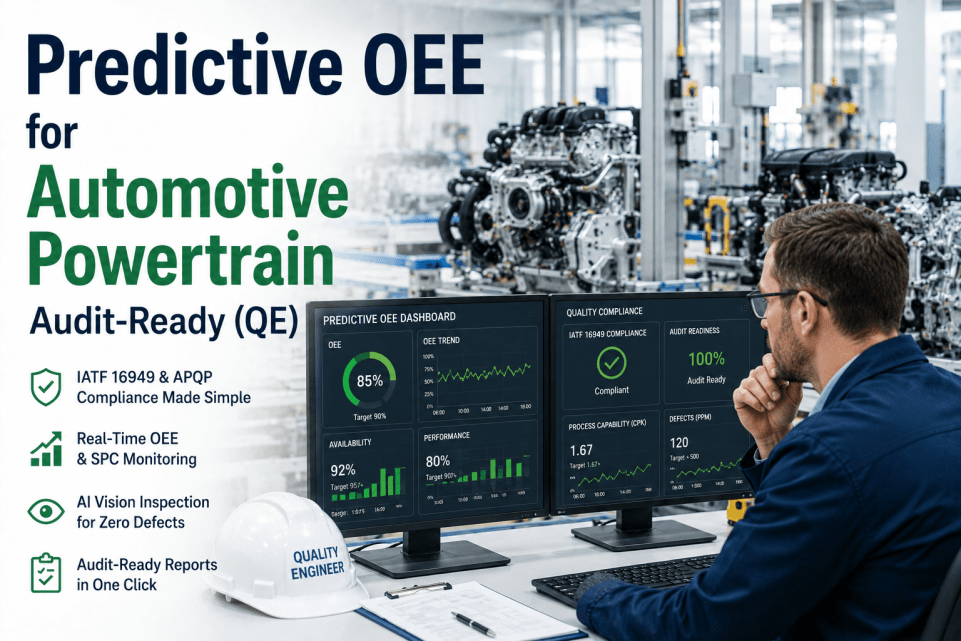
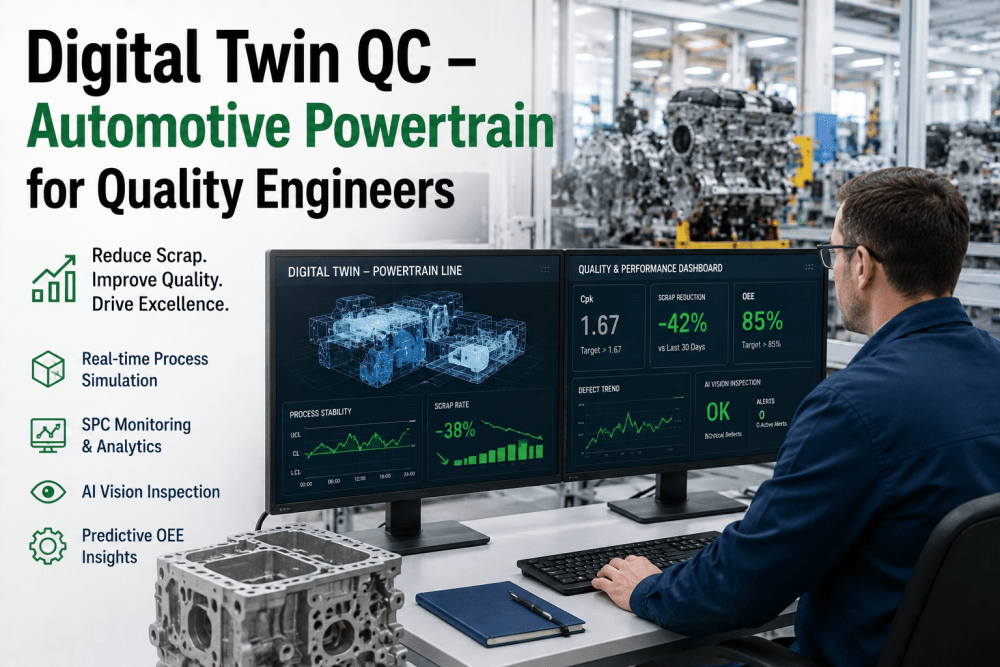
Quality engineers in automotive powertrain manufacturing operate at the intersection of production throughput and compliance integrity. Every engine block, transmission housing, and drivetrain component must meet IATF 16949 quality standards while the line maintains OEE targets above 85%. Traditional OEE tracking provides retrospective availability, performance, and quality metrics at shift end — useful for reporting but insufficient for preventing compliance gaps before they appear in an audit trail. Predictive OEE for automotive powertrain changes this by integrating real-time SPC monitoring, machine vision inspection, and AI-powered production intelligence into a single compliance-ready platform that predicts quality deviations before they occur, documents every parameter automatically for audit traceability, and maintains continuous process capability visibility. iFactory's predictive OEE platform connects to CNC machines, coordinate measuring machines, leak testers, and vision inspection systems across the powertrain line to provide real-time OEE dashboards, automated Cpk tracking, and IATF 16949-compliant quality documentation. Quality engineers and SPC specialists exploring audit-ready OEE solutions regularly Book a Demo to review the compliance integration architecture.

1.89
Sustained overall Cpk across all powertrain machining and assembly parameters after predictive OEE deployment
94%
Reduction in audit non-conformances related to SPC documentation completeness and parameter traceability
62%
Fewer quality-related line stoppages through early drift detection and predictive corrective action recommendations
100%
Parameter measurement traceability per serial number — eliminating manual data collection gaps in the audit trail
Predictive OEE · Powertrain Quality · IATF 16949 Compliance · Audit Readiness
Maintain Audit-Ready Quality Compliance with Predictive OEE for Powertrain
See how predictive OEE integrates SPC monitoring, machine vision inspection, and automated compliance documentation into a single platform — eliminating audit gaps while improving equipment effectiveness and process capability.

What Is Predictive OEE in Automotive Powertrain Manufacturing?

Predictive OEE extends traditional overall equipment effectiveness by integrating real-time SPC monitoring, machine learning anomaly detection, and automated compliance documentation into a unified quality intelligence platform purpose-built for automotive powertrain production. Unlike conventional OEE systems that calculate availability, performance, and quality from production logs at shift end, predictive OEE ingests live data from every CNC machine, CMM, leak tester, and vision inspection station — applying machine learning models that predict quality outcomes before they affect production and automatically documenting every parameter for IATF 16949 audit traceability.

Real-Time SPC & Cpk Monitoring
Every critical parameter across machining, honing, assembly, and leak testing is monitored in real time with control limits that adapt to actual process capability. Cp and Cpk are calculated per subgroup and trended continuously, enabling quality engineers to detect capability drift before it produces non-conforming output.
Automated Compliance Documentation
Every measurement, SPC calculation, control limit adjustment, and corrective action is automatically logged with timestamp, operator ID, and equipment serial number. The platform generates IATF 16949-ready quality reports per control plan element, eliminating manual data aggregation and reducing audit preparation time.
Machine Vision Quality Integration
AI vision inspection stations at critical powertrain operations — cylinder bore inspection, seal surface verification, gear tooth inspection, and thread presence detection — feed pass-fail data directly into the OEE quality module. Defect classifications are correlated with the specific machine and tool state that produced the non-conformance.

How AI Improves Quality Compliance and Audit Readiness

Predictive OEE transforms compliance from a reactive documentation exercise into a continuous, automated process that maintains audit readiness at all times. The platform addresses the three most common audit non-conformances in powertrain quality: incomplete SPC records, undocumented control limit adjustments, and missing corrective action closure. Quality engineers reviewing the compliance architecture regularly Book a Demo to see how automated documentation eliminates audit preparation overhead.

Clause 9.1.1.1
Real-time SPC monitoring with automated documentation for measurement system analysis compliance

IATF 16949 requires statistical process control for all special characteristics identified in the control plan. Predictive OEE exceeds this requirement by monitoring every critical parameter in real time with adaptive control limits, calculating Cp and Cpk per subgroup, and logging every control limit adjustment with a mandatory reason code. The platform automatically generates the SPC documentation package required for Clause 9.1.1.1 compliance — including control charts, capability studies, measurement system correlation, and corrective action records — organized by control plan element number for auditor review.

APQP Phase 4
Continuous product and process validation with real-time capability trending against PPAP baseline

Predictive OEE supports APQP Phase 4 (product and process validation) by providing continuous capability monitoring against the PPAP-baseline Cpk for each characteristic. When current Cpk trends below the PPAP-approved threshold, the platform generates a structured alert with the deviation magnitude, contributing parameters, and recommended corrective action. All capability data is stored per characteristic per production date, enabling rapid retrieval during customer-specific PPAP revalidation and layered audit requirements.

Control Plan
Automated SPC monitoring per control plan element with real-time audit trail documentation

The platform ingests the plant control plan and automatically configures SPC monitoring for every special characteristic — specifying the control method, sample size, frequency, and reaction plan for each element. When a measurement falls outside control limits or a trend indicates developing instability, the platform executes the control plan reaction plan automatically, notifying the designated quality engineer and documenting the corrective action with timestamp and operator identification.

Measurable Quality Compliance with Predictive OEE

Within 12 weeks of deploying predictive OEE across a powertrain machining and assembly line producing engine blocks and cylinder heads, quality engineers documented measurable improvements in both compliance metrics and operational performance.

Compliance & Quality Metric Before Predictive OEE After Predictive OEE Improvement
SPC Documentation Completeness 73% 100% +27 pp
Audit Non-Conformances per Audit 4.2 0.3 93% reduction
Process Capability (Cpk) — Overall 1.42 1.89 +33%
Quality-Related Line Stoppages 12.4 per week 4.7 per week 62% reduction
Control Limit Adjustment Documentation Manual, 58% captured Automated, 100% captured 100% traceable
Corrective Action Closure Time 6.8 days 1.2 days 82% faster
Audit Preparation Time 40+ hours 4 hours 90% reduction

Building a Compliance-Driven Manufacturing Strategy

Implementing predictive OEE for powertrain quality compliance follows a structured deployment framework designed to align with the plant's existing quality management system and audit schedule.

01
Control Plan & Baseline Assessment
Quality engineering team maps the plant control plan, identifies all special characteristics with SPC requirements, and establishes baseline Cpk values per characteristic. The platform ingests existing measurement system data to calibrate initial control limits and predictive models.
02
SPC Integration & Real-Time Monitoring Setup
Platform connects to CMMs, CNC gauging systems, leak testers, and vision inspection stations via OPC-UA and Modbus. Real-time SPC monitoring is configured per control plan element with adaptive control limits, automated Cpk calculation, and compliance documentation rules.
03
Predictive Model Training & Calibration
Machine learning models are trained on 12 months of historical SPC data to recognize early drift patterns across machining and assembly parameters. Models are calibrated to achieve 90%+ drift detection accuracy before deployment to production monitoring.
04
Audit-Ready Documentation & Reporting
Platform generates IATF 16949-compliant quality reports including control charts per characteristic, capability study summaries, control limit adjustment log, corrective action closure records, and measurement system analysis reports. Reports are organized by control plan element for auditor navigation.
05
Continuous Improvement & Annual Calibration
Predictive models are retrained quarterly with new production data. Control plans are updated as process improvements shift capability. Annual PPAP revalidation is supported with automated capability comparison against baseline Cpk values.

What Industry Experts Say

Our powertrain line was producing quality parts, but our audit readiness was a persistent concern. Every IATF 16949 surveillance audit would reveal gaps — incomplete SPC charts, undocumented control limit changes, corrective actions that were closed without adequate root cause evidence. Closing those findings consumed engineering hours that should have been spent on process improvement. Predictive OEE automated the documentation layer completely. Today, every control chart is generated automatically, every control limit adjustment is logged with a reason code, and every corrective action is tracked through closure with objective evidence attached. Our last audit had zero non-conformances, and audit preparation took four hours instead of forty. The platform did not change our quality — it changed how we prove it.
Quality Engineering Manager
Automotive Powertrain Manufacturing — Engine Block & Cylinder Head Machining

Conclusion

Predictive OEE transforms automotive powertrain quality compliance from a reactive documentation burden into a continuous, automated intelligence process that maintains audit readiness at all times while improving equipment effectiveness and process capability. By integrating real-time SPC monitoring, machine vision inspection, machine learning drift detection, and automated compliance documentation into a single platform, quality engineers can eliminate audit non-conformances, reduce audit preparation time by 90%, improve overall Cpk from 1.42 to 1.89, and reduce quality-related line stoppages by 62%. Quality engineers and SPC specialists ready to strengthen their compliance posture and streamline audit readiness Book a Demo to review the predictive OEE deployment plan for their powertrain operations.
Frequently Asked Questions

Traditional OEE calculates availability, performance, and quality from production logs after the shift is complete, providing retrospective metrics useful for reporting but insufficient for compliance. Predictive OEE monitors every parameter in real time with SPC control limits, predicts quality deviations before they occur, and automatically documents every measurement, control limit adjustment, and corrective action for IATF 16949 audit traceability — eliminating the documentation gaps that auditors cite as non-conformances.
Predictive OEE monitors all critical powertrain processes including engine block and cylinder head machining, crankshaft and camshaft grinding, connecting rod honing, bearing cap assembly, cylinder head valve seat machining, transmission case machining, gear hobbing and shaving, leak testing, and final assembly torque verification. The platform connects to CNC machines, CMMs, air gauging stations, leak testers, and vision inspection systems through standard industrial protocols.
The platform ingests the plant control plan and automatically configures SPC monitoring for every special characteristic — control method, sample size, frequency, reaction plan, and documentation requirements. When a measurement exceeds control limits or a predictive model detects developing instability, the platform executes the control plan reaction plan, notifies the designated quality engineer, and documents the corrective action with operator ID, timestamp, and objective evidence — creating a complete audit trail per IATF 16949 Clause 9.1.1.1.
A full deployment across a powertrain machining and assembly line typically requires 8 to 12 weeks from initial data integration to audit-ready operation. Pilot deployment on a single machining cell can be operational within 3 to 4 weeks. Predictive models achieve approximately 85% drift detection accuracy at initial deployment, improving to 95%+ within 6 weeks of site-specific calibration. The platform deploys incrementally alongside existing quality systems without production disruption.
Facilities with 4+ machining lines and IATF 16949 certification typically achieve payback within 5 to 9 months. Primary ROI drivers include audit non-conformance elimination (93% reduction), audit preparation time reduction (90%), quality-related line stoppage reduction (62%), scrap and rework cost reduction from improved Cpk, and reallocation of quality engineering resources from documentation to process improvement. iFactory provides a structured ROI analysis during the initial consultation, projected against the specific powertrain line configuration and compliance burden.
Ready to Achieve Audit-Ready Quality Compliance with Predictive OEE?
iFactory's predictive OEE platform integrates real-time SPC monitoring, machine vision inspection, and automated compliance documentation into a single system — eliminating audit non-conformances, reducing preparation time by 90%, and maintaining continuous Cpk visibility across all powertrain parameters. Get a personalized deployment projection based on your powertrain line configuration and compliance requirements.
Real-Time SPC Monitoring
Automated IATF 16949 Documentation
Predictive Drift Detection
Cpk Trending & Reporting
Audit-Ready Dashboards

Share This Story, Choose Your Platform!