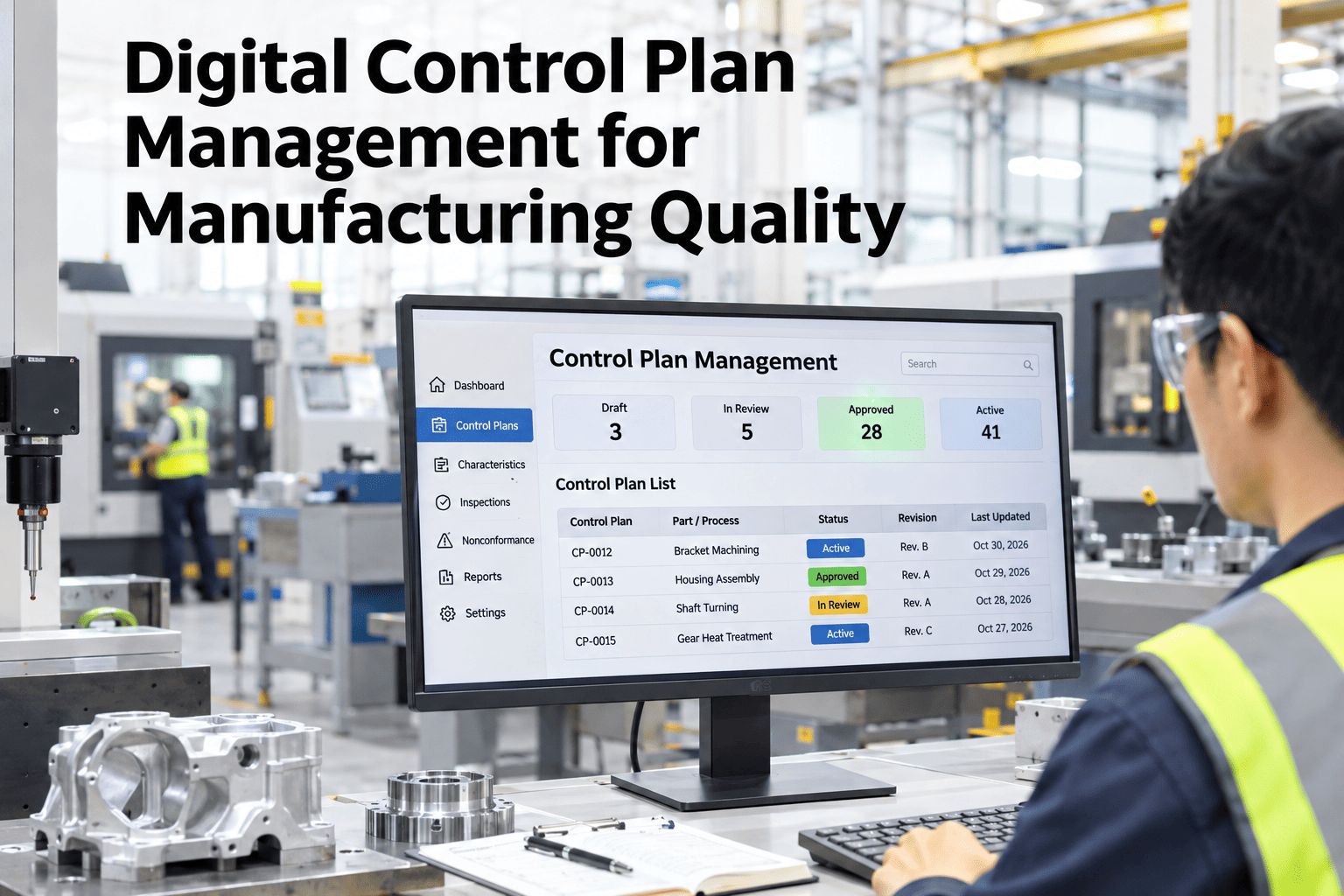
The control plan sitting in a shared spreadsheet stopped matching the line two engineering changes ago, and nobody circled back to update it because updating it means tracking down the PFMEA, the drawing revision and whoever owns the characteristic list that week. A digital control plan stays linked to the live process it describes — the current PFMEA, the current drawing, the current reaction plan — so an auditor or a new operator reads the same document the line is actually running. You can see a live control plan linked to its own process data on a short call.
Manufacturing Quality Documentation, 2026
Stop Auditing a Control Plan That Describes a Line That No Longer Exists
iFactory, an on-premise AI platform for quality control management, keeps every control plan characteristic linked to its PFMEA, its current revision, and its own SPC and inspection data — so the document and the line never drift apart again.
PFMEA
Control Plan
Live SPC Data
What it is
What Is Digital Control Plan Management?
A control plan documents how each critical characteristic on a part is controlled during production — the specification, the measurement method, the sample frequency, and the reaction plan if it goes out of spec. Digital control plan management keeps that document linked to the systems that generate the data it describes, rather than existing as a static file someone updates by hand.
The gap is rarely that nobody wrote a control plan. It is that the control plan stopped being updated the moment the spreadsheet left the launch team's desk, while the line itself kept changing underneath it.
Why static plans drift
Four Ways a Spreadsheet Control Plan Falls Out of Date
No revision trigger
An engineering change happens and nobody is prompted to check the control plan.
Disconnected from PFMEA
The PFMEA updates separately, so the two documents silently diverge.
No link to SPC data
The sample frequency on paper has no relationship to what inspectors actually check.
Single-owner bottleneck
One person holds the master file, and updates wait on their availability.
What it looks like
Five Elements of a Control Plan Worth Keeping Live
1
Characteristic list pulled directly from the current PFMEA, not re-typed separately.
2
Measurement method linked to the gauge or MSA study currently validated for that characteristic.
3
Sample frequency enforced by the SPC system, not left to operator memory.
4
Reaction plan triggered automatically when a characteristic goes out of control.
5
Revision history showing who changed what, and which engineering change triggered it.
Comparison
Static Control Plan vs a Digitally Linked One
| Dimension | Static Spreadsheet | Digitally Linked Plan |
|---|
| PFMEA alignment | Manually checked, often skipped | Pulled from the same current source |
| Revision trigger | Relies on someone remembering | Prompted by the engineering change itself |
| Sample frequency | Written on paper, not enforced | Enforced by the SPC system |
| Audit readiness | Requires manual reconciliation first | Current by default, every day |
Expert review
What an IATF Auditor Would Check First
Holds up
Control plans linked to the PFMEA and to live process data are a long-standing documentation best practice, well recognized under IATF 16949 clause expectations — digitizing it mainly closes the drift gap, not a new concept.
Watch for
A digital control plan that is still manually re-entered from the PFMEA rather than genuinely linked — that setup carries the same drift risk as the spreadsheet it replaced.
Do next
Start with the control plan tied to your most frequently audited part number, since that is where drift gets caught first and costs the most to explain.
FAQ
What Quality Teams Ask About Digital Control Plan Management
How is a digital control plan different from a shared spreadsheet?
A spreadsheet is a static file someone updates manually; a digital control plan pulls its characteristic list, measurement method and sample frequency from the live PFMEA and SPC system, so it cannot silently drift out of date.
See the difference on a live example.
Does a digital control plan replace the PFMEA?
No, it stays linked to it. The PFMEA identifies the risks and controls; the control plan documents how those controls are executed day to day, and the two need to stay consistent with each other at all times.
Ask how PFMEA linkage works in practice.
What triggers a control plan revision?
Any engineering change affecting a controlled characteristic, a PFMEA update, a new measurement system, or a customer-requested change should trigger a revision. A digitally linked plan can prompt this automatically instead of relying on someone remembering.
How does this help during an IATF 16949 audit?
An auditor comparing the control plan against the PFMEA, the drawing and the SPC data finds them already consistent, rather than requiring a manual reconciliation exercise before the audit.
Discuss audit readiness for your next review.
Can a digital control plan enforce the sample frequency it specifies?
Yes, when linked to the SPC or inspection system, the specified frequency can be enforced in the workflow itself rather than left to operator memory, closing one of the most common gaps between what a control plan says and what actually happens on the floor.
Ask how frequency enforcement works with our team.