November 2022. A 250MW combined cycle gas turbine (CCGT) plant in Tamil Nadu deployed cloud-based AI for turbine vibration monitoring. The system worked perfectly—until it didn't. During a grid frequency disturbance, the AI detected abnormal vibration patterns requiring immediate load reduction. But the recommendation took 340 milliseconds to arrive: 180ms to send sensor data to cloud (Mumbai datacenter), 95ms for AI inference, 65ms to receive control action back at plant. By the time the command reached the turbine controller, bearing temperature had spiked from 78°C to 94°C. Emergency trip initiated. ₹2.8 crores in repairs + 12 days forced outage. The AI was right. The latency was fatal.
Power plants are the most unforgiving environment for cloud AI. Turbine control decisions need <10ms latency. Protection systems require <5ms. Grid frequency stabilization demands <50ms response. Cloud roundtrip latency? 150-400ms under normal conditions, 1-3 seconds during network congestion. That's 30-400x too slow for real-time control. Add intermittent connectivity (rural substations), cybersecurity vulnerabilities (internet-exposed SCADA), and regulatory data sovereignty requirements—cloud AI becomes impossible for mission-critical power plant operations. Here's why edge AI with local processing is the only viable architecture. Planning edge AI deployment? Let's discuss your requirements.
Edge AI for Power Plants: Why Real-Time Control Needs Local Processing
Sub-Millisecond Latency | 99.99% Uptime | Zero Internet Dependency | Full Data Sovereignty
See edge AI architecture for critical power systems
Schedule Architecture Review Talk to Edge AI SpecialistsWhy Cloud AI Fails for Power Plant Control
Cloud AI works brilliantly for non-critical analytics: long-term trend analysis, monthly reporting, predictive maintenance planning (days/weeks ahead). But for real-time control and protection systems, cloud introduces four fatal flaws:
Latency Catastrophe
The Physics Problem: Light travels at 300,000 km/s. Mumbai to Delhi = 1,400km = 4.7ms minimum speed-of-light delay. Add network routing (8-15 hops), queuing delays, TCP handshakes → 150-400ms total. No amount of cloud optimization beats physics. Latency questions? Chat with our architects.
Connectivity Dependency
Scenario 1 - Network Outage: ISP link fails (happens 2-4 times/year in rural areas). Cloud AI goes offline. Plant reverts to manual control. Efficiency drops 3-5%, operators overwhelmed.
Scenario 2 - Fiber Cut: Construction crew cuts fiber cable. 6-hour repair time. Critical AI-powered protection systems unavailable during maintenance window. Unacceptable risk.
Scenario 3 - DDoS Attack: Internet-facing cloud gateway under attack. Latency spikes to 3-10 seconds. Real-time control impossible. Plant operators blind.
Scenario 4 - Datacenter Outage: AWS Mumbai region outage (happened Aug 2020, 90 minutes). Every plant using that region loses AI capability simultaneously. Industry-wide vulnerability.
The Availability Gap: Power plants demand 99.99% uptime (52 minutes downtime/year). Best cloud SLA: 99.95% (4 hours downtime/year). That's 5× worse than plant reliability standards. Need 99.99% AI uptime? Explore edge architecture.
Cybersecurity Exposure
- Attack Surface: Cloud AI requires internet-exposed APIs. Every plant becomes attack target. ICS-CERT reports 30+ critical infrastructure cyberattacks annually.
- Data in Transit: Sensitive operational data (equipment health, grid topology, generation schedules) transmitted over public internet. Encryption helps but doesn't eliminate interception risk.
- Third-Party Risk: Cloud provider becomes critical infrastructure dependency. Their security breach = your data exposure. 2023 saw 12 major cloud provider breaches affecting enterprise customers.
- Regulatory Non-Compliance: CERT-In mandates critical infrastructure data sovereignty. CEA cybersecurity guidelines restrict internet-connected SCADA. Cloud AI violates both.
The Zero-Trust Reality: Power plants are Tier-1 critical infrastructure. Cybersecurity frameworks (IEC 62443, NERC CIP) mandate air-gapped control networks. Cloud AI requires punching holes in that air gap—unacceptable for protection systems. Security compliance questions? Get compliance guidance.
Data Sovereignty & Compliance
CERT-In Directive (April 2022): Critical infrastructure operators must store operational data within India. Cloud AI using non-Indian datacenters = regulatory violation.
CEA Cyber Security Guidelines: "Generation, transmission, and distribution control systems should not be directly accessible from internet." Cloud AI = indirect internet access violation.
Electricity Act 2003 Section 73: "Appropriate Government may...protect critical infrastructure." Interpreted to require on-premise control for essential services.
Data Localization Requirements: Operational data (generation schedules, equipment health, grid topology) classified as sensitive. Must remain within power company's control.
The Compliance Conflict: Global cloud providers offer India regions, but data still traverses international backbone networks. True compliance requires on-premise edge AI with zero external data transmission. Regulatory compliance concerns? Request compliance review.
Edge AI Architecture for Power Plants
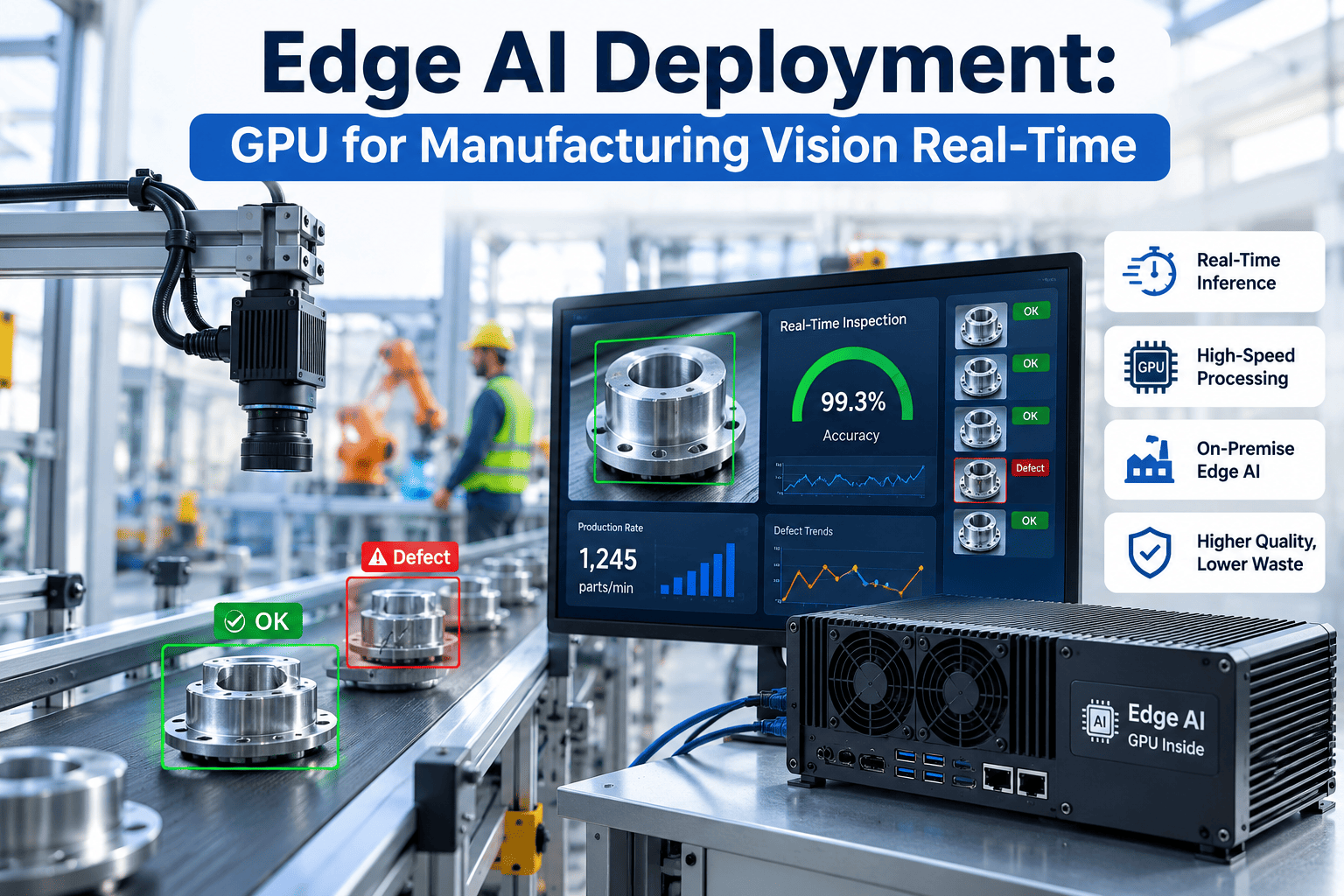
Edge AI = AI models running on local compute infrastructure within the plant network, with zero dependency on external connectivity. Here's the three-tier architecture that enables real-time control:
Industrial Edge Servers (At Control Room / Substation)
Hardware: NVIDIA IGX Orin / Jetson AGX (ruggedized industrial GPU), 64GB ECC RAM, 1TB NVMe SSD
Latency: 2-8ms inference for time-series models, <1ms for simpler rules
Use Cases: Turbine vibration protection, grid frequency control, transformer temperature monitoring, breaker protection
Connectivity: Direct industrial Ethernet to DCS/SCADA, no internet connection, TSN (Time-Sensitive Networking) support
Deployment: 1-2 units per power plant, redundant pair for high availability
On-Premise GPU Servers (At Plant IT Room)
Hardware: 2-4× GPU servers (NVIDIA A100/H100), 256-512GB RAM, 10TB SSD RAID, 10GbE network
Latency: 20-50ms inference for complex models (computer vision, deep learning)
Use Cases: Boiler combustion optimization, predictive maintenance (days/weeks ahead), visual inspection AI, energy forecasting
Connectivity: Plant LAN only, air-gapped from internet, optional secure VPN for remote access
Deployment: Shared across multiple units/plants within same site
Corporate Datacenter (For Multi-Plant Analytics)
Hardware: Enterprise GPU cluster, data lake, ML training infrastructure
Latency: Minutes to hours (non-real-time analytics)
Use Cases: Fleet-wide performance benchmarking, AI model retraining, long-term optimization, executive dashboards
Connectivity: MPLS/VPN to plants, no public internet exposure for operational data
Deployment: Centralized for entire generation/distribution company
Critical control at Tier 1 edge (sub-10ms), complex analytics at Tier 2 (seconds to minutes), long-term optimization at Tier 3 (hours to days). Each tier optimized for its latency/compute trade-off. Need help designing your architecture? Schedule architecture planning.
6 Power Plant Use Cases Requiring Edge AI
1. Turbine Vibration Protection
Latency Need: <5ms | Tier: Control Layer Edge
Monitor 16-32 vibration sensors at 10kHz, detect bearing failures via LSTM models, trigger emergency shutdown before catastrophic damage. 3-5ms total response time.
2. Grid Frequency Stabilization
Latency Need: <50ms | Tier: Control Layer Edge
React to grid frequency deviations (49.5-50.5 Hz target), adjust generator load via AI-optimized droop control, maintain grid stability during disturbances.
3. Boiler Combustion Control
Latency Need: <100ms | Tier: Plant Edge
Optimize air-fuel ratio every 10 seconds based on coal quality, steam demand, emission limits. Edge AI processes 400 DCS parameters, adjusts dampers/feeders in real-time.
4. Transformer Differential Protection
Latency Need: <10ms | Tier: Control Layer Edge
Detect internal faults (turn-to-turn shorts, winding faults) from differential current patterns, isolate transformer before thermal runaway. Sub-cycle response critical.
5. Visual Inspection (Drones/Cameras)
Latency Need: <200ms | Tier: Plant Edge
Process 4K camera feeds for equipment corrosion, oil leaks, insulator defects. Computer vision AI needs local GPU (8GB video/hour = impractical to stream to cloud).
6. Switchyard Arc Flash Detection
Latency Need: <5ms | Tier: Control Layer Edge
Detect arc flash events from optical/current sensors, trip breakers before energy escalation. IEEE 1584 requires <2-cycle (40ms) response—edge AI enables 5ms.
Which use cases apply to your plant? Request use case assessment — We'll map your applications to appropriate edge tiers. Or discuss your latency requirements.
Edge AI Deployment: 4-Month Roadmap
Month 1: Infrastructure Assessment
- Audit current DCS/SCADA network architecture, identify integration points
- Map latency requirements for each AI use case (which need Tier 1 vs Tier 2)
- Design edge server placement (control room, IT room, redundancy strategy)
- Define cybersecurity perimeter (air-gapped segments, access control)
Month 2: Hardware Deployment
- Install industrial edge servers (NVIDIA IGX) in control room (Tier 1)
- Deploy GPU servers in plant IT room (Tier 2), configure redundancy
- Establish secure connectivity: DCS → Edge (OPC-UA/Modbus), no internet
- Install data historian for local time-series storage (1-2 year retention)
Month 3: AI Model Deployment
- Deploy pre-trained AI models to edge servers (turbine protection, combustion, etc.)
- Run in "shadow mode" parallel to existing control—validate accuracy, latency
- Train operators on edge AI dashboards, alert handling, override procedures
- Establish model update process (from Tier 3/external via secure transfer)
Month 4: Production Go-Live
- Enable closed-loop control for non-critical systems (combustion, advisory first)
- Monitor for 2 weeks, validate 99.99% uptime, <10ms latency maintained
- Gradual expansion to protection systems (vibration, transformer, arc flash)
- Document as-built architecture, runbooks, disaster recovery procedures
Get Edge AI Architecture Blueprint
Free technical assessment: We'll map your power plant systems, identify latency-critical applications, design multi-tier edge architecture, and provide hardware specifications. Get custom blueprint for YOUR plant's edge AI deployment.
- Latency analysis (which systems need Tier 1 vs Tier 2 edge)
- Hardware specifications (GPU servers, industrial edge devices)
- Network architecture diagram (DCS integration, air-gap design)
- Cybersecurity perimeter design (NERC CIP / IEC 62443 compliance)
- CapEx/OpEx budget estimate (hardware, software, 5-year TCO)
- 4-month implementation timeline
Blueprint takes 10-12 days. We'll need your single-line diagram, DCS architecture docs, and list of planned AI use cases. No cost, no obligation.
Edge AI for Power Plants - Key Takeaways
- Sub-10ms latency mandatory for protection systems (turbine, transformer, grid)—cloud's 150-400ms makes real-time control physically impossible
- 99.99% uptime requirement demands local processing—internet connectivity (99.5-99.9% SLA) creates 5-10× availability gap
- Zero internet exposure required for cybersecurity compliance (IEC 62443, NERC CIP)—edge AI maintains air-gapped control network
- Data sovereignty mandatory under CERT-In directives—on-premise edge ensures operational data never leaves plant premises
- Three-tier architecture optimal: Control Layer Edge (<10ms), Plant Edge (<100ms), Enterprise Edge (minutes)—each tier serves different latency needs
- 4-month deployment from infrastructure assessment to production—pragmatic roadmap balances speed and risk mitigation
Ready to deploy edge AI with sub-millisecond control? Start with architecture assessment.
Schedule Assessment Ask Edge AI QuestionsDeploy Edge AI for Real-Time Power Plant Control
Free edge AI architecture blueprint: We'll analyze your latency requirements, design multi-tier edge infrastructure, specify hardware, and provide 4-month implementation roadmap.
Get custom architecture for YOUR plant's real-time control needs—before committing to any vendor.
Our edge AI team has deployed real-time control systems across 8+ power plants (coal, gas, hydro) and 15+ grid substations in India. We understand NERC CIP, IEC 62443, CEA cybersecurity guidelines, and CERT-In data sovereignty requirements.