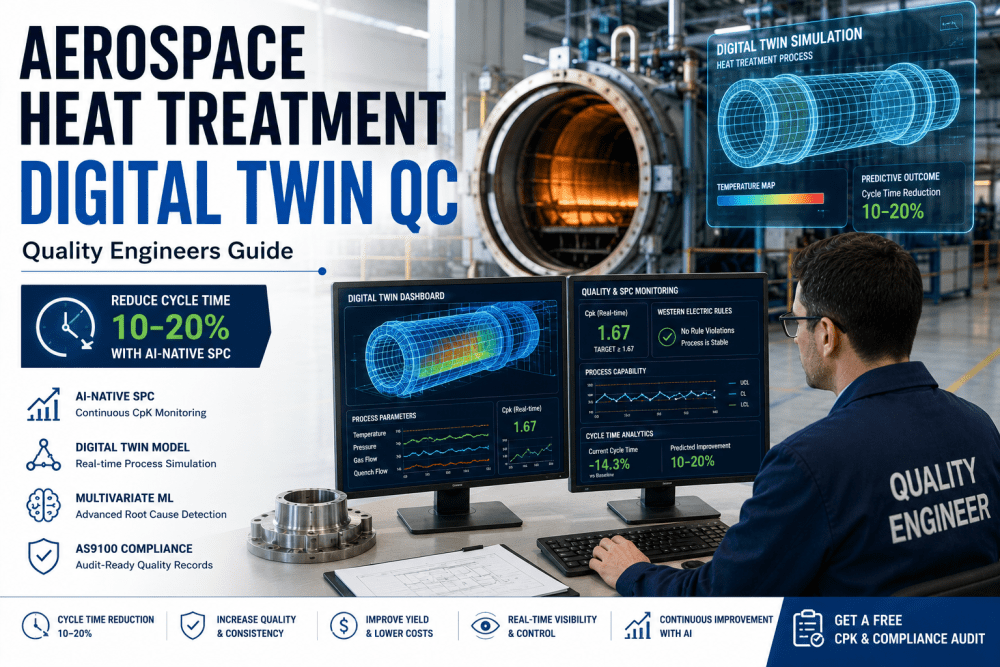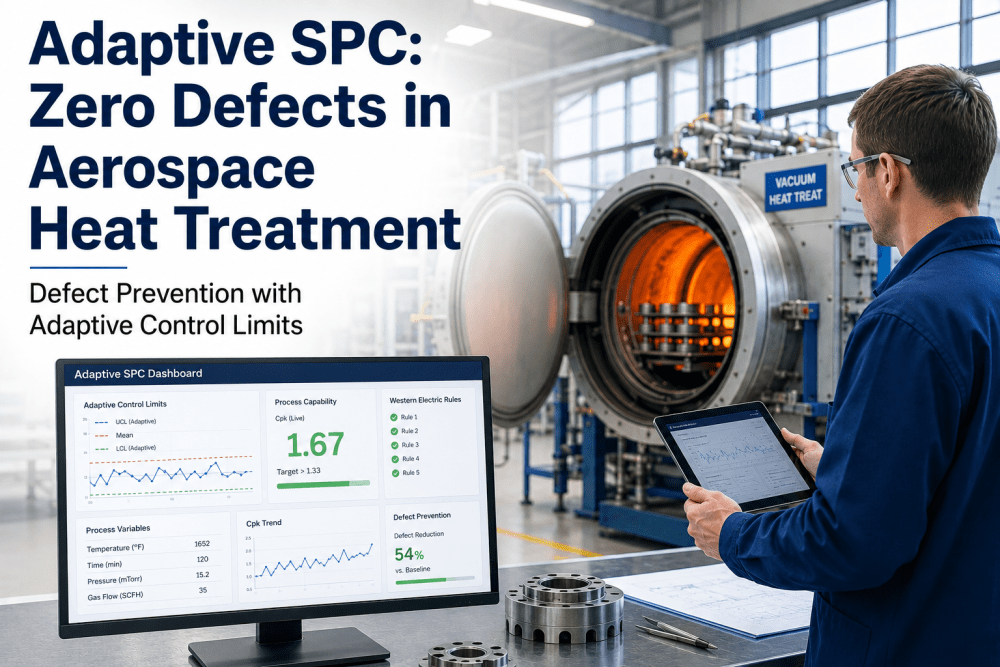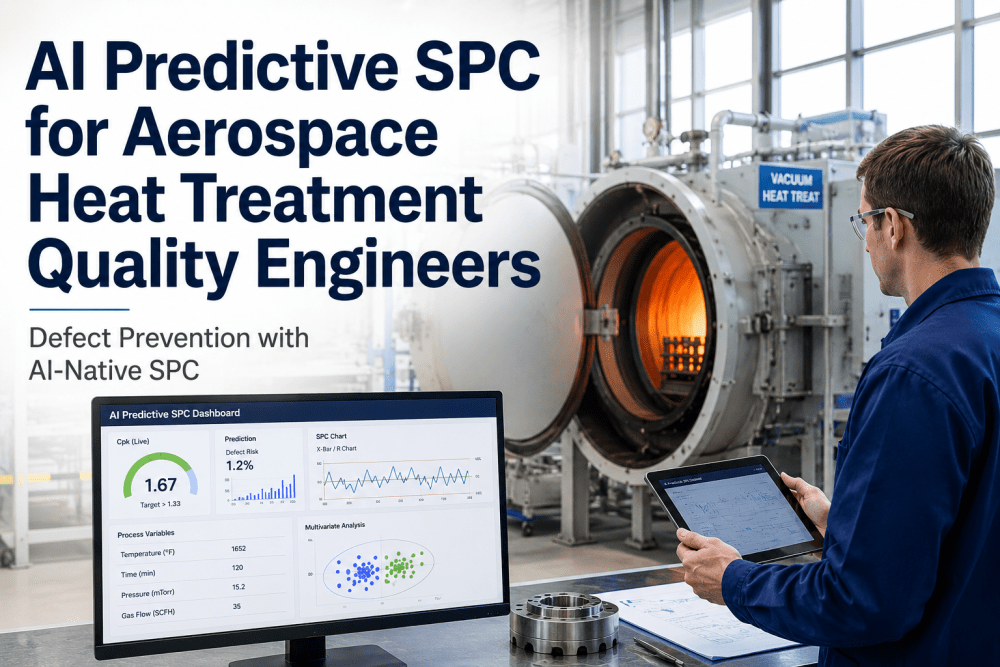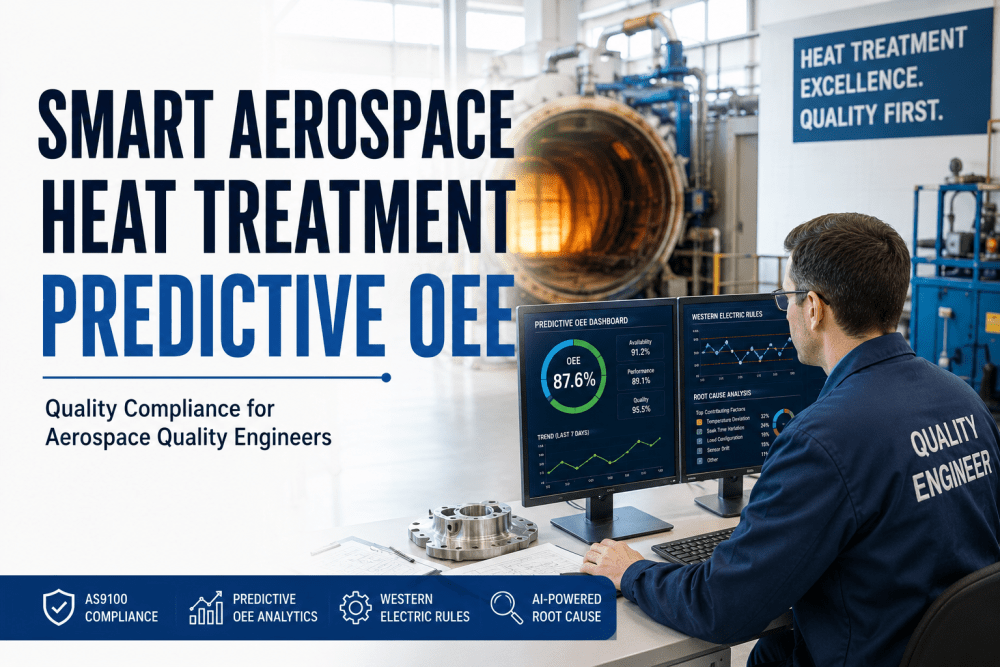
A quality engineer at an aerospace heat treatment facility reviews the morning's furnace data and finds each cycle temperature within AMS 2750 specification. Cpk values meet customer requirements. The OEE dashboard shows 82.4 percent — acceptable by most standards. But a pattern emerges: hardness readings on the vacuum furnace have drifted upward over 72 hours. No single reading triggers an alarm. No Western Electric rule violation is flagged. Yet the cumulative trend signals a developing issue that, if uncorrected, will produce non-conforming product within two production shifts. This gap — between surface-level compliance and genuine process stability — is where quality escapes are born and audit findings are written. iFactory’s Predictive OEE platform for aerospace heat treatment closes that gap.
Smart Aerospace Heat Treatment Predictive OEE for Quality Engineers
iFactory’s AI-powered Predictive OEE platform gives quality engineers continuous visibility into furnace process capability, real-time SPC monitoring with Western Electric rules, automated root cause analysis, and AS9100 and NADCAP audit-ready compliance reporting — transforming heat treatment quality management from reactive inspection to predictive prevention.
Why Aerospace Heat Treatment Demands Predictive OEE Analytics
Aerospace heat treatment is governed by strict process specifications — AMS 2750 for pyrometry, AMS 2769 for solution heat treatment, AMS 2770 for age hardening, and customer-specific requirements that demand absolute process control. Quality engineers are responsible for maintaining compliance across AS9100, NADCAP, and IA9100 quality systems while managing production throughput and OEE targets.
The traditional approach — periodic SPC charting, manual data collection from furnace controllers, and reactive root cause analysis — leaves critical gaps. Process drift can develop over multiple shifts without detection because manual SPC sampling captures only a fraction of the data stream. Audit preparation requires time-consuming manual compilation of process data, calibration records, and quality documentation across disparate systems. Root cause analysis is delayed by the hours or days required to correlate process parameters with quality outcomes.
Intermittent Data Collection Misses Process Drift
Manual SPC sampling typically captures 1 to 3 data points per furnace cycle. Subtle parameter drift that develops between sampling intervals goes undetected until quality limits are exceeded. Predictive OEE eliminates this blind spot with continuous real-time monitoring.
Manual Compliance Reporting Consumes Engineering Hours
Quality engineers spend 8 to 12 hours per audit compiling evidence of process control, calibration traceability, and corrective actions. Automated compliance reporting from predictive OEE platforms reduces this burden by generating audit-ready documentation from continuous monitoring data.
Delayed Analysis Amplifies Quality Risk
When a non-conformance is discovered days after the heat treatment cycle, correlating the root cause with specific process variables requires manual data mining across furnace logs, pyrometry records, and quality test results. Machine learning root cause analysis reduces this timeline from days to minutes.
How Predictive OEE Strengthens AS9100 and NADCAP Audit Readiness
Predictive OEE extends traditional OEE analytics beyond historical reporting by applying machine learning models to forecast availability, performance, and quality metrics before they deviate from specification. For aerospace heat treatment, this capability directly supports the continuous improvement and process control requirements of AS9100 and NADCAP.
The iFactory platform monitors every furnace cycle across three dimensions simultaneously: availability (planned vs actual operating time, including furnace maintenance and calibration compliance), performance (cycle time efficiency, temperature ramp rates, quench delay times), and quality (first-pass yield, Cpk trends, hardness conformity, metallurgical property consistency). When any dimension shows early signs of deviation, the platform alerts quality engineers before the variance affects product quality or compliance status.
Continuous Compliance Monitoring
Every furnace cycle generates a complete compliance record including temperature uniformity data, quench medium analysis, and cycle parameter verification. The platform maintains AS9100 and NADCAP traceability requirements automatically, eliminating manual data transcription and reducing audit preparation time by an estimated 70 percent.
Real-Time Process Capability Tracking
Cpk and Ppk values are calculated continuously from every available data point rather than from periodic samples. Quality engineers can view process capability trends for any parameter across any time window, enabling proactive adjustments before capability indices fall below customer requirements.
Predictive Downtime Alerts for Furnace Assets
Machine learning models analyze thermocouple drift patterns, heating element performance trends, and vacuum leak rates to predict furnace maintenance needs before they cause unplanned downtime. Quality engineers receive advance notice of potential process disruptions with recommended corrective actions.
Quality engineers can Book a Demo to see how predictive OEE analytics integrate with existing furnace control systems and quality management workflows.
Western Electric Rules and Real-Time SPC for Furnace Process Control
Statistical process control in aerospace heat treatment requires continuous monitoring of critical parameters including furnace temperature uniformity, quench bath temperature, atmosphere composition, and cycle timing. iFactory’s platform applies Western Electric rules to every data stream in real time, flagging statistical rule violations that manual SPC sampling would miss between inspection intervals.
The Western Electric rules — including one point beyond three sigma, two of three points beyond two sigma, four of five points beyond one sigma, and eight consecutive points on one side of the centerline — are applied simultaneously across all monitored parameters. When any rule is violated, the platform classifies the severity and triggers appropriate escalation based on the parameter’s criticality to product quality and compliance.
AS9100 requires documented evidence of process control, including statistical techniques for monitoring process capability. iFactory’s Predictive OEE platform automatically generates the SPC charts, capability analyses, and process monitoring records required for AS9100 compliance. All SPC data is time-stamped, traceable to specific furnace cycles and operator actions, and stored in audit-ready format.
NADCAP audit requirements for heat treatment demand rigorous process control documentation, including continuous temperature uniformity surveys, quench medium analysis records, and cycle parameter verification. The platform captures every data point required for NADCAP checklists and presents them in structured compliance reports that auditors can review at a glance.
IA9100 adds additional requirements for risk-based thinking and preventive action. Predictive OEE supports these requirements by identifying process drift patterns before they produce non-conforming product, enabling quality engineers to initiate preventive actions with documented evidence of the risk trajectory.
Data Acquisition
Furnace controllers, pyrometry sensors, and quench monitoring systems transmit real-time data to the platform at sub-second intervals for every active heat treatment cycle.
SPC Rule Application
Western Electric rules are applied continuously across all monitored parameters. Violations are classified by type and severity with automatic correlation to equipment and product data.
Severity Classification
Each violation receives a severity score based on the parameter criticality, deviation magnitude, and potential quality impact. Critical violations trigger immediate escalation to on-call quality engineering personnel.
Documentation
All SPC data, rule violations, and corrective actions are automatically documented in audit-ready format with full traceability to specific furnace cycles, product lots, and operator actions.
Transform Your Heat Treatment Quality Management with Predictive OEE.
Stop relying on manual SPC sampling and reactive root cause analysis. iFactory’s AI-powered platform gives quality engineers continuous visibility, automated compliance reporting, and predictive analytics for aerospace heat treatment operations.
Automated Root Cause Analysis for Heat Treatment Process Deviations
When a heat treatment process deviation occurs — a hardness reading outside specification, a microstructure non-conformance, or a tensile property below minimum — quality engineers must quickly identify the root cause to contain the impact and implement corrective action. Traditional root cause analysis requires manual correlation of quality test results with furnace cycle data, pyrometry records, quench medium analysis, and operator logs — a process that can consume hours or days.
iFactory’s machine learning root cause analysis engine automates this correlation by analyzing historical and real-time process data to identify the most probable cause of any quality deviation. The platform continuously learns from every investigation outcome, improving its accuracy and speed with each analysis cycle.
Automated Parameter Correlation
The ML engine correlates hundreds of process variables simultaneously — temperature profiles, ramp rates, soak times, quench delay, quench medium temperature, furnace load configuration, and thermocouple drift trends — to identify which parameters most strongly correlate with the observed quality deviation.
Probabilistic Root Cause Ranking
Each potential root cause is assigned a confidence score based on statistical correlation strength, historical frequency, and similarity to previously resolved cases. Quality engineers receive a ranked list of probable causes with supporting data evidence, enabling faster decision-making.
Continuous Model Improvement
Each investigation outcome feeds back into the ML model, improving future analysis accuracy. The platform also identifies recurring deviation patterns across different furnaces, product families, and shift operations, enabling systemic corrective actions that reduce overall quality risk.
Closed-Loop Corrective Action Tracking
When a root cause is confirmed and corrective action is implemented, the platform monitors the affected process parameters to verify that the action has resolved the deviation. Quality engineers receive automated confirmation when process stability is restored, closing the corrective action loop.
Schedule a demo to explore how automated root cause analysis integrates with your existing heat treatment quality workflows and furnace monitoring infrastructure.
Four Reasons Quality Engineers Are Adopting Predictive OEE for Heat Treatment
Continuous SPC Eliminates Sampling Blind Spots
Manual SPC sampling captures a fraction of the available process data. Predictive OEE applies Western Electric rules continuously across every parameter, detecting statistical rule violations at the moment they occur rather than at the next scheduled sampling interval. Quality engineers gain complete visibility into process behavior across all shifts and all furnace assets.
Automated Compliance Reporting Reduces Audit Burden
AS9100 and NADCAP audits require extensive evidence of process control and continuous improvement. Predictive OEE platforms generate audit-ready compliance reports automatically from continuous monitoring data, eliminating the manual compilation work that consumes quality engineering resources before every audit.
Predictive Analytics Shift Quality from Reactive to Preventive
Traditional OEE is a lagging indicator — it tells you what already happened. Predictive OEE applies machine learning to forecast availability, performance, and quality metrics before they deviate from target. Quality engineers can intervene before process drift produces non-conforming product, reducing scrap, rework, and customer escapes.
Cross-Shift Process Visibility Supports Continuous Improvement
When SPC data is collected intermittently, trend analysis across shifts and production days is unreliable. Predictive OEE platforms maintain continuous process data that spans day, night, and weekend operations, enabling quality engineers to identify and address process drift patterns that develop over extended time periods.
From Compliance Burden to Competitive Advantage
Quality engineers in aerospace heat treatment have historically operated with incomplete process visibility, manual compliance reporting workflows, and reactive root cause analysis methods that consume valuable engineering time and leave quality gaps undetected until they produce non-conforming product. Predictive OEE analytics transforms this paradigm by delivering continuous, automated, and intelligent process monitoring that strengthens compliance, reduces quality risk, and improves operational performance.
The iFactory platform gives quality engineers the tools to maintain AS9100, NADCAP, and IA9100 compliance without the administrative burden of manual data compilation. Western Electric rule violations are detected in real time. Root cause analysis is completed in minutes rather than days. Audit-ready documentation is generated automatically from continuous monitoring data. And the predictive analytics engine identifies developing process issues before they affect product quality or compliance status.
For quality engineers seeking to strengthen their heat treatment quality management systems and reduce the compliance burden on their teams, Book a Demo with iFactory’s aerospace quality analytics team.
Real Answers from Quality Engineers Adopting Predictive OEE for Heat Treatment
Stop Managing Heat Treatment Quality with Manual SPC and Reactive Analysis.
Your quality engineers deserve continuous process visibility, automated compliance reporting, and predictive analytics that prevent deviations before they impact product quality. iFactory’s Predictive OEE platform deploys in 8 weeks and integrates with your existing furnace control and quality systems.

.png)