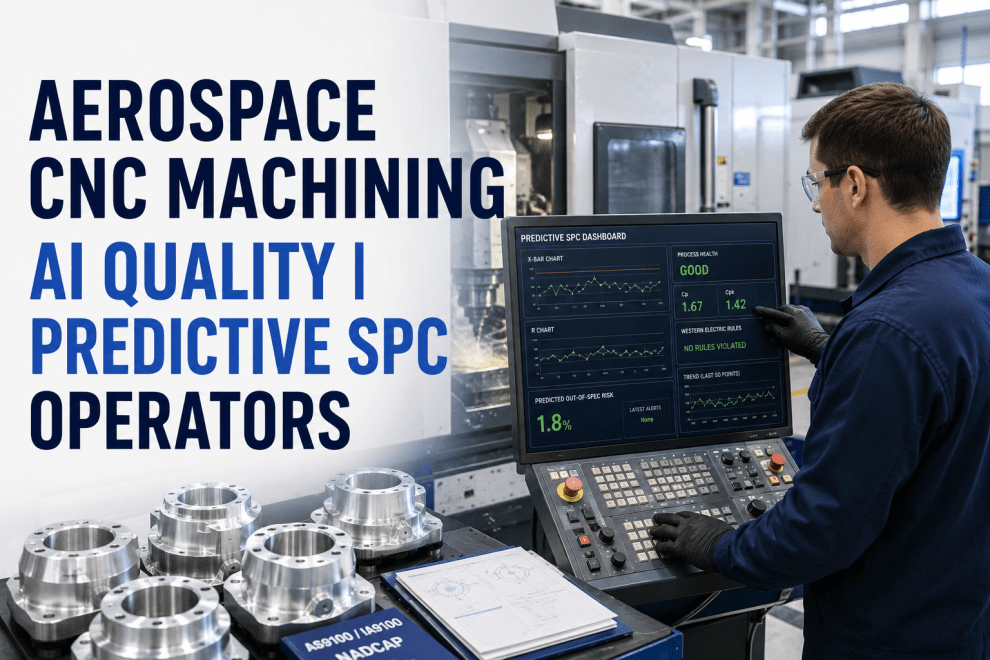
Aerospace CNC machining operators managing multi-axis mills, lathes, and five-axis machining centers face a persistent challenge: maintaining AS9100/IA9100 and NADCAP compliance while meeting production throughput targets. Predictive SPC resolves this by deploying ML-driven control charts that continuously apply Western Electric rules, monitor Cpk/Cp/Pp/Ppk in real time, and automatically detect root causes of process drift — keeping every machined feature within specification and every audit trail complete. For aerospace operations producing structural components, engine parts, and airframe assemblies from aluminum, titanium, Inconel, and composites, Predictive SPC delivers audit-ready quality assurance at every stage of production. iFactory's Predictive SPC module integrates with existing CNC machine controllers (Fanuc, Siemens, Heidenhain, Mazak) through read-only OPC UA connectors, deploying ML-driven control charts on operator dashboards within a standard deployment timeline. Book a Demo to see how Predictive SPC makes your CNC line audit-ready every day.
01 / The Quality Compliance Challenge in Aerospace CNC Machining
Aerospace CNC machining operators face a fundamental operational challenge: maintaining AS9100/NADCAP compliance requires rigorous documentation, real-time process control, and zero-defect quality — all while keeping CNC spindles running at target speeds and feeds. Traditional SPC systems create friction by requiring manual control limit calculations, static Western Electric rule configurations, and retrospective capability analysis that leaves compliance gaps exposed during audits. The root cause of this tension is that traditional SPC applies static control limits and fixed Western Electric rules regardless of current cutting conditions, tool wear state, or material batch variation — forcing operators to either slow production to maintain compliance or accept audit risk at higher throughput. Predictive SPC breaks this trade-off by continuously adjusting control limits, rule sensitivity, and parameter targets based on real-time machining data — enabling operators to maintain compliance at optimal production speeds rather than the lowest common denominator speed. Aerospace CNC machining operators exploring quality compliance solutions Book a Demo to review how Predictive SPC applies ML-driven control charts to their specific machine configurations and part portfolios.
Traditional SPC vs. Predictive SPC for Quality Compliance
| Aspect | Traditional SPC | Predictive SPC |
|---|---|---|
| Control Limit Approach | Static UCL/LCL from initial capability study — limits remain fixed regardless of tool wear, material variation, or environmental changes | ML-adjusted limits that continuously adapt based on real-time machining data, tool condition, and material batch characteristics — enabling optimal feeds and speeds for current conditions |
| Western Electric Rules | Manually configured per part number — often skipped for short runs, leaving quality gaps; rules apply uniformly regardless of process state | Automatically applied and adjusted — rule sensitivity adapts to process stability, tightening during stable periods and relaxing during transitions to prevent false alarms |
| Capability Monitoring | Cpk/Cp/Pp/Ppk calculated retrospectively at batch end or shift completion — too late for real-time production decisions | Continuous real-time capability tracking — operators see current Cpk on their dashboard and can adjust machining parameters with confidence that quality targets are being maintained |
| Documentation Process | Manual logs, paper charts, and spreadsheet-based records for AS9100 compliance — prone to transcription errors and incomplete audit trails | Automated digital audit trail generation — every control chart, capability index, and corrective action is timestamped and searchable, enabling one-click audit package generation |
| Excursion Detection | Reactive — defects detected after generation, often during downstream inspection; by then, multiple cycles of compromised parts exist | Proactive — ML predicts defect probability based on process parameter drift and alerts operators before quality limits are breached, enabling preventive offset adjustment |
| Operator Decision Support | Operators must interpret control charts manually, apply rules, calculate capability metrics, and decide on corrective actions — a skill-intensive process that varies by experience level | System provides actionable recommendations — when a parameter drift is detected, the dashboard shows the likely root cause, suggested corrective action, and projected impact on quality and compliance |
02 / How Predictive SPC Delivers Audit-Ready Quality
Predictive SPC achieves consistent quality compliance through three interconnected capabilities — ML-driven control charts that adapt to machining conditions, continuous capability monitoring that provides real-time quality confidence, and automated root cause detection that identifies process drift sources before non-conformances occur. Aerospace CNC machining operators exploring the technology Book a Demo to review how Predictive SPC applies these capabilities to their specific machine configurations, material specifications, and compliance requirements.
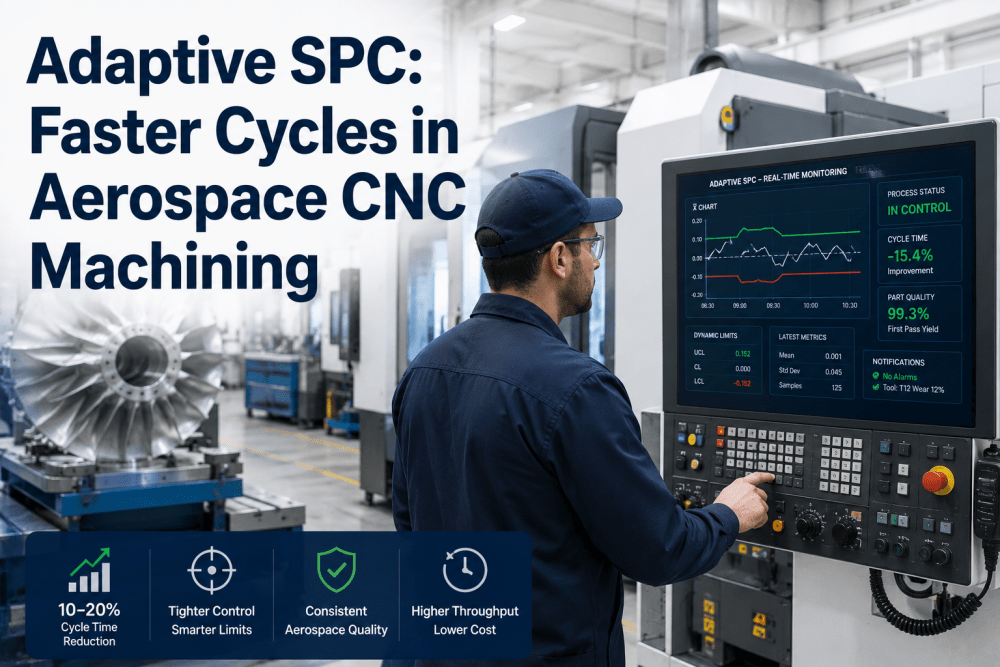
ML-driven control charts form the foundation of Predictive SPC, eliminating the need for operators to manually configure control limits or Western Electric rules for each part number and operation. The predictive engine analyzes historical machining data — typically 6–12 months of production records — to establish baseline control limit parameters for each feature, operation, and machine combination. During live production, the system continuously monitors process data streams from CNC machine controllers, probing cycles, and inspection equipment, automatically adjusting control limit width, rule sensitivity, and signal thresholds based on current tool wear state, material batch variation, and environmental conditions. When the process is stable and centered, control limits tighten to provide maximum defect detection sensitivity, enabling operators to maintain full production speed with confidence that the SPC system is operating at peak vigilance. When the process experiences expected variation — tool changes, material batch transitions, warm-up cycles after maintenance — limits expand appropriately to prevent false alarms that would erode operator trust and slow production. This dynamic behavior allows operators to maintain consistent production throughput because the SPC system adapts to machining conditions rather than forcing operations to the slowest common denominator.
Continuous capability monitoring provides operators with real-time visibility into Cpk, Cp, Pp, and Ppk metrics — updated with every machining cycle rather than calculated retrospectively at batch end or shift completion. This real-time capability feedback is the key enabler for consistent quality compliance because it gives operators the confidence to maintain production speeds while staying within specification limits. When tool wear begins to influence feature dimensions or surface finish, the Predictive SPC system immediately reflects the impact on capability metrics — if Cpk remains above the target threshold (typically 1.33 or higher for aerospace applications), the operator knows the current process settings are sustainable. If Cpk begins to trend toward the minimum acceptable threshold, the system generates a proactive alert recommending an offset adjustment or tool change before quality limits are breached. Over multiple production runs, the system learns the optimal process window for each part number, material grade, and machine combination — building a data-driven model that predicts the maximum sustainable production envelope for current conditions. This continuous learning enables progressive process optimization as the system accumulates more operating data and refines its parameter prediction models, delivering sustained compliance improvement over time.
Automated root cause detection with machine learning is the most operationally valuable Predictive SPC capability — enabling the system to identify the specific source of process drift without operator guesswork or lengthy troubleshooting. When a control chart signals an out-of-condition alert or Cpk begins trending downward, the ML engine correlates the signal against dozens of process variables — spindle load, feed rate, coolant temperature, tool offset history, material batch ID, and upstream operation data — to isolate the most probable root cause within seconds. For example, if the system detects a gradual shift in bore diameter on a five-axis machining center, the ML engine might identify that the shift correlates with spindle load changes consistent with tool flank wear, recommend a tool offset adjustment, and predict the remaining useful life before a full tool change is required. The operator receives this recommendation directly on the dashboard with confidence scoring and supporting data, enabling informed decision-making without manual analysis. Over time, the system learns from every corrective action taken — whether the operator accepted, modified, or overrode the recommendation — continuously improving root cause accuracy and building a knowledge base of failure modes specific to each machine, operation, and material combination in the facility.
03 / Measured Business Impact — Quality Compliance Results
Aerospace CNC machining operations deploying Predictive SPC have documented measurable improvements in quality compliance, process capability, audit efficiency, and overall equipment effectiveness. Aerospace CNC operators evaluating the technology Book a Demo to review the full deployment results and projected compliance impact for their specific machining configurations and production targets.
04 / Deployment Roadmap — From Assessment to Autonomous Operation
The deployment follows a phased methodology designed for aerospace CNC machining environments, with parallel validation at each phase and continuous monitoring throughout. Aerospace CNC operators exploring Predictive SPC deployment Book a Demo to review the complete deployment roadmap and projected compliance improvements for their specific machining operations.
Expert Review — An Aerospace CNC Operator's Perspective on Predictive SPC
Conclusion — Predictive SPC Makes Every Day Audit-Ready
Aerospace CNC machining operators no longer need to choose between production speed and compliance certainty. Predictive SPC delivers 99.7% quality compliance through ML-driven control charts, real-time capability monitoring, and automated root cause detection — achieving audit-ready quality at every stage of production while reducing documentation time by 50% and improving Cpk by 20% within 90 days of deployment. The technology transforms the operator's role from manual control chart maintenance and retrospective quality management to proactive process optimization supported by data-driven recommendations — enabling shop-floor personnel to make faster, more confident decisions about tool offsets, feeds and speeds, and quality trade-offs. The deployment process is structured and non-disruptive — five phases over 6–8 weeks with read-only OPC UA connectivity that requires no PLC reprogramming and carries zero risk to production operations. iFactory's Predictive SPC module is purpose-built for aerospace CNC machining operators, integrating with existing machine controllers and delivering ML-driven control charts, real-time capability metrics, and actionable root cause recommendations through intuitive operator dashboards. The next step is a zero-commitment assessment that connects to your machining data and demonstrates Predictive SPC on your actual production parameters — giving you the data you need to evaluate the quality compliance impact for your specific operations. Book a Demo to start your Predictive SPC journey and discover how ML-driven control charts can make your CNC line audit-ready every day.