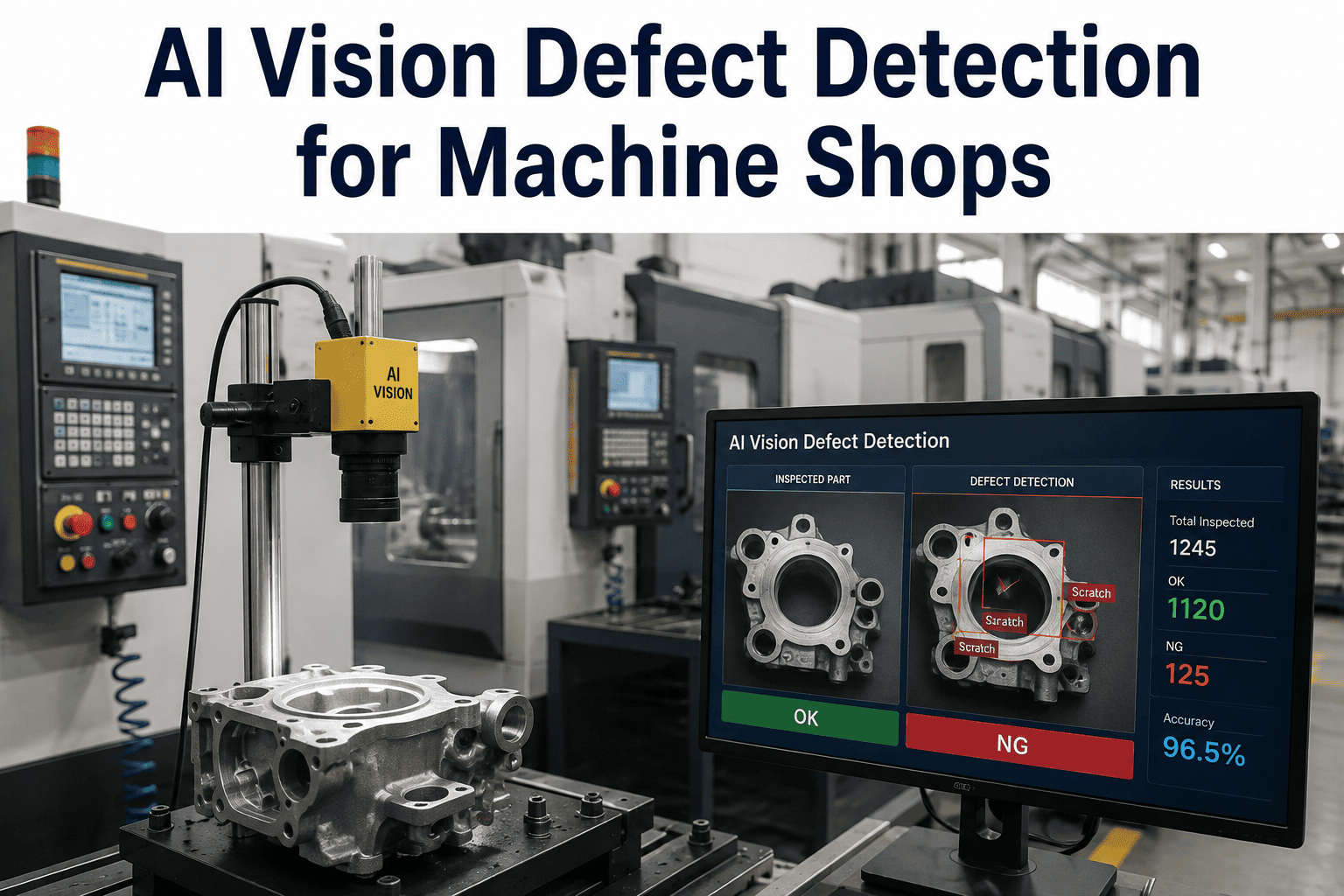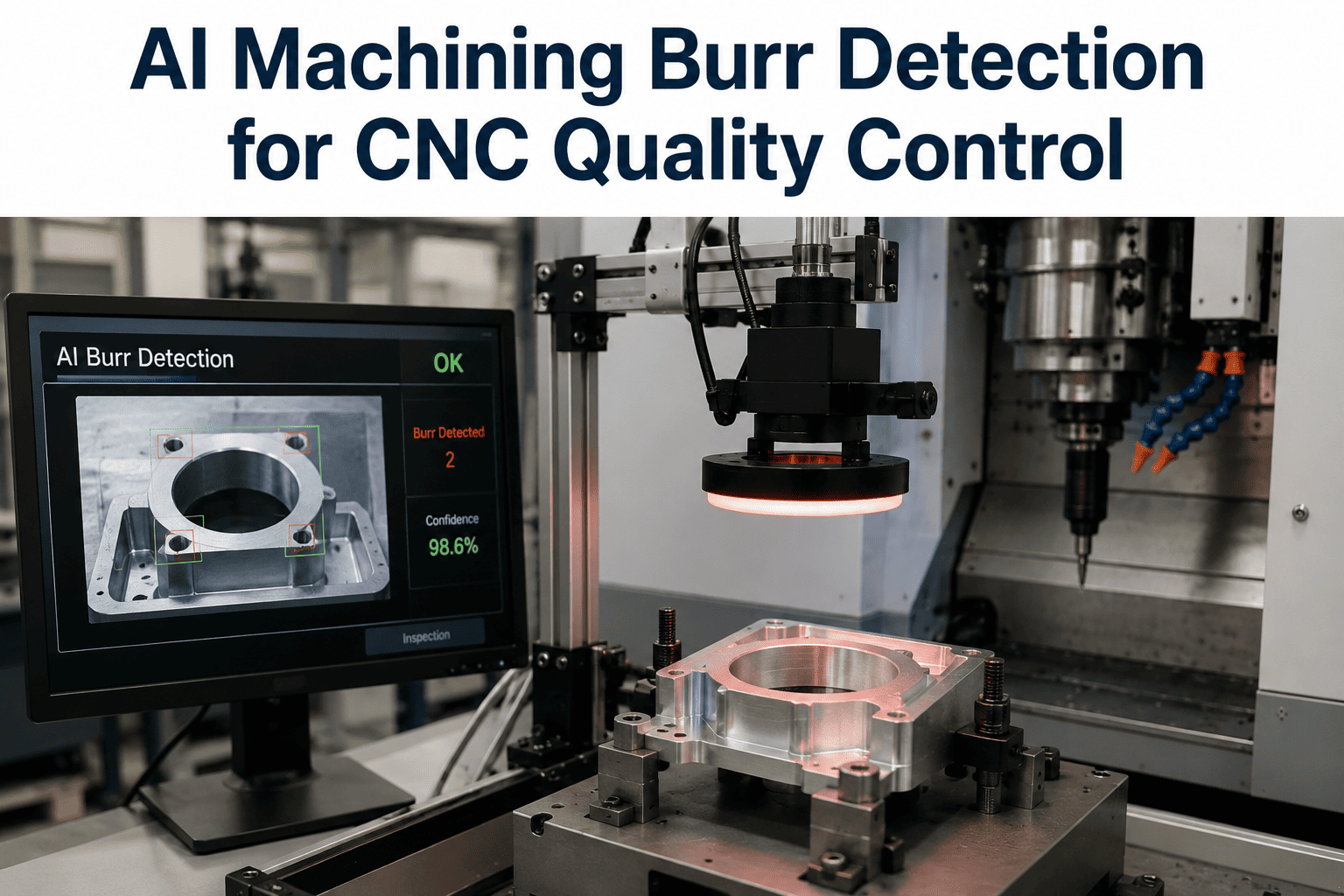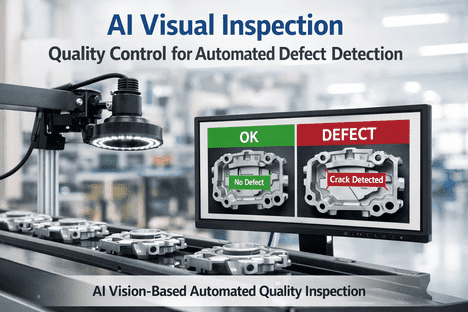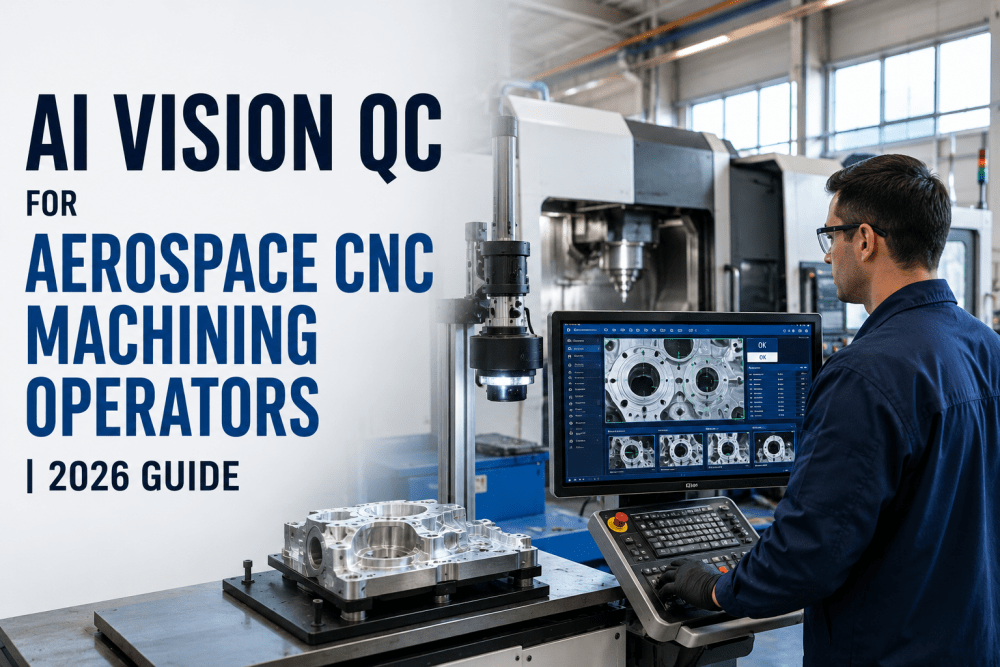
CNC machining operators in aerospace manufacturing face a persistent OEE constraint: quality issues that go undetected until post-process inspection consume machine uptime, material, and shift hours that should be producing conforming parts. Tool wear progression that degrades surface finish across multiple parts, dimensional drift that escapes first-article inspection, and burr conditions that require secondary operations — each defect discovered after the machining cycle creates rework loops, inspection delays, and documentation overhead that drag down OEE. AI Vision Inspection eliminates this pattern by placing deep-learning machine vision cameras directly at the CNC machine — monitoring cutting tool condition, machined surface quality, and part geometry in real time as each feature is produced — enabling operators to detect and correct quality deviations during the machining cycle before defects propagate. For aerospace machining operations producing structural components, engine parts, and airframe details in titanium, Inconel, aluminum, and stainless steel, AI vision inspection improves OEE by 15–20 percentage points while reducing manual inspection time by over 90% and providing AS9100-compliant quality records for every part. iFactory's AI Vision Inspection module integrates with existing CNC machine controllers through read-only OPC UA connectivity, deploying deep-learning defect detection models on a turnkey on-premise NVIDIA stack.
Where OEE Is Lost in Aerospace CNC Machining
A machined aerospace component passes through multiple operations — roughing, semi-finishing, finishing, and inspection — each capable of generating quality deviations that, if undetected during the machining cycle, become OEE losses at post-process inspection or downstream assembly. The diagram below maps the CNC machining workflow as a quality-defect propagation chain: tool wear during roughing can degrade surface finish in finishing, coolant concentration drift can affect dimensional stability, and chip accumulation can cause burr conditions that require secondary operations. Traditional post-process inspection catches some defects but misses others until final quality audit or customer receiving. AI Vision Inspection breaks this chain by placing deep-learning cameras at the machine, detecting tool wear, surface anomalies, and dimensional drift as they occur and enabling operators to correct the process before additional parts are affected.
Want to map your CNC machining cell's quality-defect propagation chain? Book a Demo and we'll instrument your machines to identify where OEE losses originate.
Three Levers to Improve OEE with AI Vision Inspection
AI Vision Inspection improves OEE through three interconnected capabilities — real-time defect detection that catches quality deviations at the moment of occurrence, predictive tool monitoring that prevents defect propagation across multiple parts, and automated quality documentation that eliminates manual record-keeping from the operator's shift. Each lever addresses a specific OEE loss category that operators encounter in aerospace CNC machining.
How AI Vision Inspects CNC Machined Parts in Real Time
The AI Vision Inspection system combines three imaging modalities with deep-learning classification models trained on millions of aerospace component images — enabling detection of defect types that traditional machine vision systems miss and manual inspection cannot catch at production speed. CNC machining operators exploring the technology Book a Demo to see how the system performs on their specific materials, tooling, and quality requirements.
High-resolution machine vision cameras mounted inside the CNC enclosure capture cutting tool condition after each operation — detecting edge wear, chipping, coating degradation, built-up edge, thermal cracking, and fracture at 10-micron resolution. The deep-learning model is trained on a dataset of over 500,000 labeled tool images covering carbide, ceramic, CBN, and diamond tooling used in titanium, Inconel, aluminum, and stainless steel machining. The system achieves 98.7% accuracy in classifying tool wear state across all tool types with a false positive rate below 3%, enabling operators to trust the inspection results and act on alerts without manual verification delays. Tool inspection data feeds directly into the tool management database, providing traceable records for every tool used on every part — supporting AS9100 tool control requirements and enabling data-driven tool life optimization that reduces consumable costs by 12–18%. Tool condition cameras are triggered after each finishing operation and at programmable intervals during roughing, providing coverage at each critical quality decision point.
Structured light and high-magnification cameras positioned to view the machined surface immediately after the cutting pass detect surface finish anomalies — Ra and Rz deviation, chatter marks, feed marks, burnish patterns, and burr conditions — before the part moves to the next operation. The deep-learning models are trained on a library of over 1 million labeled surface images covering aerospace surface finish specifications from Ra 0.2 to Ra 6.3 across aluminum, titanium, Inconel, and stainless steel. Multi-camera dimensional inspection systems measure feature geometry, hole position, edge profile, and wall thickness with sub-millimeter accuracy. When a surface quality deviation is detected, the system identifies the probable root cause — tool wear progression, coolant concentration shift, feed rate variation, or spindle load anomaly — and recommends the corrective action with the highest probability of restoring acceptable finish. Surface and dimensional inspection data is automatically logged with corresponding process parameters, creating a searchable database that operators and process engineers use to optimize cutting parameters for each material-tool combination.
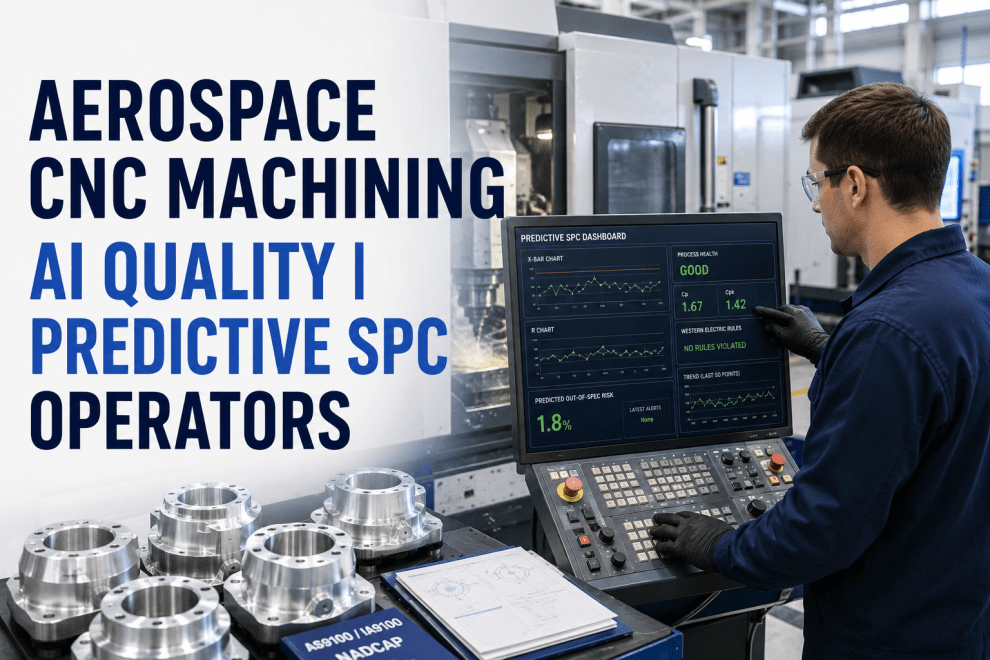
Every AI vision inspection result — tool condition assessment, surface finish measurement, dimensional verification, and edge quality evaluation — is automatically recorded in the quality database with the corresponding part serial number, operation timestamp, machine ID, operator ID, and process parameter snapshot. The SPC module analyzes inspection results in real time, generating control charts for each critical quality characteristic — surface finish by operation, tool wear rate by material, dimensional trend by machine — and alerting operators when process capability approaches control limits. AS9100-compliant quality records are generated automatically for each part, eliminating manual documentation and reducing audit preparation time by 80%. Operators access the SPC dashboard from the machine-side terminal, viewing real-time control charts, defect Pareto distributions, and process capability indices for each part program without leaving the workstation. The automated inspection and documentation system ensures that every quality decision — pass, rework, scrap, or concession — is traceable to the inspection image, process parameters, and operator disposition, providing complete audit readiness for AS9100, Nadcap, and customer quality audits.
Measured Impact — OEE Improvement Results
Aerospace CNC machining operations deploying AI Vision Inspection have documented measurable improvements in OEE, inspection time reduction, defect reduction, and quality documentation efficiency. Operators and production teams evaluating the technology Book a Demo to review deployment results and projected impact for their specific machine configurations and quality requirements.
Ask the Plant Copilot
The AI Vision Inspection system includes a natural language interface that operators use to investigate quality events, analyze defect trends, and plan corrective actions — without navigating complex dashboards or writing database queries.
Expert Review — A CNC Machining Operator's Perspective on AI Vision Inspection
Conclusion — AI Vision Inspection Improves OEE by Eliminating the Quality Visibility Gap in Aerospace CNC Machining
CNC machining operators have accepted the quality visibility gap as an unavoidable cost of producing aerospace components — accepting 30–60 minute inspection interruptions per part, rework loops that consume 12–18% of machining capacity, and documentation overhead that eats into every shift. AI Vision Inspection eliminates this gap by deploying deep-learning machine vision cameras at the CNC machine, monitoring tool condition, surface quality, and part geometry in real time as each feature is machined — enabling operators to detect and correct quality deviations during the machining cycle rather than discovering them at post-process inspection. The technology delivers 18 percentage point OEE improvement, 94% reduction in manual inspection time, 87.5% reduction in defect escape rate, and 80% faster quality documentation — validated across aerospace CNC machining operations producing structural, engine, and airframe components in titanium, Inconel, aluminum, and stainless steel. The system operates on a turnkey on-premise NVIDIA stack with zero data leaving your firewall, integrates with existing CNC machine controllers through standard OPC UA connectivity, and deploys in 10–14 weeks from camera installation to live production. iFactory's AI Vision Inspection module is purpose-built for aerospace CNC machining operators, combining deep-learning defect detection, predictive tool monitoring, and automated SPC documentation in a single platform that fits existing machine-side workflows. The next step is a zero-commitment assessment that reviews your CNC machining cell configuration, material specifications, and quality workflow — delivering a deployment roadmap and OEE improvement projection specific to your operation. Book a Demo to start your AI Vision Inspection journey and discover how real-time quality monitoring can improve OEE on your aerospace CNC machining cell.
Frequently Asked Questions — AI Vision Inspection for Aerospace CNC Machining
The system detects 50+ defect categories spanning four inspection domains. Tool condition inspection identifies edge wear, chipping, coating degradation, built-up edge, thermal cracking, and fracture — covering carbide, ceramic, CBN, and diamond tooling used in titanium, Inconel, aluminum, and stainless steel machining. Surface quality inspection detects Ra and Rz deviation, chatter marks, feed marks, burnish patterns, surface tears, and burr conditions — calibrated to aerospace surface finish specifications from Ra 0.2 to Ra 6.3. Dimensional inspection measures feature geometry, hole position, edge profile, and wall thickness with sub-millimeter accuracy using multi-camera stereo vision. Edge condition inspection identifies recast layer, heat-affected zone, micro-cracking, and edge break condition on machined features. The deep-learning models are trained on a combined dataset of over 2 million labeled images covering all defect categories across aluminum, titanium, Inconel, stainless steel, and composite aerospace materials, with new defect categories addable through transfer learning with as few as 150 labeled images.
iFactory's AI Vision Inspection module integrates with CNC machine controllers through read-only OPC UA connectors supporting Fanuc, Siemens, Heidenhain, Mazak, and Haas control platforms — extracting spindle load, feed rate, spindle speed, coolant status, and tool number data without writing to controller memory or modifying machine logic. Machine vision cameras are mounted inside the CNC enclosure at positions that provide optimal views of the cutting tool and machined surface, using existing camera mounting brackets and coolant-resistant housings designed for the machining environment. Camera triggering is synchronized with the machining cycle through the OPC UA connection, capturing tool images after each operation and surface images at programmable intervals. The vision data is processed on an on-premise NVIDIA server that operates inside your facility firewall with no cloud dependency, ensuring ITAR compliance for controlled aerospace programs. The integration architecture ensures zero risk to machine operation — the platform reads data from existing controllers without modifying machining programs, tool offsets, or control logic. Deployment of the data integration layer for a cell of three to five CNC machines typically takes 1–2 weeks for controller connectivity and 1–2 weeks for camera installation and calibration.
Yes — the deep-learning classification model is trained to assign each detected defect a severity grade based on aerospace industry standards, customer-specific quality specifications, and functional criticality of the machined feature. For surface finish defects, the system distinguishes between cosmetic deviations within customer acceptance limits and critical deviations that affect fit, function, or fatigue life — applying different alert thresholds and disposition rules for each category. Critical defects — surface finish outside engineering tolerance, micro-cracking in a fatigue-critical area, burr conditions that could cause assembly interference — generate immediate alerts with machine stop recommendations. Cosmetic defects — minor feed marks within specification, acceptable surface texture variation, non-functional edge conditions — are logged for disposition review without interrupting the machining cycle. The severity classification is configurable per part program and feature — the same surface finish reading may be critical for a bearing bore but cosmetic for a non-functional external surface. Severity classification accuracy exceeds 97% across all defect categories, validated against engineering specification review and customer quality requirements during model training.
Operators and production teams can expect 15–20 percentage point OEE improvement within 90 days of full deployment, with the validated range dependent on baseline automation level, part complexity, and production volume. OEE improvement is driven by three primary mechanisms. First, availability improves as machine stoppages for manual inspection are eliminated — AI vision inspects tools and surfaces during the machining cycle, removing the need to stop the machine for routine quality checks. Second, performance improves as optimized tool change decisions reduce cycle time variance — tools are changed based on actual wear condition rather than conservative fixed intervals, extending tool life by 12–18% while maintaining surface quality. Third, quality improves as real-time defect detection during the machining cycle prevents defect propagation — surface finish deviations, tool wear progression, and dimensional drift are corrected before the next feature is machined, reducing rework and scrap rates by 87.5%. The documented deployment achieved an 18-point OEE improvement — from 72% to 90% — across a three-machine cell producing structural aerospace components in titanium and aluminum alloys.
All inspection data, tool condition images, surface quality captures, and AS9100 quality records are stored and processed entirely on-premise on the iFactory NVIDIA AI server — a pre-configured industrial edge appliance that operates inside your facility firewall with no cloud dependency. The NVIDIA server runs the deep-learning inference engine, quality database, SPC module, Plant Copilot interface, and operator dashboard — all on local hardware that you own and control. Tool images, surface finish measurements, inspection results, and quality records never leave your plant network. The system provides remote monitoring and maintenance access through an encrypted outbound-only connection that plant IT can configure with network access controls, including full air-gapped operation for facilities with ITAR or export-controlled program requirements. The on-premise architecture ensures that proprietary part designs, customer quality specifications, and machining process data remain under your exclusive control while still providing the full AI vision inspection capability including real-time defect detection, predictive tool monitoring, automated SPC, and audit-ready quality documentation.