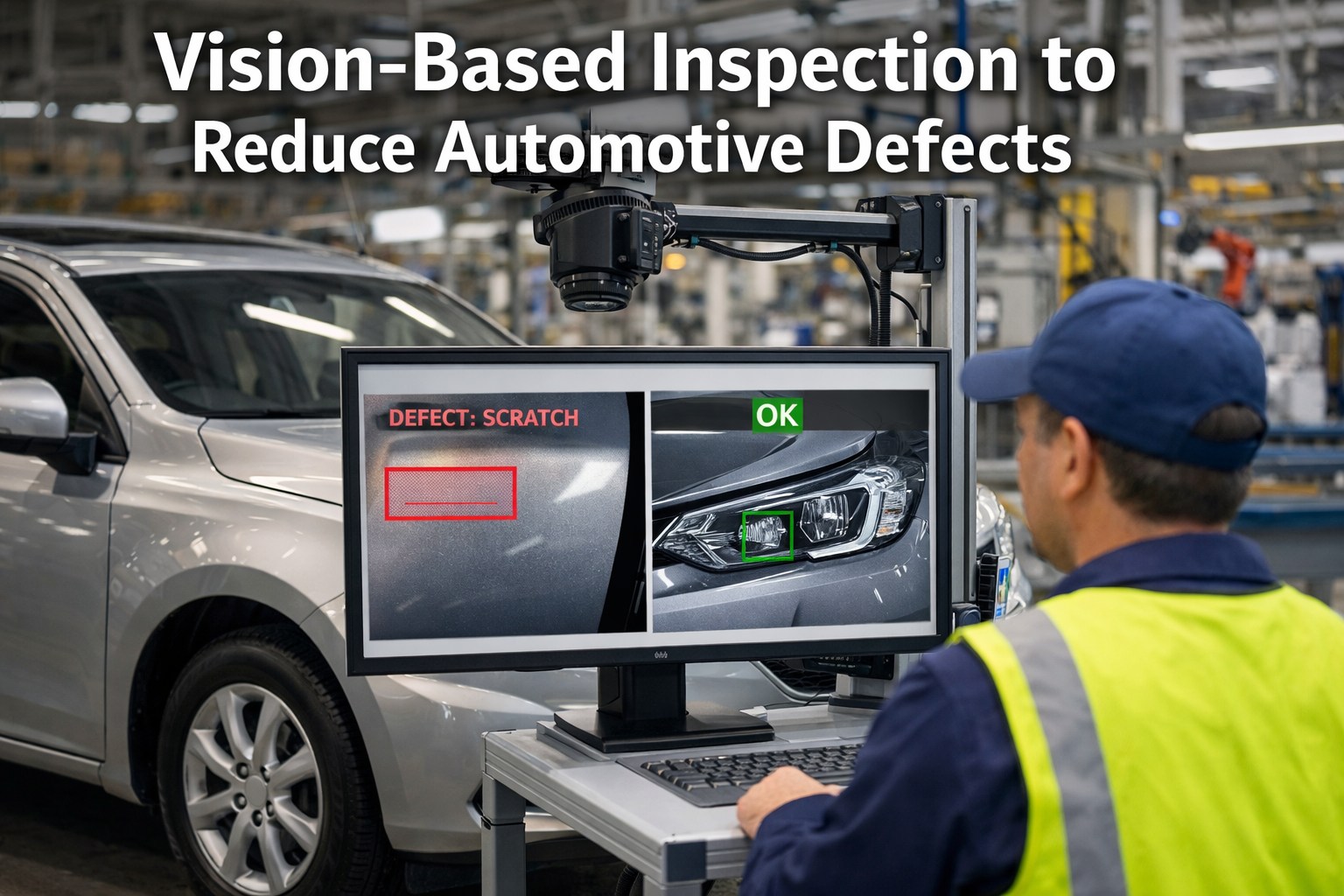
Visual Defect Detection Across Automotive Manufacturing
By Hermonie Joseph on February 17, 2026
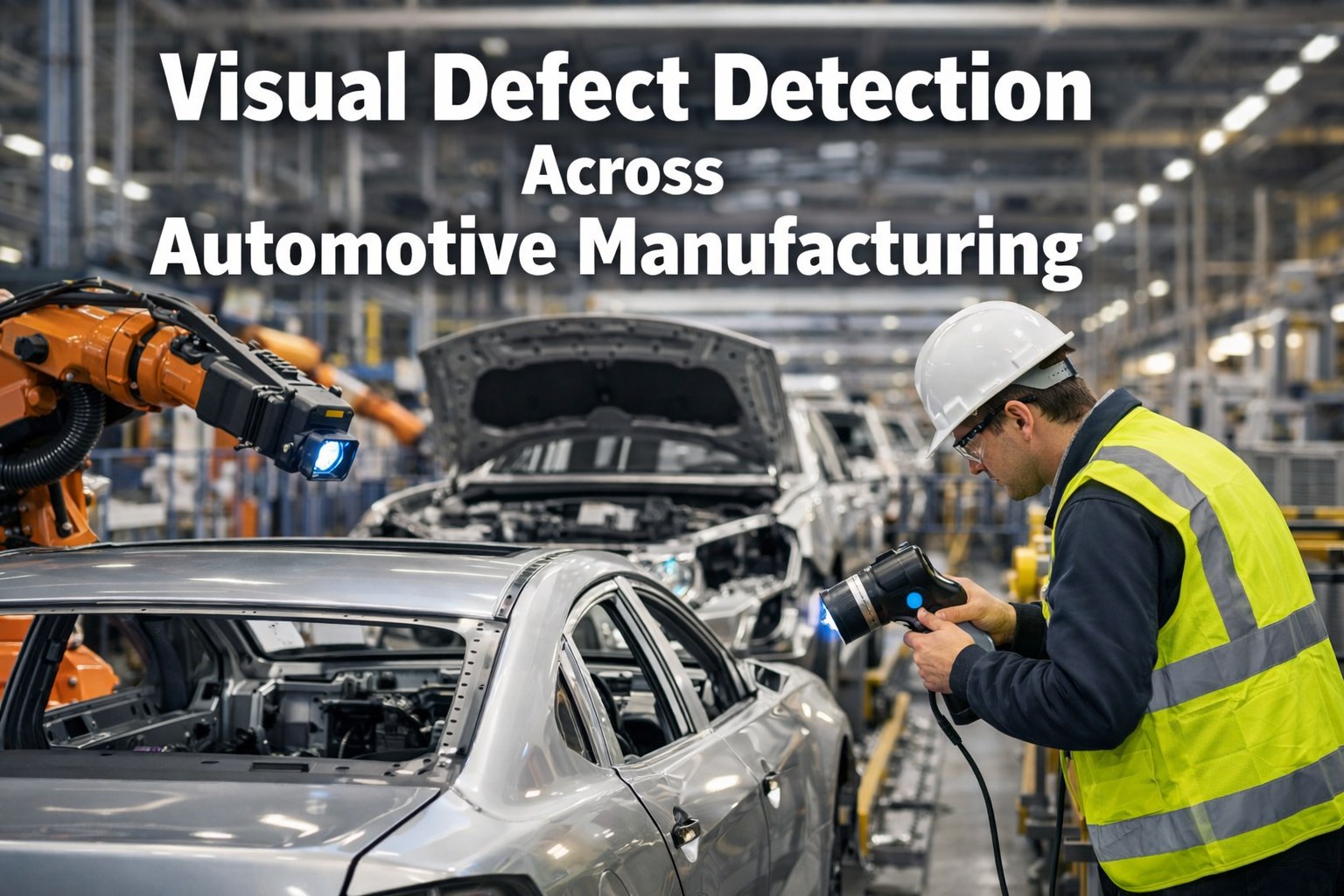
A single percentage point increase in defect rate at an automotive plant producing 250,000 cars annually costs up to $8 million. Traditional visual inspection—human eyes under fluorescent lights—misses 20-30% of defects. Meanwhile, production lines move at 60+ jobs per hour, model complexity increases every yearand experienced inspectors retire faster than they can be replaced. AI-powered visual inspection changes the equation entirely: detecting defects as small as 0.1mm in under 200 milliseconds, maintaining 99.8% accuracy across every shift, and improving over time through machine learning. From stamping to final assembly, visual AI is becoming the backbone of zero-defect automotive manufacturing.
The Inspection Gap: Human vs. AI Vision
Human Inspectors
70-80%
20-30% defects escape
VS
AI Vision Systems
99.8%
Detects down to 0.1mm
$20.4B → $41.7BMachine vision market growth by 2030. 72% of manufacturers have already adopted AI-based vision systems.
Defect Detection Across Every Manufacturing Zone
Automotive manufacturing has 5 distinct zones where defects originate—each with different defect types, surfaces, speeds, and detection challenges. Here's what AI vision catches at each stage:
01
Stamping & Press Shop
Defects:Cracks, splits, wrinkles, surface scratches, dimensional deviations, springback, edge burrs. Steel coils arrive with lumps, warps, and surface flaws that propagate through every downstream operation.
1-10-100 rule: a flaw here costs 100× more at end-of-line
02
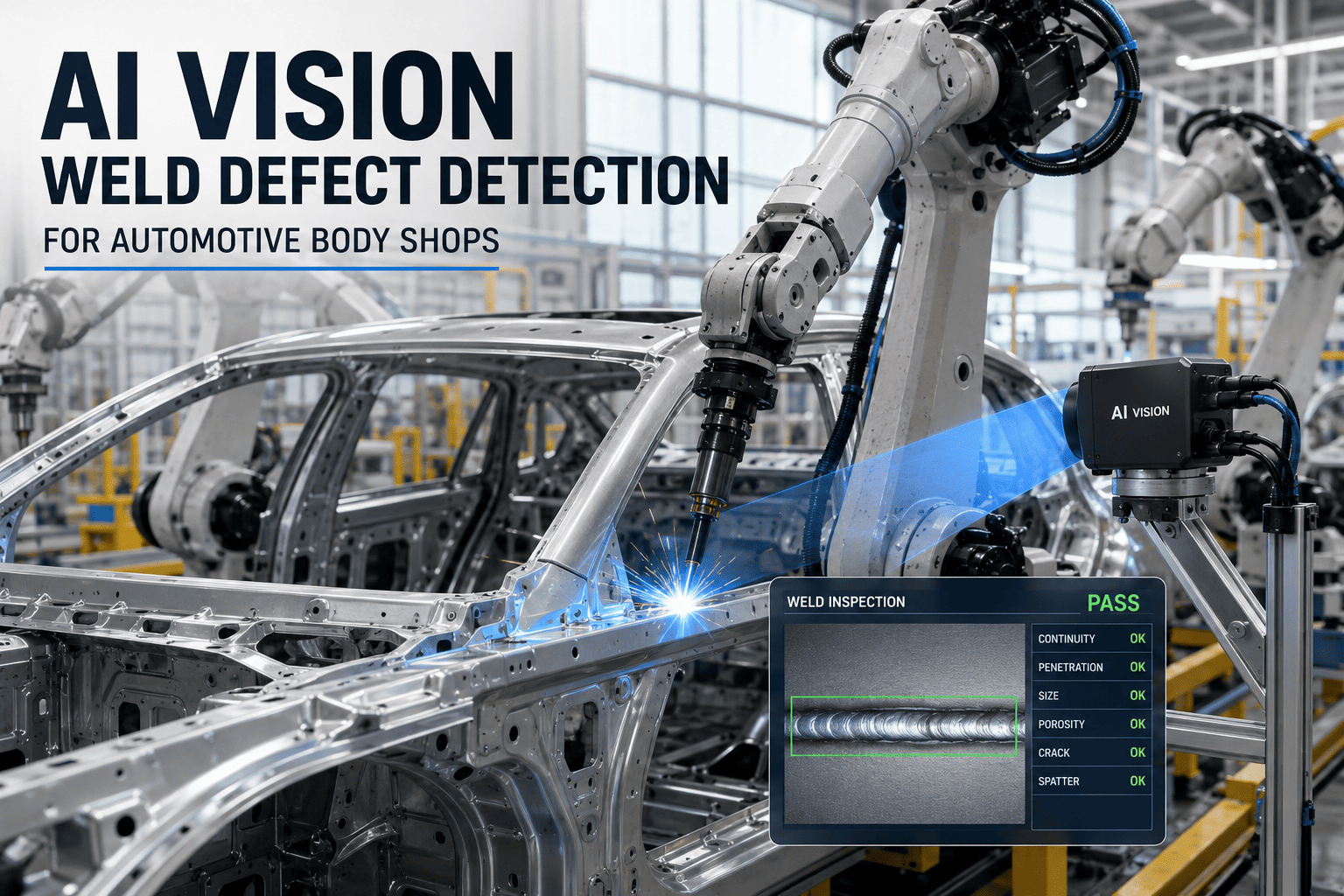
Body-in-White (Welding)
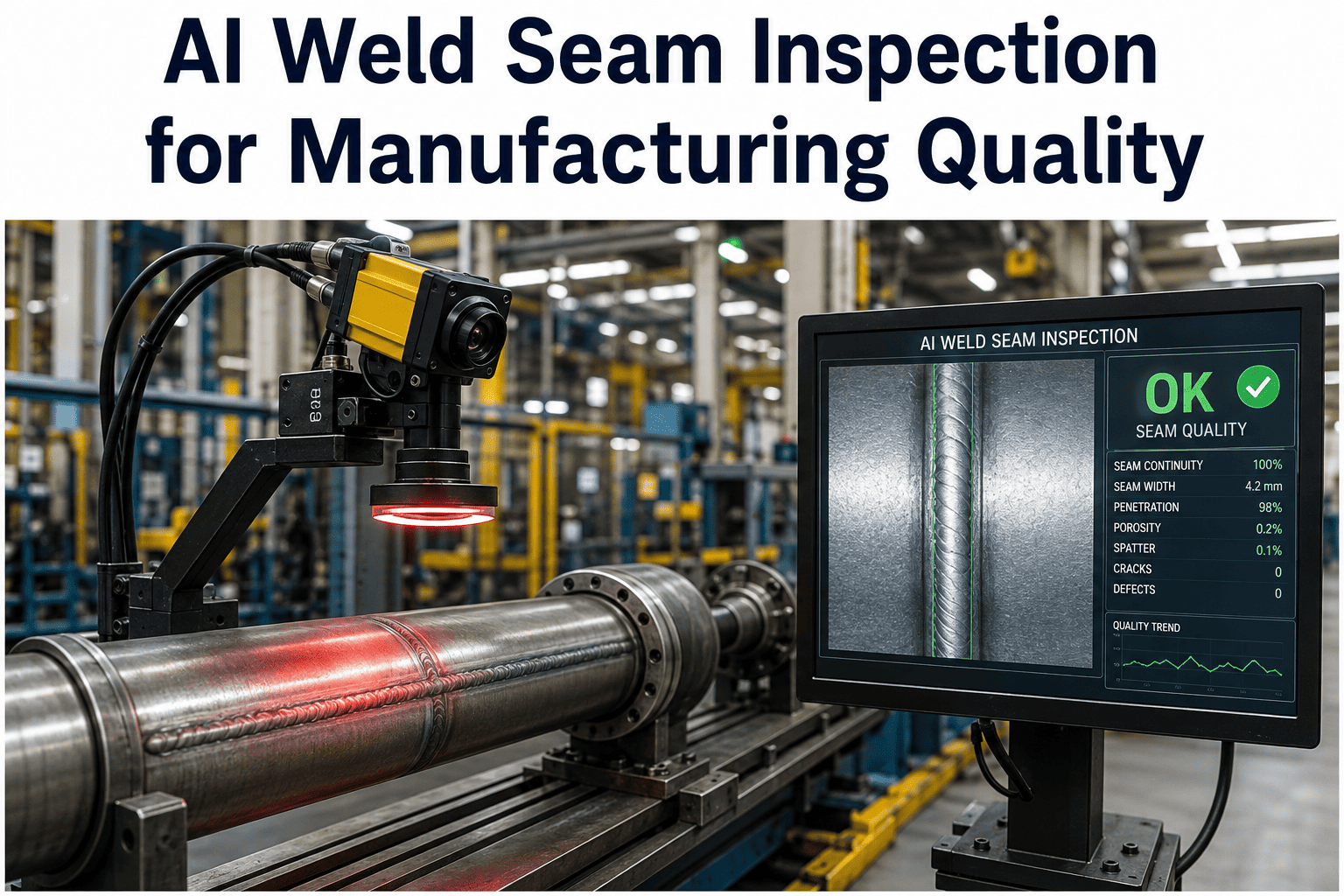
Defects:Weld porosity, undersized nuggets, missing welds, seam irregularities, dimensional gaps, fixture misalignment. 3,000-5,000 spot welds per vehicle—98% never individually verified without AI.
Structural safety + billion-dollar recall risk
03
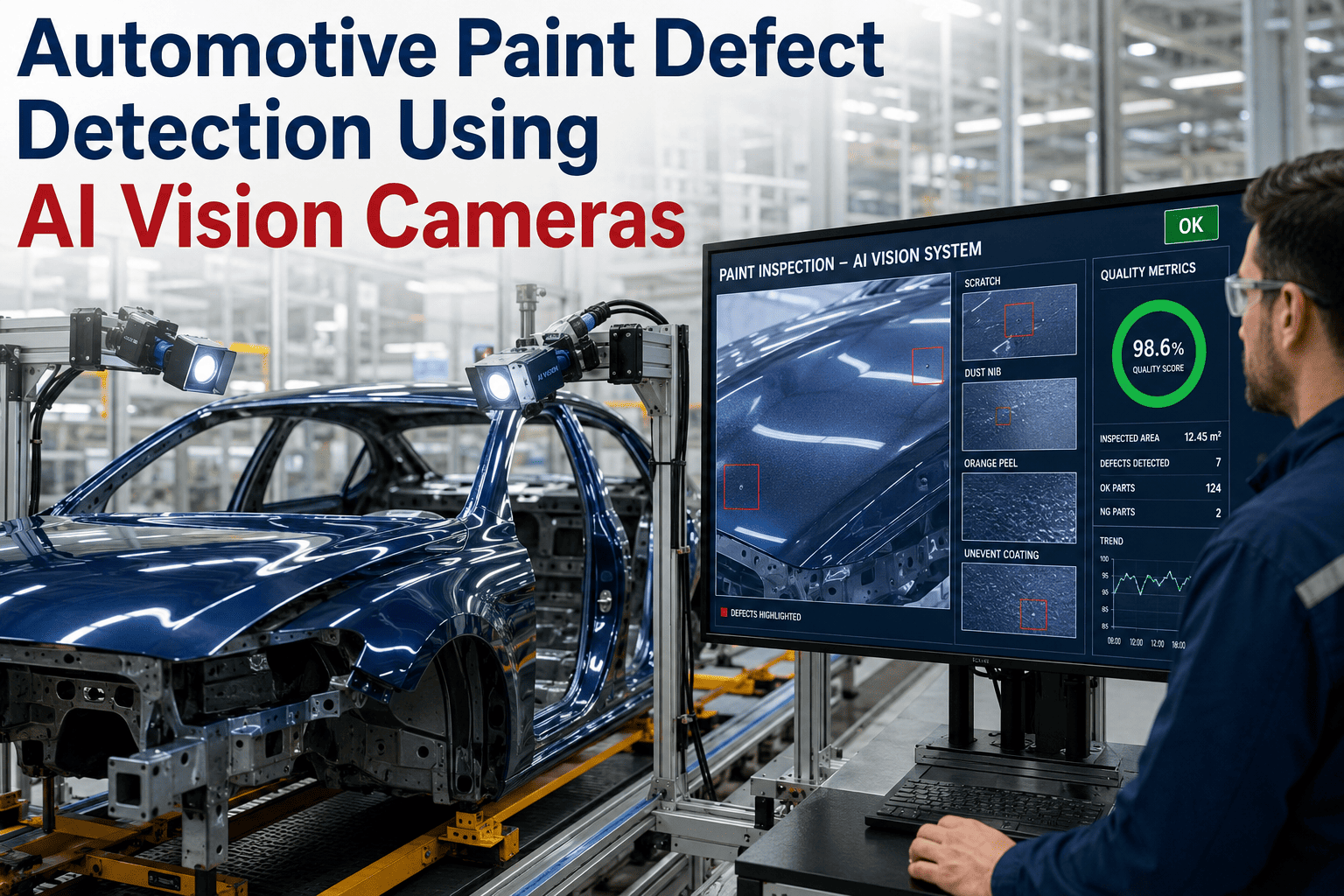
Paint Shop
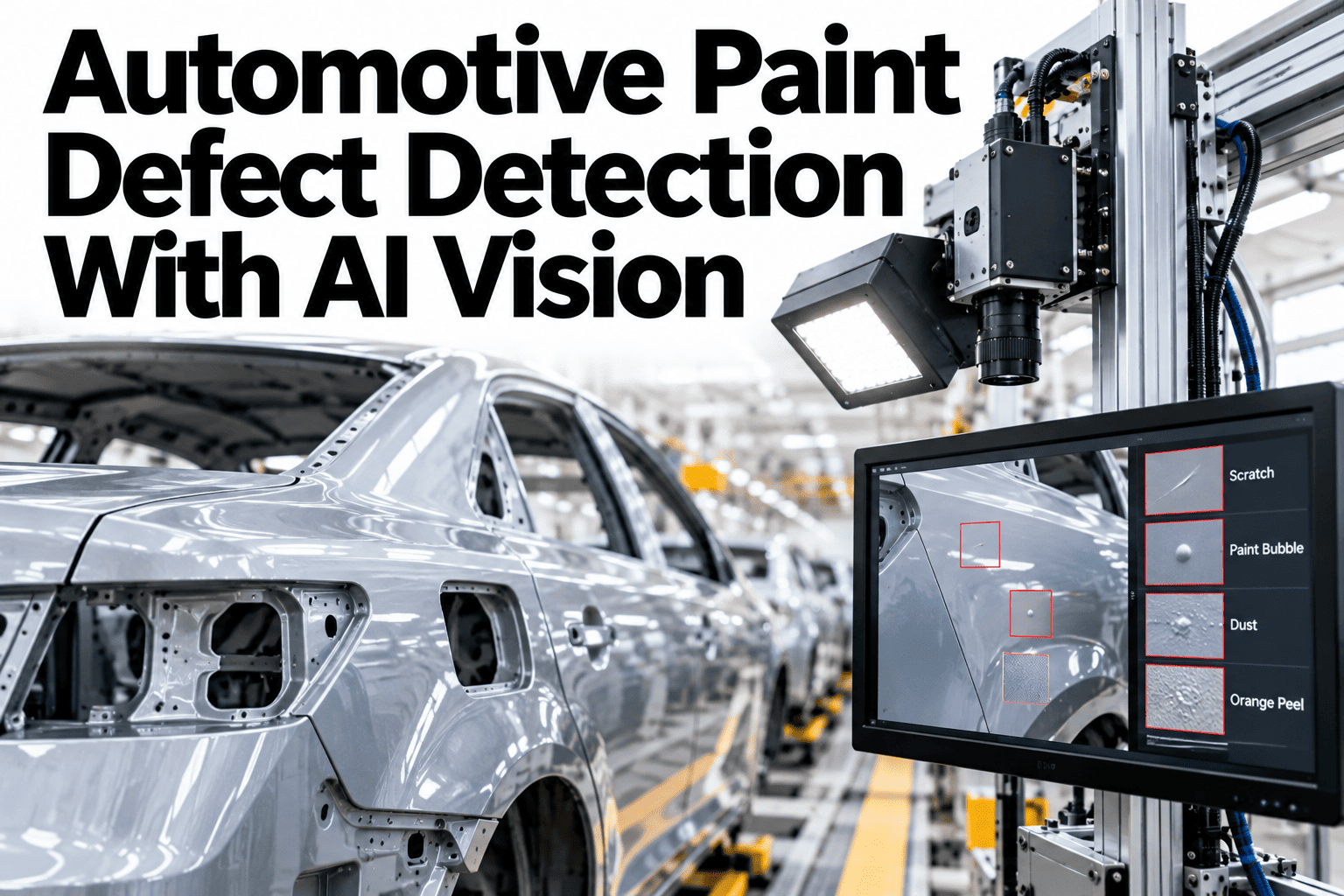
Defects:Dirt inclusions, orange peel, runs/sags, craters, pinholes, color mismatch, adhesion failure. 5-15% of vehicles require paint rework at up to $1,000 per vehicle.
BMW reduced defect rates by 30% within one year of implementing AI vision systems across European plants. Ford deployed mobile AI vision across 20 factories, performing 60+ million inspections in 2023. Nissan's AUTIS system achieved a 7% detection boost across 500,000+ vehicles. Volvo uses 20+ cameras in an inspection tunnel scanning every vehicle at end-of-line. Automotive component plants using AI inspection report 37% fewer defects and 22% OEE improvements.
iFactory's MES platform integrates with AI vision systems across every manufacturing zone—connecting defect data to process parameters, enabling root-cause analysis, and driving continuous improvement from stamping through final assembly.
Retiring inspectors are taking irreplaceable knowledge
Experienced inspectors who "just know" when something looks wrong are retiring. Younger workers avoid repetitive visual inspection roles. AI captures and scales that expertise permanently.
Warranty claims keep surprising you
If defects are reaching customers that "should have been caught," your inspection coverage has gaps. Human inspectors miss 20-30% of defects—AI catches defects invisible to the naked eye.
Night shift quality is consistently worse
If defect rates spike on night and weekend shifts, it's inspector fatigue—not process variation. AI vision systems maintain identical accuracy 24/7/365.
You can't connect defects to root causes
Without digital defect data linked to process parameters (booth temp, weld current, tool wear), you're fixing symptoms, not causes. AI vision + MES creates the digital thread.
New models and variants are overwhelming your team
Every model change requires retraining inspectors. AI systems adapt to new geometries, colors, and configurations automatically—Porsche runs 3 drivetrain types on one line.
Recognize any of these? Schedule a consultation to discuss AI-powered visual inspection for your plant.
From Detection to Prevention: The Data Loop
AI visual inspection doesn't just find defects—it prevents them. When inspection data connects to your MES, every defect becomes a data point for process optimization.
Detect
AI cameras identify defects down to 0.1mm at production speed. Every defect gets classified by type, severity, and 3D location on the part.
Correlate
MES links each defect to the specific process parameters—booth temperature, robot program, tool wear cycle, operator ID—that produced it.
Prevent
Trend analysis reveals which conditions produce defects. Process engineers fix root causes—reducing defects by 30-40%, not just catching them.
Expert Insight
"AI-powered vision systems spot defects invisible to the human eye in milliseconds. These systems check for problems in stamping, painting, assembly, and surface quality. AI-based systems significantly outperform traditional rule-based systems, achieving detection rates close to 100%, and are able to distinguish actual defects from false positives—images that only appear defective."
— Deloitte, Machine Vision on the Automotive Production Line
Connect Every Camera to Every Root Cause
iFactory's MES platform integrates visual inspection data across all manufacturing zones—creating the digital thread from defect detection to process correction. See defects. Fix root causes. Prevent escapes.
What types of defects can AI visual inspection detect in automotive manufacturing?
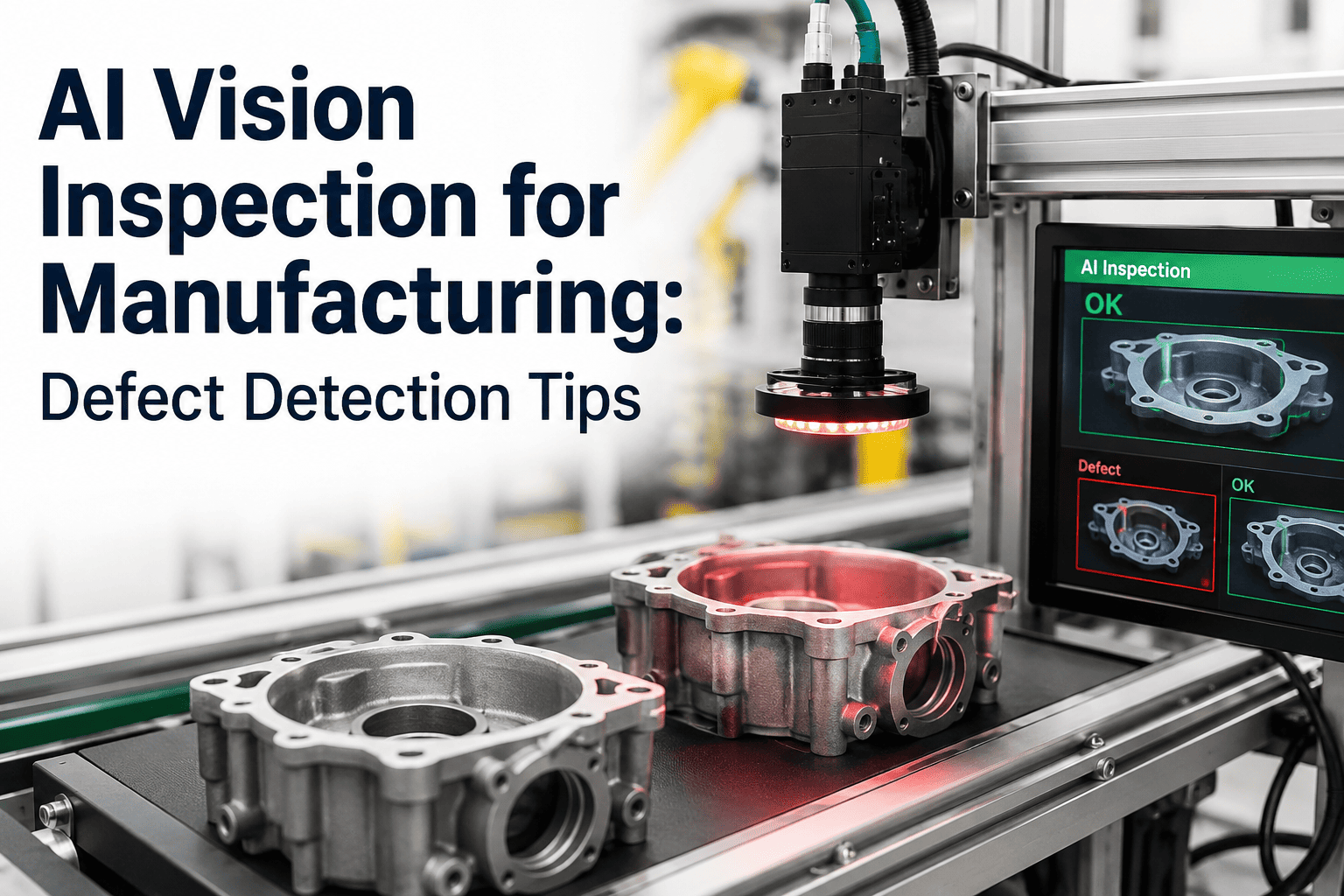
AI visual inspection covers the full spectrum: surface scratches, dents, and cracks in stamped panels; weld porosity, missing welds, and seam irregularities in body-in-white; paint defects like dirt inclusions, orange peel, runs, and color mismatch; machining burrs and bore finish in powertrain; and missing components, wrong parts, gap/flush misalignment, and label errors in final assembly. Modern systems detect defects as small as 0.1mm with up to 99.8% accuracy. The key advantage over rule-based systems is handling high-variance defects—subtle dents, texture variations, and cosmetic flaws that fixed-threshold systems either miss or over-reject.
How accurate are AI vision systems compared to human inspectors?
Research from Sandia National Laboratories found that traditional human visual inspection misses 20-30% of defects due to fatigue, distraction, and subjectivity. AI vision systems achieve detection rates close to 100% according to Deloitte, with documented accuracies of 95-99.8% depending on the application. BMW reduced defect rates 30% within one year of implementation. Critically, AI maintains identical performance 24/7—no fatigue, no shift-to-shift variation, no subjective judgment differences. The systems also improve over time through active learning as they encounter new defect variations.
What does a visual inspection system cost for automotive manufacturing?
Entry-level 2D vision systems start at $5,000-$10,000 per station. Mid-range 3D measurement systems run $20,000-$50,000. Full AI-powered systems for complex applications cost $100,000-$500,000, and complete paint shop inspection tunnels can exceed $1 million. Total cost of ownership over five years is typically double the hardware price including software, integration, and training. However, most systems achieve payback within 12-18 months through labor savings, scrap reduction, and warranty cost prevention. At $8 million per percentage-point of defect rate, even modest improvements generate massive ROI.
Can visual inspection systems integrate with our existing MES?
Yes—and this integration is where the highest value lives. When defect data from vision systems connects to your MES, every detection links to the specific vehicle VIN, process parameters, machine settings, and operator data that produced it. This creates the digital thread needed for statistical process control (SPC), automated root-cause analysis, and defect trending. Without MES integration, you have cameras finding defects. With it, you have a system preventing defects. iFactory's MES platform is designed for this exact integration across stamping, body, paint, and assembly zones.
How do we get started with AI visual inspection?
Start with your highest-cost quality problem—usually the zone with the most rework, warranty claims, or customer complaints. Paint inspection and end-of-line assembly verification are common starting points because they have the clearest ROI. Pilot on one line, validate against existing inspection data, and measure the gap between what humans found and what AI finds. Most manufacturers discover 20-40% more defects in the pilot phase. From there, expand systematically across manufacturing zones, integrating each camera into your MES for full digital traceability. Deployment timelines run 6-12 months for comprehensive systems.