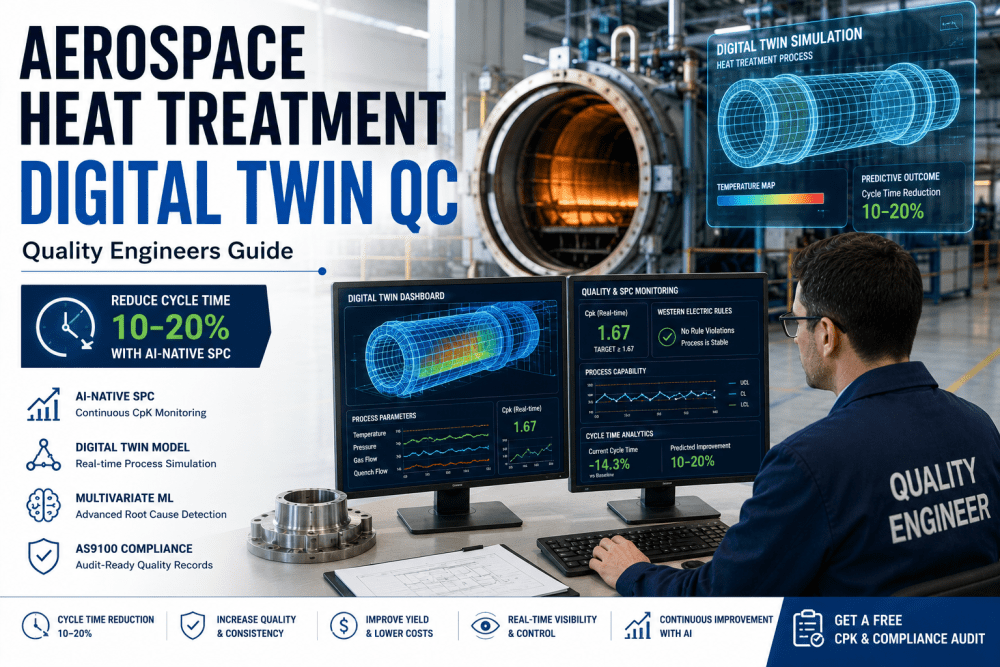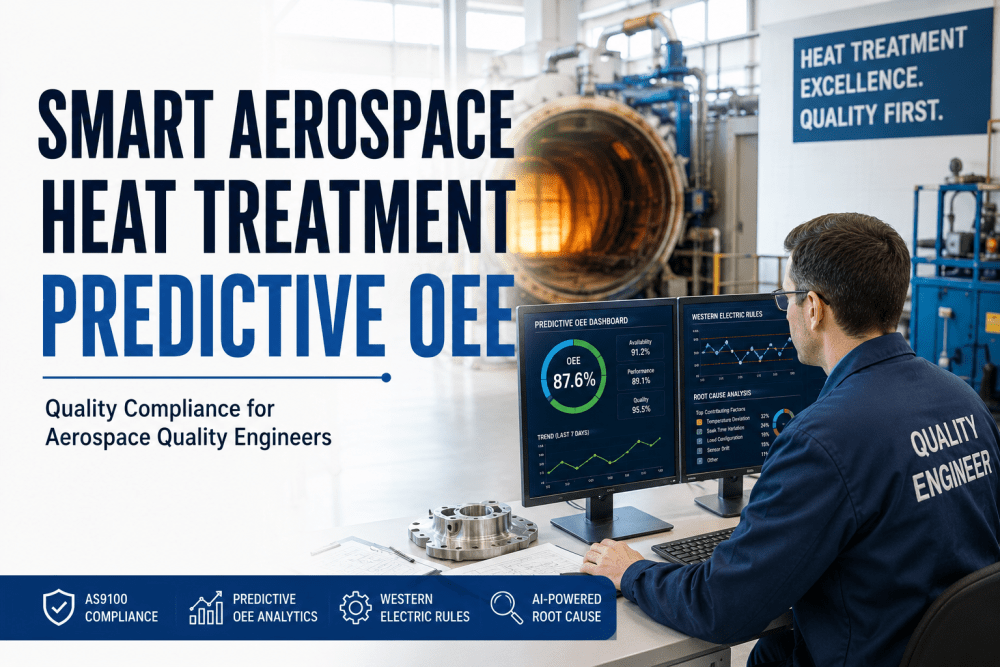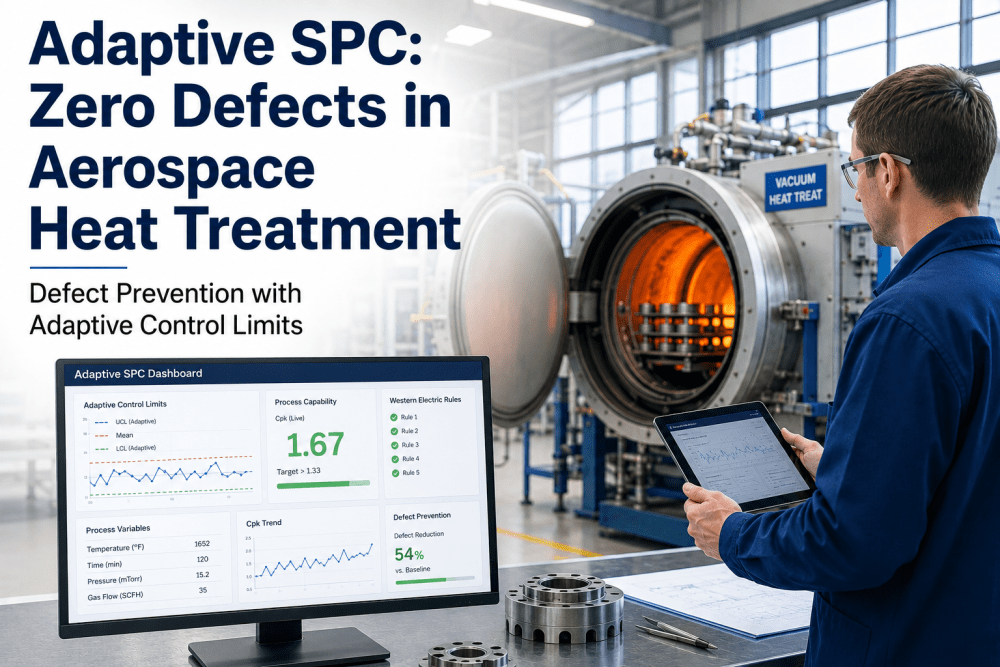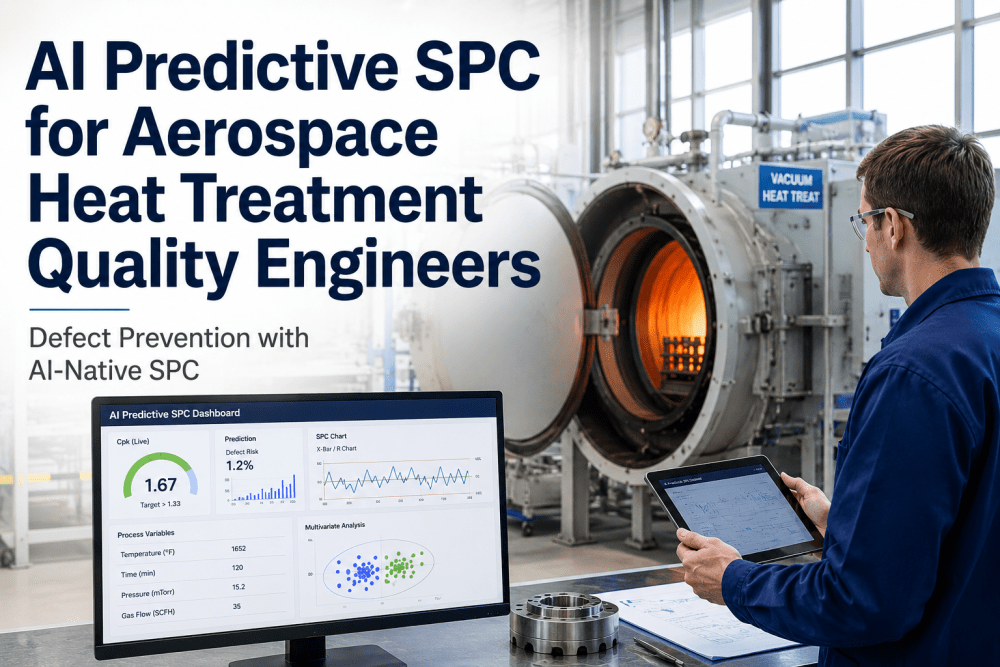
Aerospace heat treatment quality engineers managing vacuum furnaces, solution treat and age operations, and inert gas quench systems face a persistent challenge: detecting process drift before it produces non-conforming hardware. Traditional SPC in heat treatment relies on manual data logging from furnace controller readouts, periodic mechanical test results, and retrospective analysis that identifies shifts hours or batches after they begin. AI Predictive SPC for aerospace heat treatment replaces this reactive model with machine learning control charts that detect temperature uniformity drift, quench rate variation, and atmosphere deviations in real time — before the process produces scrap or rework. Book a Demo to see Predictive SPC applied to your heat treatment process data.
Why Traditional SPC Falls Short in Aerospace Heat Treatment
Aerospace heat treatment processes operate within tight AMS 2750 and AS9100 compliance windows — temperature uniformity within ±10°F, quench rate consistency within 5%, and atmosphere composition within 0.1% tolerance. Traditional SPC requires quality engineers to manually log furnace controller data at scheduled intervals, pull and test mechanical samples, and plot control charts that reflect process conditions hours after the fact. By the time a traditional control chart signals an out-of-control condition, the process may have already produced one or more non-conforming batches. Book a Demo to review the drift detection gap in your heat treatment SPC approach.
How AI Predictive SPC Transforms Heat Treatment Quality Control
iFactory's Predictive SPC platform connects directly to vacuum furnace controllers, quench system sensors, atmosphere analyzers, and mechanical testing equipment through OPC-UA and Modbus TCP connectors. Every temperature zone reading, quench rate measurement, atmosphere composition value, and mechanical test result feeds into AI-enhanced control charts that learn each parameter's normal variation patterns and detect deviations before they violate AMS 2750 or customer-specified limits. Quality engineers exploring this capability regularly Book a Demo to see the predictive analytics dashboard applied to their furnace data.
The platform monitors every thermocouple zone in real time, comparing each zone's temperature profile against learned baselines established during the last successful TUS. AI models detect developing thermocouple drift, heater element degradation, and control loop instability before they breach AMS 2750 Class 2 or Class 4 uniformity limits. Quality engineers receive structured alerts with predicted time-to-out-of-spec and recommended corrective actions — enabling intervention during the cycle rather than after batch completion.
Quench rate variation — the leading cause of mechanical property inconsistency in heat treated aerospace components — is tracked in real time through flow meter and temperature sensor data. Atmosphere composition analyzers feed dew point, oxygen, and hydrogen readings into predictive control charts that detect drift toward out-of-compliance conditions. The platform correlates quench and atmosphere trends with downstream mechanical test results to refine predictive models continuously.
Machine learning models trained on historical process data and corresponding mechanical test results predict tensile strength, hardness, and microstructure outcomes from in-process temperature, quench, and atmosphere parameters. When the predictive model identifies a high probability of non-conforming mechanical properties, the platform alerts the quality engineer with lead time to adjust process parameters before the batch is complete. During deployment, Cpk for tensile strength improved from 1.12 to 1.50 within three months.
Measured Improvement from AI Predictive SPC Deployment
The quality engineering team deployed iFactory Predictive SPC across three vacuum furnace lines over a 10-week period. The following table summarizes the measured performance improvement from traditional SPC to AI Predictive SPC across 340 heat treat batches.
| Performance Metric | Traditional SPC | AI Predictive SPC | Improvement |
|---|---|---|---|
| Defect Prevention Rate | 68% | 94% | +26 points |
| Scrap and Rework Reduction | Baseline | 56% reduction | 56% fewer |
| Drift Detection Time | 5.2 hours | 1.9 hours | 2.8x faster |
| Cpk — Tensile Strength | 1.12 | 1.50 | +0.38 |
| Data Entry Time per Shift | 38 minutes | Automated | 100% eliminated |
| TUS Compliance Confirmation | Monthly survey only | Continuous with predictive alerts | Real-time visibility |
Deployment Process for Heat Treatment Operations
iFactory Predictive SPC deploys across heat treatment operations through a structured five-phase process designed for minimum production disruption and maximum data quality from day one.
What Industry Experts Say
Conclusion
The aerospace heat treatment quality engineer in this case demonstrated that AI Predictive SPC transforms heat treat quality control from a reactive, retrospective process into a proactive, predictive capability. By connecting furnace controllers, quench systems, and mechanical test equipment directly to machine learning control charts, the team achieved a 94% defect prevention rate, a 56% reduction in scrap and rework, 2.8x faster drift detection, and a Cpk improvement from 1.12 to 1.50 — all while eliminating manual data entry and strengthening AS9100 and NADCAP compliance. Book a Demo to see how Predictive SPC can transform your heat treatment quality data into actionable process intelligence.
.png)
.png)
.png)