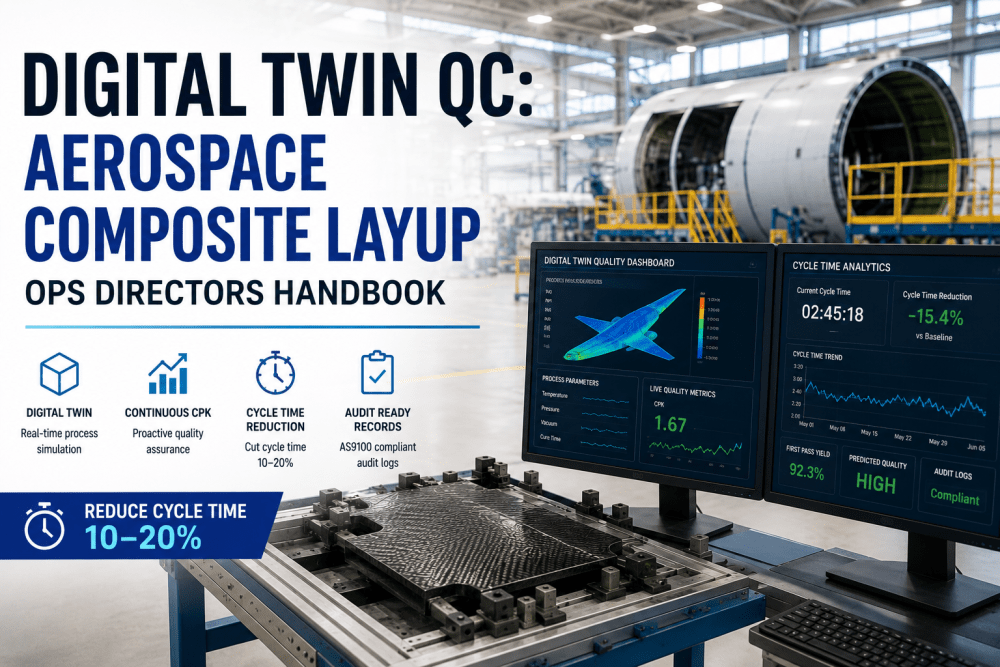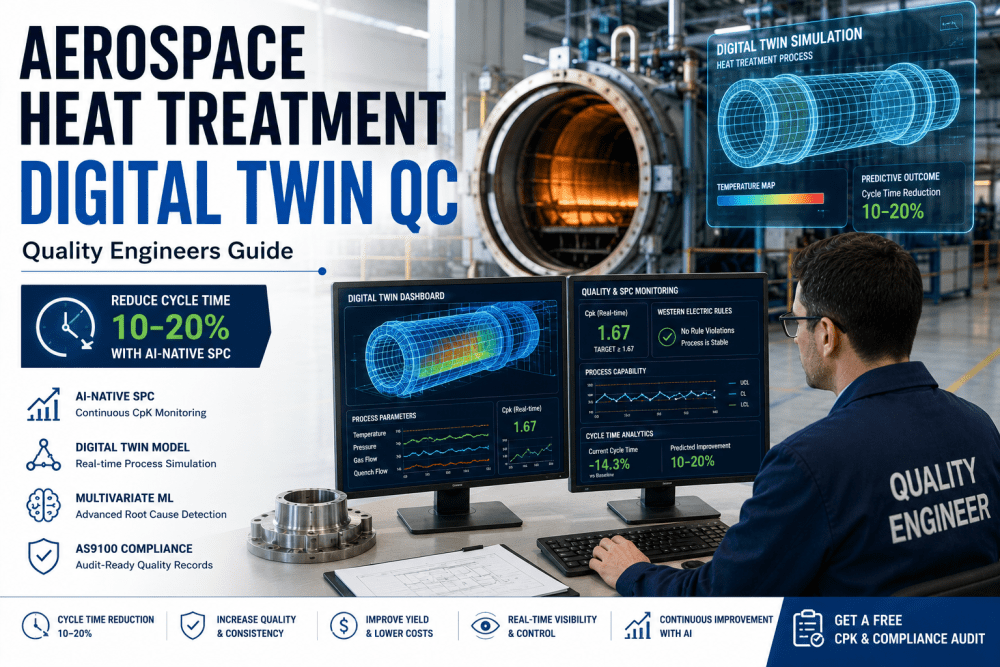
A quality engineer at an aerospace heat treatment facility reviews the weekly cycle time report and finds that furnace cycle durations have drifted 12 percent above the established baseline. Each hour of extended cycle time reduces throughput, delays downstream machining and assembly operations, and pressures delivery schedules. Traditional process monitoring tracks temperature and time against specification limits but does not identify the root cause of cycle time drift or suggest corrective parameter adjustments. Digital Twin Quality closes this gap — creating a real-time virtual replica of the heat treatment process that simulates thermal profiles, predicts cycle outcomes, and recommends optimized parameters before production begins. iFactory’s Digital Twin Quality platform for aerospace heat treatment gives quality engineers the tools to reduce cycle times while maintaining strict AS9100 and NADCAP compliance standards.
Why Aerospace Heat Treatment Cycle Times Resist Optimization
Quality engineers face a fundamental tension between cycle time reduction and process compliance. Heat treatment specifications set minimum soak times, temperature ranges, and quench parameters that must be met for metallurgical property verification. Accelerating cycles without compromising these requirements demands precise understanding of how every process variable affects the final outcome. Book a Demo to review the cycle time reduction model for your heat treatment operations.
Traditional methods rely on fixed recipes developed during process qualification. These recipes include safety margins that account for process variability but do not adapt to current furnace conditions, load characteristics, or thermal behavior. A vacuum furnace operating at the cold end of its temperature uniformity range may require 15 to 20 percent longer soak time than one operating at the hot end — yet the recipe applies the same cycle to both. This one-size-fits-all approach is the primary source of unnecessary cycle time extension in aerospace heat treatment.
Digital Twin Quality replaces static recipes with dynamic process simulation. The platform creates a real-time digital twin of each furnace and load, continuously updating the thermal model based on actual temperature measurements, load configuration, and furnace condition. Quality engineers can simulate the impact of parameter adjustments before applying them to production, identifying the minimum cycle duration that will achieve the required metallurgical properties without the safety margins baked into traditional fixed recipes.
A Structured 8-Week Deployment from Baseline to Real-Time Optimization
iFactory’s Digital Twin Quality platform deploys across heat treatment operations over a structured 8-week timeline designed to deliver measurable cycle time reduction within the first quarter of operation.
Heat treatment lines selected based on cycle time variance, throughput value, and process criticality. Baseline cycle time data collected from existing furnace controllers and MES sources. Cpk baselines established for all critical parameters.
Furnace-specific digital twin models calibrated using historical thermal survey data, load configuration records, and cycle parameter logs. AI-native SPC rules configured for each furnace asset and process type.
Digital twin activated in parallel with existing operations. Quality engineers validate simulation accuracy against actual cycle outcomes. Multivariate ML models begin identifying optimization opportunities from live process data.
Cycle time optimization parameters activated on qualified furnace assets. Pre-deployment versus post-deployment cycle time, Cpk, and throughput compared to validate ROI. Scale deployment plan developed for additional heat treatment lines.
Four Integrated Capabilities for Real-Time Cycle Optimization
Digital Twin Quality for aerospace heat treatment combines four integrated capabilities that together create a real-time cycle optimization system. Each capability feeds into the next, enabling quality engineers to reduce cycle times while maintaining process compliance and product quality. Book a Demo to see the integrated platform in production.
Cycle Time Reduction ROI from Digital Twin Quality Deployment
The Digital Twin Quality platform deployed across a major aerospace heat treatment facility over 8 weeks. The following results represent the measured performance improvement from pre-deployment baseline to post-deployment steady state.
| Metric | Pre-Deployment | Post-Deployment | Improvement |
|---|---|---|---|
| Average Cycle Time (hours) | 8.5 | 7.0 | −18% reduction |
| Cpk Stability Index | 1.12 | 1.48 | +32% improvement |
| First-Pass Yield | 88% | 96% | +8 points |
| Scrap from Thermal Deviation | 3.2% | 0% | 100% elimination |
| Audit Preparation Time (hours) | 40 | 8 | −80% reduction |
| Process Deviation Events (per month) | 14 | 3 | −79% reduction |
| Thermal Survey Compliance | 91% | 100% | +9 points |
| Annual Throughput Increase (hours) | — | 520 | 18% capacity gain |
Four Reasons Quality Engineers Are Adopting Digital Twin Quality for Heat Treatment
Real-time simulation eliminates the guesswork from cycle optimization. The most significant limitation of fixed recipe heat treatment is the inability to adapt to current furnace conditions. Digital twin simulation models the thermal behavior of each load under current furnace conditions, enabling quality engineers to identify the minimum cycle duration that achieves required metallurgical properties without trial-and-error testing on production hardware.
Continuous Cpk monitoring detects capability drift before it affects product quality. Traditional Cpk calculation from periodic sampling provides a delayed view of process capability. AI-native SPC computes Cpk continuously from the full population of process data, enabling quality engineers to detect capability drift at the moment it begins and make corrective adjustments before Cpk falls below customer requirements.
Multivariate ML identifies optimization opportunities that single-parameter analysis misses. Heat treatment cycle time is influenced by dozens of interacting variables. Multivariate ML models analyze all variables simultaneously to identify the parameter combinations that produce shortest cycle times while maintaining target Cpk, revealing optimization opportunities invisible to traditional single-parameter analysis.
The 8-week phased deployment eliminates implementation risk for regulated environments. Aerospace heat treatment quality engineers face legitimate concerns about deploying AI-driven optimization in AS9100 and NADCAP regulated environments. iFactory’s phased approach — baseline establishment, parallel digital twin operation, ROI validation before optimization activation — ensures every decision is supported by plant-specific data.
From Fixed Recipes to Dynamic Optimization in 8 Weeks
This Digital Twin Quality deployment demonstrates that the gap between fixed recipe heat treatment and dynamic cycle optimization is not a technology gap — it is an information gap. Traditional methods cannot adapt to changing furnace conditions because they lack the real-time process visibility and predictive simulation capability that digital twin technology provides. iFactory’s 8-week deployment delivers measurable cycle time reduction while strengthening, not compromising, quality compliance. The 18 percent cycle time reduction, 32 percent Cpk improvement, and 100 percent elimination of thermal deviation scrap are direct outcomes that compound as the digital twin model learns from each production cycle. Book a Demo to review the deployment plan for your heat treatment operations.


.png)