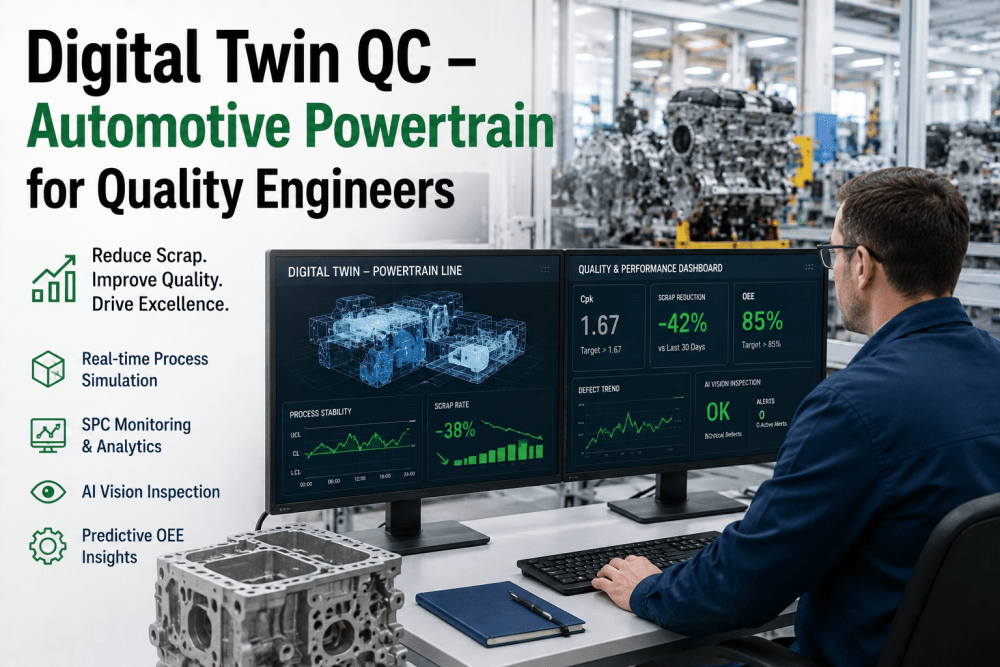
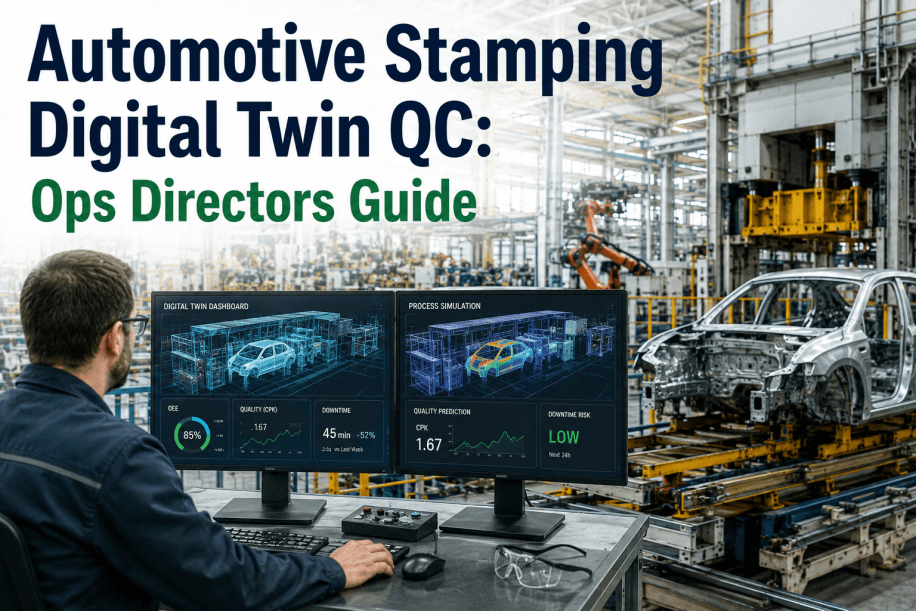
Digital twin quality for automotive powertrain manufacturing creates a real-time virtual replica of production processes, enabling quality engineers to predict deviations, optimize parameters, and prevent scrap before it occurs. By combining AI-powered simulation with live sensor data across machining centers, assembly lines, and inspection stations, quality teams detect out-of-spec conditions earlier, reduce scrap by 30–50%, improve Cpk performance, and strengthen IATF 16949 compliance. Quality engineers evaluating next-generation quality platforms Book a Demo to see digital twin quality in live automotive powertrain environments.
What Is Digital Twin Quality in Automotive Powertrain Manufacturing?
Digital twin quality technology creates a synchronized virtual replica of powertrain production processes combining real-time sensor data from CNC machines, assembly stations, torque tools, and inspection equipment. The digital twin continuously compares actual process outputs against expected quality parameters, enabling quality engineers to detect deviations, simulate what-if scenarios, and optimize processes before defects occur. Quality engineers building a digital twin quality strategy Book a Demo to see how AI-powered digital twins integrate with existing powertrain quality systems.
| Dimension | Traditional Quality Control | Digital Twin Quality |
|---|---|---|
| Detection Timing | Post-process inspection, lagging indicator | Real-time predictive alerts, leading indicator |
| Data Sources | Manual gauging, standalone CMM reports | AI vision, CNC feedback, torque curves, thermal sensors |
| Scrap Prevention | Reactive sorting and rework | Predictive prevention before deviation occurs |
| Process Optimization | Periodic capability studies, manual adjustments | Continuous simulation and automated parameter tuning |
| Compliance Model | Audit-based evidence collection | Real-time digital evidence with full traceability |
| Cpk Management | Quarterly manual recalculation | Continuous monitoring with automatic deviation alerts |
How Digital Twins Reduce Scrap and Improve Yield
Digital twin quality platforms follow a structured workflow that transforms raw production data into actionable quality improvements. Each stage builds on the previous, creating a closed loop of detection, analysis, intervention, and learning. Quality engineers assessing the scrap reduction potential of digital twin technology Book a Demo to review live powertrain deployment case studies.
Machine Vision and Digital Twin Integration
Machine vision systems act as the sensory layer of digital twin quality platforms, feeding real-time visual inspection data into the virtual model for continuous quality assessment. Quality engineers evaluating vision integration options Book a Demo to see iFactory vision systems integrated with digital twin simulation.
AI Vision Inspection detects surface defects, porosity, crack formation, and machining anomalies on engine blocks, cylinder heads, and transmission components in real time. Defect data feeds directly into the digital twin, updating the quality model within milliseconds and enabling immediate containment actions.
Thermal Process Analytics monitors temperature profiles during machining, heat treatment, and assembly operations. Thermal deviations indicate tool wear, coolant failure, or material property shifts before they produce dimensional nonconformances. The digital twin correlates thermal patterns with downstream quality outcomes for early warning.
Dimensional Measurement Fusion integrates in-line CMM, air gauging, and laser scan data into the digital twin for holistic dimensional quality assessment. The twin identifies multivariate drift patterns across multiple features simultaneously, flagging interactions such as fixture wear combined with spindle growth that univariate methods miss.
Achieving IATF 16949 Compliance with Digital Twin QC
Digital twin quality platforms support IATF 16949 compliance by automating evidence collection, continuous monitoring, and corrective action workflows. The table maps key IATF 16949 clauses to corresponding digital twin capabilities. Quality engineers strengthening their compliance posture Book a Demo to see how iFactory digital twin platforms simplify IATF 16949 audit preparation.
| IATF 16949 Clause | Requirement | Digital Twin Capability |
|---|---|---|
| 8.3 Product Design | Design validation and process capability studies | Virtual simulation of machining and assembly processes for design verification without production disruption |
| 8.5 Production | Controlled production conditions with evidence | Real-time process monitoring with automated evidence collection and digital audit trails |
| 9.1 Monitoring | Statistical process monitoring and capability analysis | Continuous Cpk and Ppk tracking with automatic reporting and deviation alerts |
| 10.2 Nonconformity | Corrective action and scrap reduction | Predictive scrap prevention with root cause analysis and automated containment work orders |
Expert Perspective — Digital Twin Quality in Powertrain Operations
We deployed digital twin quality across our engine block and cylinder head machining lines approximately nine months ago. Scrap rates dropped from 3.8% to 1.2% within the first two quarters. The most significant improvement came from the predictive analytics layer—we now detect tool wear drift and coolant temperature anomalies before they produce dimensional nonconformances. Our quality engineers spend less time firefighting and more time optimizing processes based on digital twin insights. For quality teams evaluating this technology, the key is starting with a well-defined pilot on a single high-volume line, establishing data quality, and then scaling methodically across the plant.
— Quality Engineering Manager, Powertrain Division — Tier One Automotive Supplier, IATF 16949 AccreditedConclusion
Digital twin quality for automotive powertrain manufacturing transforms quality engineering from a reactive, inspection-based discipline into a predictive, simulation-driven function. Real-time virtual models, AI-powered analytics, and machine vision integration enable quality engineers to reduce scrap by 30–50%, improve first-pass yield by over 25%, and strengthen IATF 16949 compliance with automated evidence collection. Quality engineers ready to build their digital twin quality roadmap Book a Demo to see iFactory digital twin quality platforms deployed in live automotive powertrain environments with measurable Cpk and scrap reduction results.
Frequently Asked Questions
Minimum requirements include digital CNC controllers with OPC-UA or MTConnect connectivity, in-line inspection systems with digital output, and a centralized data historian. iFactory digital twin platforms handle data normalization, synchronization, and integration with existing MES and QMS infrastructure.
iFactory digital twin platforms use standard API connectors and data adapters for major MES and QMS platforms. The digital twin layer operates alongside existing systems, enhancing them with predictive capabilities without requiring replacement of current quality infrastructure.
Yes. For high-volume lines, machine learning models train on thousands of data points daily for precise predictions. For low-volume, high-variety lines, Bayesian approaches leverage prior knowledge and transfer learning from similar process profiles to deliver meaningful insights with limited batch data.
Most facilities see measurable scrap reduction within two to three months of pilot deployment. Initial gains come from detecting and preventing known failure modes earlier. Sustained Cpk improvement and yield gains continue as the digital twin model accumulates more training data over six to twelve months.
Traditional SPC monitors output variables against fixed control limits. Digital twin simulation creates a full virtual process model that predicts future quality outcomes based on current conditions. The digital twin runs what-if scenarios, optimizes multiple parameters simultaneously, and detects multivariate drift patterns that univariate SPC charts cannot capture.

.png)