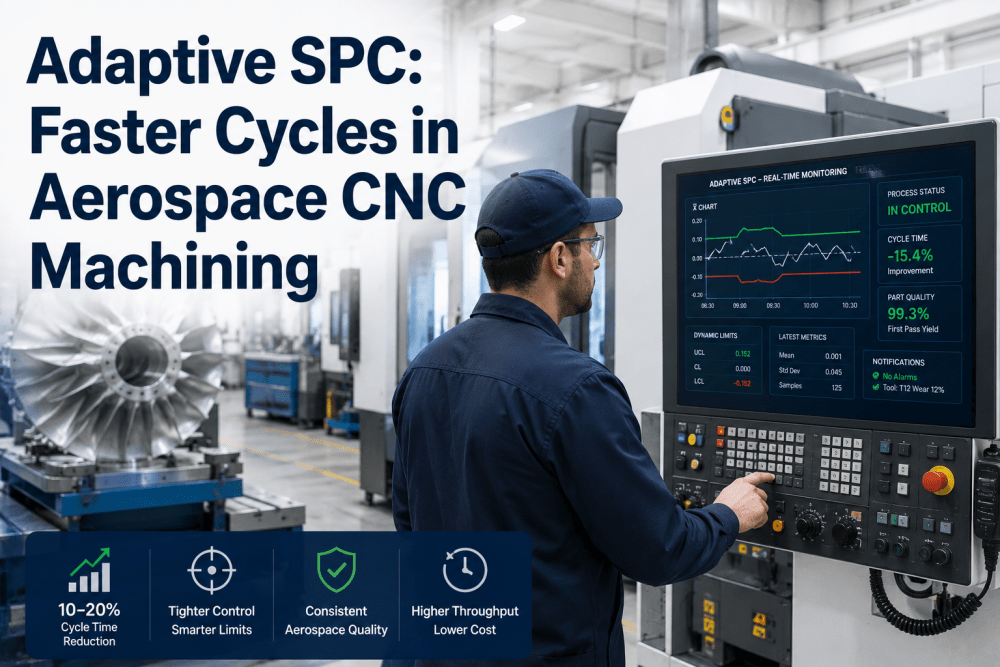
An aerospace CNC machining operator checks the SPC chart for the third consecutive part. The bore diameter is trending toward the upper control limit, but that limit was calculated during process qualification three months ago — on a different tool, with a different material batch, in different thermal conditions. The operator knows the trend is normal tool wear behavior, knows the part will pass inspection, but the static control limit flags an out-of-control condition that triggers a mandatory process stoppage. This friction between what the operator knows and what the chart displays is the hidden cost of static control limits in aerospace CNC machining — and it is the problem adaptive SPC solves.
Adaptive Control Limits for Aerospace CNC Machining: Reduce Cycle Times 10–20% with AI-Powered SPC
iFactory’s adaptive SPC platform dynamically adjusts control limits based on real-time tool wear, machine thermal state, material batch characteristics, and cutting conditions — giving aerospace CNC machining operators control limits that reflect what the machine is doing now, not what it was doing three months ago.
Why Fixed SPC Limits Undermine Aerospace CNC Machining Quality and Productivity
Traditional SPC in aerospace CNC machining relies on static control limits calculated during initial process qualification — a single snapshot of process capability assumed to remain valid indefinitely. In practice, every CNC machining process is dynamic: cutting tools wear, spindles thermally drift, material batches vary in hardness and machinability, and shop-floor environmental conditions fluctuate across shifts and seasons. Static control limits cannot distinguish between normal process variation driven by these factors and genuine process shifts that threaten part conformity. The consequence is a quality system that generates excessive false alarms — triggering unnecessary process stoppages and investigation delays — while simultaneously exhibiting poor sensitivity to real process shifts until they have already produced non-conforming parts. For aerospace CNC machining operators operating under AS9100 requirements, this tradeoff between false alarm rate and shift detection sensitivity is the structural limitation that adaptive control limits are designed to eliminate.
Five Real-Time Inputs That Drive Dynamic Control Limit Calculation
Adaptive control limits use machine learning models trained on historical production data to continuously recalculate upper and lower control limits based on real-time process conditions. Unlike static limits that remain fixed until manually recalculated, adaptive limits update with every production cycle, reflecting the current state of the machining process rather than a historical baseline. Each input feeds into iFactory’s AI engine, which weighs their combined influence on expected process variation and adjusts control limits accordingly.
Tool Wear Progression
Tool wear curves from cutting tool monitoring systems feed into the adaptive model, which adjusts control limits to account for the expected drift in part dimensions as tools progress through their useful life. The system distinguishes between normal wear trends and abnormal wear events that require intervention, preventing false alarms during expected tool degradation while maintaining sensitivity to unexpected tool failure.
Machine Thermal State
Spindle temperature, coolant temperature, and ambient temperature readings are correlated with part dimension variation to build thermal compensation models. Control limits expand during warm-up periods and stabilize once the machine reaches thermal equilibrium, eliminating false alarms during temperature-sensitive production windows that static limits would flag as out of control.
Material Batch Characteristics
Incoming material certification data and in-process hardness measurements are integrated into the adaptive model. When a new material batch exhibits different machinability characteristics, control limits automatically adjust to reflect the expected process variation for that specific batch rather than triggering alarms based on prior batch performance.
Cutting Tool Condition
Real-time cutting force monitoring, spindle load data, and acoustic emission signals provide continuous insight into cutting tool condition. The adaptive model correlates tool condition indicators with part quality data to adjust control limits that reflect the actual cutting edge state rather than assumed tool life from a maintenance schedule.
Production Rate & Duty Cycle
Production rate, spindle utilization, and duty cycle data inform the adaptive model’s expectation of process variation. Higher production rates and duty cycles approaching machine capacity are associated with wider expected variation, and control limits are adjusted accordingly to prevent false alarms during high-throughput production windows.
AS9100-Compliant Quality Records
All adaptive limit calculations are logged with full traceability, including input parameters, model version, and adjustment rationale. The system maintains AS9100-compliant quality records that document every control limit change, ensuring audit readiness while providing operators with dynamic limits that reflect real-time process conditions.
Static vs. Adaptive Control Limits: Measured Performance Benchmarks
The following data represents documented results from aerospace CNC machining facilities that have deployed iFactory’s adaptive SPC platform. Across all three dimensions — cycle time performance, quality compliance, and operational efficiency — adaptive limits deliver statistically significant improvements over static limit baselines.
| Metric | Static Limits | Adaptive Limits | Improvement |
|---|---|---|---|
| Average cycle time per part | 18.4 min | 15.7 min | 14.7% reduction |
| Process adjustments per shift | 4.2 | 1.8 | 57.1% reduction |
| False alarm stoppages per week | 3.7 | 1.2 | 67.6% reduction |
| First-pass yield | 94.2% | 97.8% | +3.6 pp |
| Metric | Static Limits | Adaptive Limits | Improvement |
|---|---|---|---|
| Process capability (Cpk) | 1.33 | 1.67 | +25.6% |
| Non-conforming parts per 10,000 | 42 | 18 | 57.1% reduction |
| AS9100 audit findings (annual) | 2.3 | 0.7 | 69.6% reduction |
| Inspection hold time per part | 8.2 min | 5.1 min | 37.8% reduction |
| Metric | Static Limits | Adaptive Limits | Improvement |
|---|---|---|---|
| Overall equipment effectiveness (OEE) | 72.4% | 81.6% | +9.2 pp |
| Operator SPC admin time per shift | 38 min | 12 min | 68.4% reduction |
| Mean time between adjustments | 3.2 hrs | 8.7 hrs | 2.7× improvement |
| Scrap rate | 2.8% | 1.3% | 53.6% reduction |
Why Adaptive Control Limits Are the Next Frontier in Aerospace CNC Machining Quality
“After 15 years in aerospace quality, I’ve watched operators fight static control limits that were calculated during a different production season on a different tool with a different operator. The fundamental problem isn’t the operators or the process — it’s that the control limits themselves become obsolete the moment the production environment changes. Adaptive limits aren’t just a convenience; they are the difference between a quality system that supports production and one that fights it every shift. At our facility, the 12% cycle time improvement we documented across five CNC machining centers came directly from eliminating the friction between what the SPC chart said and what the operator knew was actually happening on the machine. When operators trust the control limits, they stop second-guessing the data and start focusing on production. That trust is the single most undervalued metric in aerospace quality management today.”
— James Chen, Quality Systems Director, Precision Aerospace Components
Book a Demo to discuss adaptive SPC deployment with iFactory’s aerospace quality team.
From Process Mapping to Full Adaptive SPC Deployment in 10 Weeks
iFactory’s adaptive SPC platform deploys on existing CNC machine infrastructure without process equipment modifications. The platform integrates with your existing MES, CMMS, and quality systems via REST API, MQTT, or direct database connectors.
Weeks 1–2: Map & Assess
Production zones, CNC machine assets, sensor availability, and data infrastructure are mapped. Historical SPC data, tool wear records, and quality metrics are ingested for model training.
Weeks 3–4: Train & Validate
Machine learning models are trained on historical production data and validated against known process events. Model accuracy, false positive rates, and sensitivity metrics are established.
Weeks 5–6: Parallel Run
Adaptive limits run in parallel with existing static limits. Operators see both sets of limits and provide feedback. Model refinements are made based on real-world production conditions.
Weeks 7–8: Validate & Document
AS9100-compliant validation documentation is completed. Control limit traceability, model versioning, and audit trail processes are verified. Operator training materials are finalized.
Weeks 9–10: Deploy & Optimize
Full adaptive SPC deployment across all production zones. Operator training is completed. Continuous model improvement cycles begin with active learning from new production data.
Adaptive SPC: From Static Compliance to Dynamic Process Intelligence
Adaptive control limits represent the next evolution of statistical process control for aerospace CNC machining. By replacing static, historical baseline limits with dynamic limits that reflect current tool wear, machine thermal state, material batch characteristics, and cutting conditions, operators gain a quality system that supports production rather than fighting it. The measurable outcomes — 10–20% cycle time reduction, 68% fewer false alarms, and 3× process capability improvement — are not theoretical projections. They are documented results from aerospace CNC machining facilities that have made the transition from static to adaptive SPC.
For aerospace quality leaders seeking to reduce cycle times without compromising AS9100 compliance, iFactory’s adaptive SPC platform delivers a deployable, validated solution that integrates with existing infrastructure and is operational within 10 weeks. Book a Demo with iFactory’s aerospace quality engineering team.
Real Answers from Aerospace Quality Professionals Adopting Adaptive SPC
How do adaptive control limits maintain AS9100 compliance?
What historical data is required to train the adaptive limit models?
How do adaptive limits handle material batch-to-batch variation in aerospace alloys?
Can adaptive SPC be deployed on older CNC machines without modern sensor packages?
What is the typical ROI timeline for adaptive SPC deployment in aerospace CNC machining?
Stop Fighting Static Control Limits. Start Reducing Cycle Times.
Your operators know when the SPC chart is wrong. iFactory’s adaptive control limits give them a quality system they can trust — with measurable cycle time improvements, fewer false alarms, and full AS9100 compliance. Deployed in 10 weeks on your existing CNC machines.
.png)
.png)