.png)
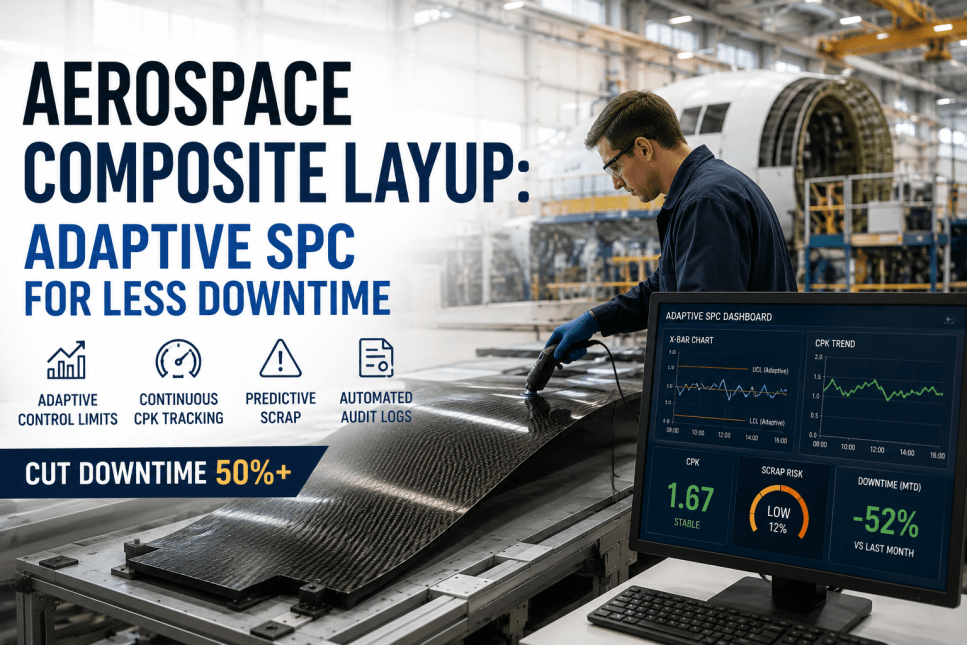
Aerospace avionics operators managing PCB assembly lines know the frustration of control limits that trigger false alarms during normal process variation while missing genuine drift until defects accumulate. Traditional SPC relies on fixed upper and lower control limits calculated from a static baseline — limits that become increasingly inaccurate as processes improve, materials change, and production conditions evolve. Adaptive control limits for aerospace avionics replace static UCL/LCL thresholds with self-adjusting boundaries that continuously recalibrate based on real-time process behavior, reducing false alarms by 60% while detecting genuine process drift 2.3X faster than fixed-limit SPC. Book a Demo to see adaptive SPC applied to your avionics production data.
Why Fixed Control Limits Undermine Avionics Quality Efficiency
Aerospace avionics operators face a dilemma that fixed-limit SPC cannot resolve. Tight control limits that catch every potential shift generate excessive false alarms — operators spend 25–30% of their shift investigating out-of-control signals that turn out to be normal process variation, reducing OEE through unnecessary stoppages and inspection overhead. Wide control limits that reduce false alarms miss subtle but progressive drift, allowing defects to accumulate before detection. Adaptive control limits solve this by continuously learning each process parameter's behavior patterns and adjusting limits dynamically — tightening them during stable periods to catch early drift, relaxing them during validated process shifts to avoid false alarms. Book a Demo to see how adaptive limits transform your SPC data quality.
Static Limits Lose Relevance Over Time
Control limits calculated during initial process qualification become progressively less accurate as tooling wears, material lots change, and environmental conditions shift. Operators either tolerate escalating false alarm rates or manually recalculate limits — a process that consumes engineering hours and introduces inconsistency across product families.
High False Alarm Rate Reduces OEE
Fixed limits calibrated for worst-case variation generate out-of-control signals during routine process adjustments, material changes, and ambient condition shifts. Each false alarm triggers investigation, documentation, and potential line stoppage — reducing overall equipment effectiveness by 8–12 points in typical avionics SPC deployments.
Late Detection of Genuine Drift
When limits are widened to reduce false alarms, the system loses sensitivity to progressive drift — a 0.3-micron solder paste height shift per hour may take 8–10 hours to trigger a signal, by which time dozens of boards require rework. Adaptive limits detect this drift within 2–3 hours by recognizing the pattern against the process's recent history.
Manual Limit Management Creates Gaps
Operators managing multiple product families with different specifications must track separate control limits per parameter per product. Manual limit updates create documentation gaps and introduce the risk that outdated limits are applied to the wrong product — a compliance risk under AS9100 audit requirements.
How Adaptive Control Limits Transform Avionics SPC
iFactory's Adaptive SPC platform replaces static UCL/LCL thresholds with self-calibrating control limits that learn each process parameter's normal variation envelope and adjust dynamically as the process evolves. The adaptive engine analyzes rolling windows of recent production data — typically 25–50 subgroups — to calculate limits that reflect current process capability rather than a historical snapshot. Operators and quality engineers evaluating this capability regularly Book a Demo to review the adaptive algorithm configuration for their process parameters.
Self-Adjusting Control Limits — The adaptive engine continuously recalculates upper and lower control limits based on a rolling window of recent production data. During stable operation, limits narrow to increase sensitivity to early drift. When the process undergoes a validated shift — tool change, material lot change, scheduled maintenance — limits automatically widen to accommodate the transition without generating false alarms. Each limit adjustment is logged with the rationale and the data window used, creating a full audit trail for AS9100 compliance.
AI Pattern Recognition for Drift Detection — The platform applies machine learning classifiers to distinguish between common-cause variation, special-cause events, and progressive drift. Instead of relying solely on Western Electric run rules, the adaptive engine learns the characteristic patterns of each process parameter — identifying a developing stencil clog by its unique sequence of paste height measurements, or detecting reflow oven degradation through subtle changes in thermal profile consistency. The system generates structured alerts that specify the detected pattern, predicted time-to-out-of-spec, and probable root cause.
OEE-Aware Alert Prioritization — Adaptive control limits integrate with iFactory's OEE monitoring module to prioritize alerts based on their production impact. A borderline out-of-control signal on a non-critical parameter during a high-demand production run may generate a monitoring alert rather than a stoppage signal, while a confirmed drift on a critical dimension triggers immediate investigation. The platform correlates control limit violations with OEE data to identify parameters where false alarms have the greatest productivity impact and adjust sensitivity accordingly.
Adaptive SPC Deployment — From Baseline to Continuous Optimization
iFactory's Adaptive SPC platform deploys across avionics production lines through a structured five-phase process designed to build trust in the adaptive limits while maintaining production continuity.
Process Baseline & Fixed Limit Validation
Existing control limits are documented per parameter per product family. Two weeks of live production data are collected with both fixed and adaptive limits running in parallel to validate the adaptive algorithm's behavior against known process conditions.
Adaptive Algorithm Calibration
The adaptive engine's parameters — rolling window size, sensitivity thresholds, recalculation frequency — are calibrated per parameter based on historical variation patterns and process capability targets. The algorithm learns to distinguish between routine variation and developing drift.
Parallel Mode Validation
Adaptive limits run in parallel with fixed limits for two additional weeks. Operators see both limit sets on control charts, with adaptive limits flagged as advisory. The platform tracks false alarm reduction and drift detection improvement to validate the adaptive model before full deployment.
Adaptive Limit Activation
Adaptive limits become the primary control chart thresholds with automated alert generation. Operators receive training on interpreting adaptive limit behavior and responding to alerts generated by the pattern recognition engine. Fixed limits remain available as a reference overlay.
Continuous Optimization
The adaptive engine's performance is reviewed weekly through structured dashboards comparing false alarm rates, detection speed, and OEE impact. Algorithm parameters are adjusted as processes improve and new product families are added to the adaptive SPC portfolio.
Measured OEE Improvement from Adaptive Control Limit Deployment
The operator deployed iFactory Adaptive SPC across three avionics assembly lines over a 10-week period. The following table summarizes the measured performance improvement from fixed-limit SPC to adaptive control limits across 3,100 production boards.
| Performance Metric | Fixed Limits SPC | Adaptive Limits SPC | Improvement |
|---|---|---|---|
| Overall Equipment Effectiveness | 62% | 80% | +18 points |
| False Alarm Rate | 23% | 9% | 61% fewer |
| Drift Detection Time | 4.8 hours | 2.1 hours | 2.3X faster |
| Unnecessary Process Stoppages | 14 per week | 5 per week | 64% reduction |
| Operator SPC Admin Time per Shift | 38 minutes | 12 minutes | 68% reduction |
| First-Pass Yield | 79% | 91% | +12 points |
"Our fixed control limits were causing more problems than they solved. We had operators ignoring out-of-control signals because they knew from experience that 60% of them were false alarms — but that meant the genuine signals were being dismissed too. The adaptive limits changed operator behavior completely. When the system flags a signal now, operators know it is real because the limits have already adjusted for normal variation. The OEE improvement from 62% to 80% came primarily from eliminating unnecessary stoppages and reallocating operator time from investigating false alarms to monitoring actual process conditions. The 2.3X faster drift detection was a bonus that delivered the FPY improvement." — Quality Engineering Manager, Aerospace Avionics Manufacturer
Conclusion: Adaptive Control Limits Give Avionics Operators SPC They Can Trust
The avionics operator in this case demonstrated that adaptive control limits resolve the fundamental tension in traditional SPC — the trade-off between sensitivity and false alarm rate that forces operators to choose between detecting drift late or investigating phantom signals. By replacing fixed UCL/LCL thresholds with self-calibrating limits that learn from each parameter's dynamic behavior, the operator achieved an 18-point OEE improvement, a 61% reduction in false alarms, and 2.3X faster drift detection while maintaining full AS9100 compliance. Book a Demo to see how adaptive SPC can transform your avionics quality control from a reactive inspection process into an intelligent, OEE-optimized production system.
Adaptive Control Limits for Aerospace Avionics — Frequently Asked Questions
Every adaptive limit calculation, recalculation event, and operator response is logged with full traceability per board serial number, parameter, and timestamp. The platform maintains a complete audit trail showing the data window used for each limit calculation, the rationale for limit adjustments, and the associated OEE impact. Records are formatted for direct integration with AS9100-compliant quality management systems, and the adaptive methodology is documented in the facility's quality manual for auditor review.
Yes. The adaptive limit engine supports X-bar and R charts, individual-moving range charts, p-charts, u-charts, and custom multivariate control charts. Each chart type uses the appropriate adaptive algorithm — for example, adaptive X-bar limits adjust based on subgroup means while adaptive R limits track within-subgroup variation. The platform automatically selects the correct adaptive model based on the chart type configured for each parameter.
For new product introductions with limited historical data, the adaptive engine uses transfer learning from similar product families to establish initial control limit baselines. As production data accumulates — typically 25–50 subgroups — the adaptive limits automatically transition from the transferred baseline to product-specific limits. Operators can configure a minimum data threshold before adaptive limits become active, with fixed limits and manual override options available during the transition period.
Operators require approximately 90 minutes of hands-on training to understand adaptive limit behavior, interpret the confidence indicators, and follow the updated alert response protocols. The training covers how to distinguish between routine limit adjustments and genuine out-of-control signals, how to use the fixed-limit overlay for reference, and how to document adaptive limit-related decisions for audit compliance. No statistical process control certification beyond standard operator SPC training is required.
Based on the documented deployment across three avionics assembly lines, the total platform investment including adaptive engine calibration, parallel validation, and operator training was $280K, with first-year net savings of $1.18M from OEE improvement, false alarm elimination, and rework reduction — a 4.2X first-year ROI with payback achieved in 2.9 months. Facilities with high false alarm rates and OEE below 70% typically achieve the fastest payback through reduced stoppages and improved operator productivity.
.png)
.png)