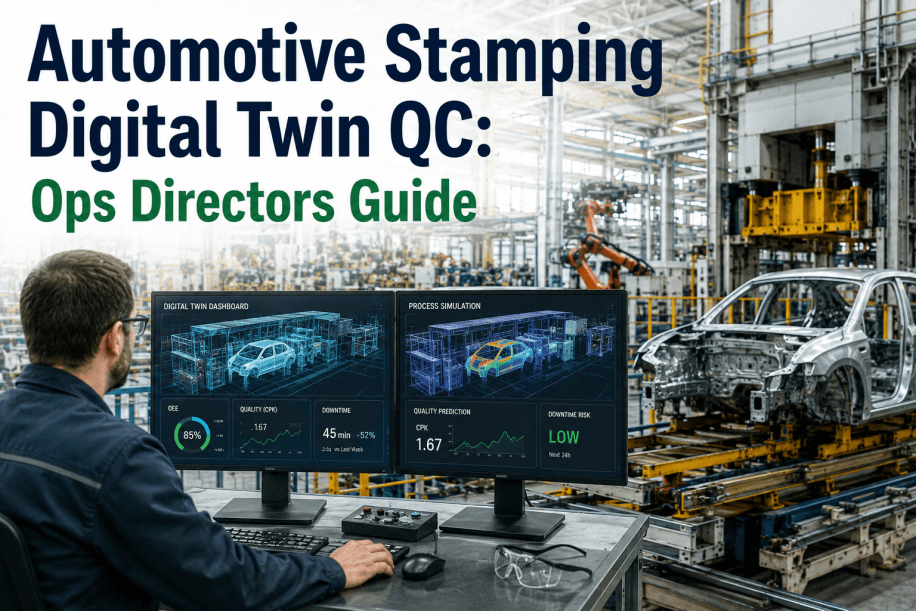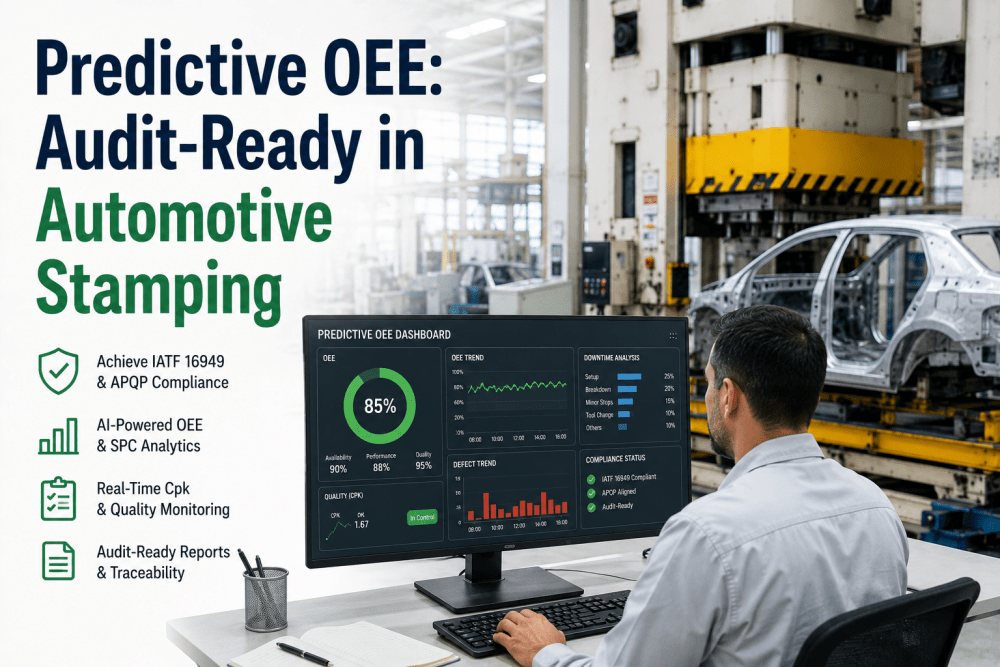
An automotive stamping operations director walks into the morning production review and sees the daily OEE report: 74% across eight press lines, with one line at 62% due to an undetected progressive die wear condition that generated 47 nonconforming hood panels before quality inspection caught it. The scrap is already in the bin. The downtime is already in the log. The IATF 16949 auditor arrives in six weeks. The gap — between what the OEE dashboard shows after the fact and what the operations team could have prevented with predictive intelligence — is the difference between a facility that maintains audit-ready compliance year-round and one that scrambles before every surveillance audit. Predictive OEE for automotive stamping closes that gap.
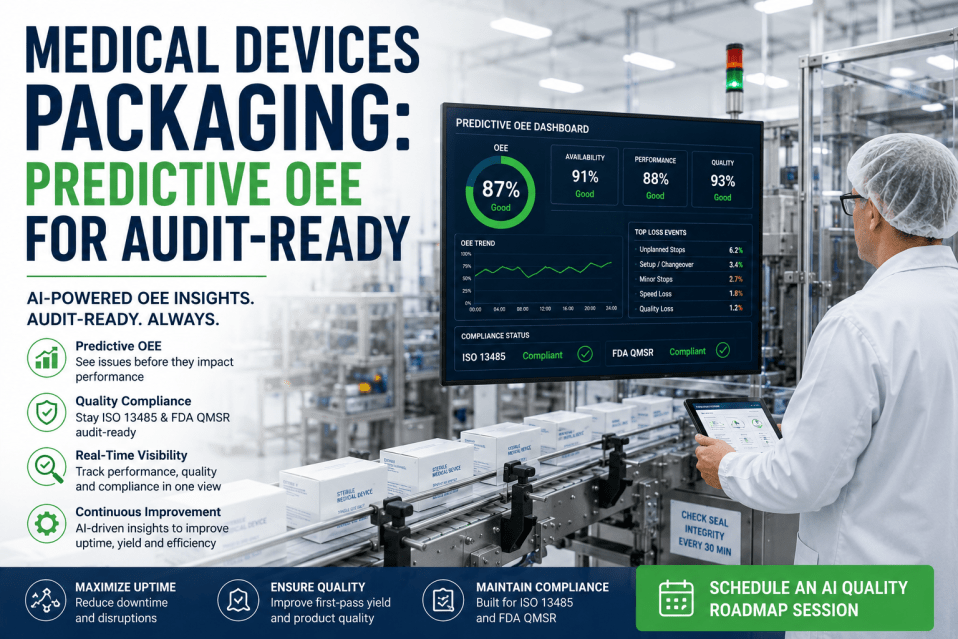
Achieve Audit-Ready Quality Compliance with AI-Powered Predictive OEE for Automotive Stamping
iFactory's predictive OEE platform combines real-time production monitoring, AI-driven downtime analytics, and integrated quality intelligence to help operations directors improve equipment effectiveness, maintain IATF 16949 and APQP compliance, and keep every press line audit-ready.
Why Traditional OEE Falls Short in Automotive Stamping Quality Compliance
In automotive stamping operations, OEE has historically been a lagging indicator — calculated at shift end from production counts, downtime logs, and quality rejects. By the time the OEE number is known, nonconforming parts have already been produced, die wear has already progressed, and compliance documentation is already incomplete. For operations directors responsible for IATF 16949 and APQP compliance, this retrospective approach creates three structural problems: quality events are detected after they occur, root causes remain unidentified across shifts, and audit evidence must be reconstructed from fragmented data sources. Predictive OEE replaces this model with real-time analytics that detect developing issues before they affect quality or compliance. Operations directors evaluating predictive OEE for their stamping operations Book a Demo to see the platform integrated with live press line data.
Six Capabilities That Enable Audit-Ready Predictive OEE
iFactory's predictive OEE platform combines real-time production monitoring with AI-driven analytics and integrated quality intelligence. Every capability is deployed on existing press line infrastructure and operational within weeks. Operations directors evaluating predictive OEE deployment Book a Demo to see the platform integrated with live press line data.
Live OEE Tracking Across All Press Lines
Real-time availability, performance, and quality metrics for every press line, die set, and shift. OEE components are calculated from PLC data, sensor streams, and quality test results — not manual entries. Dashboards update every 30 seconds with line-level and plant-level views.
AI-Driven Downtime and Quality Prediction
Machine learning models analyze historical production data, die wear patterns, material variability, and equipment condition to predict impending downtime events and quality deviations before they occur. Predictions are delivered with lead time and confidence scores.
Integrated IATF 16949 and APQP Tracking
Quality events are automatically linked to OEE data, creating a complete traceability chain from production parameters through inspection results to compliance documentation. Control plan adherence is monitored in real time with deviation alerts.
Automated Compliance Documentation
All OEE, quality, and maintenance data is automatically organized into IATF 16949 and APQP audit-ready reports. Documentation includes production records, capability studies, control plan evidence, and corrective action histories with full traceability.
Continuous Process Capability Monitoring
Real-time Cpk calculations for every stamped part number and die combination. The platform detects capability drift before it falls below the 1.67 threshold and automatically correlates Cpk changes with process parameter shifts.
Unified Manufacturing Intelligence Dashboard
Single-pane view combining OEE, SPC, quality, maintenance, and compliance data. Role-based dashboards give operations directors plant-wide visibility while shift supervisors get line-level actionable insights.
From Press Line Data to Audit-Ready Compliance in Four Steps
iFactory connects to your existing press line infrastructure — PLCs, sensors, quality gauges, and MES — with no equipment modifications required. The platform deploys on your plant network alongside production operations.
Connect & Collect
Press line PLCs, die sensors, material tracking systems, and quality inspection stations are connected to iFactory's data ingestion pipeline. OEE component data — availability, performance, quality — is collected in real time with sub-minute latency.
Analyze & Predict
AI models analyze real-time and historical data to predict downtime events, quality deviations, and Cpk drift. Predictive alerts are generated with recommended corrective actions and estimated lead time before the predicted event.
Act & Correct
Predictive alerts trigger automated work orders in iFactory CMMS for die maintenance, parameter adjustments, or material changes. Corrective actions are tracked through completion with documented evidence for audit compliance.
Report & Audit
All production, quality, and maintenance data is automatically compiled into IATF 16949 and APQP audit-ready reports. Documentation includes real-time OEE records, capability studies, control plan evidence, and full corrective action traceability.
What Poor OEE Visibility Costs a Typical Automotive Stamping Operation
Undetected Downtime and Quality Events
Equipment and quality issues detected during shift-end OEE calculation rather than in real time average 3.5 hours between occurrence and corrective action. At $420 per hour of unplanned downtime for a mid-size stamping facility, each delayed response costs $1,470 in lost production and nonconforming material.
Manual Audit Preparation Labor
Quality and production teams spend 60-80 hours preparing documentation for each IATF 16949 surveillance audit — gathering OEE records, control plan evidence, capability studies, and corrective action histories from multiple systems. At $55 per hour loaded labor cost, each audit cycle costs $3,850-$4,400 in preparation time alone.
Quality Non-Compliance Rework
Nonconforming stamped parts detected after OEE calculation rather than during production require containment sorting, root cause investigation, corrective action implementation, and customer notification. For a typical stamping plant producing 12 million parts annually with a 2.5% non-conformance rate, rework and containment costs exceed $180,000 per year.
Four Ways Predictive OEE Strengthens Quality Compliance in Automotive Stamping
Real-Time Production Visibility Eliminates the OEE Data Lag
The most significant limitation of traditional OEE is the time delay between production events and their reflection in the OEE metric. Predictive OEE eliminates this lag by calculating availability, performance, and quality components from real-time sensor and PLC data. Operations directors see developing issues as they emerge — not when the shift-end report reveals them hours later. This real-time visibility is the foundation of both OEE improvement and compliance documentation.
Predictive Alerts Enable Proactive Quality Interventions
Under the reactive OEE model, die wear, material variation, and process drift are detected only after they produce nonconforming parts. Predictive OEE models analyze die strike counts, tonnage signatures, material properties, and temperature profiles to forecast quality deviations before they occur. Operations teams receive alerts with lead time to adjust parameters, change dies, or modify material feed — preventing nonconforming production rather than reacting to it.
Automated Compliance Documentation Eliminates Audit Scramble
The weeks before an IATF 16949 surveillance audit are traditionally consumed by documentation gathering — pulling OEE records from one system, quality data from another, and maintenance histories from a third. Predictive OEE platforms with integrated compliance modules automatically organize all production, quality, and maintenance data into audit-ready report formats. Documentation is always current, always accessible, and always traceable to source data.
Continuous Cpk Monitoring Strengthens Process Capability
Stamping operations that calculate Cpk only during PPAP submissions or annual capability studies miss developing process drift that erodes capability between formal measurement points. Predictive OEE platforms continuously monitor Cpk for every part-die combination, detecting drift trends as they develop. Operations teams can intervene while Cpk remains above 1.67 rather than discovering a capability gap during the next customer quality review.
Predictive OEE: The Foundation for Audit-Ready Automotive Stamping Operations
The deployment of predictive OEE across automotive stamping operations transforms equipment effectiveness from a retrospective metric into a predictive capability. Real-time production visibility, AI-driven downtime and quality predictions, automated compliance documentation, and continuous Cpk monitoring give operations directors the tools to improve OEE while maintaining IATF 16949 and APQP audit readiness throughout the year. The 92% OEE target is achievable. The 40% reduction in unplanned downtime is measurable. The 86% faster audit preparation is documented. For operations directors ready to move from reactive OEE reporting to predictive quality compliance, Book a Demo with iFactory's automotive manufacturing intelligence team to see predictive OEE deployed in live automotive stamping environments.
Real Answers from Operations Leaders Using Predictive OEE in Automotive Stamping
Stop Discovering Quality Issues at Shift-End OEE Reports.
Your stamping operation deserves real-time visibility, predictive intelligence, and audit-ready compliance documentation — not retrospective OEE calculations. iFactory's predictive OEE platform gives operations directors the tools to improve equipment effectiveness, maintain IATF 16949 compliance, and keep every press line audit-ready. Deployed in 8-10 weeks, on-prem, no production disruption.