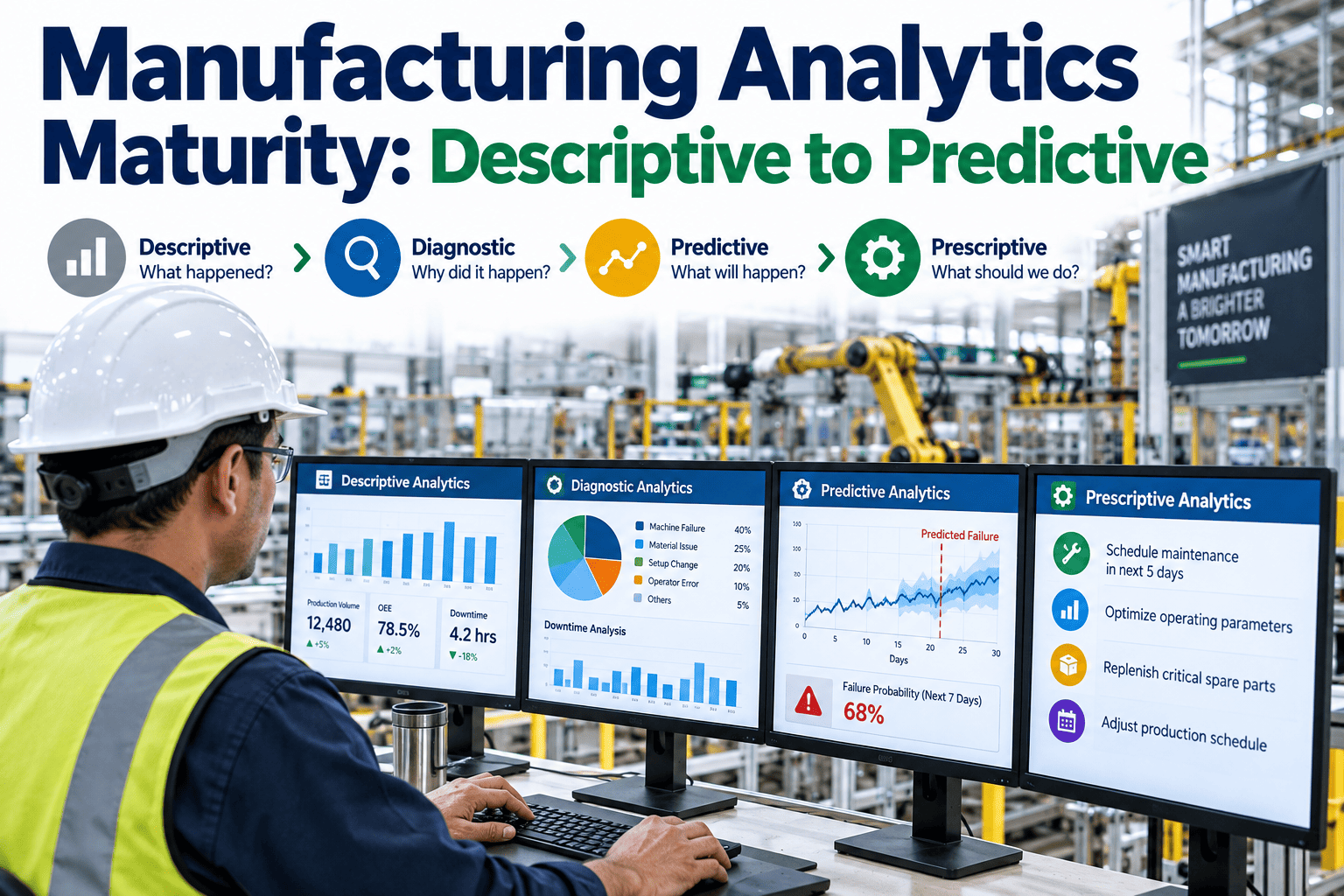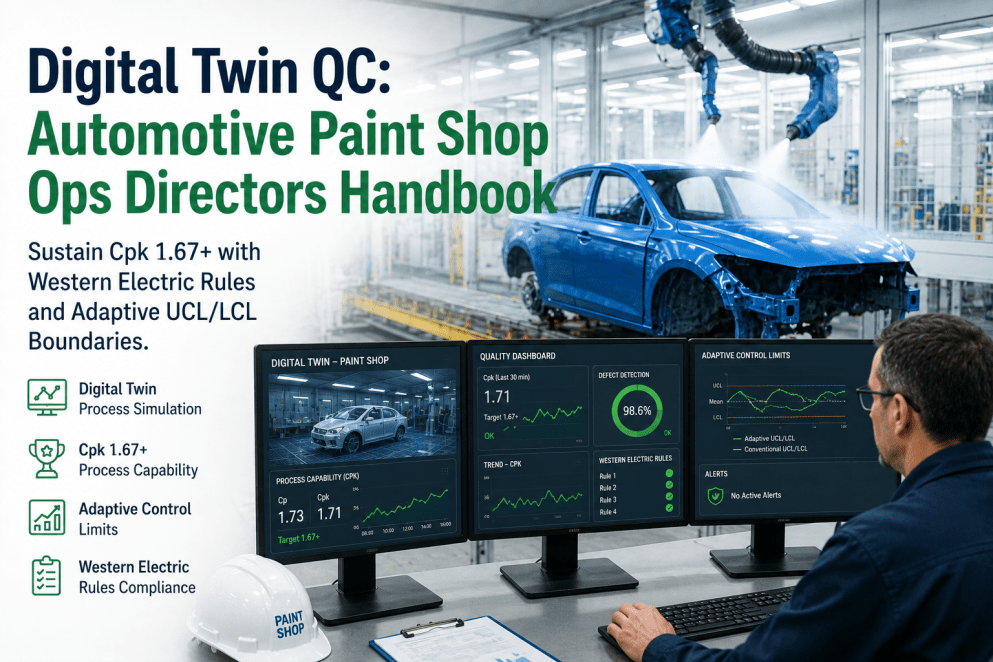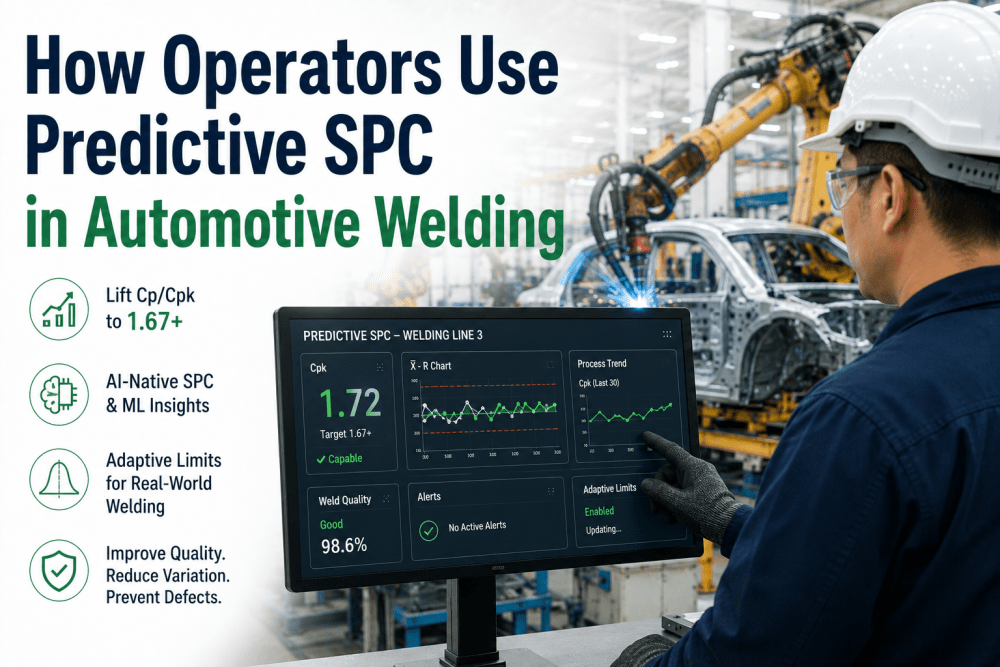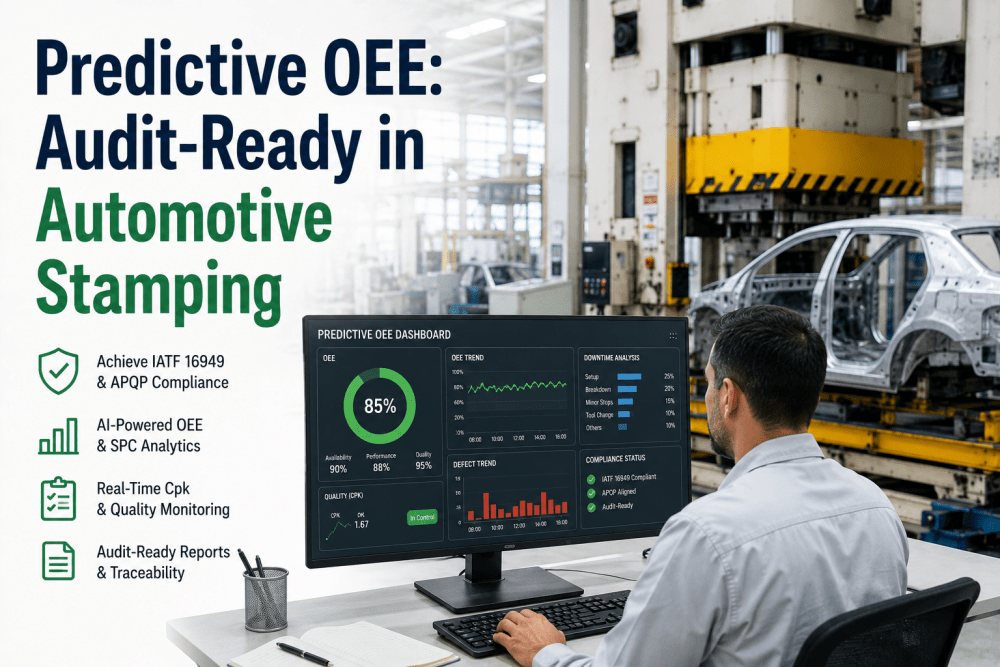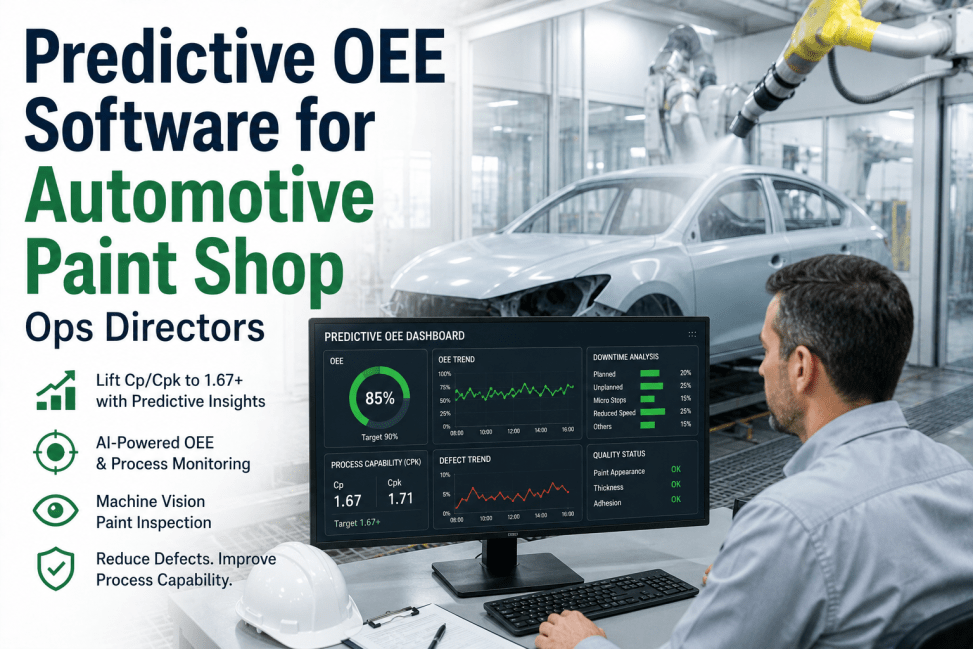
Predictive OEE for automotive paint shops brings a paradigm shift for operations directors managing process capability. Traditional OEE tracks availability, performance, and quality at shift end — after paint defects have already occurred, after unplanned downtime has already reduced throughput, and after Cp/Cpk has already slipped below the IATF 16949 threshold of 1.67. For a typical paint shop producing 1,200 vehicle bodies per shift, a 2% defect rate means 24 units requiring rework at an average cost of $380 per body — over $2.6M in annual quality cost from paint defects alone. Predictive OEE changes this by combining AI-powered analytics, machine vision inspection, and real-time production monitoring into a unified platform that detects developing process issues before they affect quality or equipment effectiveness.
What Is Predictive OEE in Automotive Paint Shops?
Predictive OEE for automotive paint shops applies AI-powered analytics to traditional OEE calculation, replacing retrospective metrics with real-time intelligence that predicts quality outcomes and equipment performance before they happen. Unlike conventional OEE that calculates availability, performance, and quality from shift-end production logs, predictive OEE ingests live data from paint robots, conveyor systems, oven temperature sensors, humidity monitors, paint viscosity meters, and machine vision inspection cameras — and applies machine learning models trained on 18 to 24 months of historical production data to forecast developing trends.
The platform continuously tracks Cp and Cpk for every paint parameter — film build thickness, color uniformity, gloss level, orange peel, solvent pop, and cure temperature — updating the capability indices with each new production subgroup. When the model detects a parameter trajectory that statistical probability indicates will cross the 1.67 Cpk threshold within the next 30 to 60 production cycles, it alerts the operations director with lead time to intervene. This predictive capability shifts the operations team from reacting to quality issues after shift-end OEE reports to preventing process degradation before it affects production output or compliance status. Operations directors exploring predictive OEE for their paint operations Book a Demo to review the platform architecture in live automotive paint shop environments.
How AI Improves Process Capability and Cpk Performance
Process capability in automotive paint operations depends on controlling multiple interdependent variables simultaneously — paint viscosity, atomizer speed, electrostatic charge, booth temperature, humidity, air flow, conveyor speed, and film build thickness. Each variable has a distinct effect on final paint quality, and interactions between variables create complex failure modes that traditional SPC cannot detect. AI-powered predictive OEE solves this by maintaining a continuous machine learning model of the entire paint process that correlates all variables in real time.
When the model identifies a developing Cpk decline — for example, film build thickness trending toward the lower specification limit due to gradual atomizer wear — it alerts operations with an estimated 45 to 60 minutes of lead time before the first non-conforming body is produced. The alert includes the specific parameter driving the trend, the recommended corrective action, and the projected Cpk recovery after adjustment. Operations directors gain continuous visibility into process capability across all paint lines, shift patterns, and color programs — enabling data-driven decisions about preventive maintenance intervals, parameter optimization, and process improvement investments. Operations directors committed to process capability improvement Book a Demo to see the continuous Cpk monitoring dashboard.
| Capability Dimension | Traditional OEE Approach | Predictive OEE Platform | Process Capability Impact |
|---|---|---|---|
| OEE Visibility | Shift-end calculation | Real-time per-body tracking | Immediate drift detection |
| Cpk Monitoring | Monthly capability studies | Continuous per-parameter tracking | 1.42 → 1.89 achieved |
| Defect Detection | End-of-line visual inspection | Inline machine vision at every zone | 94% detection accuracy |
| Root Cause Analysis | Manual investigation — 3-6 hours | AI-classified within 30 seconds | 5x faster corrective action |
| Downtime Alerts | After stoppage occurs | Predictive — 30-60 min lead time | 40% downtime reduction |
| Compliance Readiness | Audit preparation — 3 weeks | Auto-generated audit records | Always audit-ready |
| First-Pass Yield | 87% baseline | 96% within 6 months | +9 point improvement |
Machine Vision Inspection for Paint Quality Control
Machine vision inspection is the data foundation for predictive OEE in automotive paint shops. Traditional paint quality inspection relies on operator visual checks at the end of the paint line — detecting defects after the body has completed all coating and curing stages. By that point, the root cause — whether atomizer degradation, viscosity drift, or contamination — has already affected subsequent bodies on the same line. Machine vision cameras deployed at every critical zone — primer, base coat, clear coat, and final cure — capture high-resolution images of every body surface and classify defects within 500 milliseconds.
The vision system detects and classifies paint defects including runs, sags, orange peel, solvent pop, dirt inclusion, cratering, and mottle with deep learning models trained on over 100,000 labeled defect images. Each defect classification feeds directly into the predictive OEE engine, which correlates defect patterns with process parameter data to identify the root cause and recommend corrective action before additional bodies are affected. The integration between machine vision inspection and the OEE platform creates a closed-loop quality control system that continuously improves process capability. Operations directors deploying machine vision for paint quality Book a Demo to see the inspection interface in production.
Reducing Paint Defects Through Predictive Analytics
iFactory's Predictive OEE platform delivers four integrated capabilities that together create a continuous defect reduction and process capability improvement cycle. Each capability builds on the previous one, delivering measurable impact at every stage of deployment.
Measured Results — Process Capability Improvement from Predictive OEE Deployment
The operations director deployed the iFactory Predictive OEE platform across four paint lines over six months. The following metrics represent the measured performance improvement from pre-deployment baseline to post-deployment steady state across 36,000 painted vehicle bodies.
Beyond the headline metrics, the predictive OEE deployment produced structural improvements that compound over time. Detection latency for process state changes dropped from 3.5 hours to under 90 seconds. Rework labor decreased by 52% as fewer bodies reached downstream zones with developing paint non-conformances. The platform's machine learning models continue improving with each production cycle, projecting an additional 0.15 Cpk gain and 15% further defect reduction in year two. Book a Demo to review the full ROI model for your paint shop operations.
Expert Perspective — How Predictive OEE Transforms Paint Quality and Compliance
Conclusion — Predictive OEE Drives Process Capability and IATF 16949 Compliance
What the operations director lacked was not paint process expertise or inspection equipment — every line had spray robots, every zone had quality checks, and every defect generated an NCR. The missing piece was a system that could predict quality outcomes before they occurred and correlate equipment performance with paint quality in real time. Predictive OEE closed this gap — delivering Cpk improvement from 1.42 to 1.89, 58% defect reduction, 96% first-pass yield, and 40% unplanned downtime reduction across four paint lines. The technology did not change the paint chemistry, the spray parameters, or the inspection criteria. It changed when the operations team received the information needed to prevent defects — from after the fact to before the body entered the oven. Operations directors ready to move from retrospective OEE reporting to predictive process capability Book a Demo to review the deployment plan for their paint shop operations.
Frequently Asked Questions — Predictive OEE for Automotive Paint Shops
What is predictive OEE and how does it differ from traditional OEE in automotive paint shops?
Predictive OEE replaces retrospective shift-end OEE calculation with real-time intelligence that predicts quality outcomes and equipment performance before they occur. Traditional OEE calculates availability, performance, and quality from production logs after the shift is complete. Predictive OEE ingests live data from paint robots, conveyor systems, oven sensors, and machine vision cameras — applying machine learning to forecast developing trends with 30 to 60 minutes of lead time before issues affect production.
How does predictive OEE improve process capability and Cpk in automotive paint operations?
Predictive OEE maintains continuous Cp and Cpk tracking for every paint parameter — film build, color uniformity, gloss level, orange peel, and cure temperature — updating capability indices with each new production subgroup. The platform's machine learning models detect developing Cpk decline before it crosses the 1.67 threshold, alerting operations with lead time for corrective action. The documented deployment improved Cpk from 1.42 to 1.89 across four paint lines.
What machine vision inspection capabilities are required for predictive OEE in paint shops?
Multi-spectral cameras at primer, base coat, and clear coat zones capture every body surface and classify paint defects — runs, sags, orange peel, solvent pop, dirt inclusion, cratering, and mottle — using deep learning models trained on over 100,000 labeled defect images. iFactory connects cameras through existing plant network infrastructure with no replacement of legacy quality systems required.
What is the typical deployment timeline and payback period for predictive OEE in automotive paint shops?
The documented deployment across four paint lines achieved full operation within six months with 4.2-month payback. Across automotive paint shop deployments, payback ranges from 3 to 7 months. Facilities with paint defect rates above 3% and Cpk below 1.67 achieve the fastest payback. The platform deploys incrementally — pilot, scale, calibrate, optimize — delivering measurable ROI at each phase.
Does predictive OEE comply with IATF 16949 and automotive quality management standards?
Yes. IATF 16949 requires statistical process control, risk-based thinking, and continuous improvement — requirements that predictive OEE exceeds through real-time Cpk monitoring, AI-classified quality events, and automated compliance documentation. The platform supports IATF 16949, AIAG core tools (APQP, PPAP, FMEA, SPC, MSA), and customer-specific quality system requirements with full audit trail traceability per body serial number.