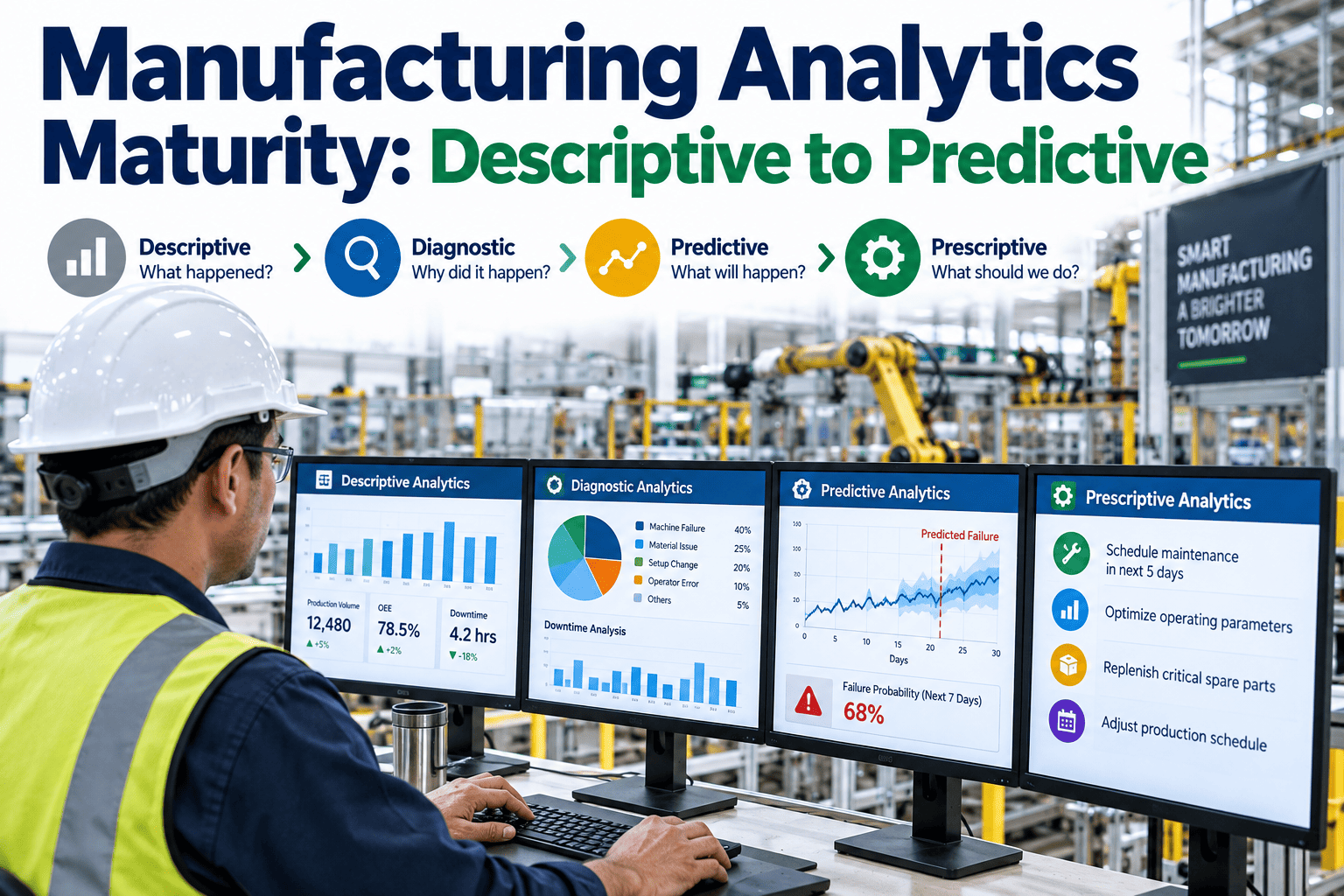
Most plants jump straight to wanting predictive analytics — a system that tells them a machine will fail next Tuesday — before they've actually built the descriptive and diagnostic foundation that makes a prediction trustworthy in the first place. Predictive models are only as good as the historical data and root-cause understanding they're trained against, and skipping straight to "what will happen" without first nailing down "what happened" and "why" tends to produce a model nobody on the floor actually believes, because it can't explain its own reasoning in terms anyone recognizes. Analytics maturity is a genuine staircase, not a single leap, and each step has to actually hold weight before the next one is worth building. See where your plant actually sits on the analytics maturity staircase.
Predictive Analytics Only Works if the Steps Below It Actually Hold
Descriptive, diagnostic, and predictive analytics build on each other in sequence. Skipping a step produces a prediction nobody trusts because it can't explain its own reasoning.
the maturity progression every manufacturing analytics program passes through, in sequence, to be genuinely trustworthy
of manufacturing plants remain at the descriptive level today, reporting what happened without a systematic view of why
typical time to move a plant from descriptive reporting to a genuinely reliable predictive analytics capability
The Analytics Maturity Staircase
Each step answers a fundamentally different question, and the answer to one step becomes the raw material the next step depends on.
Descriptive
What happened?
Dashboards and reports summarize production, downtime, and quality data after the fact, giving the plant a clear historical record to build on.
Diagnostic
Why did it happen?
Correlation analysis links loss events back to their root causes across process parameters, equipment condition, and material variation.
Predictive
What will happen?
Models trained on the diagnostic foundation forecast failures, quality excursions, and throughput risk before they occur, with reasoning the floor can trust.
Find Out Which Step You're Actually Ready For
iFactory assesses your current data foundation to show exactly which analytics maturity level your plant is genuinely ready to build next.
What Each Level Actually Requires
Moving up a level isn't just a software decision — each level has its own data and organizational prerequisites that need to be genuinely in place first.
Moving Up the Staircase Without Skipping a Step
A realistic progression plan builds each level's foundation deliberately rather than rushing toward the most advanced capability first.
Audit what descriptive reporting is actually missing
Before adding diagnostic capability, confirm the underlying descriptive data is consistent, timely, and trusted across every shift and line it needs to cover.
Build root cause correlation before forecasting
Diagnostic analysis linking loss events to their actual causes is what gives a future predictive model something real to learn from, rather than a pattern with no explanation behind it.
Pilot predictive models where the diagnostic foundation is strongest
The first predictive use case should target the failure mode or quality issue with the clearest, best-understood root cause history, building trust before expanding to less certain territory.
What Changes When the Foundation Is Built in Order
Figures reflect typical outcomes when a plant progresses deliberately through descriptive and diagnostic maturity before deploying predictive models.
A Data Science Lead's View on Analytics Maturity
Our first attempt at predictive maintenance failed because we tried to build it directly on top of descriptive dashboards, skipping the diagnostic step entirely, and the model kept flagging failures that never happened because it had no real understanding of root cause. Going back and building proper diagnostic correlation first took longer than we wanted, but the predictive model we eventually built off that foundation is one the maintenance team actually trusts and acts on.
The Bottom Line on Manufacturing Analytics Maturity
Predictive analytics is the destination most plants want, but it's never the right place to start, because a prediction is only as trustworthy as the descriptive and diagnostic foundation it's built on. Moving through the staircase deliberately — establishing what happened, then understanding why, before forecasting what will happen next — is what separates a predictive model the floor actually trusts from one that gets ignored the first time it's wrong.
Frequently Asked Questions
How do I know if my plant is genuinely ready to move from descriptive to diagnostic analytics?
A useful test is whether your descriptive reporting is consistent and trusted enough that nobody argues about the underlying numbers — if teams still debate whether the downtime data is accurate, diagnostic analysis built on top of it will inherit that same distrust. Book a review to get an honest assessment of where your foundation actually stands.
Can a plant work on multiple maturity levels at the same time for different problems?
Yes — a plant might have a well-established diagnostic capability for one critical failure mode while still building basic descriptive consistency in a newer process area, since maturity is often uneven across different parts of a plant rather than a single uniform state.
What's the biggest reason predictive analytics projects fail in manufacturing?
The most common failure mode is attempting predictive modeling before the diagnostic root-cause understanding is solid, which produces a model that can flag an anomaly but can't explain why in terms that match how the floor actually thinks about the problem, leading to alerts that get dismissed rather than acted on.
How much historical data is actually needed before predictive modeling becomes viable?
Requirements vary significantly by failure mode frequency and complexity, but a model generally needs enough historical examples of both normal and failure conditions to learn a genuine pattern rather than memorizing a handful of specific incidents, which is one of the reasons a strong diagnostic foundation with well-labeled historical events matters so much.
Does moving up the maturity staircase require new software at every level?
Not necessarily — many plants progress through descriptive and diagnostic maturity using existing data infrastructure with better integration and analysis discipline, only introducing new predictive-specific tooling once the underlying data foundation genuinely supports it. Talk to a specialist about what your current systems can already support.
Build the Foundation Before You Build the Prediction
Book a 30-minute assessment. iFactory reviews your current data maturity and shows exactly what the next step on the staircase actually requires.