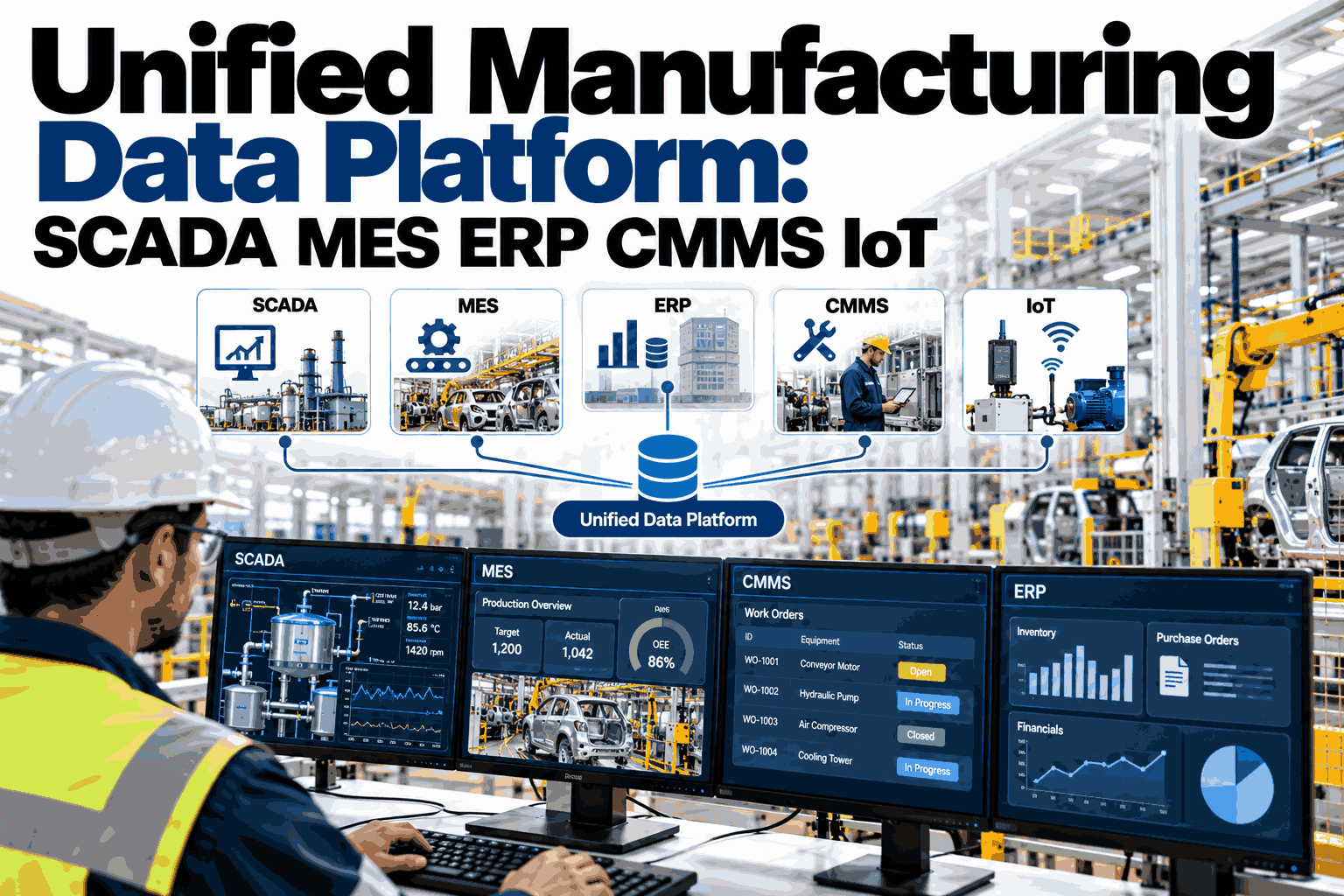
Ask five different roles in the same plant where a piece of information lives, and you'll often get five different answers pointing to five different systems that don't talk to each other. SCADA holds the process data. MES holds production events. ERP holds the business numbers. IoT sensors feed yet another dashboard entirely. Each system does its job well in isolation, but the isolation itself is the problem — no single system has the full picture, and building that picture manually every time someone needs it is exactly the kind of work a unified platform is meant to eliminate. Plants ready to break down these silos can Book a Demo to see how iFactory connects SCADA, MES, ERP, and IoT into one platform.
How Data Silos Actually Form in a Manufacturing Plant
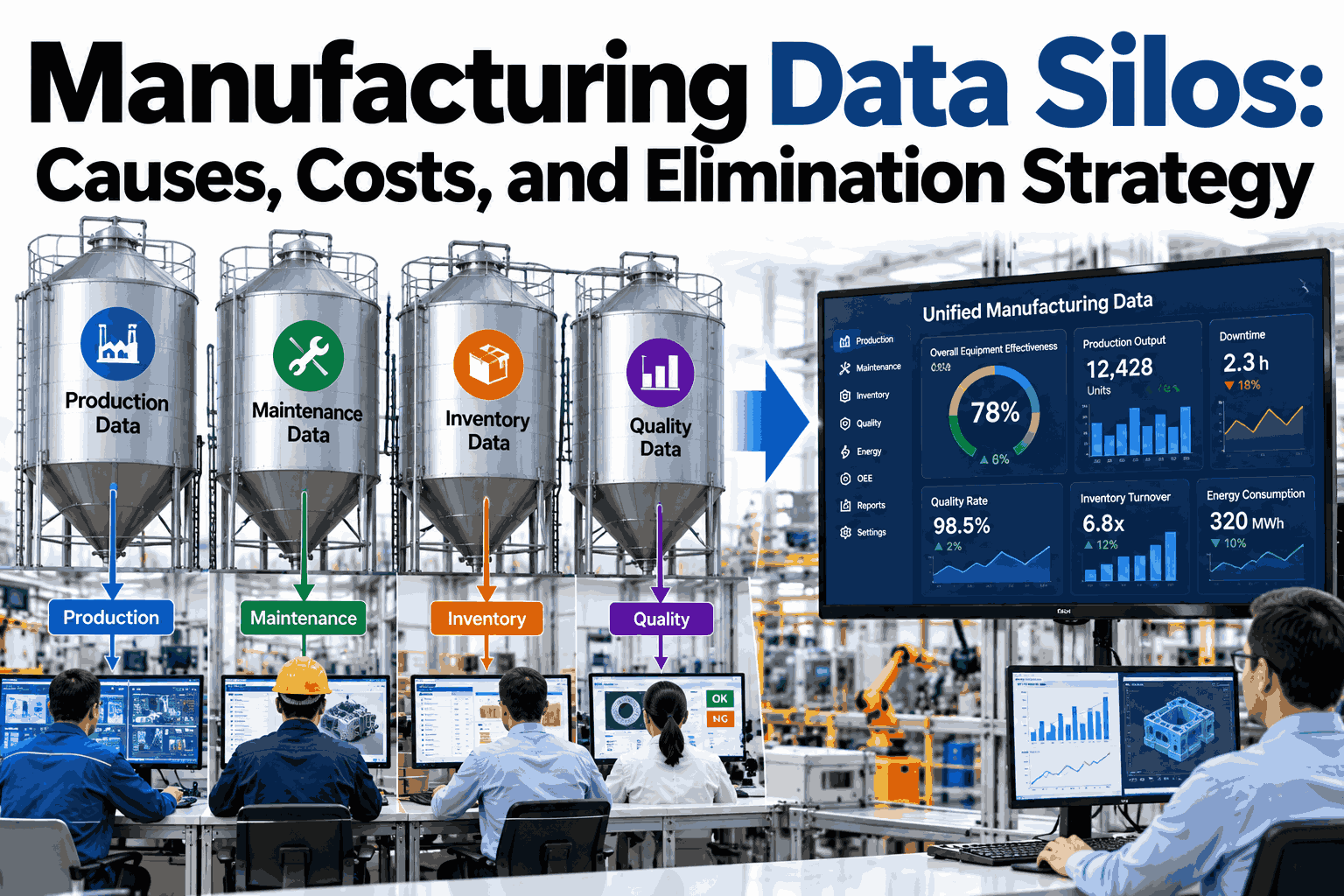
Data silos rarely appear by deliberate design — they accumulate over years as different systems get purchased and implemented to solve different problems at different times, each by a different team with different priorities. SCADA gets installed by controls engineers focused on process reliability. MES gets added by production teams focused on scheduling and tracking. ERP arrives through a finance and procurement initiative years later. IoT sensors get bolted on more recently still, often by a separate digital transformation effort. Each system solves its own problem well, but nobody was responsible for making sure they could talk to each other.
What Gets Lost When Systems Stay Disconnected
The cost of disconnected systems isn't abstract — it shows up as specific, recurring friction that plant teams learn to work around rather than solve. A production planner manually re-entering MES production counts into a spreadsheet to compare against ERP order commitments. An engineer pulling SCADA historian data into a separate tool to correlate against IoT vibration readings because the two systems have no native connection. Each of these workarounds is a small tax paid repeatedly, and collectively they represent a significant portion of the analytical effort a plant spends just reconstructing information that already exists somewhere in its own systems.
What a Unified Platform Actually Needs to Do
Eliminating silos doesn't mean replacing every existing system with one monolithic new one — that approach is expensive, disruptive, and rarely succeeds in a plant that depends on those systems running reliably every day. A unified platform instead sits above the existing systems, connecting to each one through its native interface and translating their different data formats and naming conventions into a consistent, queryable structure that any authorized user or downstream application can draw from.
| Requirement | Why It Matters |
|---|---|
| Non-disruptive connectivity | Reads from existing systems without requiring their replacement or major reconfiguration |
| Consistent data model | Resolves naming and format differences between systems so cross-system queries work reliably |
| Role-based access | Surfaces the right level of detail to each role without exposing unrelated sensitive data |
| Extensibility | Supports adding new data sources over time without requiring a full platform redesign |
Sequencing a Silo Elimination Project Without Disrupting Operations
Attempting to connect every system simultaneously is rarely the fastest or safest path to a unified platform. Most successful projects start by connecting the two systems whose disconnect causes the most daily friction — often SCADA and MES, since production and process data are closely related and frequently needed together — proving the integration approach works before expanding to ERP and IoT sources. This phased approach also gives the organization time to build trust in the unified view before it becomes the primary source teams rely on for cross-system questions.
Signs a Plant Is Dealing With a Genuine Silo Problem
Not every plant needs to prioritize silo elimination equally urgently, and the clearest way to gauge how pressing the problem actually is comes from a handful of recognizable warning signs that tend to appear consistently in genuinely siloed environments. A team spending noticeable time each week manually copying numbers between systems is one of the most reliable indicators, since that manual effort is a direct symptom of missing integration. A recurring inability to answer a simple cross-system question quickly — how did yesterday's downtime affect today's order fulfillment risk — without pulling together data from multiple places by hand is another.
Governance After Unification: Keeping the Platform From Becoming a New Silo Itself
A unified platform solves the original silo problem, but without ongoing governance it can eventually develop its own version of the same issue — inconsistent data entry standards creeping back in, new systems being added without following the established integration pattern, or access controls becoming so restrictive that teams route around the platform rather than through it. Establishing clear data ownership and a defined process for onboarding any new data source keeps the unified platform serving its intended purpose rather than slowly accumulating the same inconsistency it was built to eliminate.
Frequently Asked Questions: Data Silo Elimination in Manufacturing
Does eliminating data silos require replacing our existing SCADA, MES, or ERP systems?
No — a unified platform is designed to connect to existing systems as they are, reading their data through native interfaces rather than requiring a system replacement, which would be a far more disruptive and expensive undertaking than most plants are prepared to take on just to improve cross-system visibility. Teams can Book a Demo to see how integration works against systems already in place.
How long does a typical silo elimination project take from start to first usable results?
Timelines depend heavily on how many systems are involved and how clean their existing data already is, but a phased approach connecting one or two high-friction systems first can often produce usable cross-system visibility within a matter of weeks, with full multi-system integration extending over a longer period as additional sources are added and validated.
What is the biggest technical obstacle to connecting systems that were never designed to talk to each other?
Inconsistent naming and identification conventions across systems is typically the most persistent obstacle — the same physical asset or product might be referenced differently in each system, and resolving these mismatches into a single consistent reference requires a mapping effort that, while unglamorous, is foundational to making cross-system queries return trustworthy results.
Who in the organization should own a data silo elimination initiative?
Successful initiatives usually have a sponsor with visibility across multiple functions — often an IT or digital transformation leader working closely with operations — since a project that touches SCADA, MES, and ERP data inherently crosses departmental boundaries, and a sponsor without that cross-functional standing often struggles to get timely cooperation from every system owner involved.
How does silo elimination relate to AI and advanced analytics initiatives a plant might be planning?
Most meaningful AI and analytics use cases in manufacturing depend on data from more than one source system, so unresolved silos directly limit what these initiatives can actually accomplish, regardless of how sophisticated the analytics or AI model itself is. Addressing data unification before or alongside an AI initiative, rather than after discovering the limitation mid-project, avoids a common and costly sequencing mistake. Contact iFactory Support for guidance on sequencing a unification project ahead of planned analytics work.