Ask three people in the same plant to explain how data moves from the shop floor to the front office, and you'll often get three different answers — because in most facilities, it genuinely does move three different ways depending on which system you're tracing. SCADA holds the real-time machine state, MES holds the work-order and genealogy record, and ERP holds the financial and planning view, and far too often these three layers were built years apart by different vendors with no shared data contract between them. The plants that break out of this pattern don't buy a single mega-platform to replace everything — they design a deliberate integration architecture that lets each layer keep doing what it does best while data flows cleanly between them. This guide walks through that architecture, layer by layer, and if you'd like it mapped against your own systems, book a demo with iFactory.
Connect SCADA, MES, and ERP Without Rebuilding Any of Them
A deliberate integration architecture lets real-time control, execution, and planning systems share data cleanly — no forklift replacement required.
The Three Layers and What Each One Actually Owns
Integration architecture starts with a clear division of responsibility. Confusion about which system is the source of truth for a given piece of data is the root cause of most failed integration projects — get the ownership map right before touching any middleware.
Plans and finances
Sales orders, procurement, cost accounting, long-range production scheduling. Updates on a daily to weekly cadence.
Executes and tracks
Work orders, genealogy, quality holds, labor tracking, dispatching. Updates minute to minute as work progresses.
Controls and senses
Machine state, sensor readings, alarms, PLC tags. Updates in milliseconds to seconds as the process runs.
Four Data Flow Patterns Between the Layers
Data doesn't just flow upward from SCADA to ERP — it flows in both directions, and different data types call for genuinely different transport patterns.
Real-time telemetry, SCADA → MES
Machine state and sensor tags streamed continuously via MQTT or OPC UA, aggregated by MES into OEE and downtime events without polling delay.
Work order release, ERP → MES
Scheduled batch or near-real-time transfer of released orders, bills of material, and routing data from planning into execution.
Completion and consumption, MES → ERP
Production confirmations, material consumption, and labor actuals flowing back to update inventory and cost records, typically batched every few minutes.
Setpoint and recipe push, MES → SCADA
Process parameters and recipe values pushed down to the control layer ahead of a changeover, validated against equipment capability before release.
See This Architecture Mapped to Your Actual Systems
iFactory's integration team maps your specific SCADA, MES, and ERP versions to the right data flow pattern before any middleware gets deployed.
Choosing the Right Middleware Layer
The middleware sitting between these three systems is what determines whether the integration is resilient or fragile. The comparison below covers the three most common approaches plants choose between.
Three Mistakes That Sink Integration Projects
The technical middleware choice rarely kills an integration project. These three organizational and design mistakes do.
No single source of truth per data type
When both MES and ERP claim to own "current inventory," every integration becomes a reconciliation exercise. Assign one owning system per data type before building any connection.
Real-time data forced through a batch interface
Pushing millisecond SCADA tags through a nightly ERP batch job either drops data or overwhelms the interface. Match the transport pattern to the data's actual update frequency.
No plan for schema drift
An ERP upgrade or MES version change that alters a field name silently breaks every downstream integration unless the architecture includes a versioned data contract.
Frequently Asked Questions
Do we need to replace our existing SCADA, MES, or ERP to integrate them properly?
No — in the large majority of cases, a well-designed integration architecture connects existing systems through the right middleware rather than requiring a replacement of any layer. The exception is when one of the systems genuinely lacks any modern connectivity option, such as a decades-old SCADA historian with no OPC or API access, in which case a targeted upgrade of that one component is usually more practical than a full platform replacement.
How long does a typical SCADA-MES-ERP integration project take?
A single-site integration connecting one plant's existing systems typically runs eight to sixteen weeks from data mapping through go-live, depending heavily on how much custom logic already exists in each system and how many data flow patterns need to be built. Multi-site rollouts extend this considerably, since each site often has subtle configuration differences that need individual validation even when using the same architecture template.
What's the difference between OPC UA and MQTT for the SCADA layer?
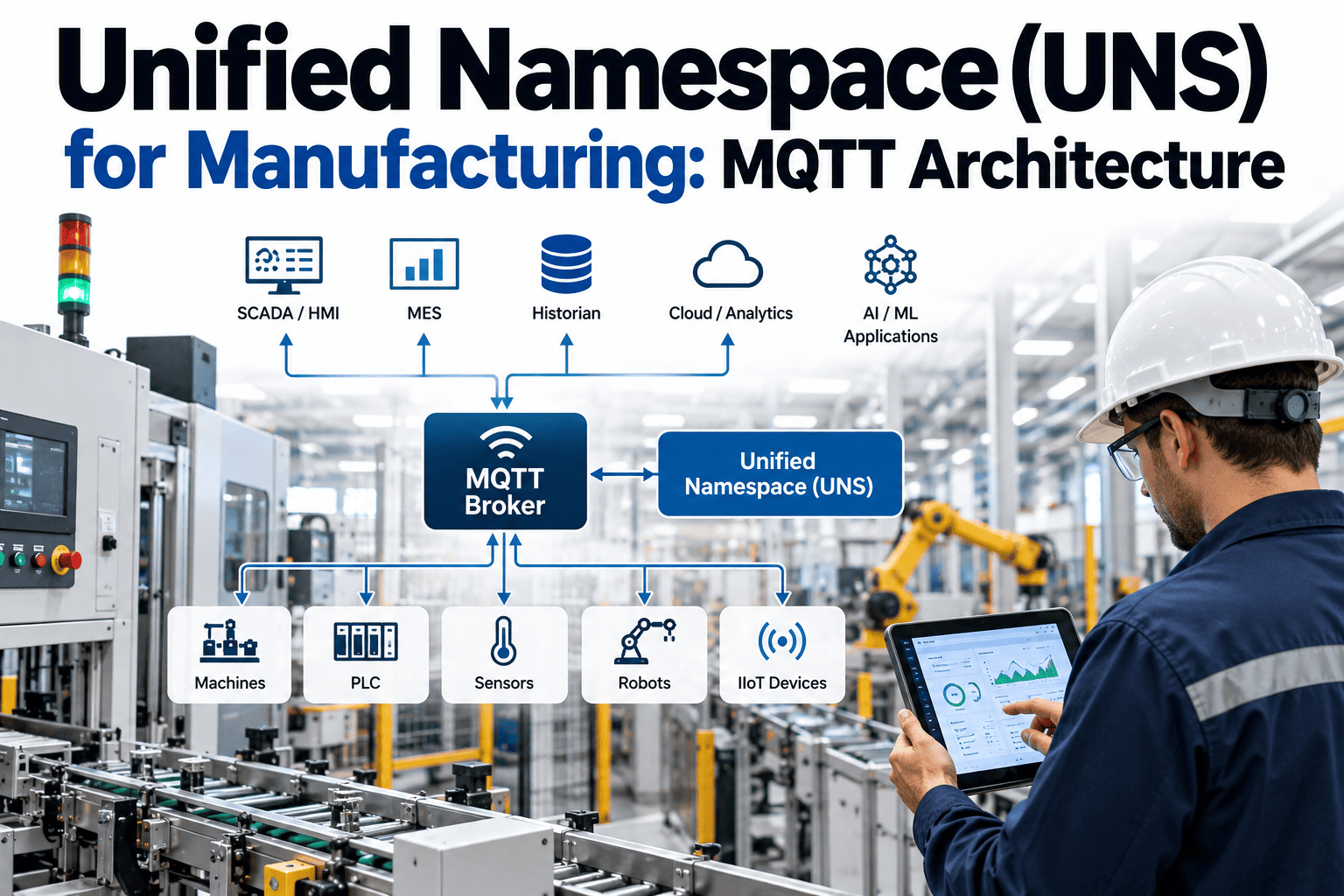
OPC UA is the more established standard for structured, semantically rich industrial data with built-in security and information modeling, while MQTT is a lightweight publish-subscribe protocol well suited to high-volume telemetry across distributed or bandwidth-constrained networks. Many modern architectures use both — OPC UA for structured machine data at the source, and MQTT to efficiently distribute that data across a broader unified namespace for consumption by MES, analytics, and other downstream systems.
How do we handle a network outage between the plant floor and the ERP system?
A resilient architecture buffers data locally at the edge or MES layer during any connectivity interruption, then synchronizes once the connection is restored, rather than losing data or blocking production. This is one of the strongest arguments for keeping real-time control logic entirely within the plant network rather than depending on a live ERP connection for anything time-critical to the process.
Where should we start if we're integrating these systems for the first time?
Start by mapping which system currently owns each critical data type — inventory, work order status, machine state — before selecting any middleware, since that ownership map determines every downstream architecture decision. Book a session with iFactory to walk through that mapping exercise against your specific systems before committing to an integration approach.
Design an Integration Architecture Built for Your Systems
Book a 30-minute session with iFactory and get a data flow map tailored to your actual SCADA, MES, and ERP versions.