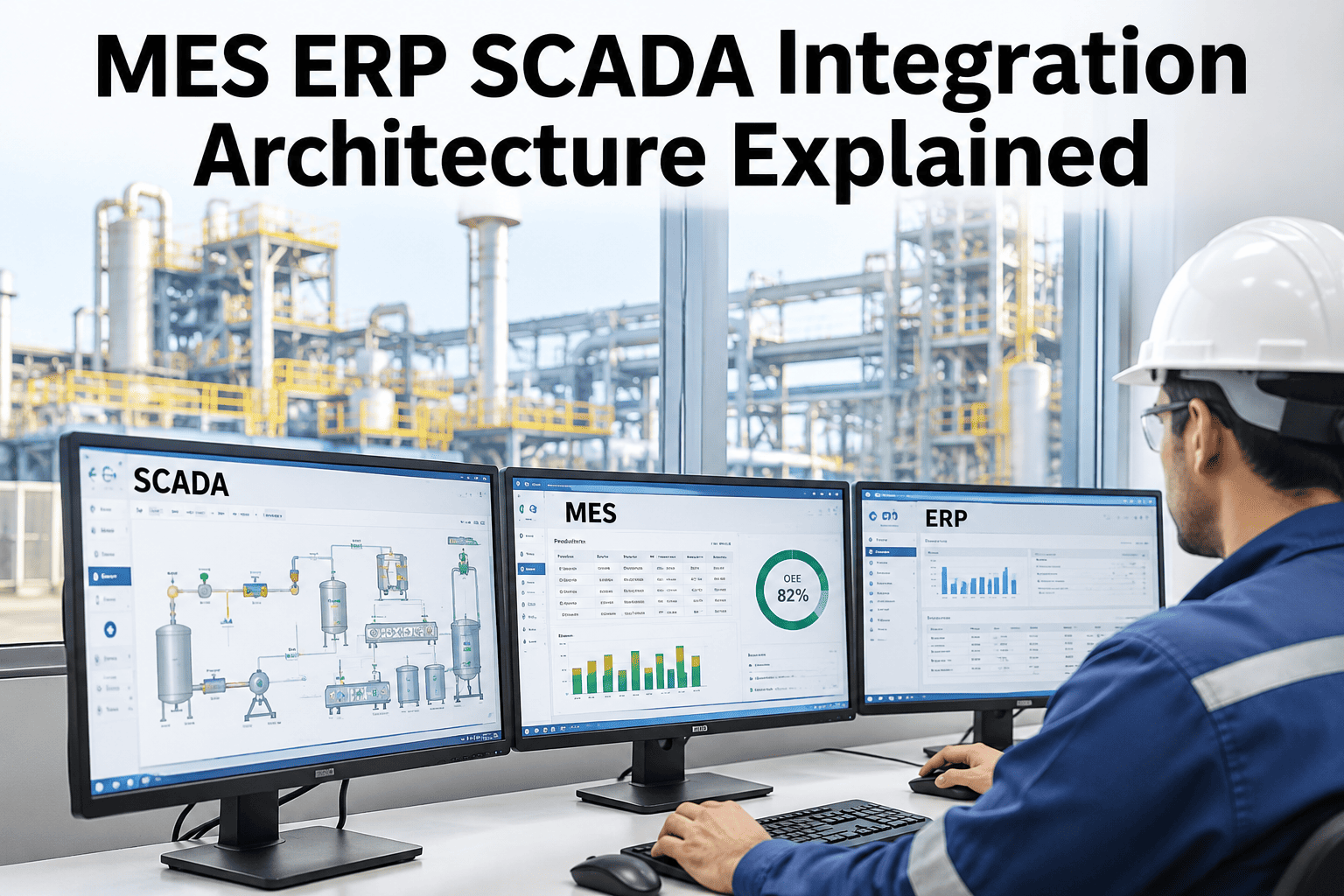
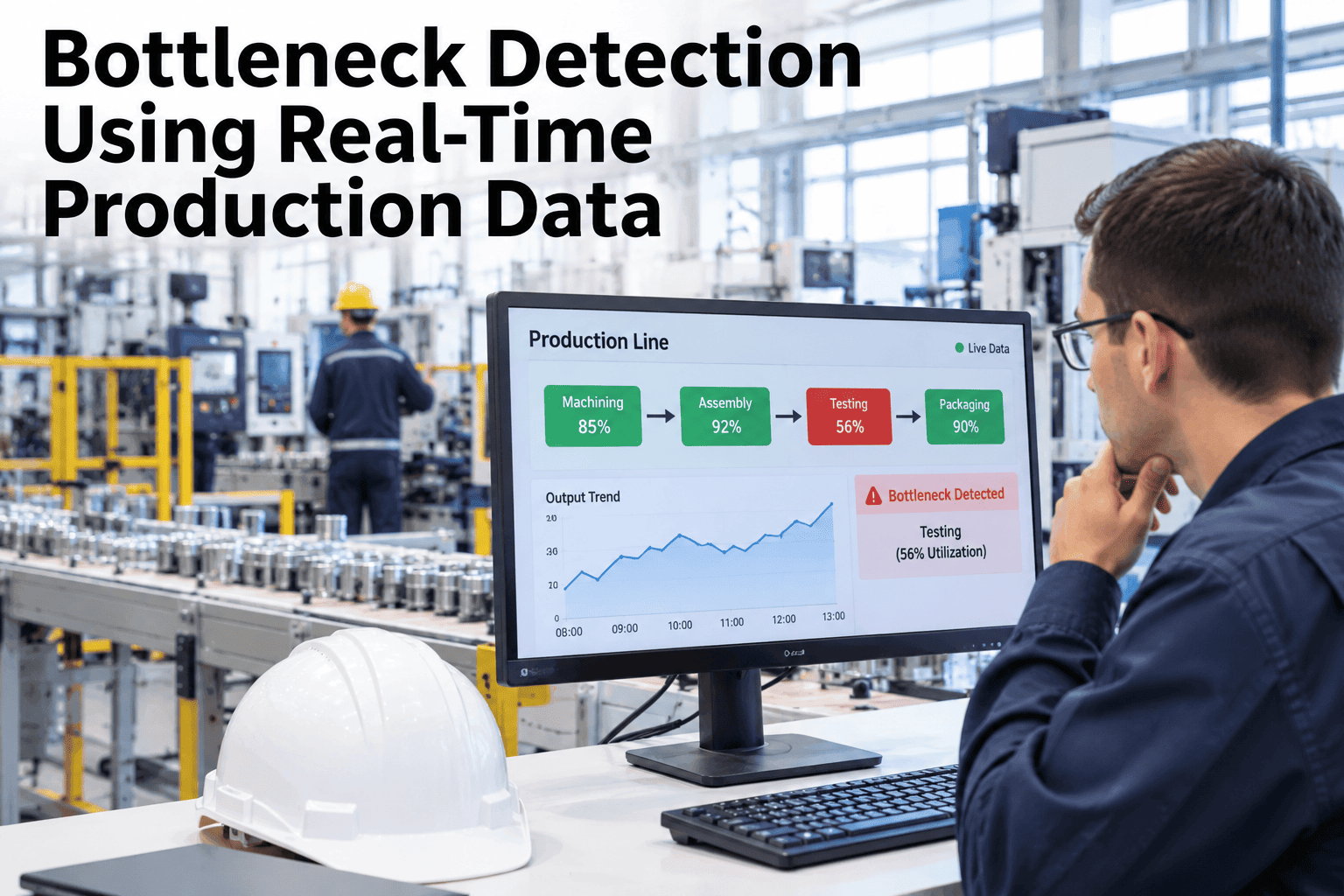
SCADA knows what a machine is doing right now. MES knows what the shop floor is executing against the current work order. ERP knows what the business sold, bought and promised to ship. Each system is authoritative in its own layer, and none of them is wrong — the problem is that most plants never built a clean architecture for the three to actually exchange data, so each layer ends up guessing at what the others already know. A connected architecture defines exactly what moves between SCADA, MES and ERP, in which direction, and on what trigger. You can review this architecture against your own plant's systems with our team.
Manufacturing Systems Architecture, 2026
Three Systems, One Plant, One Shared Picture
iFactory, an on-premise AI platform for manufacturing execution (MES) and systems integration, connects SCADA machine data, MES execution records and ERP business data into one architecture, so each layer runs on current information instead of a stale copy.
ERP
Orders, inventory, cost, customer commitments
MES
Work orders, execution, quality, genealogy
SCADA
Machine signals, alarms, real-time state
What it is
What Does MES, ERP and SCADA Integration Architecture Actually Mean?
Integration architecture defines the specific data each system sends and receives, the direction it flows, and the event that triggers the exchange — not a vague goal of "connecting everything," but a concrete map of each interface.
This is often described using the ISA-95 model, which separates business planning (ERP, Level 4) from manufacturing operations management (MES, Level 3) from the process control and sensing layer (SCADA/PLC, Levels 0 to 2). Integration architecture is how data crosses those boundaries cleanly.
What flows where
Four Data Exchanges Every Architecture Needs to Define
ERP to MES
Work orders, bills of material, scheduling constraints flow down to the shop floor.
MES to ERP
Completion, scrap, labor and actual consumption flow back up for cost and inventory accuracy.
SCADA to MES
Machine state, cycle counts and alarms flow up to drive execution records automatically.
MES to SCADA
Recipe parameters and setpoints flow down so the machine runs what the work order specifies.
The layers
What Each System Is Actually Responsible For
| Layer | Time horizon | Primary question it answers |
|---|
| ERP | Days to months | What did we promise, and what did it cost? |
| MES | Shift to day | What is being made right now, and is it conforming? |
| SCADA | Seconds to minutes | What is the machine actually doing this instant? |
Why it breaks
Why Plants End Up With Three Systems That Don't Talk
Most plants did not choose to run disconnected systems. SCADA was installed with the original equipment, MES arrived later as a shop-floor project, and ERP was selected by finance for a different purpose entirely — each decision reasonable on its own, none of them coordinated with the others.
The result is three systems that each hold a partial, aging picture of the same plant. A planner working from ERP inventory that has not synced with MES completions for hours is working from a number that is already wrong.
Expert review
What a Manufacturing IT Architect Would Check First
Holds up
The ISA-95 layered model has been the standard reference architecture for manufacturing systems integration for over two decades; it is not a vendor-specific framework.
Watch for
An "integration" that only moves data one direction — ERP pushing work orders down with nothing flowing back up leaves ERP blind to what actually happened on the floor.
Do next
Map your highest-volume data exchange first, since that is usually where a gap costs the most in reconciliation time.
FAQ
What Manufacturing Teams Ask About MES ERP SCADA Architecture
What is the ISA-95 model and why does it matter for integration?
ISA-95 is a standard reference architecture that separates business planning (ERP), manufacturing operations (MES) and process control (SCADA/PLC) into distinct layers with defined interfaces. It matters because it gives integration projects a common vocabulary instead of each vendor defining the boundaries differently.
Review your architecture against ISA-95 with our team.
Does every exchange between the three systems need to be real-time?
No — SCADA-to-MES data often needs near real-time exchange since it drives execution decisions, while MES-to-ERP data can run on a less frequent cadence depending on how quickly the business needs updated cost and inventory figures.
Ask about exchange frequency for your systems.
Can this architecture work with an existing ERP we are not replacing?
Yes — integration architecture is designed around connecting existing systems, not replacing them. The goal is defining clean interfaces to your current ERP, MES and SCADA rather than forcing a platform swap.
What is the most common architecture mistake plants make?
Building a one-way data flow — usually ERP pushing orders down — without a return path for actuals, so the business system never learns what really happened on the floor and keeps planning against stale numbers.
Check your own data flow direction with our team.
How long does a typical MES-ERP-SCADA integration project take?
Scope varies widely by plant complexity and existing system maturity, but mapping the architecture and connecting a first line is often achievable within weeks, with full-plant rollout following in phases.
Discuss a realistic timeline for your plant.