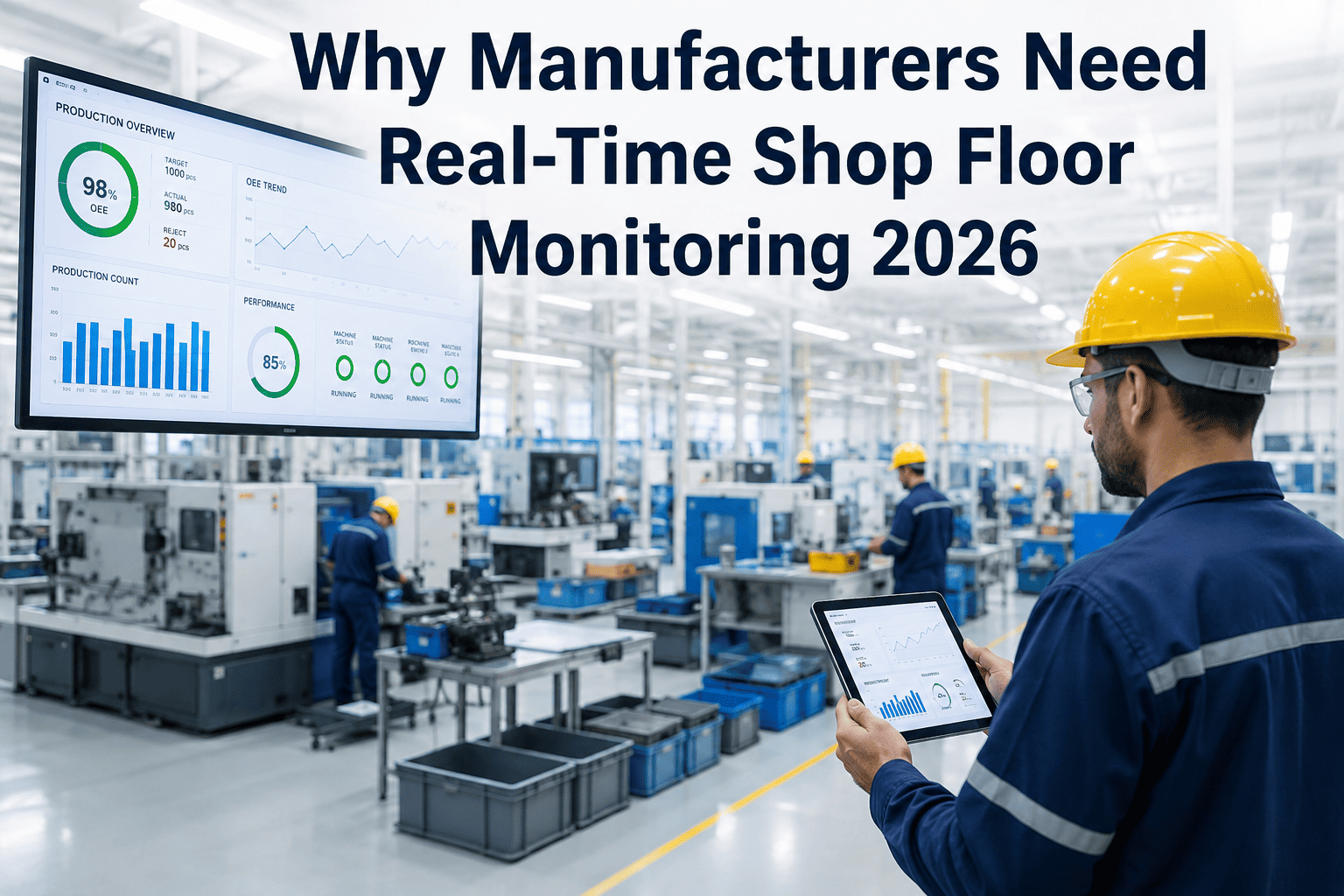
Why Manufacturers Need Real-Time Shop Floor Monitoring 2026
By James Smith on August 6, 2026
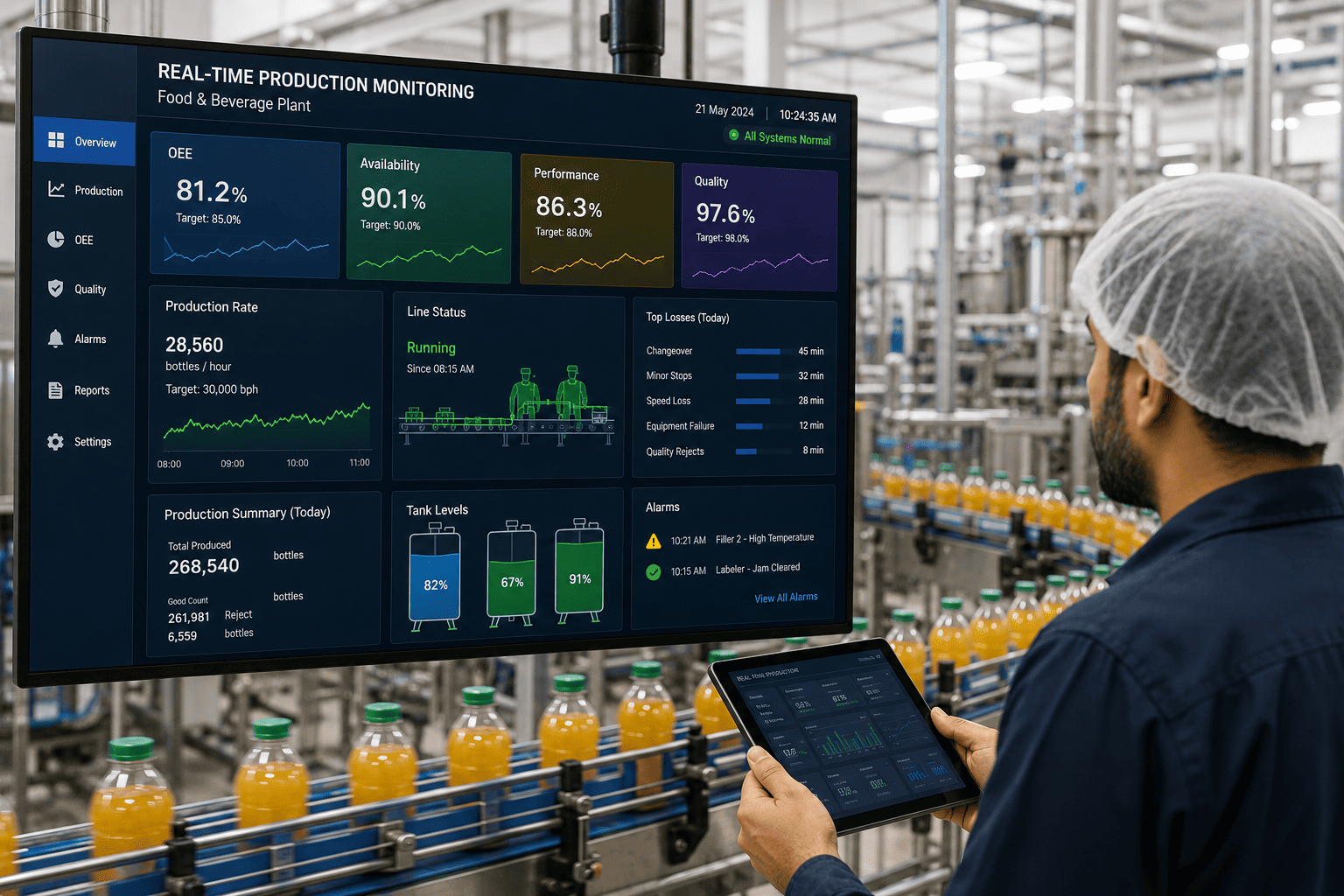
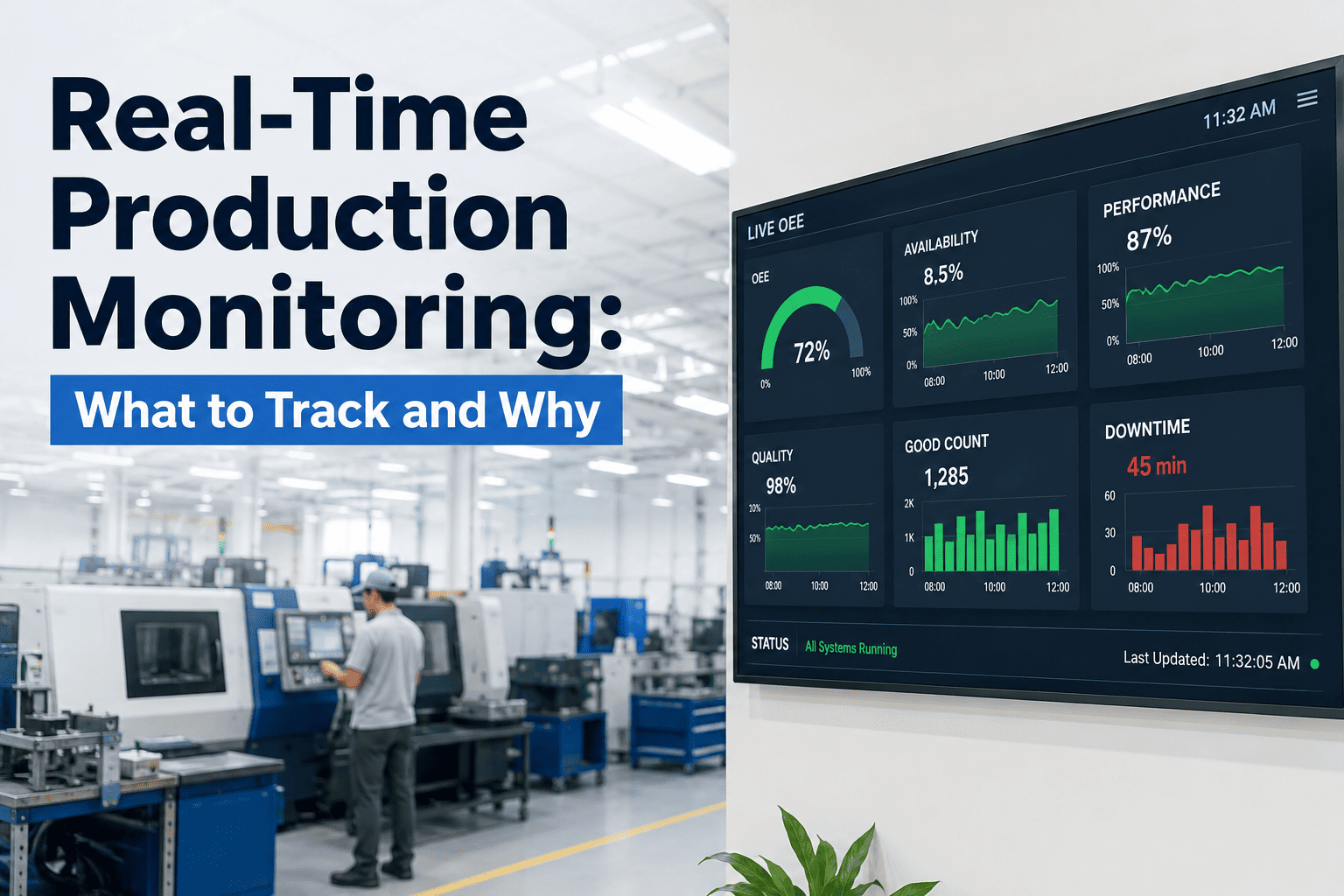
A 2024 Manufacturing Leadership Council survey found that 70 percent of manufacturers still rely on manual data entry, and only 30 percent use their production data predictively — while decision-making responsibility sits 77 percent with managers who are making those calls based on information that's already hours out of date by the time it reaches them. Separate research puts the number of manufacturers still working from spreadsheets at roughly 48 percent. This gap between when something happens on the floor and when a decision-maker actually knows about it is, by a wide margin, the largest controllable source of lost capacity in manufacturing operations that haven't closed it. It's also a gap that's easy to misdiagnose — most plants think they have a data problem, when the actual problem is a timing problem hiding behind data that already exists. See how iFactory delivers production, quality, and maintenance data as events actually happen, not as a report reconstructed after the shift ends.
Shop Floor Visibility · Why Real-Time Matters
Why Manufacturers Need Real-Time Shop Floor Monitoring
Production visibility, quality responsiveness, and maintenance awareness — the three domains where the gap between an event happening and someone knowing about it determines whether a problem costs minutes or costs a shift.
✓Visibility connects machine, labor, material, and quality data into something a decision-maker can act on
Most "real-time" systems deliver the first. Few deliver the second.
The Data Paradox
Most Plants Aren't Missing Data — They're Missing Timely Data
The uncomfortable finding underneath most manufacturing visibility research isn't that plants lack data. It's that the data exists, gets collected, and arrives too late to change the decision it should have informed. A quality deviation logged on paper and reviewed at shift-end review didn't fail to get captured — it failed to arrive while anyone could still act on it. This is a meaningfully different problem than the one most improvement initiatives are designed to solve.
This distinction matters because it changes what "solving the problem" actually means. The fix isn't collecting more data — most plants already collect plenty. The fix is closing the gap between when an event happens and when it reaches someone with the authority and information needed to respond, and that gap is measured in the difference between minutes and shifts, not in the completeness of the underlying dataset. A plant that adds three new sensors while leaving the reporting cadence unchanged has made its data problem worse, not better, because it now has more information arriving on the same delayed schedule.
Where the Delay Actually Happens
The Relay Chain Between an Event and a Decision
A typical manual data flow looks something like this: an operator captures a measurement or observes an event, a technician records it in a separate system, someone cleans up the resulting spreadsheet, a dashboard refreshes on its own schedule, and a supervisor reviews the issue once the shift is already complete. Each handoff in that chain is a reasonable response to the information available at that moment — nobody in the chain is doing anything wrong. But production keeps moving while the data catches up, and by the time the information completes its relay, the decision it should have informed has already been made without it, or missed entirely. The visual below maps that chain explicitly, because seeing every individual handoff laid out is usually what makes the cumulative delay click for a team that's never mapped its own information flow this way.
Mapping this chain for a specific event type — a quality deviation, an equipment stoppage, a material shortage — usually reveals a total relay time that surprises the people who work inside it every day, because each individual step feels fast in isolation. It's the accumulation across five or six handoffs, not any single slow step, that turns a same-shift correctable issue into a next-morning postmortem. Closing the gap doesn't necessarily mean eliminating every human touchpoint in the chain — it means shortening the total relay time enough that the information still arrives while a response is genuinely still possible.
Delayed Data Is Not Visibility
If Your System Updates Every 15 Minutes, You're Still Operating With a Lag
iFactory delivers production, quality, and maintenance events as they happen — closing the relay chain that turns real-time data into a next-shift report.
The relay-chain problem shows up across every function on the floor, but three domains consistently produce the clearest, most measurable return once the gap actually closes.
Production Visibility
Knowing a job's actual status, cycle time, and bottleneck point as it happens — rather than reconstructing it from memory at a shift-change meeting — lets a scheduler or supervisor redirect capacity mid-shift instead of only diagnosing what already went wrong the next morning.
Quality Responsiveness
A quality deviation caught and acted on within minutes stops a bad process before it produces a full run of defective units. The same deviation discovered at end-of-shift review has already been running, uncorrected, for however long the review cycle takes.
Maintenance Awareness
Equipment behavior that signals developing trouble — a drifting parameter, an unusual vibration pattern — is actionable information only if maintenance sees it before failure, not in a post-breakdown log that explains what already happened.
What "Real-Time" Actually Requires
Four Conditions a Dashboard Alone Doesn't Satisfy
Plenty of systems get marketed as real-time without meeting the bar the word implies — these four conditions are what current industry guidance consistently identifies as the actual requirements, not just a fresher-looking display.
01
Data Delivered in Minutes, Not Next-Shift Reports
A system that refreshes every 15 minutes, or that summarizes events into an end-of-shift report, is not real-time regardless of what it's labeled — the standard is accurate data delivered within minutes of an event actually occurring.
02
Automatic Capture, Not Manual Re-Entry
Every manual step in a data flow is a point where delay, error, and inconsistency enter the chain — automated capture at the point of the event itself is what actually closes the relay gap, not a faster manual process.
03
A Response Path, Not Just a Display
A dashboard that shows a problem without triggering or enabling an operational response is visibility without action — the value only materializes when the information actually changes a decision, not when it's simply displayed somewhere.
04
An Interface the Floor Actually Uses
Visibility tools only deliver value if the people making decisions actually use them — a complex interface with too many screens or unclear labels gets ignored, and over-engineering with excessive data points and alerts creates functionally the same problem as having no data at all.
Field Perspective
“
Every plant manager I talk to says they have visibility. Then I ask a simple question: if a specific machine went down four minutes ago, who knows right now, and what happens next? Most of the time the honest answer is nobody knows yet, or someone knows but has no defined next step. That's not a data problem — the sensor usually did its job. It's a relay problem. The information is technically captured somewhere, but it hasn't actually reached a person who can do something about it, on a timeline where doing something still matters. Real visibility means collapsing that relay to as close to zero as the operation can afford, and most plants have far more room to collapse it than they think — usually because nobody has ever actually mapped the chain end to end and timed it.
Desmond Okafor-Lindqvist
VP of Operations · 17 years leading manufacturing operations across discrete and process manufacturing, specializing in digital transformation
Common Questions
Frequently Asked Questions
What's the actual difference between "monitoring" and "visibility" in a manufacturing context?
Monitoring typically refers to tracking a single data point, like a machine's current running or stopped status, in isolation. Visibility is broader — it connects machine, labor, material, and quality data together into a picture a supervisor or scheduler can actually act on, rather than a single status indicator that requires additional context to become a decision. A plant can have extensive monitoring — dozens of individual machine status displays — while still lacking real visibility, because none of those individual signals are connected into the kind of unified, actionable picture that changes what happens next on the floor. This distinction is worth checking explicitly, since many systems marketed under the "visibility" label deliver only the narrower monitoring capability. Book a visibility gap assessment to see where your current monitoring stops short of genuine visibility.
Why do so many manufacturers still rely on manual data collection despite the known downsides?
Survey research consistently finds a large share of manufacturers — commonly cited around 70 percent in recent industry surveys — still rely on manual data entry, and this typically reflects legacy systems, incremental technology adoption, and the practical difficulty of retrofitting older equipment with automated data capture rather than a lack of awareness that the gap exists. Manual processes also tend to be locally optimized by the people using them even while they create a larger organizational visibility problem — an operator's paper log genuinely works for that operator's immediate need, which is part of why the underlying system-level gap persists even when individual steps in the chain feel reasonable.
How fast does data actually need to arrive to count as "real-time" for shop floor decisions?
There's no single universal threshold, but the practical standard cited across current industry guidance is accurate data delivered within minutes of an event occurring — a system refreshing every 15 minutes is still operating with a meaningful lag for many time-sensitive decisions, even though it may feel fast compared to a next-shift report. The right threshold ultimately depends on how quickly a given decision needs to be made to matter: a quality deviation that can be corrected before it affects the next few units needs a much tighter data latency than a capacity planning decision made on a weekly cadence. Talk to solutions engineering about the data latency your specific decisions actually require.
Is a real-time dashboard enough on its own, or does something else need to happen alongside it?
A dashboard alone is not enough — current industry guidance is consistent that visibility without a defined response capability is largely wasted, since a metric moving outside its normal range only creates value if someone knows what that movement means and what action it should trigger. This requires training production teams to interpret what they're seeing and know the correct response, and it requires the underlying system to be designed for the person actually making floor-level decisions rather than for the convenience of the team that built it. A beautifully designed dashboard that nobody on the floor understands or acts on delivers close to the same outcome as having no dashboard at all.
Which should a manufacturer prioritize first — production visibility, quality responsiveness, or maintenance awareness?
There's no universal answer, since the right starting point depends on where a specific operation's largest current gap actually sits — a plant with frequent unplanned downtime may see the fastest return from maintenance awareness, while a plant struggling with customer quality complaints may see more immediate value from quality responsiveness. What matters more than the specific starting domain is applying the same underlying principle consistently: closing the gap between when an event happens and when a decision-maker knows about it, with enough time remaining to actually respond, rather than treating any one domain in isolation from the others.
Close the Relay, Not Just Add a Dashboard
Production, Quality, and Maintenance Data — Delivered While It Still Matters
iFactory closes the gap between an event on the floor and the decision it should inform — automated capture, minutes not shifts, and a response path built for the people actually making the call.